Contact Form

Name

Email *

Message *

Showing posts with label Beijing. Show all posts

Wednesday, August 29, 2018

Who Else Would Be Responsible?

Did Hillary's Carelessness Lead

 to the Deaths of CIA Operatives?

  • 08/29/2018 
  • Source: AAN 
  • by: AAN Staff
23 5 2  57
image: https://aanews-structure-psyclone.netdna-ssl.com/client_assets/
aanews/media/picture/59ed/7631/6970/2d1c/9073/5600/content_cartoon-
2026564_640.png?1526483577
Did Hillary's Carelessness Lead to the Deaths of CIA Operatives?


Did Hillary's recklessness with classified emails lead to the execution or 
imprisonment of 20 CIA operatives in China?

During her time as Secretary of State, China's totalitarian government arrested
or killed 20 CIA operatives in China from 2010 to 2012.

Simultaneously, a Chinese-owned company acting as a front for their intelligence
 community hacked Hillary's private server, enabling Beijing to obtain and read
 all of Secretary Clinton's emails in real time.

It's not clear whether or not Clinton's massive intelligence breach is linked to 
China's systematic crippling of the CIA's clandestine operations.

One informant was summarily executed in front of a government building, 
according to a report in Business Insider, as an unambiguous sign to anyone 
contemplating working with Washington.

(H/T Gateway Pundit and Business Insider)

Read more at http://americanactionnews.com/articles/did-hillary-s-carelessness-lead-to-the-deaths-of-cia-operatives#mEHSFcvtqSF5QUv5.99

Monday, April 16, 2018

Making American Goods More Expensive--This Is Currency Manipulation

Trump Blasts China, Russia for Devaluing Currencies as Fed Hikes

Trump Blasts China, Russia for Devaluing Currencies as Fed Hikes
President Donald Trump accused China and Russia of devaluing their currencies, opening a new front in his argument that foreign governments are taking advantage of the U.S. economy to support their own expansions.
Just three days after the U.S. Treasury ruled no country is manipulating its exchange rate, Trump took to Twitter to declare that China and Russia are playing what he called a “currency devaluation game” at a time when the U.S. Federal Reserve is raising interest rates.
“Not acceptable!,’’ Trump wrote.
The attack adds fuel to the brewing trade dispute between the U.S. and China, while also targeting Russia which the White House recently imposed sanctions on and clashed with over Syria.
Trump has repeatedly blasted Beijing for failing to reduce its trade surplus and open its markets to American investment. China’s yuan, though, has gained about 10 percent against the dollar over the past 12 months, climbing in March to the strongest level since August 2015.
The ruble has weakened 10 percent against the dollar in the past year, with much of the decline following the U.S.’s introduction of sanctions on dozens of Russian tycoons, companies and key allies of President Vladimir Putin.
Trump’s suggestion that a currency war is underway comes as central bankers and finance ministers from around the world prepare to gather in Washington for the Spring meetings of the International Monetary Fund.

Thursday, March 29, 2018

Trump's Appointment Of Bolton Sends A "We're Serious" Message To American's Enemies. No More Pussyfooting Around!

Bolton’s appointment — a brilliant “America first” move by President Donald Trump

www.israel-commentary.org
Redacted from an article originally published at Breitbart.com.
By Carolyn Glick
President Donald Trump’s decision to appoint former UN Ambassador John Bolton to serve as his National Security Advisor is arguably the most significant single step he has taken to date toward implementing his America First foreign policy.
The news hit America’s enemies and competitors — from Pyongyang to Teheran to Moscow to Beijing — like a wall of bricks Thursday night.
Early criticisms on the political right of Bolton’s appointment have centered on two points. First, it is argued that Bolton, who has been involved in U.S. foreign policymaking since the Reagan administration, is a creature of the Washington foreign policy swamp.
While it is true that Bolton is from Washington – or Baltimore, to be precise – and although it is true that he held senior foreign policy positions in both Bush administrations, he has always been a thorn in the side of the establishment rather than a member of that establishment.
For the better part of three decades, Bolton has bravely held positions that fly in the face of the establishment’s innate preference for appeasement. He was a vocal critic, for example, of then-President Bill Clinton’s disastrous nuclear diplomacy with North Korea.
The 1994 “Agreed Framework” that Clinton concluded with Pyongyang was touted as a peaceful resolution of the nuclear crisis with North Korea. In exchange for shuttering – but not destroying — its nuclear installations, North Korea received light water reactors from the U.S. and massive economic relief.
As Bolton warned it would, North Korea pocketed the concessions and gifts and continued to develop its nuclear weapons. In other words, far from preventing North Korea from developing nuclear weapons, the Agreed Framework preserved the North Korean nuclear program and enabled the regime to develop it effectively with U.S. assistance.
For his warnings, Bolton has been reviled as a “warmonger” and a “superhawk” by the foreign policy elite, which has gone out if its way to undercut him.
President George W. Bush appointed Bolton to serve as UN ambassador in 2005 in a recess appointment. Three moderate Republicans on the Senate Foreign Affairs Committee, Lincoln Chafee (RI), Chuck Hagel (ND), and George Voinovich (OH), signaled that they would oppose Bolton’s confirmation, blocking it.
At the time, rumors surfaced that then-Secretary of State Condoleezza Rice had quietly undercut Bolton’s confirmation in private conversations with senators. Those rumors were denied, and Rice publicly supported Bolton’s confirmation.
But in 2016, Rice, along with her mentor, former secretary of state James Baker, and her deputy and successor as National Security Advisor, Stephen Hadley, openly opposed President Trump’s intention to appoint Bolton Deputy Secretary of State. At the same time, all three lobbied Trump to appoint outgoing Secretary of State Rex Tillerson.
Bolton was a vocal opponent of Rice’s nuclear diplomacy with North Korea, undertaken after Pyongyang conducted its first nuclear test in 2006. He also opposed Rice’s pursuit of diplomatic ties with Iran through negotiations in Iraq. In both cases, as events showed, Bolton’s criticisms were all in place.
Rice’s nuclear diplomacy with North Korea emboldened the regime, and enabled its continued testing of nuclear weapons and development of ballistic missiles.
In Iran’s case, Rice’s negotiations with the Iranians in 2007 and 2008 set the stage for president Barack Obama’s nuclear talks with Tehran, which led to the 2015 nuclear deal. That deal, like the 1994 Agreed Framework with North Korea, preserves, rather than dismantles, Iran’s nuclear program while providing Iran with the financial means to expand its regional power through its terrorist proxies.
On the other hand, Bolton’s actions while in office brought extraordinary benefit to US national security. For instance, as Bush’s undersecretary of state for arms control and international security, in 2003 Bolton conceptualized and launched the Proliferation Security Initiative (PSI). The purpose of the PSI was to empower nations to interdict ships suspected of carrying weapons of mass destruction, delivery systems, and related materials from states and non-state actors of proliferation concern. Originally launched with 11 state members, today the PSI has 105 state members. Its members have interdicted multiple ships suspected of transferring illicit weapons systems to other states and to non-state actors.
Like Trump, Bolton is an opponent of international treaties that bind the U.S. in a manner that may be antithetical to its national interests, and prefers bilateral agreements that are tailor-made to defend America’s national interests. Bolton was a firm opponent of the Rome Treaty, which established the International Criminal Court. He worked avidly to vacate America’s signature from the treaty.
Due largely to his cogent opposition, the Bush administration decided not to submit the treaty to the Senate for ratification. Bolton concluded 100 bilateral treaties with nations committing them never to present complaints against U.S. military personnel before the tribunal.
Bolton’s nationalist convictions, and his refusal to join the foreign policy elite in its adoration of diplomacy, whatever the substance, over a firm, fact-based pursuit of America’s national interests lies at the heart of the foreign policy establishment’s opposition to him.
Indeed, the level of hostility the foreign policy establishment has directed towards Bolton over the years has been so ferocious, it is a testament to his diplomatic skills, and success, that he has managed to persevere in Washington, in and out of office for forty years.
As to the second charge by conservative critics, that Bolton is a neoconservative interventionist, the fact is that he is neither a neoconservative nor is he a knee jerk interventionist. Rather, Bolton supports the judicious use of American power in the world to advance U.S. national security and economic interests when the use of force is the best way to achieve those interests.
It is true that Bolton supported the U.S. invasion of Iraq in 2003. But it is also true that he opposed the nation-building strategy that stood at the root of America’s failure to achieve its aims there.
It is also true that like many of the neoconservatives, Bolton is a firm supporter of Israel. However, Bolton is actually far more supportive of Israel than the neoconservatives are. As a nationalist, he supports U.S. allies because he understands that the stronger America’s allies are, the better able they are to defend their interests. Since American allies – particularly Israel – share America’s interests, the more powerful they are, the more secure America’s interests are, and the less the U.S. needs to assert its power abroad.
Bolton supported — indeed, urged — Israel to destroy Iran’s nuclear installations during the Obama presidency. Rather than treating Israel as what Rice referred to patronizingly as America’s “special friend,” Bolton views Israel as America’s most powerful ally in the Middle East. He opposes Palestinian statehood and an Israeli withdrawal from the West Bank.

Bolton’s healthy skepticism for international agreements; his support for a foreign policy that prioritizes the advancement of American national interests over multilateral diplomacy; and his belief that Obama’s signature diplomatic achievement, the nuclear deal with Iran, is a disaster, all make him the senior diplomat most aligned with President Trump’s America First agenda in Washington.
The combination of Trump and Bolton no doubt puts fear in the hearts of America’s enemies, and heartens America’s allies. Given the hatred Bolton inspires in the Washington swamp, it took great courage for Trump to appoint him. America and its allies will be the primary beneficiaries of this bold move.

Wednesday, March 28, 2018

This Is What Occurs When You Are Dealing Through Strength

After Trump’s Threat of Military Action, North Korea’s Kim Jong Un Makes Historic Concession

 Print
In a surprising shift of thought, North Korean leader Kim Jong Un appears to be very much interested in diplomacy.
Kim recently met with Chinese President Xi Jinping in Beijing, and he is set to meet in April with South Korean President Moon Jae-in before speaking face-to-face with U.S. President Donald Trump the following month.
As indicated by Business Insider, after years of attempting to build his country’s nuclear arsenal, Kim has come “out of the shadows to make history.”
And it’s noteworthy that so many new developments regarding North Korea have occurred in the first 14 months of the Trump presidency.
“Since Trump took office, Kim has overseen a series of North Korean firsts,” Business Insider noted. “North Korea tested its first thermonuclear device, its first intercontinental ballistic missile, and has now conducted its first ever leader-to-leader act of diplomacy.”

The Western Journal Daily Email

Facebook
 
It would appear that Trump’s “maximum pressure” strategy against North Korea is accomplishing its intended goal.
Trump has faced criticism from those who claim he has provoked North Korea and its leader by threatening military action against the country on Twitter and elsewhere.
Perhaps most memorably, the president said that if North Korea continued to threaten America, the U.S. would unleash “fire and fury like the world has never seen.”
In addition to threatening military sanctions, the administration has implemented harsh sanctions against the regime.

Do you think the Trump administration's "maximum pressure" campaign is the reason that Kim seems willing to talk?

   
Completing this poll entitles you to The Western Journal news updates free of charge. You may opt out at anytime. You also agree to our Privacy Policy and Terms of Use.
And most recently, Trump replaced national security adviser H.R. McMaster with John Bolton, who has not been shy about discussing the possibility of striking North Korea. According to Business Insider, thanks to this last move, “Trump may have only grown more credible.”
In a statement, meanwhile, the White House indicated that the meeting between Kim and Xi is “further evidence” that the Trump administration’s strategy is working.
“We see this development as further evidence that our campaign of maximum pressure is creating the appropriate atmosphere for dialogue with North Korea,” White House press secretary Sarah Sanders said, according to CNN.
Trump himself said on Twitter he heard from Xi that the meeting with Kim “went very well.”
RELATED: Stormy Days Not Dampening Trump’s Approval Ratings
“Received message last night from XI JINPING of China that his meeting with KIM JONG UN went very well and that KIM looks forward to his meeting with me,” the president tweeted Thursday morning. “In the meantime, and unfortunately, maximum sanctions and pressure must be maintained at all cost!”
Still, some experts have advised caution in the wake of Kim’s meeting with Xi.
“The very fact of this meeting alone, and certainly the tenor of the Chinese statement about it, really does increase Kim Jong Un’s leverage in the upcoming talks. It shows that Kim has a friend in Beijing,” Adam Mount, a senior fellow and director of the Defense Posture Project at the Federation of American Scientists, told CNN.
Trump, though, is optimistic that “peace and the denuclearization of the Korean Peninsula” is a real possibility.
“For years and through many administrations, everyone said that peace and the denuclearization of the Korean Peninsula was not even a small possibility,” Trump tweeted Thursday. “Now there is a good chance that Kim Jong Un will do what is right for his people and for humanity. Look forward to our meeting!”
What do you think? 

Thursday, March 22, 2018

China May Put On Tariffs But They Are The Ones Who Will Lose Most

China responds to Trump tariffs with proposed list of 128 US products to target

  • China on Friday announced plans for reciprocal tariffs on 128 U.S. products that include pork, wine, fruit and steel.
  • Beijing said it will take measures against the U.S. goods in two stages if it cannot reach an agreement with Washington.
The world's second-largest economy has responded to President Donald Trump's controversial trade tariffs.
China's commerce ministry proposed a list of 128 U.S. products as potential retaliation targets, according to a statement on its websiteposted Friday morning.
The U.S. goods, which had an import value of $3 billion in 2017, include wine, fresh fruit, dried fruit and nuts, steel pipes, modified ethanol, and ginseng, the ministry said. Those products could see a 15 percent duty, while a 25 percent tariff could be imposed on U.S. pork and recycled aluminium goods, according to the statement.
The statement did not go into greater detail. U.S. agricultural products, particularly soybeans, have been flagged as the biggest area of potential retaliation by Chinese President Xi Jinping's administration.
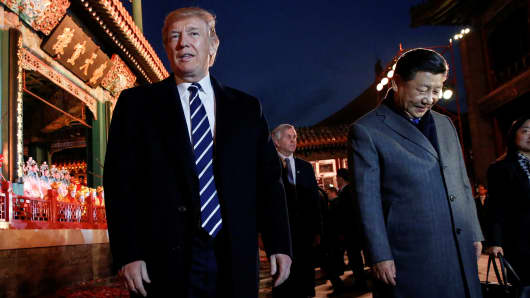
President Donald Trump and China's President Xi Jinping leave after an opera performance at the Forbidden City in Beijing, China, November 8, 2017.
Jonathan Ernst | Reuters
President Donald Trump and China's President Xi Jinping leave after an opera performance at the Forbidden City in Beijing, China, November 8, 2017.
Beijing will take measures against the 128 U.S. goods in two stages if it cannot reach an agreement with Washington, the ministry said, adding that it could take legal action under World Trade Organization rules.
Asian stock markets took a dive on the news, with Japan's Nikkei index sliding as much as 3 percent in early Friday trade.
The Friday response from Beijing is relatively measured, experts told CNBC.
The decision to target $3 billion in U.S. imports is significant, "but it's not a lot in terms of the total U.S.-China relationship," said economist Tony Nash, who is CEO and founder of data analytics firm Complete Intelligence.
Chinese imports from the U.S. are expected to hit $172 billion this year, he pointed out.

Beijing warns on damaging US actions 

Recent U.S. trade actions severely damage the multilateral trading system and disturb the international trading order, China's commerce ministry said, urging Washington to resolve its issues with Beijing to avoid harming the bilateral relationship.
Trump signed an executive memorandum on Thursday that will impose tariffs on up to $60 billion in Chinese imports. "This is the first of many" trade actions, the president said. The new measures will primarily target certain products in the technology sector where Beijing holds an advantage over Washington.
That followed Trump's executive order earlier this month that imposed broad duties on foreign aluminum and steel imports — an action that many said could trigger a global trade war.