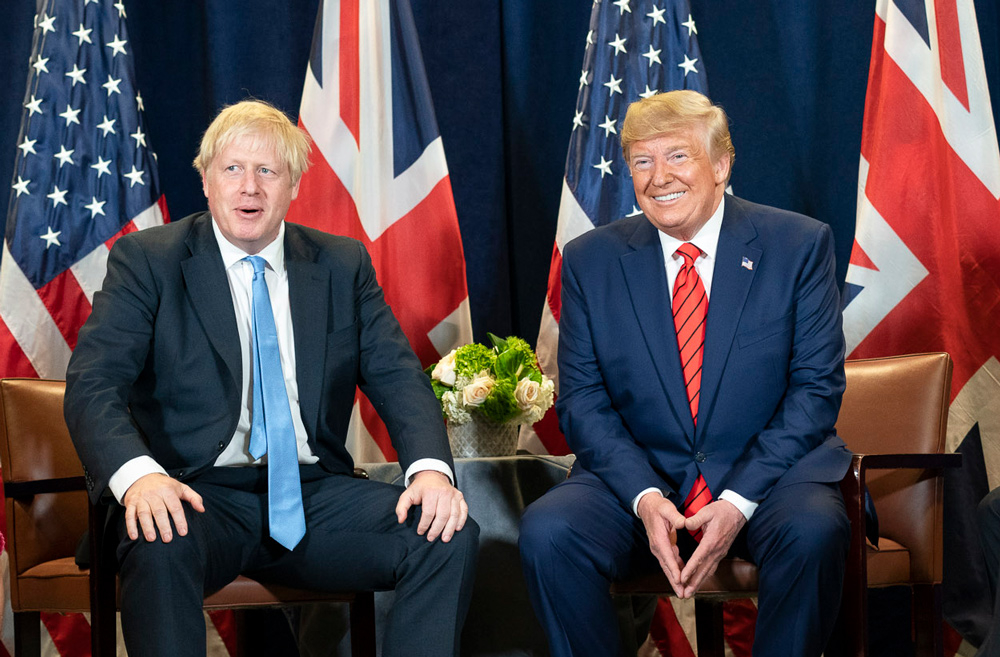
Boris Johnson's Victory Heralds a Golden Era in US-UK Relations
Boris Johnson has only been back in Downing Street a few days following his stunning victory in Britain's general election, but there are already early signs that his premiership will preside over a dramatic revival in transatlantic relations not seen since the heyday of Ronald Reagan and Margaret Thatcher. First and foremost, the British prime minister has made it abundantly clear that his first priority will be to break the Brexit deadlock that has effectively paralysed British politics, and the country's ability to make its voice heard on the international stage, at the earliest possible opportunity, thus opening the way for a trade deal with Washington. As a start, Mr Johnson has committed his new government to fulfil its election pledge to complete Britain's withdrawal from the European Union by the end of January. Furthermore, he will enshrine in law his promise that the complicated trade negotiations that are due to take place next year to finalise Britain's future trading relationship with the EU bloc will be completed by the end of 2020. Critics of Mr Johnson's ambitious programme to free Britain from the EU's shackles and negotiate a new network of global trade deals have argued that completing the process of establishing a new trading framework with the EU will take much longer than a year, especially in view of the EU's notoriously slow approach to completing such transactions. The critics point out, for example, that the Canada-EU trade deal took seven years to negotiate and was 22 years in the making. By enshrining Britain's ultimate departure date in law, Mr Johnson has effectively silenced those critics, as well as sending a clear declaration of intent to Brussels that Britain aims to complete the withdrawal process by the end of next year, with or without a deal. The fact, moreover, that Mr Johnson now enjoys a comfortable majority of 80 seats in the newly-constituted House of Commons means that he will no longer be subjected to procedural legislative obstructions from die-hard Remainers, as was very much in evidence during the death throes of the last parliament. Thus Mr Johnson's reinvigorated Conservative Party finds itself in a position to shape Britain's destiny for the foreseeable future, with rebuilding relations between Washington and London seen as being one of Mr Johnson's first priorities. During the tenure of Theresa May, Mr Johnson's hapless predecessor as prime minister, relations between Downing Street and the White House became strained, to say the least. As one senior former member of Donald Trump's foreign policy team recently told me, "By the end of Mrs May's premiership relations with the US had fallen to an all-time low". The first indication of a revival in relations between Washington and London came when Mr Trump was one of the first world leaders to congratulate Mr Johnson on his historic win -- he secured the largest Conservative majority since Mrs Thatcher's third election victory in 1987 -- and immediately promised to strike a "massive" new trade deal with the UK post-Brexit. The US president said a future US-UK trade agreement has "the potential to be far bigger and more lucrative" than any deal that could have been made with the EU. Indeed, with Mr Johnson assured of being Britain's prime minister for the next five years, and Mr Trump well-placed to secure re-election in next year's presidential election contest, there is every prospect that the two leaders could herald a new golden era of transatlantic relations not seen since the alliance of Mrs Thatcher and US President Ronald Reagan in the 1980s. There will, of course, be numerous political obstacles that will have to be overcome regarding issues where the two men have opposing views, such as the controversial nuclear deal with Iran. While Mr Trump is determined to pressure Tehran with punitive economic sanctions, Mr Johnson still remains committed to working with other European powers, such as France and Germany, to save the nuclear deal. Yet, compared with the calamitous impact a victory for Labour Party leader Jeremy Corbyn, whose politics is defined by his visceral anti-Americanism, would have had on transatlantic relations, Mr Johnson's return to Downing Street will have been greeted with enormous relief in the White House, as it means Washington now has a firm ally in London, someone who is committed to breathing new life into the vital and long-standing partnership between Britain and America. Con Coughlin is the Telegraph's Defence and Foreign Affairs Editor and a Distinguished Senior Fellow at Gatestone Institute. |
Our goal is to have intelligent discussion of the topics of the day. We realize everyone has their opinion and they should be allowed to express it in a discussion forum without calling each other names. We learn from discussion and not from name calling or argument.We use cookies to personalise content and ads, to provide social media features and to analyse our traffic. We also share information about your use of our site with our social media, advertising and analytics partners. See details
Contact Form
Showing posts with label Britain. Show all posts
Thursday, December 19, 2019
America Now Has An Ally In England
Monday, December 2, 2019
Medicare For All Would Be A Travesty Not Unlike The British Tragedy

While American patients’ survival rates for cancer are among the highest in the world, the British performance is comparatively poor. (Photo: Getty Images)
Congressional sponsors of “Medicare for All” single-payer legislation—bills abolishing virtually all existing public and private health insurance—routinely promise that all Americans will get equal access to higher quality care and enjoy superior medical outcomes.
Performance, however, is the acid test of sound policy. While the U.S. “single payer” experience is limited to the Veterans Administration program, recently plagued by headline-grabbing care delays, working models of national health insurance can teach Americans sober lessons in government-controlled health care.
Look at the British crisis. Consider Britain’s National Health Service, established in 1948. In 2017, the British House of Lords issued a stunning report on the state of the NHS. It concluded, “Our NHS, our ‘national religion’, is in crisis and the adult social care system is on the brink of collapse. No one who listened to the evidence presented by a vast array of expert witnesses who appeared before us can be in any doubt about this.”
That evidence has been building for decades, and recent high-profile cases show that the British crisis is chronic. In the October 2019 issue of the Annals of Surgery, one can check out a comparative study of English and American in-hospital mortality between 2006 and 2012.
Researchers found that Americans’ surgical treatment for abdominal emergencies (like appendicitis or a ruptured aneurysm) was roughly twice the rate for comparable English patients, and that the English death rate was also significantly higher. Thus, they concluded, “England and US Hospitals differ in the threshold for surgical intervention, which may be associated with increases in mortality in England for these 7 general surgical emergencies.”
Interestingly, this 2019 study reinforced earlier findings in the April 2018 edition of the Annals of Surgery, where another team of researchers found greater patient mortality after emergency laparotomies—surgical abdominal incisions to treat emergency medical conditions—in Britain compared with the United States.
Regarding British performance, medical outcomes for the world’s top killers, cancer and heart disease, is another big story. While American patients’ survival rates for cancer, such as breast, colon, and prostate cancer, are among the highest in the world, the British performance is comparatively poor.
The reason: British cancer patients do not benefit from the kind of robust investment in combatting cancer that characterizes American health care. That investment includes not only the recruitment and deployment of more highly-trained medical staff to serve the patient population, but also a greater reliance on advanced medical technologies and cutting-edge pharmaceutical therapies.
The British, operating under a government “global budget” for health spending, do not even come close to the American effort.
For Britain, there are approximately seven radiologists per 100,000 people. Even in the European Union, there are an average of 12 radiologists per 100,000 population. Delays in cancer care thus contribute to Britain’s relatively poor cancer survival statistics. “Our diagnostic capacity is woefully poor,” says Sir Michael Richards, Britain’s pre-eminent cancer expert.
As noted, British health care operates under a global budget, a fixed allotment of funds for the health services. This is roughly the same financing arrangement embodied in the House Democrats’ legislation (H.R. 1384) to replace and radically remake American health care. There is no logical reason why America’s future experience with such a system would be radically different.
The clash of high patient demand for “free care” at the point of service with limited health care supply is manifest in the notorious British waiting lists. According to The Guardian, a prominent left-leaning British newspaper, last year a total of 4.3 million British citizens were awaiting hospitalization, the highest level in 10 years.
As for shortages, the costs to patients are manifest in many other ways, especially in doctor and nursing shortages. According to a recent edition of The Guardian, the British system is facing a serious physician shortage, particularly specialists, and especially in rural areas. Worse, 43% of advertised medical positions went unfilled last year, exacerbating the shortage in England.
Patients, of course, bear the brunt of this dearth. Notwithstanding political promises of equal access to care, government budgeting guarantees no such thing. British mental health patients, as just one example, are being shortchanged.
According to another recent edition of The Guardian, mental health patients being treated in “decrepit,” underfunded, and understaffed mental institutions are at increased risk for suicide. According to NHS Providers, “Continued under-prioritization of the mental health estate is having a real impact on patients.”
To improve the delivery of health care, Americans need not convert to anything even remotely resembling Britain’s secular “national religion.” Rather than destroy what’s working in American health care, Washington policymakers should take decisive steps to lower health costs through intense competition and empower individuals and families with greater personal choice of coverage and care.
Sunday, March 31, 2019
Britain Is Losing Its Way
UK: Radical Muslims Welcome, Persecuted Christians Need Not Apply
In two unrelated cases, the United Kingdom denied asylum to persecuted Christians by bizarrely citing the Bible and Jesus. Both Christians, a man and a woman, are former Muslims who were separately seeking asylum from the Islamic Republic of Iran, the ninth-worst persecutor of Christians -- particularly of those who were Muslims and converted to Christianity. UK asylum worker Nathan Stevens recently shared their stories. In his rejection letter from the UK's Home Office, which is in charge of immigration, the Iranian man was told that biblical passages were "inconsistent" with his claim to have converted to Christianity after discovering it was a "peaceful" faith. The letter citedseveral biblical excerpts, including from Exodus, Leviticus, and Matthew, presumably to show that the Bible is violent; it said Revelation was "filled with imagery of revenge, destruction, death and violence." The governmental letter then concluded: "These examples are inconsistent with your claim that you converted to Christianity after discovering it is a 'peaceful' religion, as opposed to Islam which contains violence, rage and revenge."In response, Nathan Stevens, the asylum seeker's caseworker, tweeted: "... I've seen a lot over the years, but even I was genuinely shocked to read this unbelievably offensive diatribe being used to justify a refusal of asylum.Stevens added: "Whatever your views on faith, how can a government official arbitrarily pick bits out of a holy book and then use them to trash someone's heartfelt reason for coming to a personal decision to follow another faith?There seemed no awareness that, despite occasional verses of violence in the Bible, its main message, in both the Old and New Testaments, is to be found in Leviticus 19:18: "Love thy neighbor as thyself." In rejecting the claim for asylum of this man who converted from Islam to Christianity, and presumably compelling his return to Iran, the British government is effectively sentencing him to death. In the second case, an Iranian female asylum seeker was informed in her rejection letter: "You affirmed in your AIR [Asylum Interview Record] that Jesus is your saviour, but then claimed that He would not be able to save you from the Iranian regime. It is therefore considered that you have no conviction in your faith and your belief in Jesus is half-hearted."Recently interviewed on BBC Radio 4, the woman, who wishes to remain anonymous, said: "When I was in Iran I converted to Christianity and the situation changed and the government were [sic] looking for me and I had to flee from Iran.... In my country if someone converts to Christianity their punishment is death or execution."Concerning the asylum process, she said that whenever she responded to her Home Office interviewer, "he was either chuckling or maybe just kind of mocking when he was talking to me.... [H]e asked me why Jesus didn't help you from the Iranian regime or Iranian authorities." These two recently exposed cases appear to be symptomatic not only of a breathtaking lack of logic that flies in the face of history -- God obviously did not always save those who believed in Him -- but also what increasing appears to be a venomous Home Office bias against Christians. For instance, when Sister Ban Madleen, a Christian nun in Iraq who had fled the Islamic State, applied to the Home Office to visit her sick sister in Britain, she was denied a visa -- twice. Another report cites a number of other Christian orderlies who were denied visas, including another nun with a PhD in Biblical Theology from Oxford; a nun denied for not having a personal bank account, and a Catholic priest denied for not being married. In another case, the Home Office not only denied entry to three heroic Christian leaders -- archbishops celebrated for their efforts to aid persecuted Christians in Syria and Iraq who had been invited to attend the consecration of the UK's first Syriac Cathedral, an event attended by Prince Charles -- but also mockingly told them there was "no room at the inn." Even longtime Christian residents are being deported. Earlier this year, Asher Samson, 41, a Christian man who had been residing in the UK for 15 years and undergoing theological studies, was deported back to Pakistan -- where he had earlier been "beaten and threatened by Islamic extremists." (Such treatment is normative for Christians in Pakistan, the world's fifth-worst persecutor of Christians.) Samson's former UK pastor said: "I've received some messages from him. He's very scared, he's fearful for his life.... He's in hiding in Pakistan and his family are terribly worried for him.... At the moment he has no funds to live on — he can't work .... [T]he UK is sending people back to these countries where their lives are in danger."By contrast, a report from the Barnabas Fund found that in offering asylum, the UK "appears to discriminate in favour of Muslims" instead of Christians. Statistics confirm this allegation: "Figures obtained by Barnabas Fund under a Freedom of Information request show that out of 4,850 Syrian refugees accepted for resettlement by the Home Office in 2017, only eleven were Christian, representing just 0.2% of all Syrian refugees accepted by the UK."Statistics from earlier years have shown the same disparity. Although Christians accounted for approximately 10% of Syria's prewar population, the overwhelming majority of Syrians granted asylum by the Home Office were Sunni Muslims. Such an imbalance appears even more bizarre when one realizes that the Islamic State (ISIS) is itself a Sunni organization that targets non-Sunnis, primarily Yazidis, Christians and Shiite Muslims, all minority groups that the U.S. government acknowledges have been targets of genocide. As Lord David Alton of Liverpool, a life peer in the House of Lords, wrote to Home Secretary Sajid Javid, who heads the Home Office: "It is widely accepted that Christians, who constituted around 10 per cent of Syria's pre-war population, were specifically targeted by jihadi rebels and continue to be at risk.... As last year's statistics more than amply demonstrate, this [ratio imbalance between Muslim and Christian refugees taken in] is not a statistical blip. It shows a pattern of discrimination that the Government has a legal duty to take concrete steps to address."Considering that persecuted Christian minorities -- including priests and nuns -- are denied visas, one might conclude that perhaps the Home Office just has extremely stringent asylum requirements. This notion is quickly dispelled, however, when one sees that the Home Office regularly grants visas and refugee status to extremist Muslims. One has yet to hear about Muslim asylum seekers being denied visas because the Koran is too violent, or because they do "not have enough faith" in Muhammad. Ahmed Hassan, despite having no papers -- and despite telling the Home Office that "he had been trained as an ISIS soldier" -- was still granted asylum two years before he launched a terrorist attack in a London train station that left 30 injured in September 2017. The Home Office also allowed a foreign Muslim cleric, Hamza Sodagar, to enter and lecture in London, even though he advocates beheading, burning, or throwing homosexuals from cliffs. In addition, according to another report, "British teenagers are being forced to marry abroad and are raped and impregnated while the Home Office 'turns a blind eye' by handing visas to their [mostly Muslim] husbands." The case of Asia Bibi -- a Christian mother of five who has spent the last decade of her life on death row in Pakistan for challenging the authority of Muhammad -- is perhaps emblematic of the immigration situation in the UK. After she was finally acquitted last November, Muslims rioted throughout Pakistan; in one march, more than 11,000 Muslims demanded her instant and public hanging. As Pakistanis make up the majority of all Muslims in the UK -- Sajid Javid the head of the Home Office is himself Pakistani -- when they got wind that the UK might offer Asia Bibi asylum, they too rioted. As a result, Prime Minister Theresa May personally blocked Bibi's asylum application -- "despite UK playing host to [Muslim] hijackers, extremists and rapists," one headline read. The UK, in other words, was openly allowing "asylum policy to be dictated to by a Pakistan mob," reported the Guardian, "after it was confirmed it urged the Home Office not to grant Asia Bibi political asylum in the UK..." At the same time, the Home Office allowed a Pakistani cleric, Syed Muzaffar Shah Qadri, considered so extreme that he is banned even from his native Pakistan, to come and lecture in UK mosques. Qadri celebrated the slaughter of a politician because he had defended Asia Bibi. In short, local Muslim opinion apparently plays a major role in the UK's immigration policy: radical Muslims are welcomed with open arms; Christian "infidels" need not apply. Commenting on the difficulties Christian minority asylum seekers have with the Home Office, Dr. Martin Parsons, the head of research at the Barnabas Fund, remarking that "visas were granted in July to two Pakistani Islamic leaders who have called for the killing of Christians accused of blasphemy," summarized the situation: "It's unbelievable that these persecuted Christians who come from the cradle of Christianity are being told there is no room at the inn, when the UK is offering a welcome to Islamists who persecute Christians.... There is a serious systemic problem when Islamist leaders who advocate persecution of Christians are given the green light telling them that their applications for UK visas will be looked on favourably, while visas for short pastoral visits to the UK are denied to Christian leaders whose churches are facing genocide. That is an urgent issue that Home Office ministers need to grasp and correct."Raymond Ibrahim, author of the new book, Sword and Scimitar, Fourteen Centuries of War between Islam and the West, is a Distinguished Senior Fellow at the Gatestone Institute and a Judith Rosen Friedman Fellow at the Middle East Forum.

© 2019 Gatestone Institute. All rights reserved. The articles printed here do not necessarily reflect the views of the Editors or of Gatestone Institute. No part of the Gatestone website or any of its contents may be reproduced, copied or modified, without the prior written consent of Gatestone Institute.
|
Subscribe to:
Posts (Atom)