Our goal is to have intelligent discussion of the topics of the day. We realize everyone has their opinion and they should be allowed to express it in a discussion forum without calling each other names. We learn from discussion and not from name calling or argument.We use cookies to personalise content and ads, to provide social media features and to analyse our traffic. We also share information about your use of our site with our social media, advertising and analytics partners. See details
Contact Form
Showing posts with label Dead Sea Scrolls. Show all posts
Showing posts with label Dead Sea Scrolls. Show all posts
The request to include the Qumran Caves and Dead Sea Scrolls as their own may be made at the next UNESCO meeting this July, the Simon Wiesenthal Center predicts.
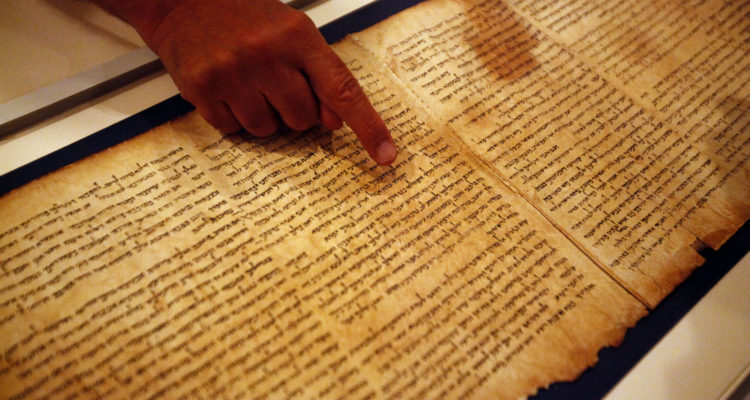
The next “prize” the Palestinians will likely claim as their own at the UN Educational, Scientific and Cultural Organization (UNESCO) will probably be the archeological site of Qumran and its Dead Sea Scrolls, Shimon Samuels of the Simon Wiesenthal Center said Wednesday, according to The Jerusalem Post.
Addressing a panel on the denial of Jewish history in international organizations at the Global Forum for Combating Antisemitism in Jerusalem, Samuels listed the Palestinians’ “success” at falsely claiming ownership of biblical and cultural sites, the Post reported.
UNESCO’s World Heritage Committee has ascribed to “Palestine” Bethlehem’s Church of the Nativity in 2012; the agricultural terraces of Battir, site of the ancient Jewish fortress at Betar, in 2014; and Hebron’s Tomb of the Patriarchs in 2017, the Post noted.
In October 2016, the Committee voted in favor of a resolution denying the millennia-old Jewish connection to Jerusalem, including the Temple Mount and the Western Wall.
“This is yet another absurd resolution against the State of Israel, the Jewish people and historical truth,” Israel’s ambassador to UNESCO Carmel Shama-Hacohen stated at the time. “There is no connection of another people to another place in the world that comes close to the strength and depth of our connection to Jerusalem from a religious, historical and national perspective, a connection that has stood the test of 2,000 years.”
The request to include the Qumran Caves and the Dead Sea Scrolls may be made at the next World Heritage Committee meeting this July in Bahrain, Samuels told the conference, the Postreported.
Already in November 2016, Israel Radio reported that the Palestinians were planning the next stage in their attempted denial of Israel’s history and heritage by preparing to lay claim to the Dead Sea Scrolls at UNESCO.
The scrolls, mostly Hebrew writings from the Second Temple period, were discovered in the Qumran Caves in the environs of the Dead Sea. They include many biblical texts and are believed to have been written by members of a Jewish sect known as the Essenes.
“Within two full years will I bring back into this place all the vessels of Hashem‘S house, that Nevuchadnetzar king of Bavel took away from this place, and carried them to Bavel;” Jeremiah 28:3 (The Israel Bible™)
Part of the mysterious Copper Scroll found at the Qumran caves (Wikimedia Commons)
A Noahide and former criminal investigator believes he has deciphered an enigmatic 2,000-year-old message known as the Dead Sea Copper Scroll, concluding that it is a treasure map leading to the hiding place of the lost Temple utensils. But while archaeological experts agree with his theory, the political complications of the region make it unlikely that the treasures will be revealed any time soon.
The Copper Scroll, discovered in 1952 near Qumran on the shores of the Dead Sea, is an archaeological mystery. Though considered part of the famous Dead Sea Scrolls, the Copper Scroll differs in that it was found in situ – on location – and that unlike the other Dead Sea Scrolls, written on papyrus, the Copper Scroll, as its name suggests, was inscribed into a thin sheet of copper. The Hebrew used in the scroll also indicates it was written in a later period than the Dead Sea Scrolls.
There is a great deal of controversy surrounding the Copper Scroll. While the other Dead Sea Scrolls contain religious and Biblical works, the Copper Scroll is simply a list of 64 locations and corresponding amounts of gold and silver.
The predominant opinion states that the gold and silver listed in the scroll was money accumulated from the Bar Kochba Revolt against the Romans after the destruction of the Second Temple. But the expert opinion has a glaring flaw: one of the locations is described as holding priestly vestments.
At first glance, Jim Barfield seems like the most unlikely person to unlock the mystery of the Temple vessels’ hiding place. He is not Jewish, does not speak Hebrew, and is not an archaeologist. But Barfield’s other qualifications enabled him to unravel a mystery that has baffled archaeologists for over fifty years.
In 2006, Barfield set out to discover the truth of the Copper scroll, following in the footsteps of Vendyl Jones, a Texas preacher turned Biblical archaeologist. Jones believed Qumran to be the hiding place for the Temple vessels and spent 30 years searching. Using the Copper Scroll as a guide, Jones discovered a small vial of Persimmon Oil used to anoint kings and high priests and a large quantity of what he believed was Temple incense. Barfield met with Jones, now deceased, and discussed the scroll, taking up the challenge.
“Like Jones, I am a Noahide,” he explained to Breaking Israel News. “I want to return the Temple artifacts to the Jewish People. It’s time.”
Barfield approached the Copper Scroll as he would an investigation, searching for ruins that matched the ‘clues’ in the Copper Scroll and recording his findings in an investigative reports. Very quickly, he began to find results.
When a young man, Barfield piloted helicopters in the US Army. He used his map-reading skills to triangulate, using the references in the Copper Scroll to pinpoint locations around Qumran. In 2007, he went to Qumran and actually found those locations. In one case, the scroll described steps, 40 cubits long, heading east. Barfield did indeed find stairs conforming to the description. He also discovered the remains of a pool, precisely 40 cubits long, exactly where the scroll said it would be. But lacking government permission, he could go no further.
In 2007, Barfield met with Israel Antiquities Authority (IAA) director Shuka Dorfman. Dorfman was unreceptive at first, but as Barfield laid out his proofs, explaining the signposts described in the Copper Scroll, Dorfman became enthusiastic and arranged a meeting with veteran archaeologist Yuval Peleg.
Peleg was also skeptical at first, noting that he was intimately familiar with the site at Qumran. But after reviewing Barfield’s work, he too was overcome with curiosity. He agreed to dig some exploratory holes at the site with Barfield. Less than an hour after beginning shallow test pits, Peleg received a mysterious phone call. Without any explanation, Peleg shut down the dig.
A map of the Qumran caves and possible locations of Temple treasures. (Courtesy Jim Barfield)
But the effort was not in vain. Barfield took away a small piece of what he thought was mortar from an unusual rock formation in the vicinity of where he believed the cave entrance to be. He reasoned that if the Temple’s greatest treasures were being hidden away for future generations, they would be carefully sealed up to withstand the test of time. Barfield sent the piece of unidentified stone to be tested. The laboratory confirmed that the sample was not natural stone but indeed man-made mortar.
This finding conforms precisely to a description in the Book of Second Maccabees, a second-century Greek text telling of the revolt against Antiochus. The book describes the prophet Jeremiah who, with the help of five men, hid the holy objects of the Temple to protect them from the conquering Babylonians, “sealing the cave carefully” and recording the locations on a copper tablet.
Jeremiah came and found a cave-dwelling, and he brought there the tent and the ark and the altar of incense; then he sealed up the entrance. 2 Maccabees 2:5
Barfield requested to scan the area using a massive metal detector that can detect metal up to 50 feet deep, but his request was denied. While the non-intrusive method of investigation would have laid to rest any doubts as to whether Barfield’s theory was correct, the IAA routinely refuses any requests to investigate the Qumran Area. Though frustrated, Barfield understands their position.
“The way things stand today, if we do find anything of value, whether it is monetary or spiritual, there will immediately be efforts to take it away from Israel,” Barfield explained. “Jordan will claim the land used to belong to them, the Palestinians will claim they were here before the Jews so the Temple vessels belong to them. And the world will believe them. And even Egypt will come along and claim it was gold and silver the Jews took out from the Exodus. By keeping it in the ground, the Israeli government is protecting it.”
For the time being, Barfield’s investigation is stalled, awaiting government permission. Building the Third Temple is an explosive political issue, and finding the actual Temple vessels would thrust that issue into the forefront. With the answer tantalizingly close, Barfield believes public opinion can tip the scales and help defuse the opposition.
As more and more people visit the Temple Mount and the nascent Sanhedrin holding Temple reenactments with reinstated Kohanim (priests), it seems that it is only a matter of time.
Read more at https://www.breakingisraelnews.com/85762/enigmatic-dead-sea-copper-scroll-reveals-true-locations-lost-temple-treasures/#qlrS1c0uvYWpYg2A.99