Contact Form

Name

Email *

Message *

Showing posts with label EMP attack. Show all posts

Friday, October 13, 2017

EMP Is America's Biggest Threat From North Korea


Congress was warned Thursday that North Korea is capable of attacking the U.S. today with a nuclear EMP bomb that could indefinitely shut down the electric power grid and kill 90 percent of "all Americans" within a year.
At a House hearing, experts said that North Korea could easily employ the "doomsday scenario" to turn parts of the U.S. to ashes.
In calling on the Pentagon and President Trump to move quickly to protect the grid, the experts testified that an explosion of a high-altitude nuclear bomb delivered by a missile or satellite "could be to shut down the U.S. electric power grid for an indefinite period, leading to the death within a year of up to 90 percent of all Americans."
Two members of the former congressional EMP commission said the threat to the U.S. has never been higher, in part because of the current high level of saber rattling by both sides and North Korea's surprising display over the past six months of its ability to deliver on its threats.
"With the development of small nuclear arsenals and long-range missiles by new, radical U.S. adversaries, beginning with North Korea, the threat of a nuclear EMP attack against the U.S. becomes one of the few ways that such a country could inflict devastating damage to the United States. It is critical, therefore, that the U.S. national leadership address the EMP threat as a critical and existential issue, and give a high priority to assuring the leadership is engaged and the necessary steps are taken to protect the country from EMP," the experts told a House Homeland Security subcommittee.
William R. Graham, chairman of the former EMP commission and its former chief of staff, Peter Vincent Pry, said that the U.S. has ignored the warning signs for years and that North Korea's military moves this year must be seen as a wake-up call.
They said:
  • Just six months ago, most experts thought North Korea's nuclear arsenal was primitive, some academics claiming it had as few as 6 A-Bombs. Now the intelligence community reportedly estimates North Korea has 60 nuclear weapons.
  • Just six months ago, most experts thought North Korea's ICBMs were fake, or if real could not strike the U.S. mainland. Now the intelligence community reportedly estimates North Korea's ICBMs can strike Denver and Chicago, and perhaps the entire United States.
  • Just six months ago, most experts thought North Korea was many years away from an H-Bomb. Now it appears North Korea has H-Bombs comparable to sophisticated U.S. two-stage thermonuclear weapons.
  • Just six months ago, most experts claimed North Korean ICBMs could not miniaturize an A-Bomb or design a reentry vehicle for missile delivery. Now the intelligence community reportedly assesses North Korea has miniaturized nuclear weapons, and has developed reentry vehicles for missile delivery, including by ICBMs that can strike the U.S.
  • After massive intelligence failures grossly underestimating North Korea's long-range missile capabilities, number of nuclear weapons, warhead miniaturization, and proximity to an H-Bomb, the biggest North Korean threat to the U.S. remains unacknowledged—nuclear EMP attack.
Their testimony also highlighted the failure of the Pentagon or Congress to extend the life of the EMP Commission and they recommended deeper study into the threat, include from a simple solar flare.
"Our current vulnerability invites attack," they said.
Paul Bedard, the Washington Examiner's "Washington Secrets" columnist, can be contacted at pbedard@washingtonexaminer.com

Wednesday, September 6, 2017

Could North Korea Be Preparing For An EMP Attack On The US?


Korea Nuclear Test Furthers EMP Bomb

Pyongyang reports 'EMP might' of nuclear arms


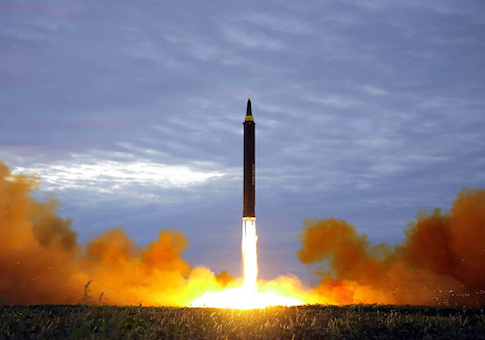
North Korea's intermediate-range strategic ballistic rocket Hwasong-12 lifts off / Getty Images
BY: 
North Korea for the first time this week revealed plans for using its nuclear arms for space-based electronics-disrupting EMP attacks, in addition to direct warhead ground blasts.
The official communist party newspaper, Rodong Sinmun, published a report Monday on "the EMP might of nuclear weapons," outlining an electromagnetic pulse (EMP) attack produced by detonating a nuclear warhead in space.
"In general, the strong electromagnetic pulse generated from nuclear bomb explosions between 30 kilometers and 100 kilometers [18.6 miles and 62 miles] above the ground can severely impair electronic devices, electric machines, and electromagnetic grids, or destroy electric cables and safety devices," said the article authored by Kim Songwon, dean of Kim Chaek University of Technology in Pyongyang.
"The discovery of the electromagnetic pulse as a source of high yield in the high-altitude nuclear explosion test process has given it recognition as an important strike method," he stated.
The official discussion by North Korea of plans to conduct EMP strikes will likely fuel debate over the threat. Former CIA Director James Woolsey has said North Korea is capable of orbiting an EMP nuclear weapon in a satellite.
Some liberal arms control advocates have dismissed the EMP threat from Pyongyang as far-fetched, such as arms control advocate Jeffrey Lewis, who in April dismissed the threat of an EMP attack by laughing at a reporter's question. "This is the favorite nightmare scenario of a small group of very dedicated people," he told NPR.
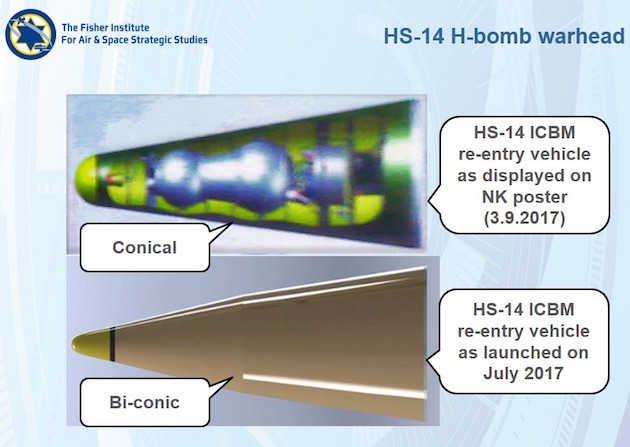
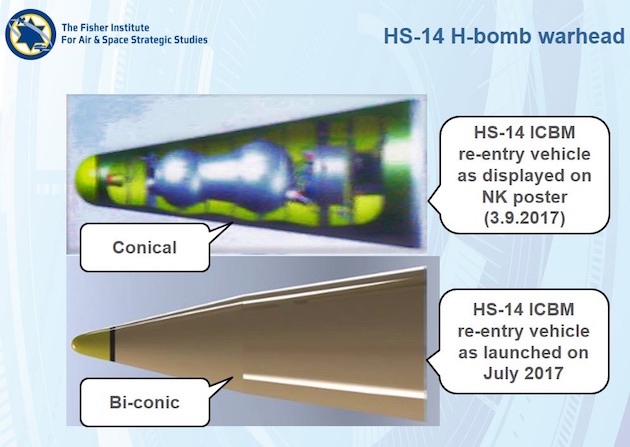
Disclosure of North Korea's intention to use its nuclear force for EMP attacks comes as U.S. intelligence agencies are continuing to analyze the latest underground nuclear test by North Korea on Sept. 3 that the regime said was its first hydrogen bomb explosion.
Senior administration officials said initial assessments of the nuclear blast in northeastern North Korea indicate it was the largest test detonation so far, and much larger than an underground test carried out last year. It was the regime's sixth nuclear test.
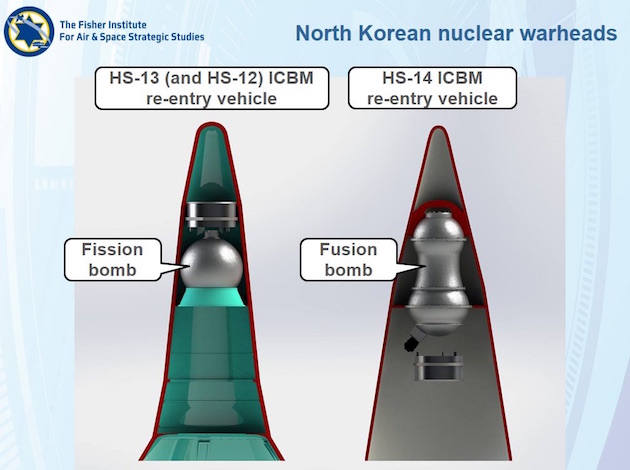
U.S. nuclear technicians have not made a definitive conclusion about the specifics of the device. Specialists are trying to determine if the test involved a hydrogen bomb, as Pyongyang asserted, or a device designed for EMP attack. They are also assessing whether the test used boosted fission technology.
Hydrogen bombs are advanced devices that use a two-stage explosion process to produce a massive explosion. Boosted fission devices are less sophisticated technologically and require more nuclear fuel.
"We're highly confident this was a test of an advanced nuclear device—and what we've seen so far is not inconsistent with North Korea's claims," a U.S. intelligence official said.
However, a final conclusion on the type and yield of the blast is not expected for several days. Data from the test is being analyzed by nuclear weapons experts at Los Alamos National Laboratory in New Mexico.
Also, the large explosion—perhaps more than 100 kilotons, or the equivalent of 100 tons of TN—likely produced significant venting of radioactive particles into the air.
Special U.S. intelligence aircraft, including the WC-135 nuclear "sniffer" jets, are conducting flights near the test zone to gather samples of particles from the test.
Kim, the North Korean technical university dean, stated that high-altitude explosions can be conducted in the stratosphere or in space where the blast wave is limited by the lack of air or the thinness of air.
"In explosions occurring at such altitudes, large amounts of electrons are released as a result of ionization reactions of high-energy instant gamma rays and other radioactive rays," he said. "These electrons form a strong electromagnetic pulse (EMP) through interaction with the geomagnetic field."
"The detonation would create a strong electric field of 100,000 volts per meter when it approaches the ground and "that is how it destroys communications facilities and electricity grids," the report said.
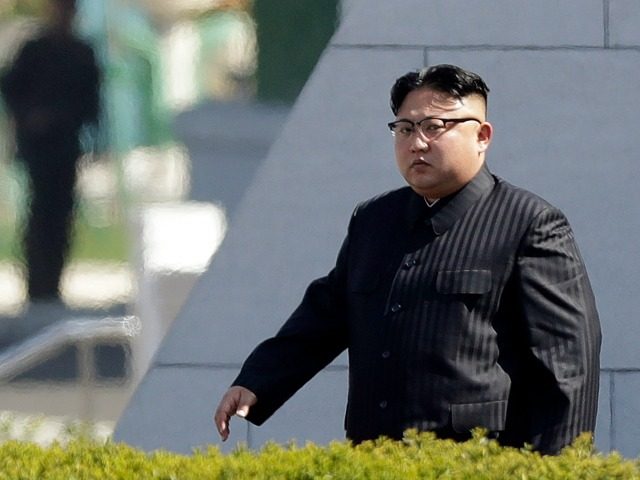
The EMP report was published Monday, a day after the same state-run outlet reported on a visit by North Korean leader Kim Jong Un to a nuclear weapons facility that also mentioned plans for using nuclear weapons in EMP attacks.
"Our hydrogen bomb—whose power as a nuclear bomb can be adjusted at will from tens of kilotons to hundreds of kilotons according to the targets of strike—is a multifunctional thermonuclear warhead which not only has enormous lethality and destructibility, but also can even carry out super-powerful EMP attack over an expansive area through detonation at high altitudes according to strategic goals," the report said.
EMP was discovered by the U.S. military during above ground nuclear tests in the Pacific Ocean during the 1960s.
EMP waves produced from nuclear tests were found to disrupt electronics throughout areas up to 1,000 miles from the center of the blast.
Peter Pry, a former CIA analyst who has been active in urging greater defenses against EMP attack, said a congressional commission on EMP has been warning for years about the North Korean EMP threat.
"EMP attack, by blacking-out the national electric grid and other life-sustaining critical infrastructures, could kill far more people than nuclear blasting a city," Pry said.
According to Pry, the Congressional EMP Commission warned that nationwide blackout and subsequent disruption from an EMP strike could kill 90 percent of the U.S. population through starvation, disease, and societal chaos.
"North Korea knows this, which is why state media describes their new nuclear warhead as capable of both blasting cities and EMP," he said.
William R. Graham, chairman of the commission, also has warned that North Korea’s two satellites orbiting over the U.S. could be armed with EMP weapons and detonated over the United States or U.S. allies.
Pry said despite the increasing danger from EMP, the commission will cease functioning Sept. 20 unless its charter is renewed.
"No one at the Pentagon or DHS has asked for the EMP commission to be extended," he said, adding that the commission has produced the best expertise on the threat.
The commission has urged the United States to harden the nation's electric grid and other critical infrastructure against EMP attack. But those efforts have been thwarted as the result of lobbying from the electric power industry that opposes the cost of expensive upgrades and stockpiling of transformers and other equipment.
In other developments related to North Korea, U.S. officials also said there are signs North Korea is preparing to conduct another long-range missile test. Two earlier long-range missile tests demonstrated new strike capabilities.
South Korean press reports said the next ICBM test could be launched over the Pacific and timed to a North Korean anniversary marking the communist state's founding on Sept. 9.
President Donald Trump announced Tuesday that in response to the nuclear test the United States will sell advanced arms to both South Korea and Japan as part of its policy of seeking to pressure the Pyongyang regime into giving up its nuclear arms.
"I am allowing Japan and South Korea to buy a substantially increased amount of highly sophisticated military equipment from the United States," Trump said.
The president also said tougher economic sanctions are being considered. "The United States is considering, in addition to other options, stopping all trade with any country doing business with North Korea," he said Sunday.
Trump also criticized China for failing to rein in its ally. "North Korea is a rogue nation which has become a great threat and embarrassment to China, which is trying to help but with little success," he said.
China maintains a defense alliance with North Korea that requires defending Pyongyang from any attack. China also provides some 90 percent of North Korea's trade.
The Trump administration recently imposed sanctions on Chinese and Russian entities supporting North Korea's arms programs. But the sanctions did not hit a Chinese company known to have supplied mobile missile launchers to the North Koreans for its long-range missiles.
Among the options being considered are an oil embargo on North Korea that would severely cripple the country's ability to provide energy resources. Additional sanctions also could target Chinese banks that have been working covertly with North Korea.
South Korea also is considering requesting that the United States return stockpiles of U.S. tactical nuclear weapons to the country. The weapons were withdrawn in the early 1990s.
Another step announced by the administration is the loosening of restrictions on the payload weight of missile warheads, agreeing not to oppose Seoul's plan to build bigger warheads for its short-range missiles.
South Korea had sought U.S. approval for exceeding both the range and payload limits for missiles under informal international Missile Technology Control Regime guidelines.
The MTCR limits signatories from building missiles with ranges greater than 186 miles and with warheads larger than 1,100 pounds.
In Japan, Defense Minister Itsunori Onodera said Tuesday initial assessments indicate North Korea may have successfully tested a hydrogen bomb, as the regime claimed.
Nuclear experts said the basis for early judgments about the nuclear test are based on seismic data.
Initial estimates of the blast registered the explosion as causing a tremor ranging from 5.8 magnitude to 6.1 magnitude on the earthquake scale. Later estimates put the blast at 6.3, indicating a much larger explosion.
David S. Maxwell, a North Korea expert and associate director of the Center for Security Studies at Georgetown University, said he did not think an underground test is a useful way to test an EMP bomb.
"An underground or ground burst has less EMP effects but as I understand it all nuclear explosions create EMP," he said, noting that during Army training in Europe, troops took down antennas and turned off all electric devices to protect them from a Soviet nuclear strike.
"It was hard back then and it will be even harder now that we are so much more dependent on electrical devices for every aspect of war fighting, and life in general," he said.
Maxwell said the rapid testing of North Korean nuclear weapons and missiles is likely designed to rapidly advance its programs in anticipation of a future negotiated freeze on the programs.
"I think the Kim family regime is banking on Russia and China being able to pressure the U.S. into a freeze, and the regime will agree to that if it believes it possesses a significant nuclear deterrent that it will not give up," he said.

Monday, May 8, 2017

Was North Korean Missile Launch A Prep Mission For An EMP Attack?


EXCLUSIVE – Congressional Expert: North Korea Prepping EMP Catastrophe Aimed At U.S. Homefront


SIGN UP FOR OUR NEWSLETTER

TEL AVIV – While the international community and news media focus on North Korean missile tests and the country’s nuclear program, one expert warned on Sunday that North Korea may be secretly assembling the capability to take out significant parts of the U.S. homeland via an electromagnetic pulse (EMP) attack.

Dr. Peter Vincent Pry is executive director of the Task Force on National and Homeland Security and is the chief of staff of the Congressional EMP Commission.
Speaking on this reporter’s talk radio program, Pry pointed to two North Korean satellites that are currently orbiting the U.S. at trajectories he says are optimized for a surprised EMP attack. “Aaron Klein Investigative Radio” is broadcast on terrestrial radio on New York’s AM 970 The Answer and NewsTalk 990 AM in Philadelphia and online.
Click below to listen to the entire interview:

Pry was referring to the KMS 3-2 and KMS-4 earth observation satellites launched by North Korea in April 2012 and February 2016 respectively.
He warned: “They are positioning themselves as sort of a nuclear missile age, cyberage version of the battleship diplomacy in my view. So that they can always have one of them (satellites) very close to being over the United States or over the United States.
“Then if a crisis comes up and if we decide to attack North Korea, Kim Jong Un can threaten our president and say, ‘Well, don’t do that because we are going to burn your whole country down.’ Which is basically what he said. I mean, he has made threats about turning the United States into ashes and he connected the satellite program to this in public statements to deter us from attacking.”
“If you wanted to win a New Korean war,” added Pry, “one of the things you would certainly consider doing is taking out the United States homeland itself.”
Pry surmised the North Koreans may be taking the idea from a Soviet plan during the Cold War to attack the U.S. with an EMP as part of a larger surprise assault aimed at crippling the U.S. military.
“During the Cold War, the Russians had a secret weapon they called a fractional orbital bombardment system,” he explained. “And the idea was to do a surprise EMP attack against the United States by disguising a warhead as a satellite. Because a satellite trajectory is different from an ICBM trajectory that is aiming to go into a city. You know, for accuracy on an ICBM you launch it on a lower energy, 45-degree angle that follows a classic ballistic trajectory. Like a rifle. To land your missile on a city.”
Pry continued of the original Russian plan:
But if you put a satellite in orbit it follows a different trajectory. It doesn’t have accuracy but it puts the satellite up there so that it stays in permanent orbit so it looks different in terms of the trajectory. And guys watching their radar screens tend not to get alarmed when they see a missile being launched on that satellite trajectory. Because they assume it is for peaceful purposes. …
So, the idea was to put a nuclear weapon on a satellite. Launch it on a satellite trajectory toward the south so it is also flying away from the United States. Orbit it over the South Pole and come up on the other side of the earth so that it approaches us from the south.
Because we didn’t during the Cold War and even today we still don’t have ballistic missile early radar warnings looking south. We don’t have any national missile defenses to the south. We are blind and defenseless to the south. We can’t see anything coming from that direction. Then when this gets over the United States you light it off so that it does an EMP attack.
Pry stated that in the Soviet plan, “They were mainly interested in paralyzing our strategic forces, our strategic command and control and communications so that we couldn’t talk to our forces. Maybe take out some of the forces themselves. And that would give them time to then launch their mass attack across the North Pole to blow up our ICBMs. So, kill them once with the EMP. Kill them twice by blasting our bases by using their long-range missiles. That was the Russian plan. But the cutting edge of the plan was this surprise EMP attack.”
North Korea, by contrast, “doesn’t have enough missiles or sophisticated missiles to blow up our missile bases and bomber bases. What they seem to be doing with the satellites is the EMP part of the Soviet plan.”
“I think what they are mainly going for is the unhardened electric grid,” Pry surmised. “Transportation, communications, all of the other civilian critical infrastructure that we depend upon to keep our population alive.”
Pry spotlighted recent North Korean nuclear and missile tests minimized by the news media for reported failures. When viewed through the lens of potential preparations for an EMP attack, Pry warned, the tests were actually successes.
Pry wrote about some of those tests in a Newsmax piece last week:
I am looking at an unclassified U.S. Government chart that shows a 10-kiloton warhead (the power of the Hiroshima A-Bomb) detonated at an altitude of 70 kilometers will generate an EMP field inflicting upset and damage on unprotected electronics. …
On April 30, South Korean officials told The Korea Times and YTN TV that North Korea’s test of a medium-range missile on April 29 was not a failure, as widely reported in the world press, because it was deliberately detonated at 72 kilometers altitude. 72 kilometers is the optimum burst height for a 10-Kt warhead making an EMP attack. …
According to South Korean officials, “It’s believed the explosion was a test to develop a nuclear weapon different from existing ones.” Japan’s Tetsuro Kosaka writes in Nikkei, “Pyongyang could be saying, ‘We could launch an electromagnetic pulse (EMP) attack if things get really ugly.'”
“The April 29 missile launch looks suspiciously like practice for an EMP attack,” Pry wrote. “The missile was fired on a lofted trajectory, to maximize, not range, but climbing to high-altitude as quickly as possible, where it was successfully fused and detonated — testing everything but an actual nuclear warhead.”
This weekend, an editorial published in the North Korean state-run media agency KNCA threatened the White House would be “reduced to ashes.”
The same news agency warned last week that “any military provocation against the DPRK will precisely mean a total war which will lead to the final doom of the US.” DPRK stands for the Democratic People’s Republic of Korea, or North Korea.

Tuesday, March 14, 2017

Our Energy Grid Is Vulnerable

PENTAGON: ENERGY GRID OPEN TO CYBERATTACK

Energy at risk?

5
0
American infrastructure including the energy grid will remain vulnerable to cyber attacks from China and Russia for at least the next decade, according to a recent Pentagon report.
The cyber vulnerabilities must be reduced while the Pentagon creates new deterrence capabilities ranging from low-level disruption to “catastrophic destruction and loss of life,” according to a report by a Defense Science Board task force.
The report, called “Task Force on Cyber Deterrence,” is based on a two-year study by a panel of defense and military experts and focuses on four countries: China, Russia, Iran, and North Korea, notes the Washington Free Beacon.
“The unfortunate reality is that, for at least the coming five to ten years, the offensive cyber capabilities of our most capable potential adversaries are likely to far exceed the United States’ ability to defend and adequately strengthen the resilience of its critical infrastructures,” the report said.
“The United States, as well as our allies and partners, are at serious and increasing risk of severe cyber attack and increasingly costly cyber intrusion,” the report continues. “The requirement for enhanced deterrence is, in our view, not debatable. Nor is the need to accelerate the implementation of deterrence measures.”
The report adds that even if preventive measures are taken, it still won’t be able to prevent sophisticated attacks from China and Russia because “improvements are not on a pace to reduce risks to acceptable levels within the next decade.”
“Such progress will not be adequate to deny Russia and China’s ability to unleash catastrophic cyber attacks on the United States, given their massive resources, and capabilities-at-scale (e.g., intelligence apparatus, ability to influence supply chains, and ability to introduce and sustain vulnerabilities) to dedicate to their objectives,” the report concludes.
China was found to have hacked the Pentagon last year, as well as the FDIC (Federal Deposit Insurance Corporation) in 2010.
Despite the narrative that Russia hacked the 2016 U.S. election, there’s still no evidence that Russia had penetrated voting systems, as former Director of National Intelligence James Clapper admitted that “they did not change any vote tallies or anything of that sort.”