
Contact Form

Name

Email *

Message *

Showing posts with label Federal Trade Commission. Show all posts

Thursday, April 5, 2018

Schumer Is A Major Roadblock While Raking In Bucks From Tech Companies--Corrupt!


Chuck Schumer HUMILIATED at his house Tuesday

What’s stopping the federal government from looking into the numerous accusations into social media outlets like Facebook, which was caught Wednesday secretly recording data from American citizen’s private messages?
Scvhumer A Los Angeles-based conservative activist that goes by the moniker Soba has started a guerilla street art campaign against Schumer’s alleged “conflict of interest” with Facebook and other tech giants.
The artist has launched an anti-Schumer information campaign across New York City, plastering Schumer’s home base with posts that taunt the lawmakers suspicious ties to Silicon Valley.
The stated goal of the campaign is to make American voters aware of Schumer’s controversial political ties to tech giant Facebook.
For example, Schumer has single-handled stopped five of President Donald Trump’s nominations to the Federal Trade Commission from taking office, which has prevented the FTC from taking any regulatory actions on social media giants like Facebook and Twitter, The Independent reported on Mar. 25. Meanwhile, Schumer has accepted boatloads of donor cash from top executives at these companies.

“Schumer received $38,900 in 2016 from Facebook and its employees, making him the top congressional recipient for Facebook donations,” The New York Post reported.
That’s not all. Schumer’s personal ties are so deep, in fact, that his daughter was given a high-paying job working for Facebook last January, a job that Glassdoor estimates pays nearly $120,000 annually.
While is daughter is raking in the cash, Schumer has effectively prevented the government from looking into a scandal that effected nearly 87 million people by preventing the FTC from functioning.
Trump has frequently protested that Democrats in Congress have unfairly stopped his administration’s ability to get his nominees put into office —
Schumer’s actions are even more sinister when the blatant bias at tech giants like Facebook, Google, and Twitter is considered — and the way they can control information gained by the American people.

For years, these tech companies and their employees have been deeply involved with supporting liberal politics.
The bias is so blantant, in Oct. 2016, Facebook COO Sheryl Sandberg actually told Hillary’s campaign manager John Podesta that she would do anything she could to help.
“I still want HRC [Hillary Rodham Clinton] to win badly,” she reportedly wrote. “I am still here to help as I can.”

Schumer has been an outspoken Facebook apologist for years. He recently defended the company to tech journal Recode, saying, “Facebook is a very powerful force. I think, overall, it’s been a very positive force and now people are taking advantage of the openness of the net. And Facebook has an obligation to try and deal with it. I talked to them. I truly believe they want to, I truly believe they know their future is at stake with this. I also believe it’s a hard thing to do.”
So what does one do when the Democrats control both the mainstream media and the information found on the internet?
One conservative artist is fighting back in a way that can’t be censored.
He’s using clever street signs in major population centers decrying Schumer and Facebook CEO Mark Zuckerburg’s ties.

Anti-corruption, old school-style. And the images spread like wildfire.
The New York Post shared an image of one of the signs popping up near Schumer’s home in New York —
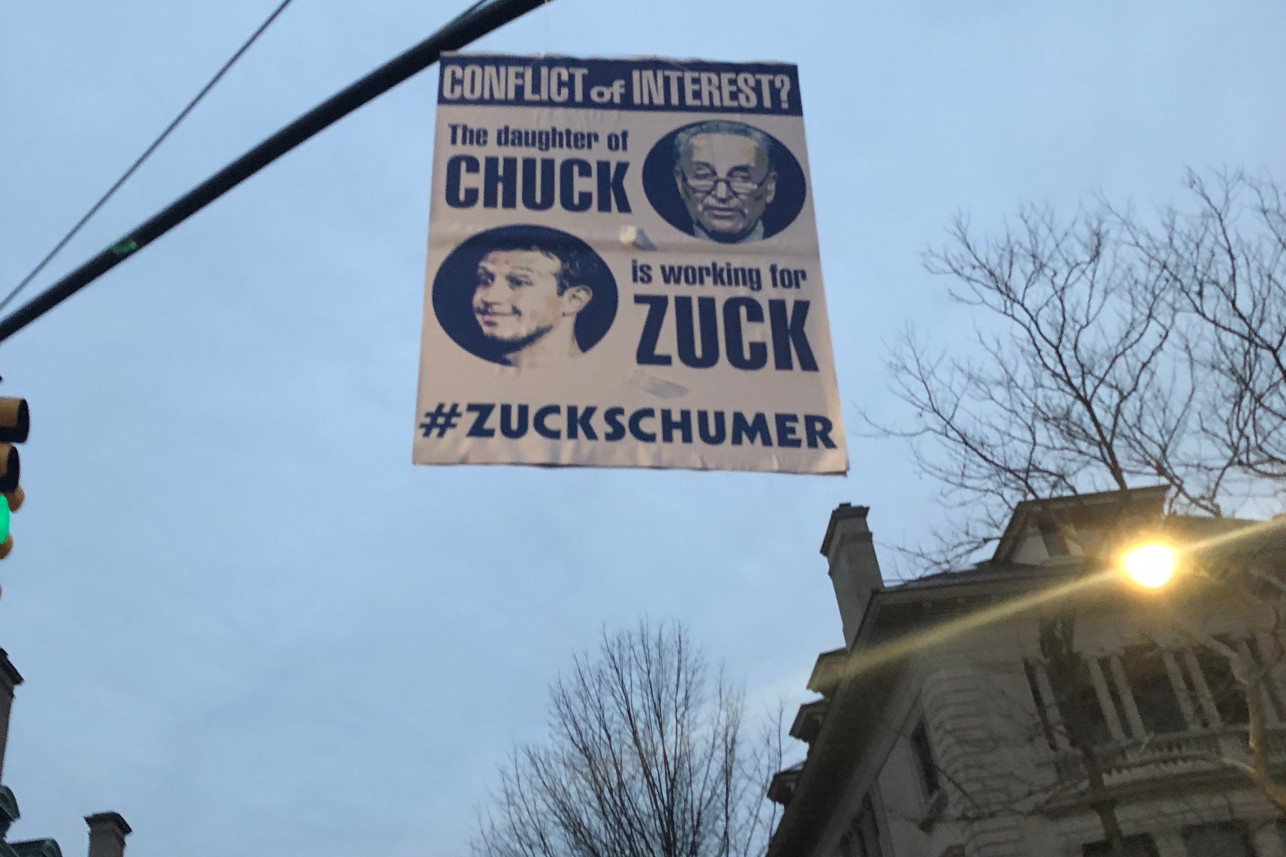
Picture shared by The New York Post.
Yahoo! Finance shared another image of a poster —
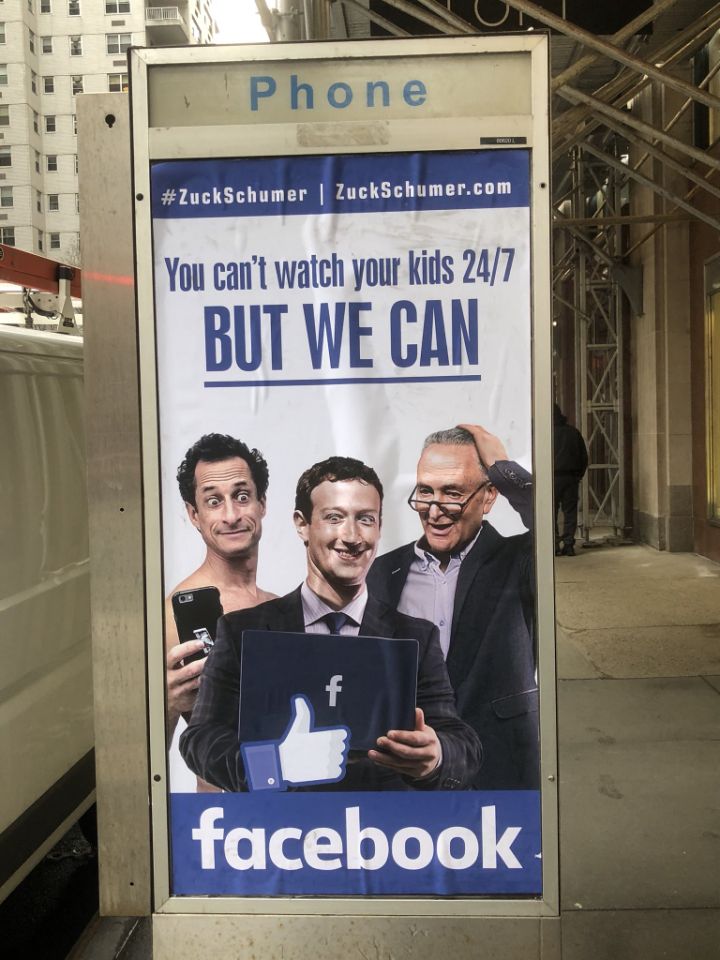
On the street artist’s website, he slams Schumer and Facebook.

“Schumer protects Zuckerberg’s creepy business spying from common-sense federal privacy regulation that would protect children and all Americans,” ZuckSchumer claims. “As a reward, Zuckerberg and other Big Data billionaires shovel money into Schumer’s campaign accounts.”
It’s something American voters need to know.
And the word is getting out.
— The Horn editorial team

Thursday, April 3, 2014

EEOC Does Background Checks Yet Wants To Stop Businesses From Doing Them

Are Employee Background Checks Racist? EEOC Thinks So

41 Comments
 Posted 
The Obama administration has threatened employers that run criminal and credit background checks on job applicants, arguing these are racial "barriers" to hiring — even though federal agencies routinely use them.
Last week the Federal Trade Commission joined with the Equal Employment Opportunity Commission to tell employers that background checks could have a "disparate impact" on black people and expose private firms to lawsuits.
Threatening aggressive enforcement, the agencies released new compliance guidelines: "Background Checks: What Employers Need to Know." They advise employers to "take special care when basing employment decisions on background problems that may be more common among people of a certain race."
Noting that black men are incarcerated at six times the rate of white men, the EEOC said African-Americans are far more likely to have a criminal record that would exclude them from jobs under screening policies.
"The data provides a basis for the commission to investigate disparate impact charges challenging criminal-record exclusions" of black job candidates, the agency warned in separate enforce ment guidance. Even "employer's evidence of a racially balanced workforce will not be enough to disprove disparate impact."
Disparate impact is a controversial civil-rights theory applied increasingly by the administration, from home loans to school discipline. It relies on statistics to indicate racism, a much lower standard of proof than actual acts of racism.
In 2011, the NAACP formally lobbied the commission to apply disparate impact to background checks and to compel employers to remove the standard checkbox question on job applications that asks: "Have you ever been convicted of a felony?"
Nine months later, the EEOC recommended "that employers not ask about convictions on job applications," it said in its 44-page enforcement guidance.
EEOC Chairwoman Jacqueline Berrien previously worked as a lawyer at the NAACP.
Employers Defend
Companies argue screening prospective employees for crimes and credit problems is essential to the hiring process. Besides determining suitability for employment, it helps protect against theft, embezzlement, fraud and workplace violence.
More than two-thirds (69%) of employers conduct criminal background checks, while almost half (47%) run credit checks for at least some positions, a recent Society for Human Resource Management poll found.
Ballard Spahr's Patricia Smith says the new rule "puts employers between a rock and a hard place." They must hire criminals and risk liability for their work-related misconduct, or reject such hires and face a federal or class-action lawsuit.
Lawsuits already are flying. EEOC extracted $3.13 million from PepsiCo in a 2012 settlement after charging the soda and snacks giant with discriminating against blacks by using criminal background checks. Pepsi (PEP) also agreed to change its screening policy to remove "roadblocks" for blacks with criminal histories.
Encouraged, EEOC in 2013 sued BMW and Dollar General (DG) over their criminal checks.
"BMW's policy had, and continues to have, a significant disparate impact on black employees and applicants," the EEOC alleged in its complaint. White people had also been denied jobs via the checks.
EEOC alleges Dollar General broke the law by denying jobs to black applicants with drug convictions and other felonies, and is engaging in "ongoing, nationwide race discrimination."
At the same time, the agency is suing Kaplan Higher Education Corp., which advises college students on financial needs, for using credit checks to screen candidates for jobs handling sensitive credit information.
The government claims this also has an unlawfully disparate impact on African-Americans, who have tended to have more credit problems than other groups. The companies have vowed to fight the charges.
Disparate Dismissed
A recent court ruling likely gives them hope. Last August, U.S. District Judge Roger Titus threw out EEOC's case vs. Freeman Cos., arguing it failed to prove — even under the disparate-impact standard — that the Maryland employer's criminal and credit checks discriminated against black job applicants.
Titus said such checks are a "rational" part of the hiring process and blasted the government for condemning "the use of common sense."
He also pointed out the hypocrisy of suing a private employer when "the EEOC conducts criminal background investigations as a condition of employment for all employees, and conducts credit background checks on approximately 90% of its positions."
Legal analysts say the administration's new policy is based on the erroneous notion that criminal records are protected under Title VII of the Civil Rights Act.
"This new guidance is legal fiction," senior Heritage Foundation legal fellow Hans von Spakovsky said. "Private industry should not be faced with an expensive case-by-case fight against an out-of-control federal agency."
Nine state attorneys general urged the EEOC to abandon its policy in a July letter.
"Race discrimination cannot plausibly be your agency's actual concern," they said. The EEOC's "true purpose may not be the correct enforcement of the law, but rather the illegitimate expansion of Title VII protection to former criminals."
EEOC chief Berrien did not back down, saying in a response that "to avoid Title VII liability," employers should give black applicants screened out because of past run-ins with the law a second chance.


Read More At Investor's Business Daily: http://news.investors.com/politics/032714-694866-eeoc-ftc-warn-employers-not-to-run-criminal-or-credit-checks.htm#ixzz2xrWRVtgj
Follow us: @IBDinvestors on Twitter | InvestorsBusinessDaily on Facebook

Thursday, January 9, 2014

Ever Been Harassed By Debt Collectors? Outrageous Tactics Are Disgusting.

Debt threats: Collectors' extreme tactics

by   January 9, 2014 4:15AM ET
In a sputtering economy, debt collectors are working harder than ever to force payment, sometimes even breaking the law
Topics:
 
Economy
 
U.S.
 
Debt
Debt threats: In a sputtering economy, debt collectors are working harder than ever to force payment, sometimes even breaking the law
Getty Images
It was almost 11 a.m. on a Tuesday in October when Jennifer Posey received the first voice mail.
"This is Jimmy Lee calling from CheckCare. Just letting you know we're in full force," he said. The man had a thick Southern accent that stretched the word "you" into a two-syllable accusation. "We're going to have warrants out for your arrest in Columbus, Ga.," the man threatened. "We know you have an apartment on the canal in Clearwater."
It was when he mentioned her home in Florida that Posey began to feel anxious. "We're hurting you," he continued. "We're hurting your family, your son's family, your cousin's family. Whatever we can do to get you to pay."
Forty minutes later, her phone rang again. "What about that 12-, 13-year-old child you're trying to raise?" the voice sneered.
That's when Posey called the police.
"This is my 12-year-old child!" Posey says. Later that afternoon, she received a letter from the Warner Robbins, Ga., franchise of CheckCare, one of the nation’s largest networks of check guarantors.
The letter claimed that Posey owed $3,560.23, an allegation she refuses to discuss. The amount, she says, was beside the point. "I don't care if it's one dollar or 1 million. You don't threaten to harm my child," she says.
Posey's experience, while extreme, is far from uncommon. As the effects of the Great Recession continue to fester in neighborhoods across the country, more Americans than ever report being abused, harassed and deceived by the notoriously unregulated debt-buying and -collecting industry. In 2012, the Federal Trade Commission received an unprecedented 180,000 complaints about these companies, nearly 13 times more complaints than were reported in 2000.
The debt collection industry is like the Luca Brasi of lenders, and there are big bucks to be made in enforcement, whether you’re working for Don Corleone or MasterCard. 
The debt collection industry is like the Luca Brasi of lenders, and there are big bucks to be made in enforcement, whether you're working for Don Corleone or MasterCard. Today, debt collection is a $12 billion business, with more than 4,500 companies and, according to the Better Business Bureau’s recent report, more ruthless tactics than ever. The abuse is part of the industry's strategy to get people to pay up — a job that's gotten even harder since Americans lost millions of jobs and trillions of dollars in wealth throughout the recession. According to John LaRosa, the research director of Marketdata Enterprises, which released a 2012 report on the industry, "Agencies have to work much harder to collect, making more calls, using more aggressive tactics."
The only problem? A hell of a lot of these tactics are illegal, and a new government agency has resolved to fight back.

Fake sheriffs, phantom firms

Approximately 10 percent of all Americans, or 30 million people, are currently being pursued by debt collectors. Of these, more than 100,000 people report being subject to predatory or illegal tactics every year. Some are called incessantly, often well after 9 p.m., which is prohibited under the Fair Debt Collection Practices Act. Others reported being threatened with arrest or felony charges by collectors, both of which are also prohibited.
Sometimes the behavior of debt collectors is egregious to the point of being ridiculous. In Erie, Pa., one company named Unicredit Debt Resolution Center hired employees to dress up as fake sheriff's deputies so they could deliver fake subpoenas and even haul people into a fake courtroom where — you guessed it — a fake judge would coerce them into disclosing their bank account information and even handing over the titles to their cars. Other actions are downright scary. One California-based company threatened to shoot and eat people's pets and even dig up the bodies of deceased family members, all in its efforts to intimidate them into paying.
In Erie, Pa., a fake judge would coerce people into disclosing their bank account information and even handing over the titles to their cars. 
Often debt collectors harass people over debts that aren't even owed. More than a third of the complaints released by the Consumer Financial Protection Bureau (CFPB) were from people being pursued for debts that weren't theirs or that they had already paid. The latter problem plagued Maryland resident Edgar Moreno after his daughter was in a car accident in Arizona last fall. One of the first things he did was send her a prepaid card to cover her hospital charges. She was only 22; the last thing he wanted was for her to have to deal with bills and forms while she was convalescing.
In November he received a letter from the hospital saying that all his daughter's medical bills were settled. But a slew of letters sent to her home by Professional Credit Services alleged the opposite. According to Moreno, the company — a third party hired by firms to collect debts — barraged her with so many threatening letters that Moreno finally had her mail forwarded to his home. He tried repeatedly to contact the company to inform it that his daughter's bills had been paid, but he couldn't get anyone on the phone.
"It's like a phantom company," he said. Finally, he took to the Web, writing indignant complaints on consumer sites like RipOffReport and the Better Business Bureau. "They're taking advantage of people when they are most vulnerable, at the worst times of their lives," he said. "She didn't even owe anything."
Neither Professional Credit Services nor any of the other agencies mentioned in this article responded to repeated requests for comment.

Reform and robo-signing

For decades, the business of debt collection operated with too little government scrutiny. The most comprehensive federal regulation, the Fair Debt Collection Practices Act, was written in 1977, back when the idea of the Internet was fiction and students taking out loans for $58,000 a year in tuition seemed as improbable as flying cars. Besides being outdated, the act is also restricted to regulating third-party debt collectors, meaning major banks like JPMorgan Chase or giant stores like Macy's are exempt from the rules when trying to collect money they lent. The Federal Trade Commission has sued dozens of collectors over the years under the act, including Expert Global Solutions, the world's largest collection company. But the agency lacks the authority to write new laws. As Chris Farrell, correspondent for the NPR show "Marketplace," recently wrote in the Minneapolis Star Tribune, the industry is essentially the "credit economy’s Wild West."
But there's a new sheriff in town, and it has vowed to clean up the business. Last year, the CFPB began overseeing large debt collectors under the Dodd-Frank Act, which gives the agency the rightto regulate both large banks and nonbank financial service providers, such as payday lenders, mortgage services and debt collectors.
In July, the CFPB announced it was "put(ting) companies on notice." By December, the agency had released thousands of complaints about debt collectors, sued one of the largest payday lendersand announced it was developing new rules to regulate the industry.
Of the more than 7,000 complaints the CFPB has published so far, more than 2,000 were from people who reported being pursued for a debt they didn't owe. 
Stopping debt collectors from pursuing the wrong people, as in the case of Moreno's daughter, is one of the CFPB's main areas of concern. Of the more than 7,000 complaints the agency has published so far, more than 2,000 were from people who reported being pursued for a debt they didn't owe.
The information breakdown often occurs when people's debt is shuffled around or purchased by debt buyers for about four cents on the dollar. When a buyer purchases debt from another company, what it's really buying is a spreadsheet filled with names and phone numbers of the alleged debtors, from which the company then tries to collect the full amount owed.
These spreadsheets are frequently filled with mistakes or missing information, said Claudia Wilner, a senior staff attorney with the New Economy Project, a resource and advocacy center in New York City. Through the organization's free legal hotline, she and the other attorneys have spoken to thousands of people who say they are being pursued by debt collectors based on faulty information.
"We have talked to many people who don’t owe these debts," she said. "Or even if there's some aspect of the debt they recognize, the amount has ballooned so much as to be completely unrecognizable."
The debt collectors also use these spreadsheets to sue people in civil court. According to a class action lawsuit in New York, suing collection agencies often fail to serve people with the required notices of complaint to inform them of their court dates. Instead they simply robo-sign affidavits that claim the notices have been served. Then, when people don't show up in court, the judge enters a default judgment against them, allowing the debt collection agencies to freeze bank accounts and garnish wages. Remember: All of this action is based on the error-ridden spreadsheets, leading to cases of people having bank accounts frozen over debts that weren't even theirs in the first place.
Wilner, who is working on the class action suit, said she was "heartened" to see the CFPB recently fine the massive payday lender Cash America $3.2 million for similar shenanigans, including robo-signing court documents.
"I would really like to see the CFPB take similar actions," she said.

Legal loopholes

Debt collection laws also vary from state to state, and there are issues that consumer advocates say the agency won't be able to remedy, no matter how aggressive its new laws are. In Minnesota, for example, third-party debt collectors can initiate lawsuits against people without even filing documents in court. This legal quirk ended up confusing St. Cloud resident Tammy Wold into missing the 20-day window she had to contest a claim, which she said is at least $1,500 more than what she owes.
On a Saturday morning in October, a man from the Law Office of Joe Pezzuto, LLC, arrived at Wold's door and handed her papers that he said were a legal summons and complaint. But when she examined the papers, she noticed there was no court number. Suspicious, she called the county clerk's office, only to be told there was no record of a lawsuit there either.
"They call it a summons, but it's not an actual summons," she said. 
When someone sees court papers without a court file on them, she assumes that they are bogus.
Peter Barry
Minneapolis consumer rights lawyer
That's exactly what collectors want people to believe — but it's not the truth, said Peter Barry, a consumer rights lawyer in Minneapolis: "The collection industry wants you to think it's a fake lawsuit because then they'll get a default."
Barry, who does not represent Wold but has sued numerous other Minnesota law firms for debt collection abuses, said that this legal loophole is an example of how the collection industry seeks ways to confuse consumers.
"The fact that she believes that it's a bogus lawsuit goes to the larger problem in Minnesota that the collection industry has intensely lobbied to get service rules that favor them," he said. He speaks to a half-dozen people each week who believe, as Wold did, that the summonses they've received are false. 
"When someone sees court papers without a court file on them, she assumes that they are bogus. Just like if I gave you a dollar bill without a serial number on it, you wouldn't take it," he said. 

An underlying problem

These types of state-by-state loopholes will be nearly impossible for the CFPB to regulate. But the bigger problem, others argue, is that it will be impossible to reform the collection industry without recognizing the underlying issue: the debt itself.
To the increasing number of Americans who are forced to assume debt to pay for basic needs, cleaning up the collection business can sound a little like slapping a fresh coat of paint on the Titanic. It might be a nice touch, but we're all still going under.
"I'm glad to see the CFPB exists, and that it seems to be taking a hard line with collectors," said Ann Larson, a professor at the City University of New York and a participant in the group Strike Debt. But in the long term, she said, people are going to have to challenge an economic system that pushes them into debts that — with flatlined wages and skyrocketing educational, medical and housing costs — fewer and fewer people can afford to pay back.
Recent headlines echo Larson's words. On Dec. 9, Shaun Donovan, the secretary of Housing and Urban Development, announced that the United States is in the midst of "the worst rental affordability crisis that this country has known," while The New York Times reported that medical costs have ballooned to the point that a single stitch costs $500. Student debt, meanwhile, has topped $1 trillion, dragging down both a generation and the overall economy.
"I just don’t see how you could address one without the other," Larson said. 
*Have you or anyone you know been harrassed by a debt collector? Leave your comment below or share your story by emailing us at ajam-community@aljazeera.net