Our goal is to have intelligent discussion of the topics of the day. We realize everyone has their opinion and they should be allowed to express it in a discussion forum without calling each other names. We learn from discussion and not from name calling or argument.We use cookies to personalise content and ads, to provide social media features and to analyse our traffic. We also share information about your use of our site with our social media, advertising and analytics partners. See details
Contact Form
Showing posts with label Freedom of Religion. Show all posts
Showing posts with label Freedom of Religion. Show all posts
In a case titled NIFLA, et al. v. Becerra, the Supreme Court is asked to opine on whether Beccera’s injunction to stop enforcement of California’s FACT Act should be granted.
California’s FACT Act requires pro-life clinics to inform their clients on how and where to get abortions. This government-forced message, Beccera claimed, is unquestionably contrary to their practices and beliefs and is therefore a violation of their freedom of speech.
The Supreme Court rightly agreed with Beccera and granted the injunction and sends the case to the lower courts to finish its legal process.
This is truly a victory for freedom of speech and also for the unborn’s right to life; however, it may have some unintended consequences for pro-life supporters.
Justice Clarence Thomas wrotes in the majority opinion:
“Content-based regulations ‘target speech based on its communicative content.’ As a general matter, such laws ‘are presumptively unconstitutional and may be justified only if the government proves that they are narrowly tailored to serve compelling state interests.'”
Thomas remarks that California’s licensed notice is a content-based regulation of speech. And since this particular notice is forced upon clinics like Beccera’s, who are morally opposed to abortion, this particular notice only serves to “alte(r) the content of (their) speech.”
Justice Breyer, writing for the dissent, claims that the government has traditionally held the power to regulate speech through professional licensing and this case should be no different. However, Justice Thomas reasons that speech is not unprotected merely because it is uttered by “professionals,” therefore the California law cannot force pro-life clinics to include government-scripted instructions about abortion.
Breyer remarks in the dissent that this opinion, depending upon how it is applied, could have widespread ramifications on many laws currently in place requiring certain businesses to supply clients with government-scripted notices.
Are you concerned about government regulation of free speech?
This point made by Breyer is where pro-life advocates may find that they have won this case, only to lose another.
Many states have laws on the books that require abortion clinics, both public and private, to provide brochures on alternatives to abortion. Many states have laws forcing these abortion clinics to provide ultrasound services along with instruction about the developmental stages of the baby in the womb. These are also government-scripted notices forced upon these clinics contrary to their practices and beliefs.
If these abortion clinics were to challenge these laws forcing the pro-life message, under this precedent the high court would also have to overturn those pro-life message laws.
This judicial tit for tat is what happens when people use the force of government to promote personal messages. As Thomas so clearly points out in the majority opinion, the pro-abortion proponents could easily inform the women about its services “without burdening a speaker with unwanted speech,” most obviously through a public-information campaigns.
To be consistent in their opinions, the majority would have to say the same thing about government forced pro-life practices and messages. This means that both parties will have to use non-governmental methods to inform the public about their services rather than relying on the force of government to promote their message.
The irony is that the Supreme Court seems unanimous to a certain degree that freedom of speech deserves the highest level of protection; however, the life of an unborn child does not.
KrisAnne Hall is a national speaker and consultant on the Constitution, founder of Liberty First University, former Russian linguist for the U.S. Army, and former prosecutor for the State of Florida. She also practiced First Amendment law for a prominent national nonprofit law firm. KrisAnne now travels the country teaching the foundational principles of liberty and our constitutional republic. KrisAnne Hall is the author of six books on the Constitution and Bill of Rights and has an internationally popular radio presence. Her books and classes have been featured on C-SPAN TV. KrisAnne Hall can be found at www.KrisAnneHall.com.
Facebook has greatly reduced the distribution of our stories in our readers' newsfeeds and is instead promoting mainstream media sources. When you share to your friends, however, you greatly help distribute our content. Please take a moment and consider sharing this article with your friends and family. Thank you.
After the Supreme Court ruled 7-2 in favor of the Colorado baker who refused to serve a gay couple, the mainstream corporate media opted instead to call it a “narrow” win.
Several news outlets, including USA Today, Reuters, and NBC have all decided to call a definitive 7-2 Supreme Court ruling “narrow,” when only liberal Justices Sonia Sotomayor and Ruth Bader Ginsberg ruled against the baker who exercised his First Amendment right and defended his religious liberty.
“But the opinion was a narrow one, applying to the specific facts of this case only,” NBC reported. “It gave no hint as to how the court might decide future cases involving florists, bakers, photographers and other business owners who have cited religious and free-speech objections when refusing to serve gay and lesbian customers in the wake of the Supreme Court’s 2015 same-sex marriage decision.”
The mainstream media is misleading the public by using “narrow” in their headlines because the case itself was clearly decided. Just because the scope of the ruling doesn’t extend beyond the facts of the case doesn’t make the decision itself narrow, which their headlines imply.
Justice Kennedy explained the ruling, saying baker Jack Philips’ religious liberty was violated in 2012 by the state commission in ruling against his decision to adhere to his religious views by refusing service to a gay couple.
“The neutral and respectful consideration to which Phillips was entitled was compromised here,” Justice Kennedy wrote on behalf of the majority.
“The Civil Rights Commission’s treatment of his case has some elements of a clear and impermissible hostility toward the sincere religious beliefs that motivated his objection.”
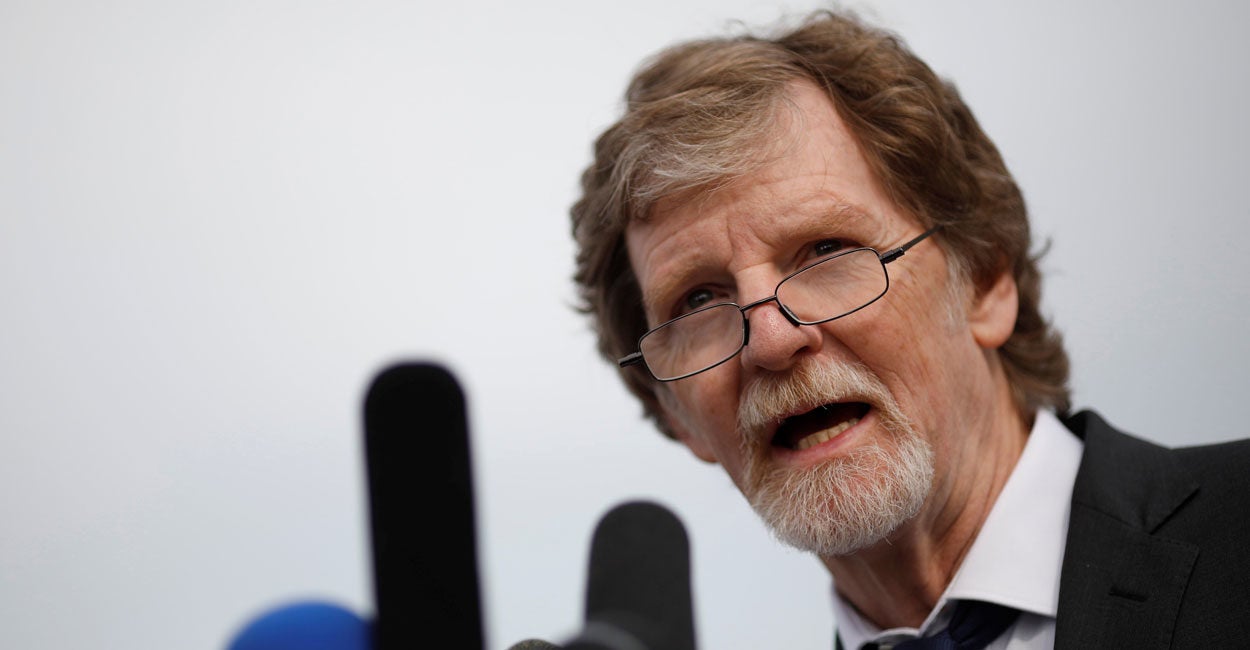
Jack Phillips speaks outside the Supreme Court following oral arguments in Masterpiece Cakeshop v. Colorado Civil Rights Commission. (Photo: Aaron P. Bernstein/Reuters /Newscom)
The Supreme Court heard oral arguments on Tuesday in a closely watched case dealing with free speech, religious liberty, and same-sex marriage.
Specifically, the justices considered whether the state of Colorado can force Jack Phillips, a Christian baker, to create a custom cake for a same-sex wedding against his deeply held religious beliefs.
Attorneys for Phillips clearly explained that he seeks to exercise his freedom only to speak messages that he agrees with, while still welcoming all customers into his store. The First Amendment’s free speech and religious liberty clauses protect his freedoms to do just that.
In a lengthy and charged oral argument, the nine justices wrestled with how Americans who hold different views on marriage in our post-Obergefell society can continue to live with each other in mutual respect.
The liberal Left continue to push their radical agenda against American values. The good news is there is a solution.Find out more >>
Here are some highlights of the argument.
1. Mutual Tolerance Is Essential in a Free Society
In one of the most charged exchanges of the day, Justice Anthony M. Kennedy questioned Colorado Solicitor General Frederick Yarger about whether a member of the Colorado Civil Rights Commission who compared Phillips to a racist and a Nazi demonstrated anti-religious bias—and that, if he did so, whether the judgment against Masterpiece should stand.
After disavowing the commissioner’s comments, Yarger argued that the ruling should still stand. But Kennedy returned to the issue again, telling Yarger that “tolerance is essential in a free society. And tolerance is most meaningful when it’s mutual. It seems to me that the state in its position here has been neither tolerant nor respectful of Mr. Phillips’ religious beliefs.”
Kennedy also pointed out there were other cake shops that would have accommodated Charlie Craig and David Mullins, the same-sex couple who requested a cake for their wedding.
In a similar line of questioning, Justice Samuel Alito pointed out that the state of Colorado had failed to demonstrate mutual tolerance when it only protected the freedom of cake artists who landed on one side of the gay marriage debate—namely, the state’s side.
When three religious customers went to cake artists to request cakes that were critical of same-sex marriage, those cake artists declined—yet Colorado did not apply its anti-discrimination statute to punish the artists. But when Phillips declined to create a cake to celebrate a same-sex marriage, Colorado imposed a three-pronged penalty that drove him out of the wedding cake business, causing him to lose 40 percent of his business.
2. Compelled Speech for Everyone
The irony of the comparison of Phillips to a Nazi is that both the ACLU lawyer representing the gay couple (David Cole) and the Colorado solicitor general admitted the state could rightfully force cake artists to celebrate the racist ideals of white supremacy, or one of the most infamous events in world history, the Holocaust.
At one point, Justice Stephen Breyer followed up on a question from Justice Neil Gorsuch about whether a cake artist could be forced to create a cross-shaped cake for a religious group that shared the beliefs of the KKK. Cole responded that if the cake artist did so for the Red Cross, then yes, the artist would have to do so for the religious group as well.
Similarly, Justice Samuel Alito asked Colorado if a cake artist who created a cake with words celebrating Nov. 9 for someone’s anniversary could also be forced to create the same cake to celebrate Nov. 9, 1938.
On that infamous night, known as “Kristallnacht,” the Nazis launched their pogrom against Jews by burning over 1,000 synagogues and damaging more than 7,000 Jewish businesses.
In the exchange with Alito, the Colorado solicitor general said that cake artists could not discriminate on the basis of identity, but could discriminate on the basis of messages. Gorsuch later responded, saying that’s exactly what Phillips has argued.
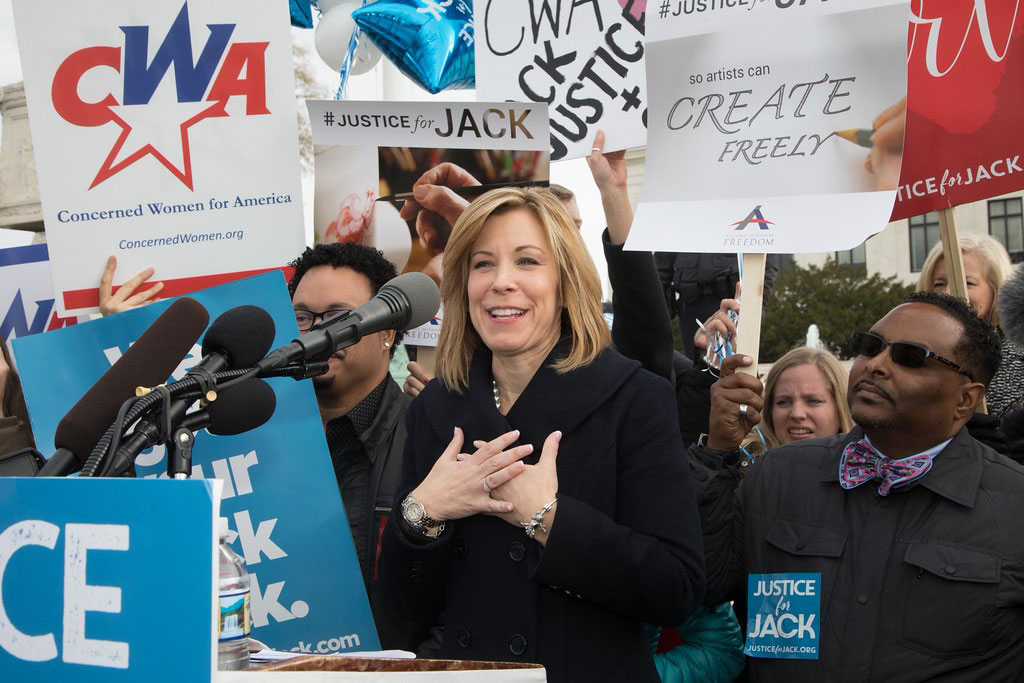
Kristen Waggoner of Alliance Defending Freedom argued Jack Phillips’ case before the Supreme Court. (Photo: Jeff Malet/The Heritage Foundation)
3. Disagreement Does Not Equal Discrimination
Kennedy also challenged Colorado and the ACLU on their argument that Phillips discriminates on the basis of identity, rather than his idea of what constitutes a marriage. In an exchange with the ACLU attorney, Kennedy called the repeated attempts to characterize Phillips as discriminating on the basis of identity “too facile.”
During the oral arguments, the court appeared to recognize what is patently obvious from the facts. Phillips welcomes all people into his store, encourages them to buy off-the-shelf items, and will make custom-designed cakes for them provided they don’t ask for items that violate his beliefs.
He has served gays for the 24 years his store has been in operation and welcomes their business to this day. He does not discriminate against anybody because of their identity.
So comparisons to shopkeepers in the Jim Crow South who sought to keep the races “separate but equal” are a smear that divert attention from the real issue: Phillips simply disagrees with the state on the issue of marriage.
Roberts appeared to recognize this when chiding the ACLU for lumping in supporters of traditional marriage with racists, noting that in Obergefell, the court had said support for traditional marriage is rooted in “decent and honorable” premises.
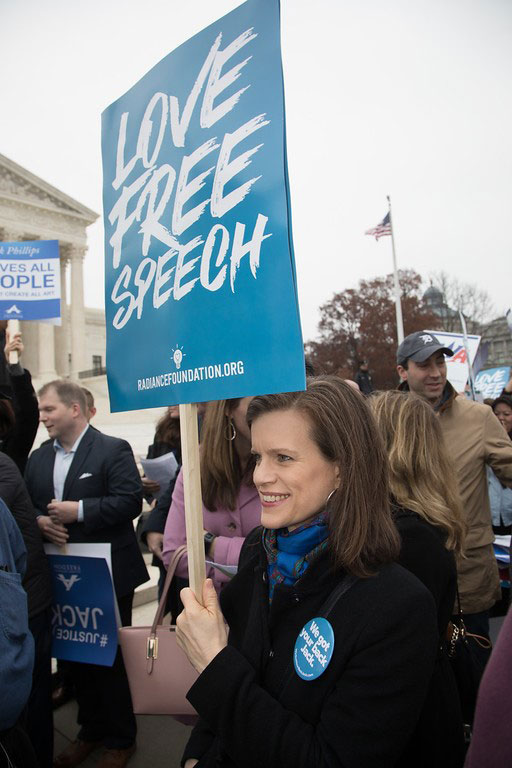
Jennifer Marshall of The Heritage Foundation holds a sign outside the Supreme Court. (Photo: Jeff Malet/The Heritage Foundation)
4. Orthodoxy Determined by the State
Finally, the oral arguments revealed the scope of how far the state of Colorado is willing to go to impose its views of marriage on citizens. In one line of questioning from Roberts, Colorado admitted that it would force Catholic Legal Services to provide a same-sex couple with legal services related to their wedding even if it violates Catholic teachings on marriage.
And in questioning from Alito, the ACLU answered that the state could force a Christian college whose creed opposes same-sex marriage to perform a same-sex wedding in its chapel.
Like many Americans, Phillips seeks to work in a manner consistent with his deeply held religious beliefs, including on marriage. In order to follow his conscience, he has turned down requests for cakes that contain messages expressing certain ideas: Halloween and divorce, anti-American themes, and even anti-gay messages.
What he has never done is turn away anyone because of who they are.
The Supreme Court should uphold the rights of all Americans to work according to their religious beliefs and to be free from government intrusion that would force them to speak messages in violation of their deeply held beliefs.
After its decision in Roe v. Wade, the court respected the freedoms of Americans on both sides of the abortion debate. It rejected the argument that opposition to abortion is rooted in animus toward women because it recognized that there are many other rational reasons why people oppose abortion.
This is no different. There are many Americans who support traditional marriage for reasons that have nothing to do with animus toward gays. All Americans will benefit when free speech and religious liberty are robustly protected.
The court’s decision in Masterpiece Cakeshop can help foster more civil dialogue on marriage so that we can all live according to our consciences and in peace with one another.
The Supreme Court ruled Monday that a Christian Colorado baker cannot be forced to make a cake for a same-sex marriage when the ceremony violates his religious principles.
Monday’s 7-2 decision reversed a Colorado court’s ruling against baker Jack Phillips, who in 2012 refused to bake a cake for gay couple Charlie Craig and David Mullins.
The decision focused on the initial ruling against Phillips from the Colorado Civil Rights Commission, and left untouched the broader issue of whether professionals who oppose same-sex marriage can be compelled to provide goods and services for those ceremonies, USA Today reported.
Advertisement - story continues below
“The outcome of cases like this in other circumstances must await further elaboration in the courts,” the majority opinion said, noting the broader battle in which this case was one part. “These disputes must be resolved with tolerance, without undue disrespect to sincere religious beliefs, and without subjecting gay persons to indignities when they seek goods and services in an open market.”
Justice Anthony Kennedy wrote the majority decision, while Justices Ruth Bader Ginsburg and Sonia Sotomayor dissented.
“The laws and the Constitution can, and in some instances must, protect gay persons and gay couples in the exercise of their civil rights, but religious and philosophical objections to gay marriage are protected views and in some instances protected forms of expression,” Kennedy wrote, according to The Hill.
“While it is unexceptional that Colorado law can protect gay persons in acquiring products and services on the same terms and conditions as are offered to other member of the public, the law must be applied in a manner that is neutral toward religion.”
Advertisement - story continues below
The case presented “difficult questions as to the proper reconciliation of at least two principles. The first is the authority of a State and its governmental entities to protect the rights and dignity of gay persons who are, or wish to be, married but who face discrimination when they seek goods or services,” Kennedy wrote.
“The second is the right of all persons to exercise fundamental freedoms under the First Amendment,” he wrote.
Is this Supreme Court ruling a victory for freedom of religion in America?
Kennedy said Colorado failed that test.
“Whatever the confluence of speech and free exercise principles might be in some cases, the Colorado Civil Rights Commission’s consideration of this case was inconsistent with the State’s obligation of religious neutrality. The reason and motive for the baker’s refusal were based on his sincere religious beliefs and convictions,” Kennedy wrote.
Kennedy noted that the case does represent a collision of rights, according to The Washington Post.
Advertisement - story continues below
“The Court’s precedents make clear that the baker, in his capacity as the owner of a business serving the public, might have his right to the free exercise of religion limited by generally applicable laws,” he wrote. “Still, the delicate question of when the free exercise of his religion must yield to an otherwise valid exercise of state power needed to be determined in an adjudication in which religious hostility on the part of the State itself would not be a factor in the balance the State sought to reach. That requirement, however, was not met here.”
Justices Stephen Breyer and Elena Kagan voted with the majority along with Justices Kennedy, Neil Gorsuch, Clarence Thomas and Samuel Alito, as well as Chief Justice John Roberts.
Phillips had lost every round of his lengthy legal fight until Monday. Phillips said the question was not about the customers but rather about violating his own principles.
“It’s not about turning away these customers, it’s about doing a cake for an event — a religious sacred event — that conflicts with my conscience,” he said, according to Fox News.
Advertisement - story continues below
The Trump administration supported Phillips’ legal claims.