Contact Form

Name

Email *

Message *

Showing posts with label General allen. Show all posts

Wednesday, June 21, 2017

It Is Obvious That General Allen Has NO Understanding Of Israel Or The Middle East

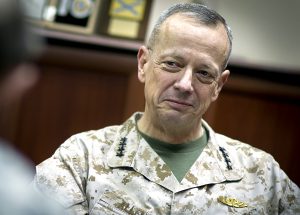
General John Allen’s Plan Is Dangerous


BESA Center Perspectives No. 504, June 21, 2017
EXECUTIVE SUMMARY: The Trump White House is currently reexamining the Allen Plan, an Obama-era proposal that calls for a Palestinian state in the 1967 borders with no IDF presence whatsoever. This plan is dangerous. If it is implemented, Israel will have to rely on foreign forces for its security, a situation that has not worked in the past. More than that, it is antithetical to the Israeli ethos of self-defense and self-preservation in the Jewish homeland.
Col. Kris Bauman’s appointment as Israel adviser to the US National Security Council is a noteworthy event. He assisted Gen. John Allen in formulating recommendations for security arrangements for Israel in the context of a permanent settlement, to which then-Secretary of State John Kerry aspired. This set of recommendations came to be known as the Allen Plan.
Gen. Allen’s vision was detailed in a comprehensive document prepared at a US research institute by two Israelis and two Americans: Gen. (res.) Gadi Shamni and Nimrod Novik, along with Ilan Goldenberg and Col. Kris Bauman.
The plan envisages a Palestinian state with full sovereignty inside the 1967 borders, its capital in east Jerusalem, with minor modifications for settlement blocs. The plan is based on complete acceptance of the Palestinian demand for full sovereignty. This means no IDF soldiers anywhere in their state, which would extend from the Jordan River to the 1967 line.
In lieu of Israel’s demands regarding defensible borders, which include an Israeli military presence in the Jordan Valley to ensure the Palestinian state’s demilitarization, the plan proposes a varied and complex security solution. One element would be a US military force that would operate in the Jordan Valley. As the document’s Executive Summary states,
The purpose of this study is to demonstrate that well-thought-through security measures in the context of the two-state solution can provide Israelis and Palestinians with a degree of security equal or greater to that provided today by Israel’s deployment into the West Bank…
The basic problem is the notion that Israel will rely for its security on foreign forces. Not only is it difficult to ensure that such forces would fulfill their duty successfully, but it is uncertain whether or not they would stay in place – particularly after they have suffered casualties like those they have suffered in Afghanistan and Iraq over the past decade.
Recall that during the waiting period before the Six-Day War, the security guarantee given by President Eisenhower to Ben-Gurion after the 1956 Sinai Campaign evaporated. When he demanded that Israel withdraw unconditionally from the Sinai Peninsula, Eisenhower promised that if the Straits of Tiran were ever again closed to Israeli shipping, the US would intervene. Yet when Israeli foreign minister Abba Eban came to Washington in May 1967, President Johnson candidly explained to him that Eisenhower’s promise – however estimable – was no longer a practical proposition. With his army bogged down in Vietnam, Johnson apparently could not have gained the nation’s or Congress’s support for an intervention in the Straits of Tiran even if he had wanted to.
The main concern is that the existence of the Greater Tel Aviv area – indeed, the daily routine of the State of Israel – will come to be dependent on the goodwill of foreign forces. That is the heart of the matter. Do we want Israel to be no more than a haven for persecuted Jews where they can subsist under foreign protection? Or do we want Israel to be a place of freedom, a homeland, in which we alone are responsible for our own security and sovereignty?
The authors of the Allen document emphasize that Israel’s security would continue to be based on the IDF’s power. But it is hard to imagine under what circumstances Israel would attain the international legitimacy to pursue an offensive deep within the Palestinian state, should the need arise. Regarding the conditions that could justify an IDF operation in Palestinian territory, the document says:
The Palestinians will never agree to an Israeli right of re-entry, but there could be a side agreement between Israel and the United States on the conditions under which the United States would support unilateral Israeli action. Ultimately, Israel is a sovereign state that enjoys the right of self-defense. Thus, it can unilaterally violate the sovereignty of another state, but with the attendant risks that would have to be weighed by Israeli leadership.
Should the IDF evacuate the territories completely, as envisaged by this plan, the Palestinians would certainly employ their carefully honed tactical and strategic talent for nonaccountability and ambiguity. They would take care to ensure that the Palestinian state cannot be defined as a hostile entity against which a “just war” can be declared. Whether deliberately or not, they would be able to let “rogue,” non-state forces do their work for them, and avoid taking responsibility. What then?
There is also good reason to doubt whether conditions for demilitarization can be maintained. In an era of global arms proliferation, and of forms of smuggling that elude surveillance (as in the flow of weapons to Hamas in Gaza and to Hezbollah in Lebanon), along with increasingly sophisticated local arms manufacture, there is no way to guarantee real demilitarization without a constant effort to keep the territory fully isolated and to operate within it.
We must also take into account the possibility that war could erupt in more than one arena at at a time. If war were to break out with the state of Palestine in the West Bank, it could happen simultaneously in Lebanon, Gaza, and so on. The IDF would be unable to concentrate its efforts in the West Bank arena – which, because of its geographic proximity to Israel’s population centers, could inflict a heavy blow. Under the new conditions of war, which are fundamentally different from those that prevailed in June 1967, reconquering the territory would be incomparably more difficult.
And what of the document’s validity under changing conditions? The security solution the document proposes must be weighed in terms of the time dimension, and in circumstantial contexts that are subject to change. If a solution is responsible and workable, what time span is envisaged? Who knows under what evolving circumstances the solution will be required to provide protection to a state of Israel that has been trimmed down to the coastal plain? Is there not also a need for responsible risk management regarding contingencies that are still beyond the horizon?
We must ask to what extent we ourselves, with the excessive emphasis we have placed on security concerns in recent decades as a key criterion by which to assess any prospective solution, have laid the groundwork for Gen. Allen’s plan. His security document is, after all, intended expressly to offer a technical solution to all the familiar security issues. It would leave the Israeli leadership without the faintest possibility of invoking a security pretext to ward off the “peace solution.”
In describing Kerry’s efforts, Thomas Friedman asserted (The New York Times, February 17, 2013) that in light of Gen. Allen’s solution for Israel’s security concerns, the Israeli government had reached a juncture where it would have to choose between peace and ideology.
Perhaps we have forgotten that protecting the national existence, in terms of how the IDF defines national security, does not pertain solely to ensuring the physical existence of the citizens of the country but also to safeguarding national interests. A national interest – such as the sovereignty of the people of Israel in their capital, Jerusalem – can go far beyond the technical contents of a plan for security arrangements, however worthy. Security is only a means, not an end in itself.
From a practical, professional standpoint, Gen. Allen’s plan leaves much to be desired. But on a deeper level, it completely ignores the possibility that the people of Israel, in renewing their life in their homeland, are motivated by something much greater than the need for a technical solution to security concerns.
This article was first published in Israel Hayom on June 8, 2017.
Gen. (res.) Gershon Hacohen is a senior research fellow at the Begin-Sadat Center for Strategic Studies. He served in the IDF for forty-two years. He commanded troops in battles with Egypt and Syria. He was formerly a corps commander and commander of the IDF Military Colleges.

Tuesday, November 11, 2014

Revealed--The UAE Is A Major Player In The Fight Against ISIS And Iran.

Author(s):  Rajiv Chandrasekaran
Source:  The Washington Post.     Article date: November 9th, 2014


0
AL-DHAFRA AIR BASE, United Arab Emirates — Night after night for the past six weeks, U.S. fighter jets have streaked into the muggy sky from this vast desert airfield, their afterburners spewing orange flames as they head north on bombing runs over Iraq and Syria.
The American presence at Al-Dhafra, which the Pentagon has not publicly acknowledged, is a vital part of the U.S.-led campaign against Islamic State militants: The base’s twin runways have launched more strike aircraft — including the Air Force’s most-sophisticated warplane, the F-22 Raptor — than any other military facility in the region.
On many nights, the American planes are accompanied by a wave of F-16 Fighting Falcons operated by the UAE’s air force. After the U.S. military, Emirati fighters have conducted more missions against the Islamic State since the air war began than any other member of the multinational coalition, often striking targets that are just as difficult and dangerous as those attacked by the Americans.
The cooperation at Dhafra — and in the skies over Syria — is the result of a fast friendship between the U.S. and UAE militaries. While American relationships with most other Arab nations over the past decade have grown strained, Washington’s alliance with the Emirates has strengthened in remarkable ways, driven by robust participation in the Afghan war as well as shared concern over the rise of militant Islam and Iran’s nuclear program.
“The UAE has gone all-in,” said Anthony Zinni, a former commander of all U.S. forces in the Middle East. As U.S. ties with long-standing allies Turkey and Saudi Arabia have frayed, and Egypt and Jordan contend with domestic challenges, the UAE now occupies a unique position in the region. “It’s the strongest relationship that the United States has in the Arab world today,” Zinni said.
It is also the least well known. Although there are about 3,500 U.S. military personnel stationed at Dhafra, and it is the only overseas base with F-22s, the facility has never been identified by the U.S. Air Force in publicly available materials because the UAE government had been concerned that touting the extent of its cooperation with the United States could antagonize some of its citizens.
But UAE officials relaxed those rules during a recent visit by a Washington Post reporter because of growing concern at senior levels of the Emirati government that keeping mum has led to an underappreciation of the country’s contributions beyond what is known in a handful of offices in the Pentagon and at the State Department, particularly as this nation seeks to convince the Obama administration to sell it more advanced fighter jets and adopt a tougher line on Iran.
“We’re different from our neighbors,” said Yousef al-Otaiba, the UAE ambassador in Washington, who noted that his country has participated in every major U.S.-led coalition since the 1991 Persian Gulf War — save for the 2003 invasion of Iraq — joining Americans in Somalia, Kosovo, Libya and Afghanistan in addition to the ongoing air campaign against the Islamic State. “We’re your best friends in this part of the world,” he said.
The alliance extends beyond air power. Jebel Ali, the deep-water harbor near the city of Dubai, is the U.S. Navy’s busiest overseas port of call. The UAE kept elite ground troops in Afghanistan for 11 years, conducting raids and training Afghan commandos in cooperation with U.S. Special Operations forces.
The close relationship has alarmed some in Washington and the Middle East, but the concern does not come from the usual quarters. The government of Israel and its supporters in the United States have been privately in favor of the UAE’s military buildup because of shared anxiety about Iran’s nuclear ambitions and the growing influence of Islamists in the Arab world. Instead, the critics include U.S. and Arab officials who prefer a more conciliatory approach toward Islamists and Iran. “They want to be your friends,” a senior official of an influential Arab nation said of the UAE, “because they want to pull you into their fights.”
It is a fight, Otaiba insisted, that needs to be fought. “We see extremism as an existential threat,” he said.
What makes the UAE unique, according to current and former U.S. military officials, is a combination of great oil wealth, which has allowed the country to buy advanced weapons and fund extensive training programs, and a willingness to put its personnel and equipment in harm’s way by participating in coalition operations. From 2012 until earlier this year, the UAE sent six F-16s to support the NATO-led security mission in Afghanistan. Their deployment to Kandahar occurred as European nations were reducing their troop levels in the country.
But it was far more than a show of force: UAE pilots were deemed by NATO officials to be so skilled that they were permitted to fly hundreds of close air-support missions to protect coalition ground forces. On multiple occasions, U.S. and UAE officials said, American troops under attack in southern Afghanistan relied on UAE pilots to bomb Taliban fighters.
The UAE and Australia were the only non-NATO nations allowed to fly such missions by the top U.S. commander at the time, Marine Gen. John R. Allen, now retired. He gave his assent, he recalled, because the UAE’s pilots were “very, very good.”
“They’re not just willing to fight — they’re great warriors,” said retired Marine Gen. James Mattis, who ran the U.S. Central Command from 2010 to 2013. Within the U.S. military, he said, “there’s a mutual respect, an admiration, for what they’ve done — and what they can do.”
He and other generals have taken to referring to the UAE as “Little Sparta.”
Small ally, outsize role
As a tiny nation on the Arabian Peninsula comprising seven sometimes-fractious emirates led by different royal families, the UAE could have opted to go the way of other small countries in its neighborhood by building a modest military focused on domestic security and instead turning to the regional powerhouse — Saudi Arabia — for protection from Iran and other external threats.
But Mohammed bin Zayed al-Nahyan, the crown prince of Abu Dhabi, the emirate that manages the country’s defense and foreign policy, did not want to be beholden to the Saudis. It was part pragmatism, part pride: As the UAE has become more prosperous — not just through oil, but also as a regional hub for commerce and finance — Zayed has sought to build an equally influential military that can project power well beyond its borders.
His approach has involved purchasing the most advanced weapons the Emirates can obtain. The UAE’s F-16s, which have been outfitted with custom-made radar units and fuel pods that permit long-range strike missions, are more sophisticated than the U.S. Air Force’s F-16 fleet. Last year, the United States agreed to sell the UAE a new class of bombs to enable more powerful airstrikes.
Unlike other small-but-wealthy countries that have gone on weapons-buying binges, the UAE has chosen to use what it has acquired. Its armed forces train as often and intensely as the U.S. military does, often jointly on the sands of the Mojave Desert and in the skies over Nevada. The UAE has set up an air warfare center at Dhafra that is operated in partnership with the U.S. Air Force, allowing American pilots to practice missions they cannot simulate in the United States.
What is particularly unusual about the UAE, in the view of current and former U.S. commanders, has been Zayed’s willingness to send Emirati troops to war. He dispatched members of the UAE’s special forces to Afghanistan in 2003 — the first Arab nation to do so — and they remained there until this year. The deployment, which involved more than 1,200 Emirati soldiers, helped to forge closer ties with U.S. Special Operations leaders — “We were under fire together,” said a senior UAE special forces officer — but it also matured the UAE troops.
“It really hardened our soldiers,” said the officer, who served as one of the task force leaders in Afghanistan. “It tested us like never before in a real environment.”
Although UAE officials speak in glowing terms about the work they performed in Afghanistan, which included the construction of mosques and health clinics, to U.S. military officials, the mission was about more than altruism. “For them, Afghanistan was all about another country: Iran,” said a senior U.S. officer involved in Middle East operations, who spoke on the condition of anonymity. “They want to be ready in case they really have to fight a war.”
Iran’s development of a nuclear program has also led the Emiratis to modify rules governing how the Americans can use Dhafra. When the U.S. military first stationed planes there in 1990, the UAE government told the Pentagon not to send fighter aircraft, only refueling tankers. A secret defense cooperation agreement between the nations limited the mission for U.S. troops on the base to defending the UAE against an attack.
Over the past six years, however, those restrictions have loosened. First came U-2 spy planes, which fly over the region at 70,000 feet. In 2012, the UAE permitted the U.S. Air Force to relocate a squadron of F-15C Strike Eagle fighters from Bagram Air Base in Afghanistan. Last year, a half-dozen F-22s arrived. So, too, did a handful of Global Hawk long-range drones. Although the U.S. presence here still is technically transient — many troops live in air-conditioned tents instead of permanent structures — the base is now home to some of the Air Force’s most sophisticated offensive hardware.
Prior to the start of the air war in Syria and Iraq, the F-22s flew over the Persian Gulf on training runs and presence patrols. The F-15s frequently zipped over to Afghanistan to provide air support for troops on the ground.
“It’s critical,” a senior U.S. defense official said of Dhafra. “It’s a key base for some of our most important assets in the region.”
‘We can do the job’
Three days before President Obama planed to commence airstrikes against the Islamic State, U.S. commanders invited UAE military leaders to al-Udeid Air Base in Qatar, where the U.S. Central Command’s regional operations center is housed. American officers presented their Emirati counterparts with a list of proposed targets for their pilots to bomb in Syria.
The Emiratis objected, according to two officers present at the session. Instead, they said, the UAE officers sought to do more.
“They said, ‘We want to do this, this and this,’ ” one of the officers recalled. “They wanted to hit more aggressive targets and provide more airplanes. They offered more than we were asking.”
The Americans agreed, and the UAE team returned to Dhafra to begin preparing for the operation. Their pilots had only 30 hours to plan the mission, check their planes and rest, but they managed to join the initial waves on the first night of bombing.
The UAE planes “ended up flying as close to” surface-to-air missiles manned by troops loyal to Syrian President Bashar al-Assad as American fighter jets, the officer said. Although most of the missile batteries had switched to an non-operational mode — a sign of Assad’s acquiescence to the attacks — one of them activated its radar as the UAE fighters flew overhead. Instead of targeting the battery to neutralize the threat, the pilots kept flying — an act of restraint and bravery that thrilled American commanders.
Since that night, UAE F-16s have flown in close formation with U.S. F-15s on other bombing runs, and they have conducted their own missions. On several occasions, Emirati pilots have been the only Arab coalition members given overall command of airstrike missions that involve American aircraft as well, the officers said.
To facilitate the collaboration, the U.S. Air Force has set up a joint planning center at Dhafra to share sensitive targeting and intelligence reports.
“We have been an integral part of the operation,” said Maj. Gen. Ibrahim al-Alawi, the commander of the UAE air force. “We have shown that we can do the job.”
The UAE’s enthusiasm to attack the Islamic State is rooted in the government’s zero-tolerance policy toward Islamic militancy. Although home-grown extremist groups do not appear to pose much of a threat to the leadership in Abu Dhabi – the country possess an extensive and aggressive internal-security service – Emirati officials are concerned that civil wars in Syria, Libya and other parts of the Arab world threatens their stability and prosperity.
“We can’t be a stable house if there is a brush fire around us,” said Anwar Gargash, the minister of state for foreign affairs.
In late August, several UAE Mirage 2000 jets flew all the way to Libya to assist the Egyptians in bombing a militia that is allied with the Muslim Brotherhood, a pan-Arab Islamist organization that the government here regards as a threat to regional stability. The airstrike took the U.S. government by surprise and prompted the White House to privately chide the UAE for interfering beyond its borders.
Although the U.S. government also opposes the Libyan militia targeted by the UAE, senior U.S. officials involved in Middle East policy contend that the best path to long-term stability across the region involves engagement with moderate members of the Muslim Brotherhood — a step that finds little support among officials in Abu Dhabi. “We don’t believe in being sympathetic to extremists,” a senior UAE official said. “And we don’t think our American friends should either.”
Differences also have emerged in the Syria air campaign. UAE officials privately grumble that the rules of engagement set by the White House, aimed at limiting civilian casualties, have prevented them from attacking Islamic State convoys.
“We’d like to do more to go after ISIS,” the official said, using a common acronym for the Islamic State.
Points of frustration
UAE officials are negotiating to buy 30 more F-16s — to augment the 80 they already have — equipped with even more advanced features. Last year, the UAE purchased a $7 billion set of high-altitude anti-missile batteries from the United States that would have a far longer range than its existing Patriot missile defense system. As with the F-16s, the government in Abu Dhabi has not sought U.S. subsidies or loans for the arms.
Current and former U.S. military commanders believe the UAE’s weapons-buying strategy is aimed at not just deterring Iran, but also wooing the United States. “Their thinking is that if they make that kind of commitment to their military, it will draw our commitment to them in a stronger way,” Zinni said.
So far, however, that approach has met with mixed results. UAE officials have been openly frustrated that the Obama administration failed to heed warnings they voiced several years ago about how former Iraqi prime minister Nouri al-Maliki was alienating religious minorities. The White House also ignored UAE calls to intervene in Syria well before the rise of the Islamic State.
Adding to those diplomatic tensions, the Obama administration’s ongoing efforts to broker a deal with Iran over its nuclear program have prompted deep worries here. Emirati officials do not believe Iran will comply with the terms of any agreement limiting their attempts to build a nuclear bomb — an argument they have made repeatedly to the Obama White House.
Equally important to the Emiratis is the question of American strategy in Syria. Some Emirati officials are pressing he United States to do what it takes — perhaps to include ground combat advisers — to defeat the Islamic State. And they hope that Washington will also turn its sights to toppling Assad.
To the UAE government, both goals are non-negotiable.
“They’re trying to keep us tight,” Mattis said. “Their biggest concern isn’t Iran. It’s American disengagement.”
An earlier version of this story misstated the type of fighter aircraft used in the Libya operation.
Rajiv Chandrasekaran is a senior correspondent and associate editor. He has served as national editor and as bureau chief in Baghdad, Cairo and Southeast Asia.