Contact Form

Name

Email *

Message *

Showing posts with label Gorsuch. Show all posts

Saturday, June 30, 2018

Gillibrand Shows She Is A Deceiving Lightweight!

WATCH: Democrat Senator Makes False Claim About Neil Gorsuch, Gets Embarrassed

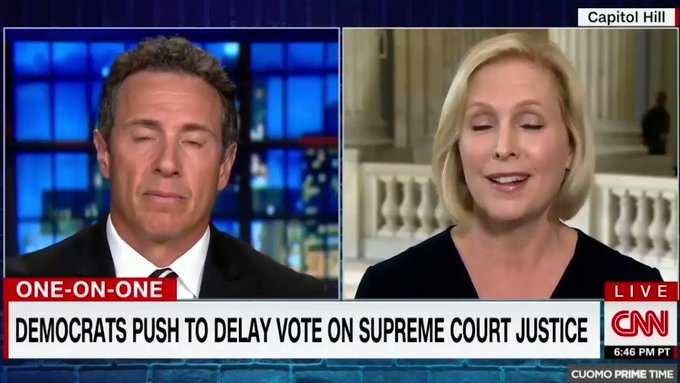
Screenshot: CNN Video
New York Democratic Senator Kirsten Gillibrand embarrassed herself on national television on Thursday night after she falsely stated that no Democratic senators voted to confirm President Donald Trump's first Supreme Court justice nominee, Neil Gorsuch.
Appearing in CNN's "Cuomo Prime Time" with host Chris Cuomo, Gillibrand falsely stated multiple times that Gorsuch did not receive any Democratic votes and was confirmed with only Republican votes.
After Gillibrand said, "He didn’t get a vote from one Democrat," Cuomo pushed backed, asking, "Are you right that he didn’t get one vote? Didn’t he get three?"
Gillibrand doubled down and continued to repeat her belief that Gorsuch did not receive any votes from Democrats, going as far as to say: "[The Democrats] stood strong and they passed it with Republican votes."
After Cuomo again hinted to her that she was wrong, it appeared as though someone caught Gillibrand's attention off camera and signaled to her that she was wrong.
"You might be right, Chris, but I believe this Democratic caucus will stand together," Gillibrand said after realizing that she was wrong.
The three Democratic senators who voted to confirm Gorsuch were Joe Donnelly (D-IN), Heidi Heitkamp (D-ND) and Joe Manchin (D-WV).
WATCH:

Tuesday, June 12, 2018

Its Time States Were Allowed To Eliminate Voters Who Are Not Eligible

Supreme Court Gives States the Green 

Light to Clean Up Voter Rolls

The Supreme Court reversed a 6th Circuit ruling on Monday that prevented Ohio from maintaining up-to-date voter rolls. (Photo: SeanPavonePhoto/Getty Images)
Can a state take reasonable steps to ensure the accuracy of its voter rolls by removing people who have left the jurisdiction?
On Monday, by a 5-4 vote, the Supreme Court answered “yes,” affirming an Ohio law allowing for the removal of voters who have left the state.
The opinion in Husted v. A. Philip Randolph Institute, written by Justice Samuel Alito, and joined by Chief Justice John Roberts and Justices Anthony Kennedy, Clarence Thomas, and Neil Gorsuch, is a major win for voters, who have an interest not only in ensuring that states offer sufficient opportunities to register, but also that they take steps to ensure the integrity of the electoral process.
A critical part of that process is guaranteeing that voter registration records are accurate and up-to-date, a task with which many states seem to be struggling. According to one 2012 Pew study, 24 million voter registrations nationwide—one out of every eight—are inaccurate or outdated, and some 2.8 million voters are registered in two or more states.
The liberal Left continue to push their radical agenda against American values. The good news is there is a solution. Find out more >>
A study of the voter registration records in just 21 states by the Government Accountability Institute showed that almost 8,500 individuals voted illegally in more than one state in the 2016 presidential election.
Clearly, voter rolls need some cleaning up. Lawmakers in Columbus set out to do just that, adopting a state law creating a mechanism to remove voters believed to have moved out of the state. That process takes six years and several steps to complete.
First, a voter must fail to partake in “voter activity,” including not just casting a ballot but also other actions like signing a petition, for two years. Ohio then mails a pre-stamped, pre-addressed notice to the voter asking that he confirm he is still a resident of Ohio. If the notice is not returned, and the voter fails to cast a ballot in any election over the next four years, state officials may then remove the voter on the grounds that he is no longer a resident.
Unfortunately, even reasonable election integrity policies like this invited the ire of liberal activists, and they took Ohio to court to stop its voter-roll maintenance activities.
In Husted, the challengers claimed that the Buckeye State’s process for maintaining the accuracy of its voter rolls violated two federal voter registration laws: the National Voter Registration Act and the Help America Vote Act.
The National Voter Registration Act sets out the requirements states must meet to remove a voter who is no longer eligible “by reason of … a change in the residence of the registrant” that precludes him from voting in the original jurisdiction. The Help America Vote Act, meanwhile, requires states to undertake a process to purge inaccurate entries.
Under the National Voter Registration Act, in order to remove a voter for nonresidency, a state must either receive written notice from the voter attesting to the move, or the voter must fail to return a card affirming his residency and then fail to vote in the next two federal general elections. The Ohio law was obviously fully in compliance with that provision of the law.
Nevertheless, the challengers in Husted claimed that Ohio ran afoul of the law’s “failure-to-vote clause,” which stipulates that no person can be removed from a voter roll “by reason of the person’s failure to vote” without following the law’s procedures. They asserted, incorrectly, that Ohio’s use of a voter’s failure to vote at two points in its clean-up process—first, to trigger the mailing, and then again during the subsequent four-year period—violated this provision. They also argued that Ohio was removing eligible voters as part of its clean-up process.
The district court rejected both claims, but on appeal, the 6th U.S. Circuit Court of Appeals reversed the lower court, holding that Ohio had indeed violated the National Voter Registration Act.
Now, the Supreme Court has resolved the matter, handing down a victory for Ohio, and for the integrity of American elections.
Alito’s opinion made swift work of the challengers’ claims.
First, Alito noted that Ohio’s process—mailing a notice seeking confirmation of residency, followed by a waiting period encompassing two federal general elections—followed the process prescribed in the National Voter Registration Act “to the letter.” In fact, he wrote, “[n]ot only are states allowed to remove registrants who satisfy these requirements, but federal law makes this removal mandatory.”
Next, the court rejected the claim that Ohio ran afoul of the failure-to-vote clause, concluding that the law “simply forbids the use of nonvoting as the sole criterion for removing a registrant”—something Ohio does not do. Rather, nonvoting is treated as evidence of nonresidency, but is not itself sufficient to result in removal from the voter roll.
This is exactly how Congress intended nonvoting to be used. Not only did it make it part of the requirements prescribed in the National Voter Registration Act for removal, it subsequently included provisions in the Help America Vote Act specifying that no one could be removed “solely” for this reason, and amended the original failure-to-vote clause to specify that it “may not be construed to prohibit a state from using” the procedures on which Ohio based its law.
Adopting the challengers’ argument would have led to a bizarre reading of the statute in which it would be illegal for any state to adhere to the National Voter Registration Act’s own requirements. “Congress could not have meant for the failure-to-vote clause to cannibalize” the other provisions of the law.
In fact, as Thomas pointed out in his concurrence, reading the statute the way the challengers claimed “would seriously interfere with the state’s constitutional authority to set and enforce voter qualifications.” Such an interpretation would render the National Voter Registration Act unconstitutional.
Justices Stephen Breyer, Ruth Bader Ginsburg, Sonia Sotomayor, and Elena Kagan dissented, arguing that Ohio violated the National Voter Registration Act’s requirement that a state make “a reasonable effort to remove the names of ineligible voters” because “failure to vote is not a reasonable method for identifying voters whose registrations are likely invalid.”
Alito rejected this claim, pointing out that it is not for the “federal courts to go beyond the restrictions” in the law and “strike down any state law that does not meet” the justices’ arbitrary conceptions of “reasonableness.” Policy judgments like these are properly addressed not in court, but in Congress. And Congress determined when it passed the National Voter Registration Act that a failure to vote after receiving a written notice from the state is, in fact, a “reasonable method” for identifying voters who have moved out of state.
Hopefully, this opinion will spark a new wave of state interest in adopting modern measures and using new technologies designed to remove ineligible voters from the rolls. So long as voter registrations remain an area rife with inaccuracy, states invite the potential for fraud and risk damaging faith in the electoral process itself.

Tuesday, December 19, 2017

Do You Agree With This List Of Trump's Accomplishments/Fails?

YEAR ONE: The Complete Good Trump/Bad Trump List

 President Donald Trump speaks before a swearing in ceremony for the new Secretary of Homeland Security Kirstjen Nielsen, in the Roosevelt Room of the White House in Washington, DC on Friday, Dec. 08, 2017.
Jabin Botsford/The Washington Post via Getty Images
As we reach the end of President Trump’s first year in office, it’s time to take stock: how well has he done? The emerging popular view among people on the right is that Trump has had a wildly successful first year, but that his successes have been ignored by a recalcitrant Leftist media seeking his destruction. There’s certainly some truth to that. But it’s also true that Trump has undercut himself repeatedly, and that his policy legacy may well be reversed by a Democratic swell at least partially of his own making.
So, here are the pros and cons of Trump’s first year – the first year Good Trump/Bad Trump.
Good Trump:
1. Justice Gorsuch. Despite recent reports that Trump nearly pulled Neil Gorsuch’s nomination thanks to Gorsuch’s comments on Trump’s behavior as president, he didn’t – so who cares what he said behind closed doors? Gorsuch is a major victory for the president, and was for the first ten months of his administration, the only major win the president could point to.
2. The Defeat Of ISIS. Trump hasn’t gotten the credit he deserves for this, but ISIS’ territorial holdings are now non-existent. As Ross Douthat, no Trump acolyte, wrote at The New York Times, “If you had told me in late 2016 that almost a year into the Trump era the caliphate would be all-but-beaten without something far worse happening in the Middle East, I would have been surprised and gratified.” ISIS has carried out terrorist attacks abroad, but their star is obviously on the wane, and Trump’s strengthening of the Obama strategy is largely to credit.
3. The Soaring Stock Market. The stock market has been breaking records all year. It’s difficult to credit Trump with that, unless you also want to credit President Obama for a stock market that increased 250% over his term, but there’s little doubt that a positive business climate has been unleashed under President Trump and a Republican Congress, and that shows in the market.
4. The Excellent Growth And Unemployment Statistics. Similarly, unemployment and growth statistics have been terrific since Trump’s presidency began – we’re at nearly full employment, and last quarter, the GDP grew at nearly 4 percent. That has a lot to do with Trump’s decisionmaking with regard to cutting regulations and pursuing policies that would put more money into business’ pockets to spend and invest.
5. Cutting Regulations. Trump brags that he’s cut 22 regulations for each new one created. That is indeed a massive achievement. The only problem here is that regulatory cuts can be undone if Trump were to lose in 2020 – so Trump is doing the right thing, but executive policy is also the easiest policy to reverse.
6. Curbing The Iran Deal. Trump hasn’t ended the Iran deal, but he has decertified it. This is a first step toward reinstalling sanctions, though why Trump hasn’t pursued new sanction remains a mystery. In the meantime, Trump has ardently pursued the creation of a new anti-Iranian alliance, led by Saudi Arabia, Egypt, Jordan and Israel. Obama’s Iran-led Middle East has, ironically, created serious compatibility between Israel and many of her former adversaries.
7. Announcing Jerusalem As Israel’s Capital. Trump sees that Jerusalem is Israel’s capital, both morally and historically. He fulfilled a campaign promise made by every president since Clinton. He also recognized, correctly, that most of the Arab world doesn’t care that much about Israel – they’re more concerned about the rise of Iran, and Israel is part of the alliance necessary to combat Iran’s rise. Trump’s administration has been stalwart on this issue despite media and international pressure, and Nikki Haley’s performance at the anti-Semitic UN has been heroic.
8. Opening Public Lands. Under President Trump, the government is moving to open up public lands, particularly in the West – which makes a good deal of sense considering that the federal government controls a vast majority of all land in states like Utah and Nevada. Trump has also finally opened the Arctic National Wildlife Refuge to drilling, which makes economic and practical sense – talk of environmental catastrophe in that area has been wildly overstated for nearly two decades.
9. Passing New North Korean Sanctions. Trump doesn’t have a lot of options on North Korea, but he has leveraged American power to achieve new, unprecedented sanctions at the United Nations.
10. Repeal Of The Individual Mandate. The new tax reform package contains the repeal of the individual mandate. That’s a big win for Trump politically, since he’ll be able to say he presided over the death of the most unpopular aspect of Obamacare, but it’s likely to bear mixed results in terms of policy: individual policies will become more expensive as young people aren’t forced to buy them to subsidize older people, and Republicans will have to fill the gap with government funding.
11. Tax Reform. The much-maligned tax bill will lower corporate taxes dramatically, which is necessary. It doesn’t do much on the individual side, but it wasn’t meant to – and while the media lie about the bill incessantly, Americans will feel it in their pocketbook, and businesses will feel it in their bottom line. This is Trump’s only major legislative accomplishment this year.
12. Record Number Of Appellate Court Appointments. Trump has nominated 12 appellate court judges, more than any other president historically. That’s a big win for the administration, which pledged to remake the judiciary along Constitutionalist lines.
13. Pullout From The Paris Accords. Trump pulled out of the Paris Accords, which doesn’t mean much practically, but obviously set a new course for the government internationally – we’ll no longer be signing onto pie-in-the-sky initiatives designed to eventually boil down to restrictions on American growth.
14. Travel Ban. The originally-botched travel ban didn’t help Trump in his opening days, but it eventually passed Constitutional muster, and will now be implemented in full. The ban is overbroad and underbroad, but it is better than nothing, and it’s useful for the president’s power to be restated by the judiciary in this area.
15. Unshackling The Military And Supporting Police. Trump has changed the rules of engagement for the military, changed their strategic timeline in Afghanistan, and made clear that he wants the military fully funded. That’s a major shift from Obama, and a positive one. Unlike President Obama, Trump doesn’t respond with antipathy to police departments the country over.
Bad Trump:
1. Charlottesville. Trump’s response to Charlottesville was inexcusable, both morally and politically. It helped cripple his administration practically by allowing Democrats the opportunity to shift away from him at the first available opportunity. Plus, dude, come on.
2. Trans-Pacific Partnership Pullout. While some on the right love the TPP withdrawal, Trump should have simply renegotiated it. Pulling out of TPP opened the door to China, which has rushed through – TPP was originally conceived as an anti-Chinese trade alliance, and sinking it has made nations in the South China Sea more subject to Chinese power.
3. Obamacare Repeal Failure. While the individual mandate will be gone, federal regulations on insurance companies will not be. That means a spiral in the individual insurance market barring federal subsidies. Obamacare needed to be destroyed wholesale; instead, it still stands, and in some ways, has actually been strengthened by government subsidies rather than mandates.
4. Picking Mike Flynn And Steve Bannon. Trump never should have chosen Mike Flynn for his national security advisor, and that decision has echoed down throughout the administration, thanks to Flynn lying to the FBI. He never should have chosen Steve Bannon as part of his team – Bannon is toxic, useless, and polarizing, a self-aggrandizing leech on Trump.
5. Firing James Comey. Trump shouldn’t have fired Comey – or if he should have, he should have done it immediately. Firing Comey in the dumbest possible way, then announcing to the Russians that it had to do with Russia, then announcing it had to do with Russia on national television – all of it turned out to be rather stupid.
6. Overall Russian Investigation Botchery. Overall, Trump should shut up about the Russia investigation – and he seems to have figured that out now, too late. If he’d just let the thing progress, let the media investigate the investigation, and let his allies point out discrepancies, he’d be in good shape. As it is, Americans have largely polarized along political lines about the usefulness of the investigation.
7. No Border Wall. Ann Coulter’s fighting mad over this one, and she has a right to be. This is nowhere in sight.
8. Push For New DACA. Trump struck down Obama’s unconstitutional executive order on DACA, but pledged to replace it through Congress, or reinstate it later. This isn’t exactly the tough-on-immigration policy Republicans voted for. With that said, Trump has seen a marked decline in illegal immigration thanks to increased deportations.
9. Constant Barrage Of Nonsense. From shouting “fake news” at real news to jabbering about crowd size to asking why there was a civil war to telling myths about General Pershing to a weeks-long crusade against the NFL to a fight with Lavar Ball, President Trump can’t seem to stop himself from following every rabbit down every hole. It eats up energy, it allows the press to misdirect from his accomplishments, and it tires the American people. If somebody unplugged the president’s phone, his approval ratings would jump 10 percent within two weeks.
10. Kissing Up To Putin. Trump is still making nice with Putin on a personal level, although his new national security strategy admits that Putin is a strategic enemy. Trump’s decision to downplay Russian election meddling may be self-serving, but it also may be a sop to Putin, who is in fact a rogue dictator.
11. Treating Duterte With Kid Gloves. Similarly, Trump has been rather overkind to Rodrigo Duterte, the mad leader of the Philippines, who has engaged in massive human rights abuses in his war on drugs.
12. Roy Moore Endorsement. Trump should have stayed out of this race. Instead, he jumped in just long enough to be linked with a credibly accused child molester with other serious political baggage. And Trump won’t just be linked with Moore’s loss – he’ll be linked with losses in Virginia and across the country.
13. Attacking His Own Staffers. Trump has attacked a huge number of his own employees: Attorney General Jeff Sessions, Deputy Attorney General Rod Rosenstein, former Health and Human Services Secretary Tom Price, and Secretary of State Rex Tillerson, among others. This isn’t smart. It gives the impression of an administration in chaos, even as things get done.
14. Not Staffing The Federal Government. Trump has done well nominating judges, but he’s done terribly at filling career posts at various agencies. That’s left a lot of Obama appointees in place, which puts Trump in bad position.
As you’ll notice, Trump’s accomplishments aren’t minimal – and a huge number of his setbacks are self-made and rhetorical. All of which demonstrates why Trump is beloved by his base but carries an approval rating of 35 percent, the lowest approval rating of any president at this point in modern American history (every other president since Kennedy was above 50 percent, except for Reagan in 1981, who clocked in at 49 percent). If Trump could just curb his own appetite for the spotlight and stop feeling the need to sound off like a commenter on Breitbart on every issue, he’d be in much more solid position to keep winning on the issues Americans care about. If he can't, he'll continue to polarize Americans, drive young voters away from him, and help lead to losses in the Congress that will prevent him from winning -- and may prevent his re-election, too. Rhetoric matters when you're the president, contrary to popular conservative opinion, and Trump should remember that. In fact, he should know that better than anyone else: he's a salesman first, and he's not selling himself or his accomplishments. That's a mistake he should work to rectify, if it's not too late.

Monday, November 6, 2017

A Supreme Court Jurist Should Be Very Concerned What The Constitution Says!


NPR Legal Reporter 

Criticizes Gorsuch for 

Citing the Constitution


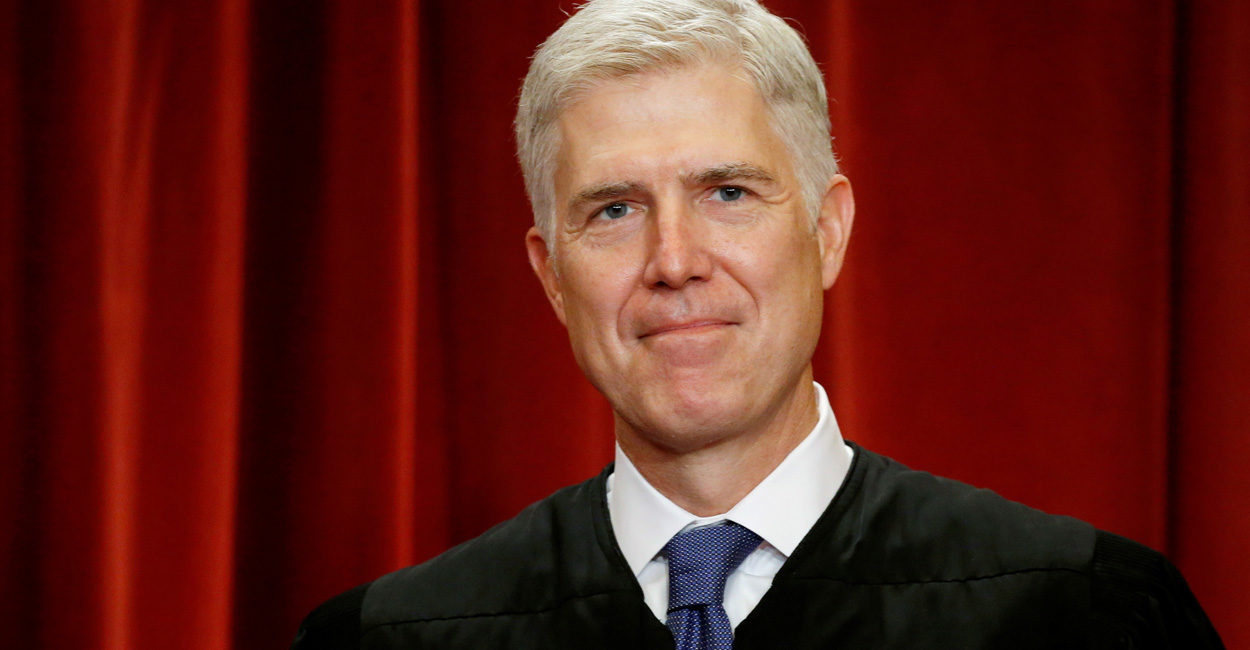
As a member of the Supreme Court, Justice Gorsuch is fulfilling his commitment to faithfully interpret the Constitution according to its original public meaning. (Photo: Jonathan Ernst/Reuters/Newscom)


The newest Supreme Court justice, Neil Gorsuch, has made headlines since joining the court last spring—and not just for his written opinions. Pedantic. Boorish and juvenile. Annoying. In his colleagues’ faces. These are some of the harsh things liberal Court watchers have had to say about Gorsuch.
It’s hard to square these comments with the outpouring of support Gorsuch received from former clerks, classmates, and others after he was nominated to the Supreme Court earlier this year. Just watch a few minutes of this speech by Mark Hansen, Gorsuch’s former law partner, who was close to tears at the end, talking about what an honorable, decent (and whip smart) friend and colleague he has been:
But the left would have you believe otherwise.
Americans need an alternative to the mainstream media. But this can't be done alone. Find out more >>
In a recent episode of the Supreme Court podcast “First Mondays,” NPR’s legal affairs correspondent Nina Totenberg took aim at Gorsuch. First in her crosshairs was his habit of frequently citing the Constitution. She objected to Gorsuch bringing things back to first principles at oral argument. He often prefaces his questions by saying, “Let’s look at what the Constitution says about this … It’s always a good place to start.” This should come as no surprise.
When rumors were swirling about potential Supreme Court nominees in late 2016, a former Gorsuch clerk wrote on Yale’s Notice & Comment blog: “Whenever a constitutional issue came up in our cases, he sent one of his clerks on a deep dive through the historical sources. ‘We need to get this right,’ was the memo—and right meant ‘as originally understood.’”
As a member of the Supreme Court, Gorsuch is putting these principles into practice and fulfilling his commitment to faithfully interpret the Constitution according to its original public meaning.
And that’s not all Totenberg had to say about Gorsuch. She claimed there is a rift on the court between Gorsuch and Justice Elena Kagan. Here’s what she said:
My surmise, from what I’m hearing, is that Justice Kagan really has taken [Gorsuch] on in conference. And that it’s a pretty tough battle and it’s going to get tougher. And she is about as tough as they come, and I am not sure he’s as tough—or dare I say it, maybe not as smart. I always thought he was very smart, but he has a tin ear somehow, and he doesn’t seem to bring anything new to the conversation.
First, I’m highly skeptical of someone purporting to know what happened when the court met in conference. The justices are notoriously secretive about these meetings—not even law clerks are allowed in the room. During conference, the justices discuss cases following oral argument and cast their initial votes in conference, though they sometimes change after draft opinions have been circulated. This is precisely the time for the justices to debate the issues in a case.
Second, Totenberg’s assertion that Gorsuch is “maybe not as smart” as she thought is off base. Anyone who has read his speeches or his written opinions—either from his time on the appeals court or his first two months on the Supreme Court—can see why that is patently false. The Columbia-Harvard-Oxford-educated judge weaves literary references into his opinions and writes in a clear, concise manner that’s easy for lawyers and lay people alike to understand.
Totenberg also said she hears Gorsuch “doesn’t believe in precedent”—which is likely motivated by a concern that he would overturn cases liberals like if given the chance. This same issue came up during his confirmation hearing, when Sen. Dianne Feinstein, D-Calif., grilled Gorsuch about his views on the “superprecedent” status of Roe v. Wade. During the hearing, Gorsuch explained several factors that judges weigh when deciding whether an old decision is still good law.
He even wrote a book on this topic, along with 11 other judges and leading lexicographer Bryan Garner. And he’s given every indication that he’ll follow the Supreme Court’s guideposts for when to overrule or uphold a past decision. It’s also worth mentioning that, even if he disagreed with a past decision, Gorsuch can’t singlehandedly overturn precedents like Roe v. Wade. If an appropriate case came before the court, a majority of the justices would need to agree.
Gorsuch rubs Totenberg the wrong way—and she isn’t the only one.
At the start of the court’s current term, Jeffrey Toobin wrote an article for The New Yorker taking issue with Gorsuch “dominat[ing] oral arguments, when new Justices are expected to hang back” and writing dissents in his first couple months on the job.
Toobin highlighted a case involving statutory interpretation where Gorsuch dissented from the majority’s reading of the statute. Gorsuch wrote, “If a statute needs repair, there’s a constitutionally prescribed way to do it. It’s called legislation.” What Toobin objected to are basic functions of the job—if justices aren’t to ask questions at argument or write separately when they disagree with the majority, what are they supposed to do?
In an article in The New York Times over the summer, Linda Greenhouse—who referred to Gorsuch as “the justice who holds the seat that should have been Merrick Garland’s”—said the new justice violated the court’s unwritten rules and norms and “morph[ed]… quickly into Donald Trump’s life-tenured judicial avatar.” This gets to the heart of the problem.
According to the left, Gorsuch shouldn’t be on the Supreme Court, and Trump shouldn’t be in the White House. In other words, these criticisms of Gorsuch can be explained as simply another iteration of the resistance movement.
But Gorsuch isn’t going anywhere. The apoplectic left better get used to him sparring with the other justices, asking questions, writing fiery dissents, and generally returning to first principles
.
As a member of the Supreme Court, Justice Gorsuch is fulfilling his commitment to faithfully interpret the Constitution according to its original public meaning. (Photo: Jonathan Ernst/Reuters/Newscom)


The newest Supreme Court justice, Neil Gorsuch, has made headlines since joining the court last spring—and not just for his written opinions. Pedantic. Boorish and juvenile. Annoying. In his colleagues’ faces. These are some of the harsh things liberal Court watchers have had to say about Gorsuch.
It’s hard to square these comments with the outpouring of support Gorsuch received from former clerks, classmates, and others after he was nominated to the Supreme Court earlier this year. Just watch a few minutes of this speech by Mark Hansen, Gorsuch’s former law partner, who was close to tears at the end, talking about what an honorable, decent (and whip smart) friend and colleague he has been:
But the left would have you believe otherwise.
Americans need an alternative to the mainstream media. But this can't be done alone. Find out more >>
In a recent episode of the Supreme Court podcast “First Mondays,” NPR’s legal affairs correspondent Nina Totenberg took aim at Gorsuch. First in her crosshairs was his habit of frequently citing the Constitution. She objected to Gorsuch bringing things back to first principles at oral argument. He often prefaces his questions by saying, “Let’s look at what the Constitution says about this … It’s always a good place to start.” This should come as no surprise.
When rumors were swirling about potential Supreme Court nominees in late 2016, a former Gorsuch clerk wrote on Yale’s Notice & Comment blog: “Whenever a constitutional issue came up in our cases, he sent one of his clerks on a deep dive through the historical sources. ‘We need to get this right,’ was the memo—and right meant ‘as originally understood.’”
As a member of the Supreme Court, Gorsuch is putting these principles into practice and fulfilling his commitment to faithfully interpret the Constitution according to its original public meaning.
And that’s not all Totenberg had to say about Gorsuch. She claimed there is a rift on the court between Gorsuch and Justice Elena Kagan. Here’s what she said:
My surmise, from what I’m hearing, is that Justice Kagan really has taken [Gorsuch] on in conference. And that it’s a pretty tough battle and it’s going to get tougher. And she is about as tough as they come, and I am not sure he’s as tough—or dare I say it, maybe not as smart. I always thought he was very smart, but he has a tin ear somehow, and he doesn’t seem to bring anything new to the conversation.
First, I’m highly skeptical of someone purporting to know what happened when the court met in conference. The justices are notoriously secretive about these meetings—not even law clerks are allowed in the room. During conference, the justices discuss cases following oral argument and cast their initial votes in conference, though they sometimes change after draft opinions have been circulated. This is precisely the time for the justices to debate the issues in a case.
Second, Totenberg’s assertion that Gorsuch is “maybe not as smart” as she thought is off base. Anyone who has read his speeches or his written opinions—either from his time on the appeals court or his first two months on the Supreme Court—can see why that is patently false. The Columbia-Harvard-Oxford-educated judge weaves literary references into his opinions and writes in a clear, concise manner that’s easy for lawyers and lay people alike to understand.

Totenberg also said she hears Gorsuch “doesn’t believe in precedent”—which is likely motivated by a concern that he would overturn cases liberals like if given the chance. This same issue came up during his confirmation hearing, when Sen. Dianne Feinstein, D-Calif., grilled Gorsuch about his views on the “superprecedent” status of Roe v. Wade. During the hearing, Gorsuch explained several factors that judges weigh when deciding whether an old decision is still good law.
He even wrote a book on this topic, along with 11 other judges and leading lexicographer Bryan Garner. And he’s given every indication that he’ll follow the Supreme Court’s guideposts for when to overrule or uphold a past decision. It’s also worth mentioning that, even if he disagreed with a past decision, Gorsuch can’t singlehandedly overturn precedents like Roe v. Wade. If an appropriate case came before the court, a majority of the justices would need to agree.
Gorsuch rubs Totenberg the wrong way—and she isn’t the only one.
At the start of the court’s current term, Jeffrey Toobin wrote an article for The New Yorker taking issue with Gorsuch “dominat[ing] oral arguments, when new Justices are expected to hang back” and writing dissents in his first couple months on the job.
Toobin highlighted a case involving statutory interpretation where Gorsuch dissented from the majority’s reading of the statute. Gorsuch wrote, “If a statute needs repair, there’s a constitutionally prescribed way to do it. It’s called legislation.” What Toobin objected to are basic functions of the job—if justices aren’t to ask questions at argument or write separately when they disagree with the majority, what are they supposed to do?
In an article in The New York Times over the summer, Linda Greenhouse—who referred to Gorsuch as “the justice who holds the seat that should have been Merrick Garland’s”—said the new justice violated the court’s unwritten rules and norms and “morph[ed]… quickly into Donald Trump’s life-tenured judicial avatar.” This gets to the heart of the problem.
According to the left, Gorsuch shouldn’t be on the Supreme Court, and Trump shouldn’t be in the White House. In other words, these criticisms of Gorsuch can be explained as simply another iteration of the resistance movement.
But Gorsuch isn’t going anywhere. The apoplectic left better get used to him sparring with the other justices, asking questions, writing fiery dissents, and generally returning to first principles.