Russia's Military Must Leave Venezuela Immediately
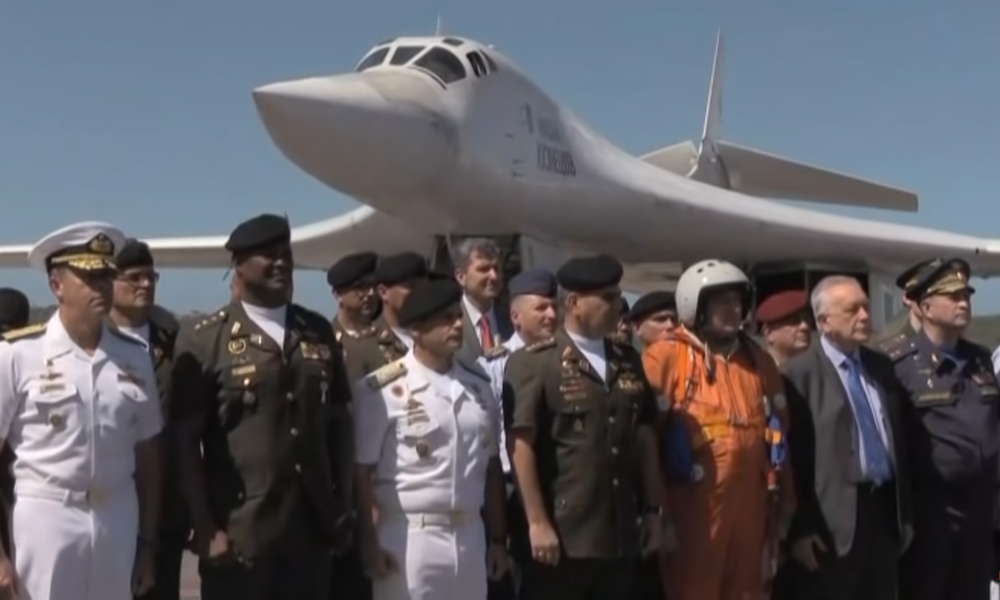
After the landing of two Russian aircraft in Caracas on March 23 -- one an Ilyushin Il-62 passenger plane transporting 100 ground forces and the other an Antonov An-124 military cargo plane carrying 35 tons of materiel – U.S. President Donald J. Trump said that "Russia has to get out" of Venezuela. In January, two months before this arrival of Russian military personnel and equipment in Venezuela, two Russian Air Force Tu-160 strategic bombers flying over the Arctic region near the North American coastline were detected and escorted out of the area by Canadian and U.S. Air Force jets. Although it was not clear where these Russian bombers were headed, a similar incident had occurred a few weeks before, when two of the same type of Russian Tu-160 strategic bombers landed outside Caracas -- sorties indicating that these, too, were headed to Venezuela. According to the Moscow Times, the Russian newspaper Nezavisimaya Gazetareported earlier in December that Russia was considering deploying strategic bombers full-time in Venezuela. The Russian media outlet also reported that an agreement had been reached between Moscow and Caracas to allow the deployment of Russian aircraft at a military base on Venezuela's Caribbean island of La Orchila, where Russian advisers were dispatched in December. The above moves are all part of Russia's open support for the beleaguered government of Venezuelan President Nicolás Maduro, which the U.S. and dozens of other nations have declared illegitimate. These countries support the popular young chairman of Venezuela's National Assembly, opposition leader Juan Guaidó, who has claimed an interim presidency. Most 21st century Russian invasions have been launched in order to bring about or prevent regime change. Putin invaded Georgia in 2008 to undermine President Mikheil Saakashvili, who had pushed aggressively for Georgia's entry into NATO and the EU. Putin's 2014 invasions in Crimea and eastern Ukraine were a response to what viewed as an illegal and unconstitutional coup in Kiev, which removed Ukraine from the Kremlin's orbit. While intervening in the Syrian civil war, which began in 2011, ostensibly to save Syrian President Bashar Assad's rule, Putin also aimed at projecting Russian power into the eastern Mediterranean. By late 2018, Putin had achieved both goals. Meanwhile, Trump -- heir to a covert war started by his predecessor, President Barack Obama -- decided to withdraw U.S. forces from Syria. Putin's response was to defrost the conflict with Ukraine in the Azov Sea. Instead of attacking the port city of Mariupol, however -- as some had expected -- he turned his attention to the more timely crisis in Venezuela. As it did for Syria's Assad, Russia has been providing the Maduro regime with economic and military aid. While Syria is an important energy-transfer state, Venezuela is an energy jewel: in fact, it harbors one of the world's largest oil reserves. Maduro's Venezuela is also part of what U.S. National Security Adviser John R. Bolton has termed the "troika of tyranny," the others being Cuba and Nicaragua. The recent landing of the two Russian planes in Venezuela came a mere a few days after the Trump administration's special envoy to Venezuela, Elliott Abrams, met with Russian Deputy Foreign Minister Sergei Ryakbov in Rome. At that meeting, the two negotiators agreed to disagree over who was the real leader of Venezuela, Maduro or Guaidó. Ryakbov failed to mention, however, that Russia was about to dispatch military aircraft and manpower to Caracas. Although this and other recent Russian moves in Venezuela are relatively minor at the moment, Moscow's intervention, if kept unchecked, obviously will grow as it did in Syria. The same also applies to moves by Beijing. As Gordon G. Chang recently wrote: "[China and Russia] back Maduro to the hilt because they have much to lose if his leftist government falls. Both maintain crucial military facilities in the country... In recent months, China, the regime's largest creditor, has been digging itself in deeper. In September, Beijing extended Venezuela another $5 billion in credit. Russia has also loaned the country billions."Meanwhile, two Leninist-turned-narcotics traffickers – the Revolutionary Armed Forces of Colombia (FARC), and the National Liberation Army (ELN) -- have been coordinating their activities with the Maduro regime, which is also backed by Iran. It is therefore not sufficient for Trump to tell Russia to leave Venezuela. It is imperative for the U.S. to liberate the people of Venezuela -- in the throes of a major humanitarian catastrophe -- from Maduro's stranglehold. It is urgent for Washington to act before Russia and Venezuela reach their imminent formal military agreement. President Trump should declare that no additional Russian and Chinese military planes and ships will be allowed to enter Venezuela, and, if legally possible, back up this announcement with an air and sea blockade. At the same time, NATO membership should be offered to Brazil, a major ally, and economic aid should be provided to Colombia. Only a speedy, tough response can salvage what is left of the Monroe Doctrine, the basic premise of which is to keep extra-hemispheric hostile forces out of the U.S.'s strategic backyard. A few weeks ago, when Maduro denied food and medical assistance to his starving people, the U.S. had a compelling enough reason, political considerations permitting, to invade Venezuela, even before the Russians got militarily involved. Delay, as Moscow's move constitutes a dangerous encroachment on U.S. national security, has made things both more complicated and more necessary. While the Trump administration contemplates how to proceed further to prevent Venezuela from falling to Russia, it might recall the words of the late American diplomat George Kennan, best known for advocating the policy of "containment" to oppose Soviet expansionism after World War II. Kennan, in a 1950 memorandum, summed up his view of how the U.S. should approach and keep Latin America from falling to the Soviets. He wrote to the countries south of the border an "imaginary statement" that read, in part: "We hold out to you what perhaps no great power—no power of our relative importance in world affairs — has ever held out to neighboring smaller powers: the most scrupulous respect for your sovereignty and independence, the willing renunciation of the use of force in our relations with you, the readiness to join with you at any time in a large variety of forms of collaboration which can be of benefit to us both. But you will appreciate that the payoff for this unprecedentedly favorable and tolerant attitude is that you do not make your countries the sources or the seats of dangerous intrigue against us..."Dr. Jiri Valenta is a member of the U.S. Council on Foreign Relations in New York, and formerly served at the Brookings Institution and the Wilson Center for International Scholars in Washington, D.C. A former tenured associate professor at the U.S. Naval Postgraduate School, he is presently a senior research associate at the Begin-Sadat Center for Strategic Studies at Bar-Ilan University in Israel. The author of Soviet Intervention in Czechoslovakia, 1968, and other books, his publications include the BESA monograph, "Washington and Moscow: Conflict or Cooperation?"
© 2019 Gatestone Institute. All rights reserved. The articles printed here do not necessarily reflect the views of the Editors or of Gatestone Institute. No part of the Gatestone website or any of its contents may be reproduced, copied or modified, without the prior written consent of Gatestone Institute.
|
Our goal is to have intelligent discussion of the topics of the day. We realize everyone has their opinion and they should be allowed to express it in a discussion forum without calling each other names. We learn from discussion and not from name calling or argument.We use cookies to personalise content and ads, to provide social media features and to analyse our traffic. We also share information about your use of our site with our social media, advertising and analytics partners. See details
Contact Form
Showing posts with label Monroe Doctrine. Show all posts
Thursday, April 4, 2019
If The Monroe Doctrine Is Being Violated, Shouldn't We React?
Tuesday, May 24, 2011
The New Venezuela Missle Crisis?
While the world has been focused on the Middle East and the Arab Winter (Spring means new growth and that is not what is happening in the area) Iran has quietly been working out a relationship with Venezuela to place medium range missiles there. Now where might those missiles be aimed? Cuba? Mexico? The US?
Apparently this news was broken last year and for some reason, I had not heard it. How about you?
Die Welt broke the story and for some reason our media has not seen any reason to let us know. Could it be that they do not want to further hurt their President? Regardless of the motivation, we as observant, informed citizens must take notice and let others of our ilk know what really is occurring.
Does anyone have any other information on this obvious violation of our Monroe Doctrine? I would like to know what you have heard and I will post it either as comments or as a posting itself.
My information comes from a blog called Richocet and the article is written by Judith Levy. I did check out the Die Welt article for confirmation. Here is the article.
Iran Building Missile Base in Venezuela
Judith Levy · May. 17 at 12:56am
There's a situation developing south of the border that has the potential to become President Obama's very own missile crisis.
Die Welt reports that in fulfillment of a commitment made by Venezuelan President Hugo Chavez and Iranian President Mahmoud Ahmadinejad in Tehran in October 2010, Iran has now entered the concrete planning phase for constructing launching pads for Iranian intermediate-range missiles in Venezuela. The missiles Iran intends to deploy at the site are believed to be Shahab 3s (1300-1500 km range), Scud-Bs (285-330 km) and Scud-Cs (300, 500 and 700 km).
Note that Venezuela is about 2000 km from Florida. And according to the International Institute for Strategic Studies, Iran is making "robust strides" in its attempts to manufacture longer-range ballistic missiles "with the apparent aim of being able to deliver nuclear warheads."
Citing "Western security insiders," Die Welt claims that Iran is building the launching pads on the Paraguaná Peninsula, which is on the coast of Venezuela about 75 miles from Colombia. This would appear to be the first stage of a larger project to establish a military base that will eventually be manned by Iranian missile officers and soldiers of the Iranian Revolutionary Guards, as well as Venezuelan missile officers who are to receive intensive training from the Iranians.
When the agreement between Iran and Venezuela was signed last fall, the Hudson Institute noted the significance of the timing: it coincided with NATO's Lisbon summit (19-20 November 2010), which set up a missile defense capability to protect NATO's European territories against ballistic missile attacks from the East (i.e., Iran). "Iran's counter-move consists in establishing a strategic base in the South American continent -- in the United States's soft underbelly," the Institute wrote.
The plan is now in motion. Engineers from Khatam al-Anbia, a construction company owned by the Revolutionary Guards, visited Paraguaná in February. According to Die Welt, their delegation was approved by Amir al-Hadschisadeh, the head of the Guard’s Air Force. The project is believed to entail command and control stations, bunkers, barracks and watch towers, and twenty-meter deep rocket silos. It's being financed by Iranian petroleum revenues, and Iran is said to have already paid in cash for the preliminary phase of construction.
The missile base, when armed, will constitute a multi-level threat. Chavez agreed at the 2010 meeting in Teheran to fire on Iran's Western enemies if Iran is itself attacked, and Iran agreed to allow Venezuela to use its missiles for "national needs" -- a phrase that should cause some sleep to be lost in Bogotá and elsewhere in the region.
The base will also, as the Hudson Institute notes, represent a means by which Iran and its suppliers can sidestep UN sanctions. After the latest round of sanctions, "Russia decided not to sell five battalions of S-300PMU-1 air defence systems to Iran," the Institute wrote in December 2010. "These weapons, along with a number of other weapons, were part of a deal, signed in 2007, worth $800 million. Now that these weapons cannot be delivered to Iran, Russia is looking for new customers; according to the Russian press agency Novosti, it found one: Venezuela."
Apparently this news was broken last year and for some reason, I had not heard it. How about you?
Die Welt broke the story and for some reason our media has not seen any reason to let us know. Could it be that they do not want to further hurt their President? Regardless of the motivation, we as observant, informed citizens must take notice and let others of our ilk know what really is occurring.
Does anyone have any other information on this obvious violation of our Monroe Doctrine? I would like to know what you have heard and I will post it either as comments or as a posting itself.
My information comes from a blog called Richocet and the article is written by Judith Levy. I did check out the Die Welt article for confirmation. Here is the article.
Iran Building Missile Base in Venezuela
Judith Levy · May. 17 at 12:56am
There's a situation developing south of the border that has the potential to become President Obama's very own missile crisis.
Die Welt reports that in fulfillment of a commitment made by Venezuelan President Hugo Chavez and Iranian President Mahmoud Ahmadinejad in Tehran in October 2010, Iran has now entered the concrete planning phase for constructing launching pads for Iranian intermediate-range missiles in Venezuela. The missiles Iran intends to deploy at the site are believed to be Shahab 3s (1300-1500 km range), Scud-Bs (285-330 km) and Scud-Cs (300, 500 and 700 km).
Note that Venezuela is about 2000 km from Florida. And according to the International Institute for Strategic Studies, Iran is making "robust strides" in its attempts to manufacture longer-range ballistic missiles "with the apparent aim of being able to deliver nuclear warheads."
Citing "Western security insiders," Die Welt claims that Iran is building the launching pads on the Paraguaná Peninsula, which is on the coast of Venezuela about 75 miles from Colombia. This would appear to be the first stage of a larger project to establish a military base that will eventually be manned by Iranian missile officers and soldiers of the Iranian Revolutionary Guards, as well as Venezuelan missile officers who are to receive intensive training from the Iranians.
When the agreement between Iran and Venezuela was signed last fall, the Hudson Institute noted the significance of the timing: it coincided with NATO's Lisbon summit (19-20 November 2010), which set up a missile defense capability to protect NATO's European territories against ballistic missile attacks from the East (i.e., Iran). "Iran's counter-move consists in establishing a strategic base in the South American continent -- in the United States's soft underbelly," the Institute wrote.
The plan is now in motion. Engineers from Khatam al-Anbia, a construction company owned by the Revolutionary Guards, visited Paraguaná in February. According to Die Welt, their delegation was approved by Amir al-Hadschisadeh, the head of the Guard’s Air Force. The project is believed to entail command and control stations, bunkers, barracks and watch towers, and twenty-meter deep rocket silos. It's being financed by Iranian petroleum revenues, and Iran is said to have already paid in cash for the preliminary phase of construction.
The missile base, when armed, will constitute a multi-level threat. Chavez agreed at the 2010 meeting in Teheran to fire on Iran's Western enemies if Iran is itself attacked, and Iran agreed to allow Venezuela to use its missiles for "national needs" -- a phrase that should cause some sleep to be lost in Bogotá and elsewhere in the region.
The base will also, as the Hudson Institute notes, represent a means by which Iran and its suppliers can sidestep UN sanctions. After the latest round of sanctions, "Russia decided not to sell five battalions of S-300PMU-1 air defence systems to Iran," the Institute wrote in December 2010. "These weapons, along with a number of other weapons, were part of a deal, signed in 2007, worth $800 million. Now that these weapons cannot be delivered to Iran, Russia is looking for new customers; according to the Russian press agency Novosti, it found one: Venezuela."
Subscribe to:
Posts (Atom)