Our goal is to have intelligent discussion of the topics of the day. We realize everyone has their opinion and they should be allowed to express it in a discussion forum without calling each other names. We learn from discussion and not from name calling or argument.We use cookies to personalise content and ads, to provide social media features and to analyse our traffic. We also share information about your use of our site with our social media, advertising and analytics partners. See details
Contact Form
Showing posts with label Muslim countries. Show all posts
Showing posts with label Muslim countries. Show all posts
Homeland Security can require travelers to turn over devices
Kelly says illegal immigration has fallen under Trump
The Department of Homeland Security will continue searching the mobile phones and electronic devices of travelers at U.S. airports, the agency’s leader said as lawmakers of both parties questioned whether the anti-terrorism tool is unlawfully intrusive.
DHS Secretary John Kelly, speaking Wednesday to the Senate Homeland Security Committee, said such searches are valuable in the fight to keep terrorists out of the U.S. and that they affect a fraction of the 1 million people who enter the country every day.
The electronics searches are "not routine; it’s done in a very small number of cases," the retired Marine general told lawmakers. "If there’s reason to do it, we will do it. Whether it’s France, Britain Egypt, Saudi Arabia or Somalia, it won’t be routinely done at a port of entry."
Kelly appeared before the panel to announce that the number of undocumented immigrants apprehended at the border last month reached a 17-year low since President Donald Trump took office.
Critics of the searches say they discourage visitors from coming to the U.S. and amount to an invasion of privacy that could ensnare innocent Americans who traveled abroad. Senator Rand Paul, a Kentucky Republican, pointed to multiple media accounts of law-abiding citizens whose electronics were searched without a warrant.
The practice is increasing: U.S. Customs and Border Protection says it processed more than 390 million arrivals in fiscal 2016 and performed 23,877 electronic media searches, or 0.0061 percent of the total. A year earlier 4,764 electronic media searches were conducted on 0.0012 percent of the 383 million arrivals.
Current standards allow border agents to search phones and other electronics of anyone whose statements appear to betray inconsistencies, and Kelly said agents have used searches to nab pedophiles as well as suspected terrorists. Failure to comply could result in devices being seized by federal authorities and the person not being admitted to the U.S.
"There’s a difference between searching my bag and my cellphone," Paul said. "The spirit of the Constitution is that if you’re going to seize my phone, you’re going to have to go to a court and get a warrant."
Trump’s administration has been criticized for anti-terrorism initiatives including a travel ban on six predominantly Muslim countries that has been blocked by federal courts. The administration last month ordered travelers flying to the U.S. from 10 airports in the Middle East and North Africa to store large electronic devices in checked baggage, a policy Kelly said was based on intelligence reports and could be expanded if needed.
Senator Claire McCaskill, a Missouri Democrat, said she recognized the need for security measures but raised concerns about the electronic searches.
"I want to make sure that what we’re doing is effective," she said. "The people who are going to get caught up in this aren’t going to be terrorists, because if they were, they’d be smart enough to bring a new phone."
Kelly told the committee that in March fewer than 17,000 undocumented immigrants were apprehended at the border, a 71 percent decrease from the 58,478 caught in December 2016, the last full month before Trump took office. Still, he said, the U.S. needs to build the border wall sought by Trump.
"It won’t last unless we do something again to secure the border –- the wall or a physical barrier," he said. "Physical barriers do work if you put them in the right places."
Acting Attorney General Sally Yates was fired by President Donald Trump because she instructed the Justice Department lawyers not to defend Trump's Executive Order regarding travel to the U.S. by people from certain Muslim countries. She is neither a hero, nor a villain. She made an honest mistake when she instructed the entire Justice Department not to defend President Trump's wrong-headed executive order on immigration. The reasons she gave in her letter referred to matters beyond the scope of the attorney general. She criticized the order on policy grounds and said that it was not "right." She also referred to its possibly unconstitutionality and unlawful. Had she stuck to the latter two criteria she would have been on more solid ground, although perhaps wrong on the merits. But by interjecting issues of policy and directing the Justice Department not to defend any aspect of the order, she overstepped her bounds.
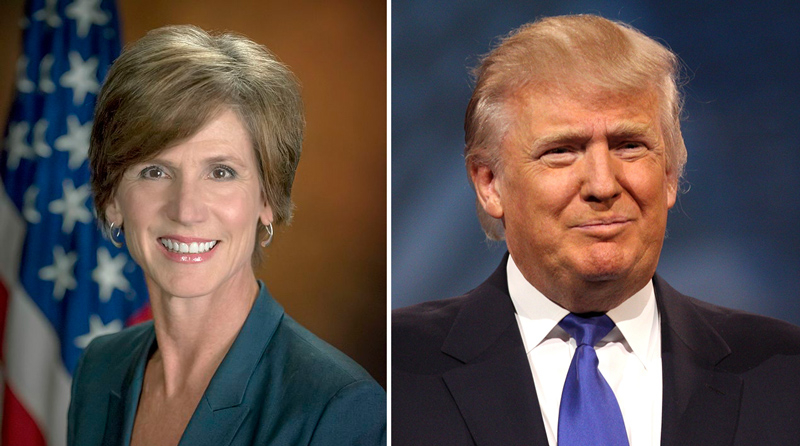
Former U.S. Acting Attorney General Sally Yates (left), and President Donald Trump. (Images source: Wikimedia Commons)
An Attorney General, like any citizen, has the right to disagree with a presidential order, but unless it is clear that the order is unlawful, she has no authority to order the Justice Department to refuse to enforce it. This order is multi-faceted and complex. It raises serious constitutional and legal issues that deserved nuanced and calibrated consideration from the nation's highest law officer. There are significant differences between the constitutional status of green card holders on the one hand, and potential visitors from another country who are seeking visas. Moreover, there are statutory issues in addition to constitutional ones. A blanket order to refuse to defend any part of the statute is overkill. If she strongly disagreed with the policies underlying the Order, she should have resigned in protest, and left it to others within the Justice Department to defend those parts of the Order that are legally defensible.
I, too, disagree, with the policy underlying the order, but I don't immediately assume that any policy with which I disagree is automatically unconstitutional or unlawful.
The President has considerable constitutional authority to control entry into the United States by non-citizens and non-residents. Congress, too, has some degree of control over our borders. The precise relationship between presidential and congressional power has never been defined by the Supreme Court. A more responsible Attorney General would seek to analyze these complex issues before jumping into the political fire by a blanket refusal to defend any part of the order.
In addition to failing to do her duty as Attorney General, Sally Yates handed President Trump an underserved political victory. She gave him the power to control the situation by firing her, instead of herself maintaining control by resigning in protest. It is the President who emerges from this unnecessary confrontation with the undeserved status of hero among his constituents.
I do not know Sally Yates except by reputation. She is highly regarded as a career prosecutor and public servant. My criticism of her is not personal, but rather institutional. These are dangerous and delicate times, and anyone who wants to confront the newly elected president must do so with wisdom, nuance and calibration. She played directly into his hands by responding to an overbroad order with an overbroad response. President Trump has now appointed a new acting Attorney General who will defend the order, or at least those parts of it that are legally defensible. Any individual Justice Department official who feels uncomfortable defending this controversial order should be given the freedom by the Department to decline to participate in the case. There are plenty of good lawyers in the Department who would have no hesitation standing up in the courtroom and making the best ethically permissible argument in defense of the order. I have had many experiences with Justice Department lawyers who personally disagreed with the prosecutorial decision in particular cases, but who vigorously defended the government's position.
Sally Yates did what she thought was right. In my view she was wrong. She should neither be lionized nor accused of betrayal. Nor should President Trump's critics, and I include myself among them, accuse him of doing anything even remotely close to President Nixon's infamous "Saturday night massacre." Nixon fired the very officials who were seeking to prosecute him. That constituted a personal and unethical conflict of interest. President Trump fired Yates over policy differences. It may have been unwise for him to do so, but it was clearly within his authority.
Now we will see our adversarial system at work. Excellent and dedicated lawyers will continue to bring challenges throughout the country against this ill-advised executive order. Other excellent lawyers will defend the order vigorously in court. Ultimately the issue may come to the Supreme Court (with or without a full complement of Justices). That is the way our system of checks and balances is supposed to work.
Alan M. Dershowitz, Felix Frankfurter Professor of Law, Emeritus, is the author of Taking the Stand: My Life in the Law and Electile Dysfunction. A version of this article appeared in The Hill.
Nihad Awad, executive director of the Council on American-Islamic Relations. (Photo: Saul Loeb/AFP/Getty Images)
Muslim, Christian and Jewish leaders gathered at the national headquarters of the Council on American-Islamic Relations (CAIR) in Washington, D.C., Wednesday to condemn expected orders by President Trump that would stop the resettlement of Syrian refugees in the United States and impose travel restrictions on visitors from several other Muslim countries.
CAIR co-founder and executive director Nihad Awad said that such action, which Trump has yet to formally announce but which he repeatedly endorsed during his presidential campaign as a national security measure, “does not make our country safer.”
Rather, Awad said, “it will hand a propaganda tool to our enemies who promote a false notion of an American war on Islam.”
Trump signed two executive orders Wednesday, which included provisions to begin construction of a wall along the southern border, increase detention facilities to hold more illegal border crossers, give border agents more power to enforce immigration laws and cut federal funding to cities that offer sanctuary to certain undocumented immigrants.
An additional order, which Trump is expected to sign as soon as Thursday, would impose an indefinite ban on Syrian refugees as well as a temporary hold on the resettlement of all refugees from other parts of the world. The order would also ban anyone from Iran, Iraq, Libya, Somalia, Sudan, Syria or Yemen from traveling to the U.S. for one month.
“We’ve already seen an unprecedented spike in anti-Muslim bigotry in recent months,” said Awad, adding that efforts to limit immigration from specifically Muslim countries would increase Islamophobic sentiment.
Trump’s approach to immigration, Awad continued, including his “multibillion-dollar monument to racism on our border with Mexico” as well as the expected travel ban, “flies in the face of the American inclusion that we all hold dear.”`
President Donald Trump with one of the executive orders he signed on Wednesday. (Photo: Pablo Martinez Monsivais/AP)
Rabbi Joseph Berman, manager of government affairs for the grassroots advocacy organization Jewish Voice for Peace, agreed with Awad, pointing to the Holocaust and his own personal experience as the grandson of refugees as a warning.
Berman said that one side of his family fled Nazi Germany in the 1930s, while his grandparents on the other side survived the Auschwitz concentration camp in Poland. Though they were all lucky enough to receive asylum in the United States, Berman noted, there were “many who did not make it out and died as a result.”
“Make no mistake that suspending immigration [and] refugee resettlement will result in more deaths,” he said. “People will die in refugee camps.”
Orders like the one Trump is expected to sign Thursday, Berman said, “go against the most basic of human values” and are “an affront to us, an affront to all human beings, and an affront to God.”
Rabiyah Ahmed, of the Muslim Public Affairs Council, which advocates for the civil rights of American Muslims, reiterated the argument that such restrictions on immigration and refugee resettlement will create a “false sense of security.”
With “the continuing scapegoating of minority communities,” Ahmed said, “what Trump is saying is that, as president, he’s really not committed to upholding the values that we hold dear.”
Like Berman, Rev. Steven Martin of the National Council of Churches offered solidarity with the Muslim community as well as other immigrants who will likely be affected by Trump’s policies.
“I cannot believe that state sponsored persecution against a class of Americans is taking place,” he said. “Even though I’ve been watching it grow, I cannot believe it.”
Martin said that the National Council of Churches, which represents roughly 45 million Christians from 38 religious denominations across the U.S., supports sanctuary cities and condemns “any attempts to define terrorism as a product of any one religion,” as well as “any attempts to place a religious test upon refugees attempting to build their new lives in the United States.”
“This is a big, big deal,” he added. “Today is the day for action.”