Israel Must Choose: Enforce the Law or Lose the Negev?
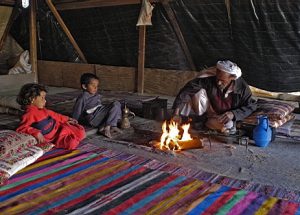
Unrecognized Bedouin Village in Negev, photo by Elisheva Smith, Physicians for Human Rights, via Flickr Creative Commons
BESA Center Perspectives Paper No. 422, March 9, 2017
EXECUTIVE SUMMARY: Arab MKs, left-wing NGOs, and local Bedouin leadership have decided to resist state attempts to regulate the hundreds of illegal Bedouin settlements in the Negev. This will be difficult to counter, as radical Arab nationalists and the Islamic Movement are infiltrating and co-opting the Bedouin conflict as a tool against the state. Israel should continue to enforce the law and negotiate with Bedouin families while remaining realistic about the endeavor’s long-term goals. Failure to do so will consign the Negev to lawlessness.
A recent flare-up in the ongoing tensions between the Israeli government and the Negev Bedouin resulted in two deaths. This will either deter further Arab resistance or cause the state to refrain from regulating illegal Bedouin settlements.
The Supreme Court had approved the state’s plan to demolish the unrecognized village of Umm Hiran, just east of Hura. Umm Hiran is a small, makeshift grouping of rudimentary dwellings with windy and bumpy dirt paths serving as roads. The demolition was to be accomplished in stages. On January 18, Israeli forces arrived to begin the first stage of dismantling the village.
A local Bedouin, reported to have been a member of the southern branch of the Islamic Movement and with possible ties to Islamic State (IS), rammed Staff Sgt. Maj. Erez Levi, 34, in what Israeli authorities initially called a car-ramming attack. Police shot the Bedouin, whom local Bedouin and Arabs claim was killed in error as he did not intend to run over the policeman. In late February, Public Security Minister Gilad Erdan seemed to soften the government’s position, saying an apology would be issued if the investigation reveals that it was not a terror attack.
Arab MKs, left-wing NGOs, and local Bedouin leadership have decided to resist moves by the state to regulate the hundreds of illegal Bedouin settlements in the Negev. The head of the Joint Arab List, MK Ayman Odeh, published an article in The New York Times on February 13 entitled “Israel Bulldozes Democracy.” In it, he claimed that there are only 35 unrecognized villages, when in reality there are many more. Odeh, as well as some NGOs, propose that the state recognize all illegal settlements.
In 2013, the state abandoned the formal Begin-Prawer bill, which sought a compromise solution involving the recognition of the majority of illegal Bedouin settlements. The government’s strategy since then has been to negotiate family by family to encourage the Bedouin to relocate to existing legal towns. According to the State Comptroller’s report of May 2016, one-third of the approximately 200,000 Bedouin live in illegal settlements. The problem is bound to get worse as the population is one of the fastest growing in the world: it doubles about every 15 years.
On February 12, the state announced its latest push to integrate the Bedouin population – a 3 billion NIS five-year plan to develop the Bedouin sector.
The nomadic culture of the Bedouin has been one of rebelliousness against authority and state sovereignty, and Israel is no exception. Israel is trying to carry out what might be an overly ambitious task of social engineering by investing large resources in modernizing the Bedouin. It is one thing to enforce the law and resettle Bedouin in recognized settlements, and quite another to get it to work in terms of altering their tribal and patriarchal culture and integrating them into Israeli society.
The object is to get the Bedouin to live in high-density cities the way Jews do in Petach Tikva, with 100-meter apartments, functioning city services, transport, and respect for the rule of law. Local Bedouin have told this author that it is against their culture to live in small apartments and without expanses of land.
Clifford Geertz, the American anthropologist, writes in The Interpretation of Cultures: Selected Essays: “To entertain the idea that the diversity of custom across time and over space is not a mere matter of garb and appearance, of stage settings and comedic masques, is to entertain also the idea that humanity is as various in its essence as it is in its expression.”
In other words, there are genuine cultural differences that Israel is trying to bridge through development projects. The limits on Israel’s goal of integration must be addressed realistically. Unfortunately, Israel appears to be falling into a trap Geertz spoke about regarding the manipulation of state statistics and the announcement of new budgets to demonstrate that its development plans are working.
“Then, too, there is the closely related problem of what, in connection with the strange fact that according to the 1941 census of India there were 25 million tribal peoples but in the 1951 census only 1.7 million, Weiner has aptly called 'genocide by census redefinition,’” wrote Geertz.
Amichai Yogev, southern director of the NGO Regavim, which closely monitors illegal Bedouin building and describes itself as seeking to enforce the rule of law, offers a different view. He told this author that the Bedouin way of life is already modernizing as they are moving from tents to homes – and the state is not, in fact, erring by making this effort. He acknowledged the cultural difficulties, but says that if the state succeeds in resettling the Bedouin into legal towns, “the situation would be much better than it is now, and especially for the quality of life of the Bedouin themselves … The state of Israel does not have enough land to allow the Bedouin to roam and settle wherever they wish.” Regavim estimates that there are more illegal Bedouin settlements in the Negev today than the 1,700 acknowledged by the government.
Will the relocation of Bedouin into modern towns succeed to the degree envisioned by the country’s ruling politicians? This objective will be hampered by radical Arab nationalists’ and the Islamic Movement’s efforts at infiltrating and coopting the Bedouin conflict as a tool against the state. For them, the Bedouin issue is just another front in the Israel-Palestinian struggle.
However, radical infiltrations aside, it should not be too difficult for the state to negotiate with the generally pragmatic and non-ideological Bedouin. They have not traditionally identified themselves as either ardent Palestinian nationalists or Islamists.
Yair Maayan, head of the Bedouin Development and Settlement Authority in the Negev, told the author, “The state will not give up on this issue and is doubling the number of inspectors.” Maayan is optimistic that the government will be able to evacuate all the illegal settlements and persuade the Bedouin to move into legal modern towns within six to eight years.
The thinking is that the example of Umm Hiran will scare the Bedouin into compromising and cutting deals with the state. The night before the evacuation, the Bedouin leadership turned down offers of free plots of land in neighboring Hura and generous cash compensation.
While the government believes it will be able to enforce the law, Israel’s policy goals for the Negev need deeper thought. Is the state ready to continue evacuating illegal settlements one by one, with each possibly serving as another last stand by the Bedouin and their Arab political and international supporters? Beyond relocation, what is the goal of integrating the Bedouin into society? Integration programs have not had great success with the general Muslim Arab population, which continues to identify itself primarily as Palestinian or Muslim rather than Israeli.
Yogev predicts that the success of Israel’s resettlement policy will be greater if the Bedouin reject interference from the Arabs of the north. “The Balad party and Islamic Movement do not really care about the Bedouins’ welfare, but are hijacking the conflict for their own political interests,” he said. He noted that other small settlements were evacuated without much fanfare because Arab politicians had not taken a public stand the way they did at Umm Hiran.
The violent resistance that occurred at Umm Hiran might be an example of what is to come, but Israel need not give in to fear. It should continue to enforce the law and negotiate with Bedouin families, yet remain realistic about the long-term success and idealistic goals of the endeavor. If it doesn’t, it will leave the Negev to lawlessness.
Ariel Ben Solomon is a freelance writer on the Middle East and a PhD candidate in Middle East Studies at Bar-Ilan University. He is the former Middle East Correspondent at The Jerusalem Post.


