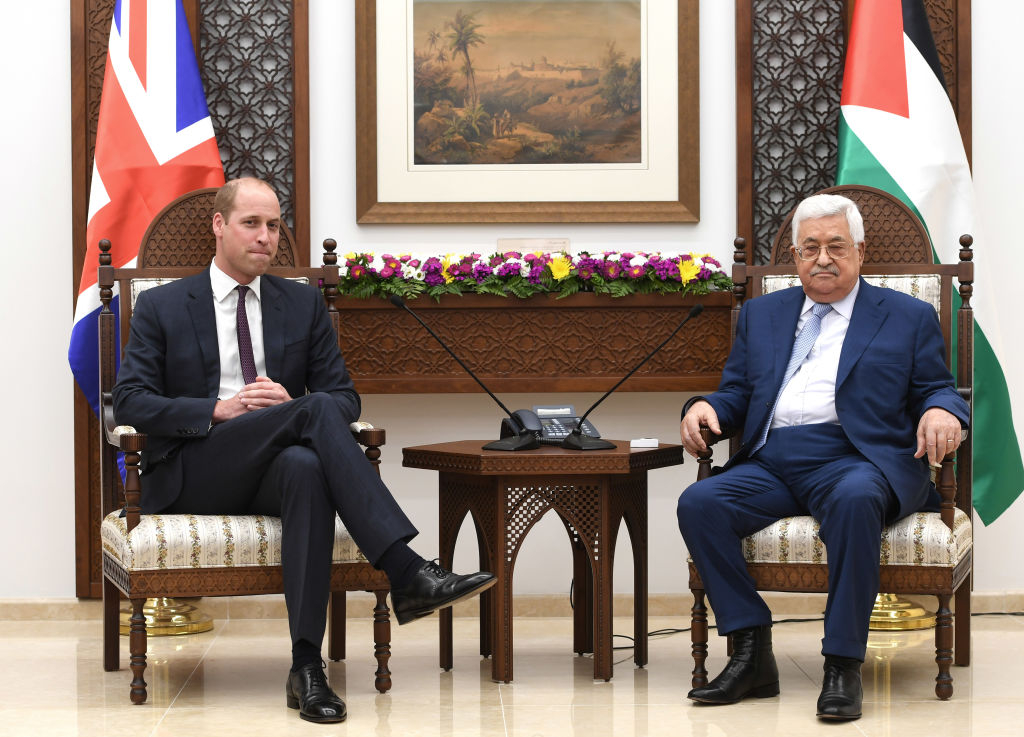
What Prince William Did Not See in Ramallah
Palestinian Authority President Mahmoud Abbas shared some interesting news with England's Prince William during a meeting in Ramallah on June 27. He informed the royal visitor that the Palestinians are "serious about reaching peace with Israel." Abbas also said that the Palestinians were "committed to combating terrorism."
What makes this news interesting is that as Abbas was speaking to Prince William in his Ramallah headquarters, known as the Mukata, the Palestinian government issued a statement praising Palestinian terrorists imprisoned by Israel. The Ramallah-based government also vowed to continue paying salaries to Palestinians convicted of murdering and injuring Jews, defying Israeli and American demands to stop the payments. The Palestinian government's pledge to continue supporting the terrorists and their families financially came in response to a new Israeli law that allows the Israeli government to deduct funds that are supposed to be transferred to the Palestinian Authority commensurate with the amount of money the Palestinians pay to the terrorists and their families. The Knesset's Foreign Affairs and Defense Committee approved the law this week, on June 27. The bill, which was proposed by MK Avi Dichter (Likud) and MK Elazar Stern (Yesh Atid), states that welfare payments paid by the Palestinian Authority to the terrorists and their relatives will be deducted from tax revenues Israel transfers each month to the Palestinian Authority. The money withheld would instead go into a fund designated to help victims of Palestinian terror attacks. Abbas and his government are outraged by the new Israeli law, which comes in the context of Israel's effort to combat terrorism -- the same terrorism that the Palestinian leader claims he is "committed" to fighting. They see nothing wrong with funding terrorists and their families. It seems that Abbas and Israel have different views on how terrorism should be combated. Abbas seems to think that paying salaries to convicted terrorists and their families is a good first step in that direction. For some reason, Prince William, who sat next to Abbas when the Palestinian leader made his statement about combating terrorism, did not bother to ask the Palestinian leader about the payments to the terrorists and their families. Nor did the visiting prince deem it necessary to ask his host about the Palestinian Authority's long-standing tradition of glorifying terrorists who target Jews. Instead, Prince William just spread smiles around as Abbas was talking about the Palestinians' "serious" desire to achieve peace with Israel and their "commitment" to combating terrorism.
The prince must have been unaware of what the Palestinian government had to say about convicted terrorists during his visit to Ramallah. In case the prince still does not know, here is a translated excerpt from the Palestinian government's statement (which was issued while the prince was meeting with Abbas): "Palestinian prisoners are our national icons and symbols of defending freedom and dignity and confronting oppression and subjugation." The Palestinian government vowed that it would "not abandon the prisoners and the families of the martyrs." It is worth noting that the "martyrs" that Abbas's government is talking about are in fact Palestinian terrorists, who were killed by the Israeli army or police during attacks on Jews. The "martyrs" also include Palestinians who blew themselves up during suicide bombings in Israel. Abbas, like the vast majority of the Palestinians, consider terrorists who killed or maimed Jews as heroes, shaheeds (martyrs) and role models. Of course, there is nothing new about the Palestinian tradition of glorifying terrorists, and much has been said about the policy of naming schools and squares after Jew-murderers in Palestinian cities, villages and refugee camps in the West Bank and Gaza Strip. In addition to the government's statement, another Palestinian Authority institution, The Commission for Palestinian Prisoners and Ex-Detainees, describedthe Palestinian terrorists as "soldiers of freedom and dignity." The commission was responding to the new Israeli anti-terrorism law. In sharp contrast to Abbas's message of peace during his meeting with Prince William, the commission denounced Israel as a "fascist" state that engages in "piracy and theft" of Palestinian funds. "The Palestinian people, government and leadership will not abandon the prisoners and the families of the martyrs," the commission said in a strongly worded statement. The Palestinian terrorists, it added, "have sacrificed their lives and souls for the sake of their people and homeland and the entire humanity." On the eve of Prince William's visit, the Palestinian Authority inaugurated a monument commemorating the "martyrs" of Ramallah. At the ceremony, the mayor of Ramallah praised the "martyrs" and described them as "great" fighters who sacrificed their lives for the sake of their people and homeland. Predictably, Prince William was not taken by his Palestinian hosts to see the monument erected in the old city of Ramallah to honor Palestinian terrorists. Instead, he was escorted by his Palestinian hosts to enjoy falafel, hummus and kenafah sweets and attend a musical presentation on the streets of Ramallah. But the choice to share candy rather than training for terrorism makes sense good sense, from the Palestinian point of view. The last thing the Palestinians want is for the prince and his entourage to see a monument honoring terrorists. That would stand in sharp contrast to Abbas's claim that the Palestinians are committed to combating terrorism and serious about achieving peace with Israel. The Palestinian leadership sought to protect the prince from the double-talk and hypocrisy of Abbas and his cronies. They do not want the prince and the rest of the world to know about the conflicting messages they send to their people and to the rest of the world. The message to the Palestinians: We support anyone who murders a Jew and will take care of their families if they are killed or imprisoned by Israel. The message to Prince William and other world leaders and dignitaries: We are committed to peace and the war on terrorism. Prince William may have received a red-carpet reception in Ramallah, but he left the city ignorant of the dark side of Palestinian culture -- particularly the part concerning the glorification of terrorists and the ongoing anti-Israel incitement. Falafel and hummus are just the beginning of what is happening on the Palestinian street and in the mosques and the media. As chance would have it, on the very day that the prince was in Ramallah, the Palestinian Authority was repeating its pledge to continue funding terrorists and their families. One hopes that Prince William enjoyed his visit to Ramallah. One also hopes that he asks his advisors to translate for him what Palestinian leaders are saying to their own people in Arabic. Bassam Tawil is a Muslim Arab based in the Middle East.
© 2018 Gatestone Institute. All rights reserved. The articles printed here do not necessarily reflect the views of the Editors or of Gatestone Institute. No part of the Gatestone website or any of its contents may be reproduced, copied or modified, without the prior written consent of Gatestone Institute.
|
Our goal is to have intelligent discussion of the topics of the day. We realize everyone has their opinion and they should be allowed to express it in a discussion forum without calling each other names. We learn from discussion and not from name calling or argument.We use cookies to personalise content and ads, to provide social media features and to analyse our traffic. We also share information about your use of our site with our social media, advertising and analytics partners. See details
Contact Form
Showing posts with label Ramallah. Show all posts
Thursday, June 28, 2018
Smiles Do Not Tell The Whole Story
Tuesday, June 5, 2018
No Trial, No Attorney, Held Without Charges--The Law Under Hamas
Palestinians: A Story You Have Not Heard in the West
A Palestinian mother of five just spent 23 days in prison. During her incarceration, she was held in unspeakable conditions and denied family visitations. She was also prohibited from consulting a lawyer.
This is a story that no one has heard in the West. Why? Because the Palestinian woman, Samah Abu Ghayyath, was detained not by Israel, but by Hamas, the Palestinian terror group that rules the Gaza Strip. Abu Ghayyath would have been "fortunate" if she had been arrested by Israel. Then, the case would have reached the pages of major media outlets around the world and "pro-Palestinian" activists would have staged demonstrations and online campaigns to support her and denounce Israel. By contrast, for instance, consider the example of Ahed Tamimi, a Palestinian teenage girl from a village near Ramallah in the West Bank. In December 2017, Tamimi was detained by Israeli authorities for physically assaulting an Israeli soldier. After agreeing to a plea bargain, she was sentenced to 8 months in prison. Tamimi has since become a symbol of the Palestinian "struggle" against Israel. She is glorified by many in the mainstream media in the West and advocates of Palestinian human rights around the world, who have turned her into an icon. Tamimi has won all this fame and glory because she and her family members have long been staging skirmishes with Israeli soldiers in their village of Nabi Saleh. The teenager and her parents have made it a habit to invite journalists -- or anyone carrying a camera -- to document their provocative actions against the soldiers. Abu Ghayyath, however, the woman from the Gaza Strip, has been less fortunate than the golden girl from the West Bank. Unlike Tamimi, the arrest of the mother of five in early May by Hamas did not spark an international outcry. Western journalists and human rights organizations did not endorse Abu Ghayyath, as they were quick to do with Tamimi, a girl who hit an Israeli soldier. Had Abu Ghayyath been arrested by Israel, her name would have appeared on the front pages of The New York Times and in the broadcasts of the BBC and CNN. The only ones who picked up her ordeal and demanded her release, however, were a few Palestinian women's groups and, of course, her family.
Predictably, only a handful of Palestinians -- and no Westerners -- dared to denounce Hamas for arresting the woman. Even after Abu Ghayyath's release, it remains unclear why Hamas's security forces arrested her in the first place. Some Palestinians speculated that she could have been taken into custody because of her affiliation with Hamas's rivals in Fatah, the secular faction headed by Palestinian Authority (PA) President Mahmoud Abbas. Others believe she may have been arrested because of her activities on behalf of women's rights in the Gaza Strip. Abu Ghayyath still has not been formally charged with committing any crime. Hamas will not say why she was held in detention for 23 days. She herself appears to be too afraid to talk about the hard days she spent under interrogation in Hamas prison. In addition, her personal computer and mobile phone were confiscated. Abu Ghayyath's friends and family claim she was tortured physically and psychologically during her incarceration. They say they cannot understand the silence of many Palestinians and the international community towards Hamas's action against a mother of five (her youngest child is only 8 months old). During the time Abu Ghayyath was being held by Hamas, her children, some in tears, appeared on a Ramallah-based television station to appeal for the release of their mother. Hamas clearly did not care about these children, who were left at home alone, especially during the fasting month of Ramadan where the older girls (aged 13 and 11) had to prepare food and look after the younger ones. Abu Ghayyath's friends in Fatah have denounced her arrest as a "stain of shame on the forehead of Hamas." But who said that Fatah's human rights record is any better? Fatah is the dominant party of the Palestinian Authority that rules the West Bank. Its members and supporters also make up the largest percentage of the PA security forces, responsible for suppressing public freedoms and cracking down on political rivals and dissent. Abu Ghayyath may have been the latest victim of the 11-year-old power struggle between Fatah on one side, and Hamas in the West Bank and Gaza Strip on the other. Both Fatah and Hamas have been arresting and harassing each other's supporters for more than a decade. The rivalry between Fatah and Hamas has resulted in a situation where the Palestinians have two separate mini-states -- one ruled by Fatah in the West Bank and another ruled by Hamas in the Gaza Strip. The two mini-states are both failed entities run by vicious and corrupt leaders who are blocking the emergence of new and younger leadership and clamping down on public freedoms. These two mini-states have spared nothing in their struggle to throttle each other, from throwing Palestinians from rooftops and lynching them in public squares, to cutting off medical supplies, as President Abbas has done to the Gaza Strip. This is the real tragedy of the Palestinians: failed leadership that has deprived them of international aid and a good life in favor of hating and killing Jews. Their leaders have dragged their people from one disaster to another -- from Black September in Jordan in the '70s to the civil war in Lebanon in the '80s and '90s to the Second Intifada during the 2000s to wars in the Gaza Strip that have claimed the lives of thousands of Palestinians. But let us return to Abu Ghayyath. Where was Western sympathy or even attention while she was languishing in Hamas prison? Why was no one in the West interested in her story? Because she was not the victim of Israel. She was targeted only by her own people, by Hamas. As such, Western journalists covering Palestinian affairs could not care less. The same way they do not care about repressive measures taken by Fatah and Hamas against Palestinians. The same way they see no wrongdoing on the Palestinian side. The only stories foreign journalists are interested in are those that reflect negatively on Israel. This is yet another reminder of the dangerous double standard of the international community. Where all those who claim to be "pro-Palestinian" and are spewing hatred against Israel and Jews at college campuses in the US and Canada? If they really want to help the Palestinians, let them stand up and shout about the rights of women and gays living under Hamas's repressive regime, and journalists who are being harassed and arrested by Mahmoud Abbas's security forces. Yelling lies about Israel and Jews does not make one "pro-Palestinian." It only makes one an Israel-hater. Hating Israel does not improve human rights conditions for Palestinians living under Hamas and Fatah. Instead, it serves as a distraction and even facilitates Fatah and Hamas in suppressing public freedoms and human rights. Bassam Tawil is a Muslim Arab based in the Middle East.
© 2018 Gatestone Institute. All rights reserved. The articles printed here do not necessarily reflect the views of the Editors or of Gatestone Institute. No part of the Gatestone website or any of its contents may be reproduced, copied or modified, without the prior written consent of Gatestone Institute.
|
Subscribe to:
Posts (Atom)