Contact Form

Name

Email *

Message *

Showing posts with label Robert Epstein. Show all posts

Wednesday, April 25, 2018

Google Algorism Could Sway Undecideds--Worse Than Russia?


EXCLUSIVE — Research: Google Search Manipulation Can Swing Nearly 80 Percent of Undecided Voters

By inserting negative search suggestions under the name of a candidate, search engines like Google can shift the opinions of undecided voters by up to 43.4 percent, according to newresearch by a team at the American Institute for Behavioral Research and Technology and reported exclusively by Breitbart News.

The lead author of the study, Dr. Robert Epstein, has previously conducted research into what he calls the Search Engine Manipulation Effect (SEME). This research showed that the manipulation of results pages in search engines can shift the voting preferences of undecideds by anywhere between 20 and 80 percent, depending on the demographic.
His latest research looks at how search engines can affect voters by suggesting negative or positive search terms when a political candidate’s name is entered into the search bar. Dr. Epstein’s research found that when negative search terms are suggested for a candidate, it can have a dramatic effect on voter opinion.
From the study:
advertisement
The voting preferences of participants who saw no search suggestions shifted toward the favored candidate by 37.1%. The voting preferences of participants in the search suggestion groups who saw only positive search suggestions shifted similarly (35.6%). However, the voting preferences of participants who saw three positive search suggestions and one negative search suggestion barely shifted (1.8%); this occurred because the negative search suggestion attracted more than 40% of the clicks (negativity bias). In other words, a single negative search suggestion can impact opinions dramatically. Participants who were shown four negative suggestions (and no positives) shifted away from the candidate shown in the search bar (-43.4%).
The researchers conclude that by using this method of manipulation, search engines can shift a “50/50 split split among people who are undecided on an issue to a 90/10 split without people’s awareness and without leaving a paper trail for authorities to follow.”
The conclusions are based on 16 months of experiments conducted with a total of 1,800 people from all 50 U.S. states. Participants in the study came from diverse ideological backgrounds, including liberal, conservative, and moderate. In order to control prior biases, participants were asked to judge political candidates that they were unfamiliar with.
Further on in the paper, the researchers reference allegations of search suggestion manipulation made against Google during the 2016 election, when the tech giant appeared to be suppressing negative search suggestions for Hillary Clinton while allowing negative suggestions for Donald Trump and Bernie Sanders to remain.
The research also notes discrepancies with Google’s current search suggestions, particularly with regards to its commercial interests. For example, entering “G” into the search bar in Google will instantly provide users with suggestions to click on search terms about other Google products – Gmail, Google Maps, Google Drive, and others.
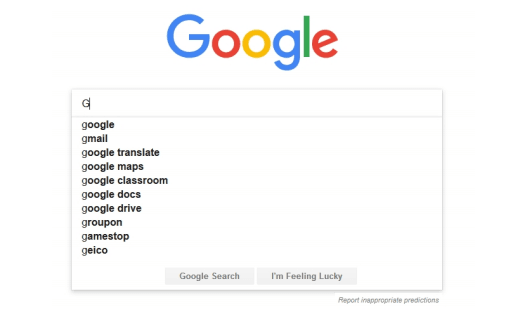
The resarchers also found a recurring pattern of major brands being favored in Google search suggestions if they were financially linked to Google. The top search suggestions for “a” is Amazon – Google’s top client on Google Adwords, the company’s digital advertising service. The top search suggestion for “t” is Target – Google’s third-biggest advertising client.
According to the research summary, “The same pattern occurs for other major advertisers on Google, among them Best Buy, Home Depot, Lowe’s, and Zillow.”
“The only companies that are shortchanged by this arrangement are those with names beginning with ‘g.'”
Allum Bokhari is the senior technology correspondent at Breitbart News. You can follow him on Twitter, Gab.ai and add him on Facebook. Email tips and suggestions to allumbokhari@protonmail.com.

Wednesday, November 8, 2017

Facebook And Google Are Trying To Control The News We Get

www.israel-commentary.org
(Redacted from a much more detailed, documented and shocking expose’)
By Jeff Mordock - The Washington Times - Monday, October 23, 2017
Robert Epstein tried a simple experiment in the run-up to the presidential election: running searches on Google and Yahoo for political topics.
The results were stunning. Google searches returned twice as many pro-Hillary Clinton news articles as Yahoo searches.
Perhaps even more stunning was that men and blue-state residents saw more than double the number of pro-Clinton articles than women and people living in red states, Mr. Epstein, of the American Institute for Behavioral Research and Technology, and Robert E. Robertson, a professor at Northeastern University, argued in a report this year.
Mr. Epstein said he is still studying what caused the bias but worries that Google’s search algorithm — a form of artificial intelligence that chooses what results a searcher is looking for — ranked pro-Clinton articles ahead of positive articles about her opponent, Donald Trump.
Those algorithms have become the modern-day Walter Cronkite or Edward R. Murrow, deciding what news reaches the eyes and ears of Americans in an increasingly Google-Facebook-Twitter media environment.
(There is absolutely no doubt in my mind that this is true. They definitely pick and choose which of my submissions agree with their limited, biased political position and that encompasses virtually the entire media.) Jerome S. Kaufman
In recent months, the focus has been on whether the companies were able to be manipulated by Russian-connected operatives who attempted to sow “chaos” in the U.S. surrounding last year’s elections.
But the power of the companies to shape American politics goes well beyond that.
“The social media companies are the gatekeepers,” said Frank Foer, a writer at The Atlantic and former editor of the New Republic who has authored a book on social media’s power. “Whatever choices these companies make to elevate or bury information is very powerful and will have a big impact on what people read.”
Mr. Epstein and Mr. Robertson, in their research, looked at 4,045 election-related searches on Google and Yahoo during a 25-day period from mid-October through Election Day. They found that the pro-Clinton articles swamped pro-Trump news.
“The algorithms are not programmed with an equal time rule,” said Mr. Epstein, a vocal Clinton supporter. “They are programmed to put one thing ahead of another in a way that is highly secret and ever-changing.”
He said his experiments show the power of news searches to affect politics and has found that he could boost support for a candidate by as much as 63 percent after just one Google search session. He has dubbed this the “search engine manipulation effect.”
Analysts have caught some deeper glimpses over the years, based on testing and on information gleaned from patent applications Google has filed, saying Google judges trustworthiness and importance of a news site, how much content it produces and even length of stories to gauge whether to elevate a site’s content.
Facebook workers raise questions
Accusations of an indirect bias may not carry as much weight if not accompanied by accusations of direct bias by the social media companies.
In May 2016, a group of several former Facebook workers told technology blog Gizmodo that they routinely suppressed news about prominent conservatives, including Mitt Romney, Rand Paul and the American Conservative Union’s Conservative Political Action Conference.
The employees, who worked as ‘news curators,’ also said stories reported by conservative outlets such as Brietbart and Newsmax were dismissed unless The New York Times, BBC or CNN covered the same article.
Facebook denied the accusations and said an internal study found virtually identical rates of liberal and conservative new topics. The company did concede bias could have occurred through improper human actions and it would take steps to prevent it from happening in the future. Facebook CEO Mark Zuckerberg invited 16 conservative leaders to the company’s headquarters for a meeting.
“The meeting opened on a positive, honest note and went that way throughout the whole meeting,” said Brent Bozell, president of the Media Research Center. Mr. Bozell said Facebook has made a sincere effort since the meeting to include conservative voices. “We’ve never had a serious problem with Facebook,” he said. “Does that make us the exception to the rule? I don’t know.”
It’s not just Facebook and Google. Earlier this month, Twitter blocked a campaign ad by Rep. Marsha Blackburn, Tennessee Republican, claiming it included “an inflammatory statement that is likely to evoke a strong reaction.” In the ad, Ms. Blackburn said she helped stop Planned Parenthood from selling baby body parts.
“The damage being done to conservatives is almost incalculable,” said Seton Motley, a technology policy specialist and president of Less Government, a conservative organization dedicated to reducing government power. “If network television media bias can give a candidate a 4- to 6-point advantage and social media giants have more power than the networks, can we even quantify a number?”
Facebook also donated heavily to the Democratic Party. Of the nearly $4.6 million Facebook employees and affiliates spent on last year’s election, 67 percent went toward Democrats and 32 percent went to Republican candidates. Mrs. Clinton received $478,000 from Facebook, while Mr. Trump received about $4,665.
Google and Facebook have increased their lobbying efforts over the past few months as Congress scrutinizes their power. Facebook spent $285 million on lobbyists from July through September, a 41 percent increase over the same period last year. Google spent $417 million during those three months, including hiring Republican lobbyists Jochum Shore & Trossevin PC to fight a bill that would penalize tech companies for content that promotes sex trafficking. The companies are fighting the bill because it weakens some of their legal protections.
“The social media companies will engage in full-scale censorship with the approval or rejection of advertising content in the next presidential election,” he said. “Trump’s advertising will be critiqued in a way that they will not do to the Democrats.”