Our goal is to have intelligent discussion of the topics of the day. We realize everyone has their opinion and they should be allowed to express it in a discussion forum without calling each other names. We learn from discussion and not from name calling or argument.We use cookies to personalise content and ads, to provide social media features and to analyse our traffic. We also share information about your use of our site with our social media, advertising and analytics partners. See details
Texas Gov. Greg Abbott and Attorney General Ken Paxton released statements on Wednesday condemning the jail sentence of salon owner Shelley Luther, who was sentenced to seven days in jail and a $7,000 fine for violating Gov. Abbott's executive order regarding the closing of "nonessential" businesses.
State District Judge Eric Moyé declared from the bench that he would not sentence Luther to jail if she apologized, admitted that she had been "selfish" and "wrong," and promised not to reopen her salon until Friday, when salons are permitted to open under the governor's revised executive order.
In response, Luther said:
I have much respect for this court and laws. I have never been in this position before and it's not some place that I want to be. But I have to disagree with you, sir, when you say that I'm selfish — because feeding my kids is not selfish. I have hair stylists that are going hungry because they'd rather feed their kids. So sir, if you think the law is more important than kids getting fed, then please go ahead with your decision, but I am not going to shut the salon.
In their statements, Abbott and Luther condemned Judge Moyé's decision to jail Luther.
Paxton's statement said, in part, "I find it outrageous and out of touch that during this national pandemic, a judge, in a county that actually released hardened criminals for fear of contracting COVID-19, would jail a mother for operating her hair salon in an attempt to put food on her family's table." Paxton went on to call the sentence "a shameful abuse of judicial discretion."
Abbott's statement stated that he joined "the Attorney General in disagreeing with the excessive action by the Dallas judge. ... Compliance with executive orders is important to ensure public safety; however, surely there are less restrictive means to achieving that goal than jailing a Texas mother."
As governor, Abbott would presumably have the power to commute the jail portion of Luther's sentence, if he so desired. His statement did not indicate whether he intended to do so.
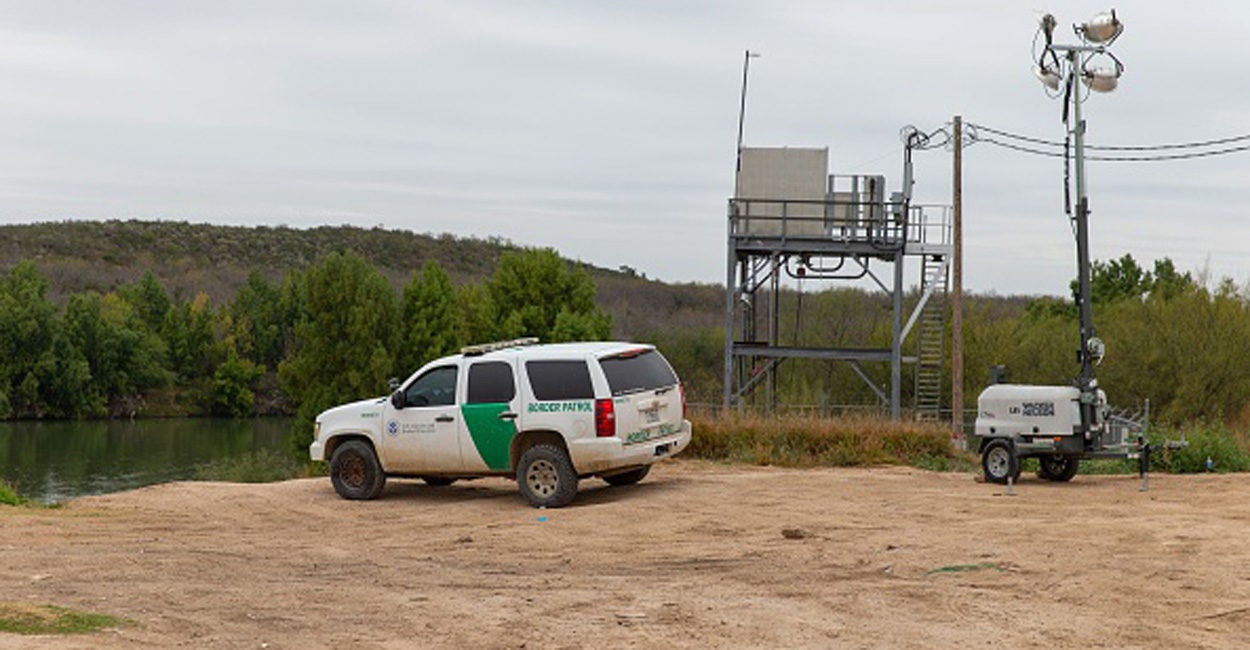
A Border Patrol vehicle keeps watch of the Rio Grande River in Laredo, Texas, on Jan. 14. Mexico is just minutes away on foot, the time it takes to walk across one of the bridges spanning the river to connect Laredo with its Mexican sister, Nuevo Laredo. (Photo: Suzanne Cordeiro/AFP/Getty Images)
LAREDO, Texas—Guarding this sector of the southern border involves a set of challenges that is quite different than nearby stations in the Lone Star State.
I learned this during a tour of the border last week that included this city of about 250,000 across from Nuevo Laredo, Mexico, just a few hours away across the Rio Grande Valley station.
I traveled along the 171-mile stretch of border as a reporter for The Daily Signal, and here’s some of what I learned firsthand from Border Patrol agents who guard it.
1. Cartel Control
The liberal Left continue to push their radical agenda against American values. The good news is there is a solution.Find out more >>
The violent Cartel del Noreste controls and profits from illegal immigration across the southern border.
“The Laredo sector is unique compared to our bordering neighbors to the left and to the right of us, up river and down river, in that we sit right across the border from the headquarters of the Cartel del Noreste, formerly known [as] the Zetas Cartel,” Joel Martinez, deputy chief of the Border Patrol for the Laredo sector, told me during an interview.
“They are the main reason we are not getting the massive humanity coming at us,” Martinez said of the drug cartel, “because they control that part of the border so violently.”
Martinez continued:
So last month they discovered through interviews with aliens that a lot of people were being held against their will until they could pay the Zetas, or the Cartel del Noreste. That being said, our agents were actually able to identify the smugglers and the keepers of these houses. And working with FBI and other federal partners, and also our Mexican partners, we were able to identify exactly where these stash houses were, and who these smugglers were.
And keep in mind, they’re pretty ruthless. If you don’t pay, they start punishing these people severely until the families pay. So we just got a conviction on two of them on our side, on the American side; when they did come across, we were able to identify them.
Tuesday, May 28, marked the 95th anniversary of the Border Patrol, now part of U.S. Customs and Border Protection in the Department of Homeland Security.
The Border Patrol’s Laredo station assists the Rio Grande Valley sector, which deals primarily with humanitarian problems associated with illegal immigrants. Laredo deals mostly with the criminal element.
“In the Rio Grande Valley, if you go down to the river banks with our Border Patrol agents, you’ll have people walking up to you. That is the opposite of what’s happening here,” Martinez said. “Here, people are actually trying to get away from us.”
“We’re getting the people that are being kept at stash houses, that are being put [inside] 18-wheelers as cargo because they do not want to get caught,” he said. “So it’s a total opposite dynamic that we have here in the Laredo sector.”
The drug cartel potentially makes more money from smuggling in migrants than from smuggling in drugs, Special Operations Supervisor Narcizo Ramos told me. That’s because people trying to get into the U.S. are ready to pay the cartel.
The city across the shallow river, Nuevo Laredo, is the hub for Cartel del Noreste, formerly known as Los Zetas.
“If someone tries to cross without them, and they get caught, they will be punished by the cartel,” Ramos said. “Normally, they will just hold them on the Mexican side for ransom and say pay the money, call your family. But, they want to teach them a lesson because that’s their business right now and it makes them millions of dollars.”
The drug cartel generally avoids coming to the U.S. side of the border, instead hiring a smuggler—typically a juvenile—to transport migrants illegally into the United States, Ramos said.
The more illegal immigrants cross in this sector, the richer the cartel becomes.
“A lot of kidnapping, a lot of drugs, a lot of murders,” Ramos said. “The people of both Laredos want border security. They don’t want a chaotic border. They understand that illegal immigration and human smuggling brings crime in this area.”
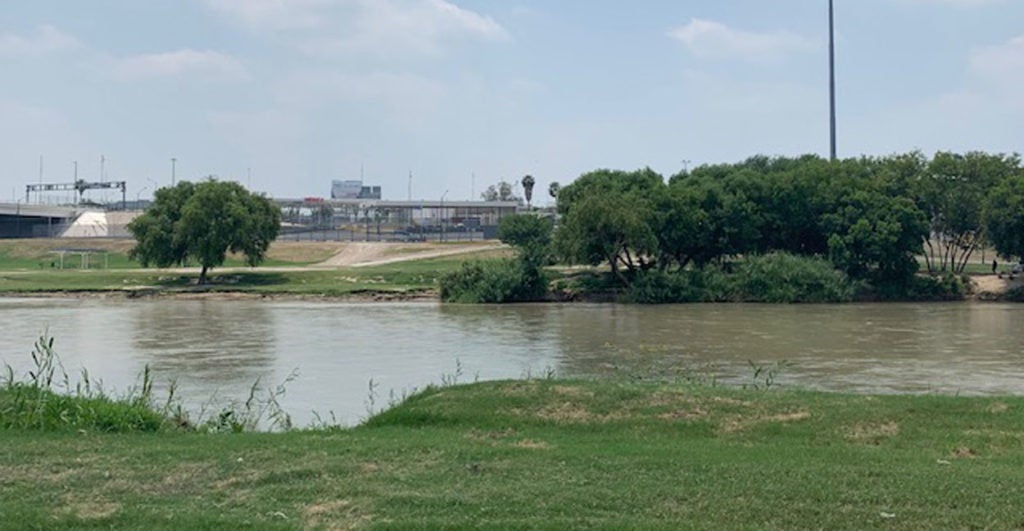
A view of the Rio Grande River between Laredo, Texas, and Nuevo Laredo, Mexico, on May 22. (Photo: Fred Lucas/The Daily Signal)
2. Proximity to Population
As an out-of-towner, what most jumped out to me was just seeing how close the border—marked by the Rio Grande River—was to residential areas, shopping centers, and schools.
If illegal immigrants are able to get across into Texas, they don’t have far to go to blend into the population. The Rio Grande is as low as a foot deep and rarely higher than 5 feet along much of Laredo, which allows migrants to wade across.
Rafael Garza, also a special operations supervisor, said this makes it difficult to apprehend illegal border crossers.
Laredo has a population of 250,000. The Nuevo Laredo metropolitan area, across the river, is more than twice that.
“Laredo is not a common border town,” Garza said. “Truck traffic is the No. 1 land import into the United States. That’s why there is so much truck traffic, vehicles, businesses here and there going back and forth. All of that is an advantage to the smugglers. It just helps them blend in a lot quicker. It’s not your average border town of 10,000 or something like that.”
If illegal immigrants can make it through the brush, Ramos said, they get into the residential areas.
“Come after school, you’ve got kids practicing for Little League [on a school baseball field], parents bringing their kids to practice,” Ramos said, pointing. “The smugglers will try to blend in with the people in the park.”
3. Where the Cane Grows High
The Texas Legislature passed a bill in 2015 establishing the Rio Grande Carrizo Cane Eradication Program to combat the carrizo cane that grows dense and tall and spreads quickly.
The clearing of the vegetation, which looks like corn stalks, has helped, but many property owners oppose clearing it on their land. And that leaves plenty of areas to get lost in for a short amount of time.
Brush that grows 15- to 20-feet high also makes border crossings difficult to view from the cameras.
“This brush area is no more than 50-100 yards. Lose me, and they are in town and get into a vehicle, or a stash house,” Ramos said. “If I want to get into a stash house, I need a warrant. First of all, I gotta find out what house he went into. To get a warrant, I gotta see him go in there. Otherwise, what’s my probable cause to get a warrant? They know our laws. They know our limitations.”
4. Lack of Resources
The control room monitoring remote camera views was the first room I saw. Given the lack of technology, officials at the sector say they’re missing out on spotting many illegal border crossers.
I later got a look at the lighting stands used to illuminate the surroundings for agents patrolling at night. The lights hardly seemed imposing.
So far in fiscal year 2019, which began Oct. 1, the Laredo sector has apprehended 24,000 illegal border crossers.
“One of our biggest challenges is the lack of situational awareness,” Greg Burwell, division chief of the Border Patrol’s Laredo sector, said. “With the cameras we have, whether they’re infrared, night vision, thermal cameras, we can only see about 30% of the 171 miles [of border] that we have.”
“So the real question to ask is if we can see 30%, and we’re apprehending about 125 to 150 people a day, how many people [crossing the border] are we missing? And definitely it makes our job very difficult when we know that there’s 70% that we’re not seeing.”
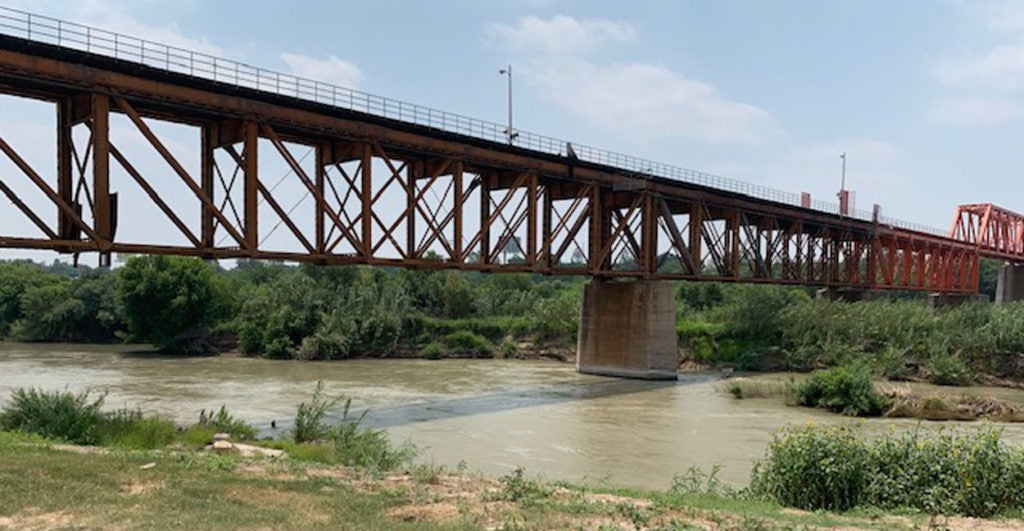
This bridge across the Rio Grande River, as seen May 22, connects Laredo, Texas and Nuevo Laredo, Mexico. (Photo: Fred Lucas/The Daily Signal)
5. Two Bridges
Two physical bridges over the river at Laredo connect Texas to Nuevo Laredo in Mexico. From the Laredo side, you can look over the short stretch of water and see the customs building in Mexico.
I didn’t witness any chase scenes or any action firsthand—which I honestly had hoped for. At bridge No. 2, though, I saw Border Patrol agents escorting what looked to be five illegal immigrants back to the Mexican side.
A significant number are already in the United States before being caught and sent back.
“We’re up to 24,000 illegal immigrants apprehended in Laredo,” Ramos said. “We didn’t see 24,000 people crossing. They’re evading us. They didn’t do it in plain sight. They’re hiding in nighttime hours. They are hiding in the brush.”
6. Sea of 18-Wheelers
Martinez, the deputy sector chief, said that just last month, the Border Patrol stopped an 18-wheeler trying to transport 18 individuals into the United States.
“One smuggler had 18 people in the back of an 18-wheeler,” Martinez said. “The temperatures are already averaging above 90 degrees daily. So inside a locked 18-wheeler, it can go up to 120 degrees in a matter of minutes.”
Laredo is one of the busiest areas for importing products from Mexico into the United States by truck, which is one reason it’s so easy for the cartel to smuggle illegal immigrants into the city.
The agents drove up outside a sea of parked 18-wheelers to point to one of the biggest problems.
“Look at that yard of tractor-trailers,” Ramos said. “They can hide through all those trailers. We, the Border Patrol, have no infrastructure impedance-and-denial structures to be able to prevent that.”
So far in fiscal year 2019, agents have stopped 97 tractor-trailers carrying a combined 1,400 illegal immigrants into the country.
“Several years ago, if we had one or two tractor-trailer cases, of human beings being locked in there, that was a lot,” Ramos said. “It was uncommon. It was common to see people crossing this river without a smuggler. That’s not happening now.”
7. Disadvantaged in Vehicles
In rural border areas or ranch areas, agents can track illegal border crossers on foot, or better yet, in a vehicle.
Agents in the Laredo sector have a significant disadvantage regarding what they call “lateral mobility.” Essentially, that means there just aren’t enough roads to drive on.
In Laredo, and in other more urban border cities, illegal immigrants can often travel much faster on foot. They’ll take a straighter route to residential areas, retail stores, schools, and parks than their pursuers ever could make to reach them.
“We don’t have a road down here. We don’t have a fence,” Ramos said. “We have trails that you can walk, but—imagine from where we were at—to get to the parkland would take us a good hour’s walk.
“Driving is ideal. We need to get to areas. We need to get to areas fast,” he said. “But we have to come here to this main road to try to get around to our power plant. That is the lateral mobility we were talking about.”
Most areas along the border in Laredo have no road whatsoever.
The Border Patrol created a rough road close to the Rio Grande River that sports utility vehicles and trucks could drive more easily than standard cars. Agents also worked with the Defense Department to build a smoother, paved road, but that road goes for only 4.5 miles along the 171 miles of border in the Laredo sector.
Garza said the 4.5 miles of paved road was started in 2016 and completed in 2018, and that the Defense Department is scheduled to complete another 7 miles by late 2019 or early 2020.
8. Questionable Families
Fake families have been a problem at various border check points. Under current law, it’s difficult for authorities to check whether a group is an actual family.
Garza recalls a time he processed a man and woman who crossed the border and said they were husband and wife.
Garza later saw the woman clinging to and laughing with another man. He said to the first man, “I thought that was your wife.”
The man who had professed to be the woman’s husband said the other man had threatened him. Garza had no means to prove otherwise.
The anecdote illustrates how Border Patrol agents often suspect that individuals are pretending to be a family. U.S. policy restricts family members from being detained separately.
Children often pose bigger questions, Ramos said.
“I used to be the juvenile coordinator and family coordinator. I can tell you that a lot of our agents, when they process a family, you get a gut feeling that that’s not a family,” Ramos said. “The problem with that is you just don’t know if that kid was really a family member, was it a borrowed kid, a recycled kid, or was it a stolen kid? You just don’t know. We talk about our immigration laws.”
“I encountered a case where there was a 84-year-old woman with a 3-year-old, claiming to be the mother,” Ramos said. “I said, ‘Ma’am, you’re 84 years old and that’s your daughter?’ She’s like, ‘She’s not really my daughter, she’s my granddaughter. She doesn’t know that. Let’s keep it that way.’”
“How do I know that’s true? How do I know she didn’t steal this little, tender-age girl that has no recollection of who the mom is?”
It isn’t that unusual for elderly people to illegally cross the border, Ramos added.
In rare cases, parents and children may still be separated.
“We’ve encountered a father with a criminal record and [he] wanted to bring in his child, thinking that we’re not going to separate them because he’s got his child,” Ramos said. “But he’s a felon and he’s wanted.”
Dallas County District Attorney John Creuzot has stolen some of the political oxygen in the city, and the state in general, with his new reform measures, even with all the national news going on. But that small theft wouldn't be prosecuted by his office these days: They don't do that anymore.
Creuzot, a Democrat, has angered local and state officials, and importantly police unions, with his decree that his office will no longer be prosecuting what he has non-technically referred to as "low-level" crimes. As a recent Dallas Morning News op-ed put it, "shook" the people tasked with law enforcement and government. Or perhaps it would be more accurate to say he has them "shook."
The new agenda for the new district attorney is, he says, aimed at ending "mass incarceration" and jail time for "technical" violations which aren't a threat to public safety. That includes a lot drug offenses, and although his letter informing the county residents of his overall plan was only published a week ago, he's already dismissed more than 1,000 drug possession cases since taking office this year.
"The changes that I promised will be a step forward in ending mass incarceration in Dallas County, and will make our community safer by ensuring that our limited resources are spent where they can do the most good," said Creuzot in the letter. He also specifically covered the drug offenses he has already dismissed.
First-Offense Marijuana Although African Americans and people of other races use marijuana at similar rates, in Dallas County African Americans are three times more likely to be prosecuted for misdemeanor marijuana possession than are people of other races. After arrest, African Americans are assessed money bond at a higher rate for marijuana possession, and are assessed higher bond amounts than other races. African Americans are more likely to be convicted of marijuana possession once charged and are more likely to serve a jail sentence.1
The District Attorney must take action to end that disparity. To that end, I have declined prosecution on misdemeanor possession of marijuana cases for first-time offenders whose offenses do not occur in a drug-free zone, involve the use or exhibition of a deadly weapon, or involve evidence of delivery. After the first offense, people will be offered a program that, if successfully completed, will keep their record clear. I am also in the process of dismissing all pending misdemeanor marijuana cases filed before I took office, according to the new policy stated above. To date, I have dismissed over a thousand misdemeanor marijuana cases.
They will likewise decline prosecution on "State Jail Felony and 3rd Degree Felony Possession of Tetrahydrocannabinol (THC)" in first-offender cases matching the above listed criteria.
Also on the no-prosecution docket are some petty theft cases of less than $750, except in cases where the object was financial gain.
Theft of Necessary Items Study after study shows that when we arrest, jail, and convict people for non-violent crimes committed out of necessity, we only prevent that person from gaining the stability necessary to lead a law-abiding life. Criminalizing poverty is counter-productive for our community's health and safety. For that reason, this office will not prosecute theft of personal items less than $750 unless the evidence shows that the alleged theft was for economic gain.
Other items include not prosecuting criminal trespass or driving with a suspended license, and no jail time for "technical" violations of probation.
His new regime has a lot fans on the Dallas Morning News editorial page, but many fewer in office. Not to mention law enforcement officers. The Combined Law Enforcement Associations of Texas union has issued a formal statement demanding Creuzot's resignation or removal. (included in full below.)
In it, the union calls Creuzot's plan "unacceptable," and say he "should be removed" as the DA. "When he was campaigning for the office we don't remember not prosecuting crime as part of his platform," it reads.
In addition to the letter from the union, six Dallas County police agencies held a joint press conference condemning the DA's policy. The current and former officers said the policy will harm small businesses suffering from small dollar theft, will put families in danger, and will encourage an escalation of crime in the county.
In that persser, Irving police officer and vice-president of the Texas Municipal Police Association Travis Hammond said that Creuzot is "singlehandedly creating his own version of social engineering."
Also at the joint press conference, Richardson Police Association Past President Jimmy Holley said Creuzot " should not be in the position of creating his own Penal Code that he is going to enforce."
Dallas Mayor Mike Rawlings called the policy "problematic, and said that he told Creuzot he "probably should've taken this on a case-by-case basis rather than issue some broad policy that really impacts only a very small number of people." Amid the growing pushback on the plan, Rawlings assured his constiuents that police will continue to enforce the law regardless of the DA's preferences.
City of Dallas police officer and president of the Greater Dallas chapter of the National Latino Law Enforcement Organization Sgt. George Aranda says the policy "has opened up many windows to allow the common criminal to feast on the business retail community."
"That is legalizing stealing for property less than $750. What kind of message does that send for one, but for another, listen if your district attorney wants to change the law he is in the wrong job. He needs to run for the legislature and come here to try and change the law," said the governor. "His job, his oath, is to enforce the law that exists and he should prosecute anybody for stealing anything."
In response to Abbot, Creuzot told WXAS that "it doesn't make sense to clog up our jails with people who are not a danger to society. We need to focus on criminals who are a threat to our communities and individuals who commit thefts for economic gain."
Not prosecuting crime may seem an odd plan for a District Attorney, but it is not without its fans. From a Dallas Morning News op-ed:
At last, Texas has an elected official with a comprehensive plan to bring more sensible, humane practices to our justice system. It is no secret that the determinative factor of a person's outcome in the criminal justice system is often the money in his or her pocket. Coupled with the fact that communities of color, which studies show bear the highest burden of poverty, are disproportionately targeted by law enforcement, our justice system has become rife with inequities, from arrest to sentencing to supervision.
You can watch the press conference with police representatives condemning the plan, and Creuzot's own announcement outlining his polices, below. Further down, find the CLEAT demand for Creuzot's removal.
Watch District Attorney John Creuzot discussing his new policy to combat mass incarceration.
Dallas DA reveals plan for 'ending mass incarceration' for petty crimes, slashing probation and bailyoutu.be
The Combined Law Enforcement Associations of Texas demand for Dallas County District Attorney John Creuzot to be removed:
For Immediate Release
April, 17, 2019 Contact: George Aranda, President, Dallas NLLEO-CLEAT; Todd Harrison, President, Combined Law Enforcement Associations of Texas, CLEAT
DALLAS -The Combined Law Enforcement Associations of Texas, CLEAT is calling for the removal of Dallas County District Attorney John Creuzot from his newly elected position after he announced he will not prosecute certain crimes.
"While he has announced the retrial of a police officer because he didn't like the result of a jury trial verdict DA John Creuzot has declared he will not follow the law and prosecute certain crimes," said Sgt Todd Harrison, President of the Combined Law Enforcement Associations of Texas, or CLEAT, "That's unacceptable and he should be removed from office."
"When he was campaigning for the office we don't remember not prosecuting crime as part of his platform," said Harrison.
"I don't think he understands that Dallas Police Officers are sworn to uphold the law. Officers are lawfully bound to answer the calls of citizens and business owners who have suffered a loss. The officers have no choice. Under this scenario we'd have officers risking their lives, enforcing the law, making arrests and protecting Dallas families and businesses only to have a giant double standard applied to their actions," said Harrison, an Austin Police Sergeant and 31 year law enforcement veteran.
"Will the Dallas Chief of Police issue a directive that her officers will no longer answer the calls of citizens who are reporting a theft of under $750? Will the officers no longer be responsible for writing these reports? Can a Dallas Police Officer be investigated because of an Internal Affairs complaint for refusal to take a statement of a theft of a certain dollar amount? Will the Chief refuse to discipline or terminate an officer who doesn't make the arrest on one of these cases?"
"It is with great disappointment that DA Creuzot has opened up many windows to allow the common criminal to feast on the business retail community not to mention your everyday stakeholder who will become victims of property theft. LEOs in Dallas County have taken an oath to uphold the law which includes to protect the property of those said citizens. This decision removes a basic crime fighting tool and handcuffs your everyday patrol officer," said Sgt. George Aranda, President of the local union Dallas NLLEO-CLEAT, a 27 year veteran of the Dallas Police Department.
There is a political and subversive word that has been created and is promoted by the establishment as a major key to formulate and channel the public mind. The word has more than saturated the public conscience. It's uttered hundreds of times a day on political talk shows and in the halls of government. Very "intellectual" people spout this word assuming it means human freedom and liberty.But this word has a dark and hidden meaning. It is a cover and disguise for fascism and socialism and tyranny.
It is workhorse of the American propaganda ministry. It is taught in schools (government indoctrination centers) as the source of all freedoms. Politicians love to hear it and use it. Adolf Hitler and Joseph Goebbels used it. The word is "democracy."
Mainstream Democrats and government propaganda media political pundits are clamoring for the end of the Electoral College. Why? "Democracy."
This is not new. They say that the Electoral College is an affront to freedom because it prevents democracy. After all, Hillary Clinton won the popular vote. But the Electoral College gave us what they have determined is an abomination of a president in Donald Trump.
Electors had not even yet met to cast their Electoral College (EC) votes for Trump in December 2016 before Senator Barbara Boxer had introduced a bill to abolish the EC. Boxer's bill was followed by the predictable propaganda from government propaganda organs claiming it's time to do away with the "archaic" EC and become a "real democracy." As we approach another presidential election the calls for "democracy" in elections have only grown louder.
In April, leading Democrat senators took a new swipe at the EC, introducing a new bill to abolish it. Most of the leading contenders for the Democrat presidential nomination support the bill.
Abolishing it this way will be long shot as it will have to happen via constitutional amendment. The process for amending the Constitution through congress requires approval by two-thirds of both houses of congress plus ratification by three-fourths of the states. But there is an attempted work-around under way.
Called the National Popular Vote Interstate Compact, a growing number of blue states have signed on to a process by which their electoral votes would go to the presidential candidate that wins the national popular vote, regardless of how their state voted.
So far, 14 states and the District of Columbia have signed on. They represent 189 electoral votes, just 81 short of the 270 needed for election. Many leftists applaud this movement, not recognizing or caring — or perhaps even embracing — that it will disenfranchise them if their state happens to vote one way while the popular vote goes another.
Proponents of eliminating the EC claim it will make the U.S. more "democratic." And therein lies the rub.
Democracy is an esoteric belief system that manipulates the people in such a way that all power flows to the state. As with pure dictatorships, power flows from the top down.
Democracy implies freedom in the public's mind while power and wealth is constantly channeled to the federal government. Human liberty is regressively crushed under "democracy."
Democracy is a political word that is embraced by all political parties and all politicians under many labels in every country of the modern world. It is a cover and a facade for communism, socialism, fascism, for class warfare, for the exploitation and manipulation of minorities against stability, cultural heritage and private property. (By the way; communism, socialism and fascism are all equal. Don't be fooled by claims that one is a right wing and another is a left wing philosophy. They all transfer power to the state. The difference is simply semantics.)
When politicians utter the word democracy, they are using a code word that signifies their total allegiance to the state. They are using mass hypnosis to manipulate the people against human liberty.
The U.S. was founded as a republic. When asked what type of government they had created, Benjamin Franklin replied, "A republic, if you can keep it."
The Founding Fathers feared two things above all else: a democracy and an overly powerful executive. The Electoral College was designed to prevent both. For a good history of the Electoral College and its evolution over the years, read "Origins of the Electoral College," by Randall G. Holcombe.
In Article II, Section 1 of the U.S. Constitution, the Founders established the method of electing the president, with electors from each state, not the people — the number of electors being equal to the states' congressional delegations — casting their votes for president. The candidate getting a majority of the electoral votes would be named president. If no candidate received a majority the House of Representatives would select the president from the top three vote-getters.
The people played little part in early presidential elections. Instead, presidents prior to 1828 were selected by political elites.
The election process has drifted far from where the Founders intended. Still, the Electoral College is essential for preventing the U.S. from becoming a democracy with the president elected by popular vote.
Democracies are mob rule or groupism. Democracy is anathema to individual liberty. Democracy is tyranny with a pretty face.
Without the Electoral College a presidential candidate would merely have to win a big majority of the population in the five or six of the most populace states to carry the election — say California, New York, Texas, Ohio, Pennsylvania and Florida. As it is, Democrats hold a decisive advantage in the Electoral College math because they advocate for socialism. Minorities love socialism, and minorities tend to congregate in the urban areas.
In a Facebook post, the Uncle Sam's Misguided Children group explained it this way:
ELECTORAL COLLEGE
It's a safety net so that EVERYONE's vote counts.
1: There are 3,141 counties in the United States. Trump won 3,084 of them. Clinton won 57.
2: There are 62 counties in New York State. Trump won 46 of them. Clinton won 16.
3: Clinton won the popular vote by approx. 1.5 million votes.
4: In the 5 counties that encompass NYC, (Bronx, Brooklyn, Manhattan, Richmond & Queens) Clinton received well over 2 million more votes than Trump. (Clinton only won 4 of these counties; Trump won Richmond) Therefore these 5 counties alone, more than accounted for Clinton winning the popular vote of the entire country.
5: These 5 counties comprise 319 square miles. The United States is comprised of 3,797,000 square miles.
6: When you have a country that encompasses almost 4 million square miles of territory, it would be ludicrous to even suggest that the vote of those who inhabit a mere 319 square miles should dictate the outcome of a national election.
Large, densely populated Democrat cities (NYC, Chicago, LA, etc) don't and shouldn't speak for the rest of the country.
And this is WHY you have an Electoral College.
And even if "democracy" did equal freedom, how is a presidential election based on the outcome of the vote of five New York counties in any way "democracy?"
Anyone seeking human liberty, privacy and private property under the mental deception of democracy is under the greatest illusion. Let us purge our minds of this seductive appeal, this spiritual despotism. It has stolen our conscience, our soul and our honor. It is our legacy to future generations to whom we are passing on our slavery. Shame could have no greater victory.
Democracy is a faith, a state religion, a state of mind. It is the progressive destruction of the person — the individual. It is covered and masked with benevolence, philanthropy and brotherhood. Democracy is the opposite of the common belief. It is "democratic" tyranny, a camouflage for despotism. Its goal is nothing less than universal slavery.
If the people imagine that they are free, all sorts of crimes by the political system can be imposed, without protest, upon the people. It is an invisible armed guard.
Mental democracy is a psychological weapon of the state that motivates the people to obey the system and to love the state. As George Orwell wrote in his book, 1984, the people come to love Big Brother (the state).
The elimination of the Electoral College will not usher in "democracy." It will usher in the complete end of personal freedom and liberty. Remember that Hitler said Germany was a "democracy in the best sense of the word."