Contact Form

Name

Email *

Message *

Showing posts with label Wealth Tax. Show all posts

Monday, April 22, 2019

Demoncrat Plans To Conquer School Debt

Elizabeth Warren wants to use her wealth tax to wipe out Americans’ college debt and pay for tuition

  
KEY POINTS
  • Democratic presidential candidate Elizabeth Warren has identified something else to finance with her proposed wealth tax: wiping out student debt and tuition at public colleges.
  • She says her proposal would benefit 95% of the 45 million Americans carrying student debt and wipe it out for 75% of them.
  • Warren’s plan would also cut off federal money from for-profit colleges, which she says “enrich themselves while targeting lower-income students, service members and students of color and leaving them saddled with debt.”
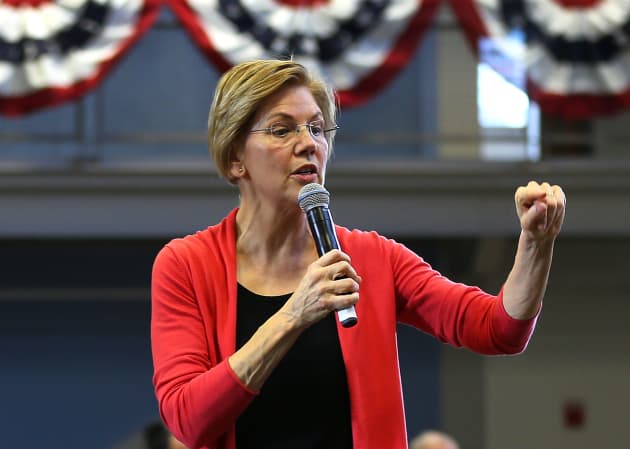
GP: U.S. Senator Elizabeth Warren Visits New Hampshire
U.S. Senator Elizabeth Warren speaks at Manchester Community College in Manchester, NH on Jan. 12, 2019.
John Tlumacki | Boston Globe | Getty Images
Democratic presidential candidate Elizabeth Warren has identified something else to finance with her proposed wealth tax: wiping out student debt and tuition at public colleges.
The Massachusetts senator, who has raced ahead of her 2020 rivals with detailed plans to rearrange America’s economic priorities, unveiled on Monday her proposal for easing access to higher education. It would:
  • Spend $1.25 trillion over 10 years to eliminate up to $50,000 in student debt for those with household incomes under $100,000
  • Allow states to make public colleges tuition-free
  • Spend $100 billion on expanded Pell grants to defray more nontuition expenses
The money would come from the 2% annual tax she proposes to levy on accumulations of wealth exceeding $50 million, with an additional 1% on wealth exceeding $1 billion. Warren justified the link by asserting that higher education financing has long been crimped by tax cuts for wealthy Americans and corporations.
“It’s time to end that experiment, to clean up the mess it’s caused and to do better,” Warren wrote in a Medium post. “We can make big structural change and create new opportunities for all Americans.”
The first step to addressing the student debt crisis is to deal with the outstanding debt that's weighing down millions of families. My plan for broad student debt cancellation would cancel debt for more than 95% of the 45 million Americans with student loan debt. Join our fight.
See Elizabeth Warren's other Tweets

Warren’s plan would scale back relief for people with incomes above $100,000 and would end entirely at the $250,000 level. She said her proposal would benefit 95% of the 45 million Americans carrying student debt and wipe it out for 75% of them. Those steps, she argued, that would stimulate the economy by improving credit scores, increasing homebuying and easing small-business formation.
At the same time, it would cut off federal money from for-profit colleges, which she says “enrich themselves while targeting lower-income students, service members and students of color and leaving them saddled with debt.”
Warren’s wealth tax would raise an estimated $2.7 trillion over 10 years. She has previously proposed using roughly $700 billion of that money to provide universal child care and early childhood education. In theory, that would leave nearly $1 trillion more for Warren to spend.

VIDEO09:38
What Democrats’ plans could mean for growth, spending and inequality
Warren has separately proposed a “Real Corporate Tax” designed to raise more than $1 trillion over 10 years from companies with profits exceeding $100 million, which now use deductions and loopholes to minimize or even eliminate their federal tax liabilities. She has also outlined higher estate taxes intended to raise $400 billion for expanding access to affordable housing.
With her flurry of proposals, Warren aims to demonstrate how fundamental policy shifts can expand opportunity for average Americans, curb the trend toward widening income inequalityand boost the overall economy in the process. In the crowded field of Democratic contenders, she seeks to stand out with the expertise gained in a career of consumer advocacy.
So far, the second-term senator has lagged behind rivals such as Sen. Bernie Sanders, former Rep. Beto O’Rourke and Sen. Kamala Harris in fundraising and in national polls. Even in New Hampshire, next door to Massachusetts, polling averages show her far behind Sanders and former Vice President Joe Biden, who is expected to enter the race this week.
One challenge facing Warren, among others in the massive 2020 field, is expanding her support among non-white voters who represent a large of growing chunk of the Democratic electorate. With so many blacks and Latinos burdened with student debt, Warren touted her plan’s ability to narrow the wealth gap between whites and those two groups. It includes a $50 billion fund to assist historically black colleges and universities.

Sunday, November 22, 2015

Turkey NEVER Changes!

  • The law stated that the homes and workplaces of those non-Muslims who could not afford the tax would be sequestered.
  • Under the AKP rule, Turkey's dwindling Jewish community, now at around a mere 17,000, as well as other non-Muslims, have come under systematic intimidation from government politicians and bureaucrats. These non-Muslim minorities are also often the targets of racist attacks.
It was 1942 when, one day, Hayim Alaton, a Jewish yarn importer in Istanbul, received two payment notices from the tax office: He was asked to pay 80,000 liras in total -- a fortune at that time. He ran to the tax office to object, but was told to pay the whole amount within 15 days. It was the infamous Wealth Tax, passed on Nov. 11, 1942 and it remained in effect for a year and a half until it was repealed on March 14, 1944.
The Wealth Tax exclusively targeted Turkey's non-Muslims at a time when 300,000 Orthodox Greeks and 100,000 Jews were living in Istanbul (where total population was one million). The law stated that the homes and workplaces of those non-Muslims who could not afford the tax would be sequestered. Alaton was able to pay no more than 11,000 liras. That was the start of "black years," as Alaton's son, 15 years old at that time, would later recall.
Before long, the Alaton's home and store were sequestered. The merchandise in the store and the goods in stock were sold at auction. Every item in the Alaton home, including kitchen utensils, bed frames and lamps were seized and sold too. The family of six was left only with mattresses. In later days, Alaton was taken from his home and sent to a tent camp in Istanbul where he was kept for two months. There were no meals, so his children would bring him whatever food they could find. One day the 15-year-old Ishak went to the camp and saw his father's tent empty. The Turkish authorities had put Alaton, along with many others, on a train bound for the town of Askale, in eastern Turkey, where the non-Muslims would be forced to perform physical labor, in this instance, cutting stones on a hill. Alaton would stay in the forced-labor camp for two hard winters and one summer.
The family would not hear from him for a year. During that time, the bodies of 20 laborers at Askale were sent home. Ishak recalls his father's return: "One evening, there was a knock on our door and an aged, wretched beggar stepped in. We wondered who he was and looked at him with curiosity. When he started to speak, we knew from his voice that he was my father."
By that time, the family business had gone bankrupt and Alaton, in the grip of a crippling depression, could not leave home. He died running a small store where he sold a small inventory of imported goods.
In a 2011 interview, Hayim Alaton's son, Ishak, who, after turbulent years in his youth, would found one of Turkey's most successful industrial conglomerates, would praise Turkey's ruling Islamists, the Justice and Development Party (AKP) by saying "the AKP has taken many positive steps to improve the situation of non-Muslim minorities."
Unfortunately, that was a premature conclusion, as the younger Alaton would learn four years later.
Under the AKP rule, Turkey's dwindling Jewish community, now at around a mere 17,000, as well as other non-Muslims, have come under systematic intimidation from government politicians and bureaucrats. These non-Muslim minorities are also often the targets of racist attacks.
Now 90, Ishak Alaton, although widely respected as "a man of wisdom" by the Turks -- Jews, Christians and Muslims alike -- is under scrutiny on charges of supporting terror.
An Ankara prosecutor is inspecting claims that Alaton has provided financial and moral support to what the state bureaucracy calls "the parallel structure" -- a movement led by an influential U.S.-based Muslim cleric, Fethullah Gulen. Gulen and his movement were staunch AKP allies until the end of 2013, when the two engaged in an all-out war. The Gulenists accuse Turkey's President Recep Tayyip Erdogan and the AKP of autocratic rule and corruption, and the Turkish government has declared the Gulenists a terror organization that aims to topple the government.

Ishak Alaton (left), a 90-year-old Turkish Jewish industrialist, is being investigated on charges of "supporting terror," for providing financial and moral support to Fethullah Gulen (right), a U.S.-based Muslim cleric who is a political rival of Turkey's president.

The charges against Alaton are based on his 2013 biography, "Unnecessary Man," and were leveled after a former colleague of Alaton's filed a criminal complaint against him. Some passages in the book refer to Alaton's support for the Gulen movement schools outside Turkey, particularly one in Moscow. The probe has been ongoing for about a year.
This is the passage from the biography that the prosecutors may be thinking is an evidence of the 90-year-old man's support for terror:
"This [Gulen] movement is a great educational movement. It educates people. It changes people's outlook on life and makes them into better equipped, worldly people. The Gulen movement is involved in educational efforts. I've seen the outcome of such efforts with my own eyes. Once in Moscow we, as a company, participated in the establishment of such a school. We managed to acquire the land from the Moscow municipality and the school began there. The Russian officials asked us, 'What are they trying to do? We don't know them, what do you say?' [My business partner] Uzeyir Garih and I vouched for them, we told them [the Russians], 'Don't worry, let them build the school.'"
When it comes to persecution Turkey's state machinery never changes.
Burak Bekdil, based in Ankara, is a Turkish columnist for the Hürriyet Daily and a Fellow at the Middle East Forum.
© 2015 Gatestone Institute. All rights reserved. No part of the Gatestone website or any of its contents may be reproduced, copied or modified, without the prior written consent of Gatestone Institute.