Contact Form

Name

Email *

Message *

Showing posts with label Wuppertal. Show all posts

Tuesday, June 13, 2017

Germany Under Knife Attack!

Translations of this item:
  • Not only are knife-related crimes surging, but the perpetrators and victims of such crimes are increasingly younger and increasingly female.
  • Germany's knife-crime problem is being exacerbated by its lenient judicial system, in which offenders receive relatively light sentences, even for serious crimes. In many instances, individuals who are arrested for knife-related crimes are released after questioning from police. This practice allows criminal suspects to continue committing crimes with virtual impunity.
  • More than 1,600 knife-related crimes were reported in Germany during just the first five months of 2017 — an average of 300 such crimes each month, or ten a day.
A Syrian migrant was stabbed to death in northern Germany by another Syrian because he was eating ice cream during Ramadan. The murder — which occurred in broad daylight in a busy pedestrian shopping area in Oldenburg and caused great consternation among local citizens — is not just the latest example of Sharia law being enforced on German streets. The crime also highlighted the growing epidemic of knife violence in Germany.
Knives, axes and machetes have become weapons of choice for criminals in Germany, which has some of the strictest gun laws in Europe. Knives are not only being used to carry out jihadist attacks, but increasingly to commit homicides, robberies, home invasions, sexual assaults, honor killings and many other kinds of violent crime.

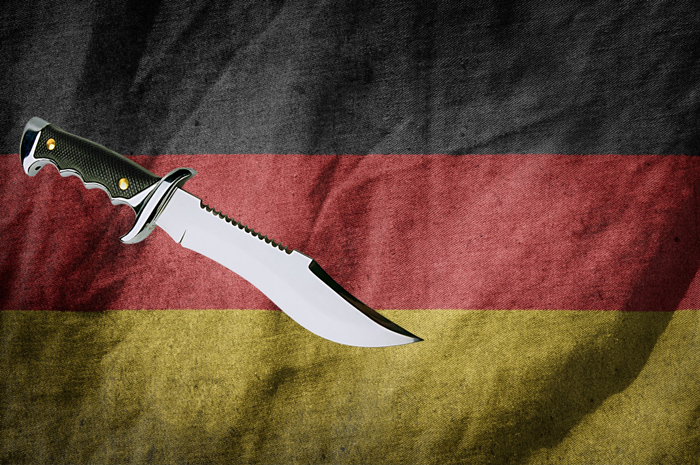
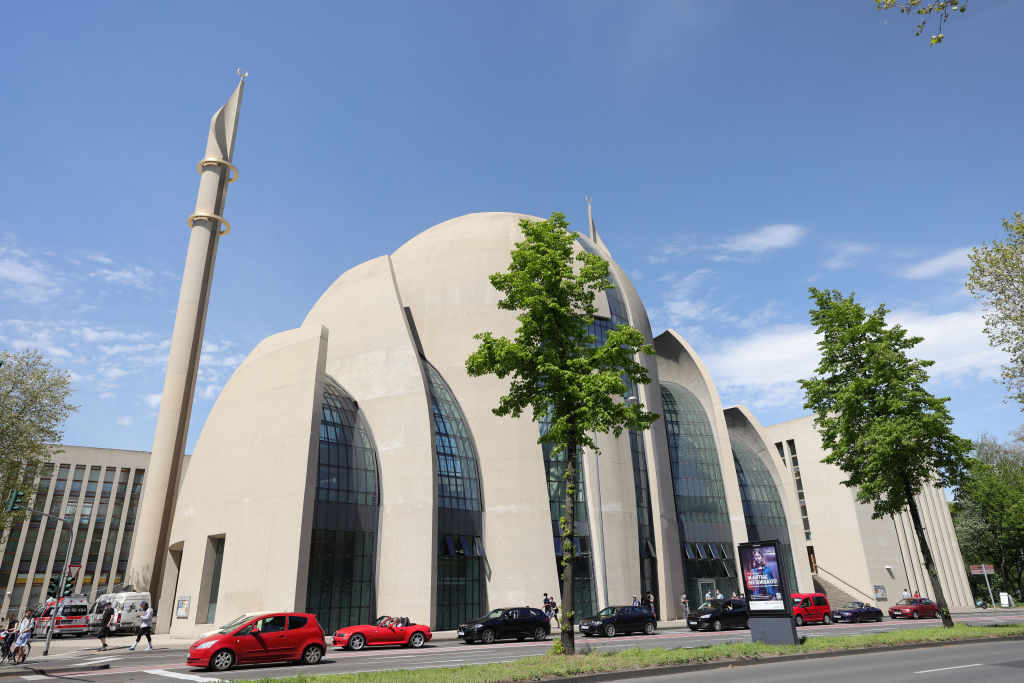
(Images source: Pixabay)

Reliable statistics on knife violence in Germany do not exist. A search of German police blotters, however, shows that during the past ten years the number of knife-related crimes in Germany has increased by more than 1,200%. Around 4,000 such crimes were reported to police in 2016, up from just 300 in 2007.
It is also impossible to determine how many of these knife crimes involved migrants. Increased censorship by the police and the media, aimed at stemming anti-immigration sentiments, makes the public incapable of knowing the names and national origins of many perpetrators or victims.
The surge in knife-related violence in Germany does, however, coincide with Chancellor Angela Merkel's decision to allow in some two million migrants from Africa, Asia and the Middle East. The number of reported knife crimes in Germany jumped by 600% during the past four years — from about 550 in 2013 to nearly 4,000 in 2016.
Police reports show that both migrants and non-migrants are responsible for the increase in knife crimes in Germany. Merkel's open-door migration policies appear to have set in motion a self-reinforcing cycle of violence in which more and more people are carrying knives in public — including for self-defense. Her policies appear to be leading to more and more stabbings, especially when alcohol is involved.
Not only are knife-related crimes surging, but the perpetrators and victims of such crimes are increasingly younger and increasingly female:
  • In Bochum, a 19-year-old woman stabbed two boys, aged 12 and 13 years. Police said the three had been arguing when the woman pulled out a knife. The boys ran away and tried to hide in a parking garage, but the woman pursued and attacked them.
  • In Soest, a 16-year-old boy stabbed a 17-year-old classmate seven times in the chest in a dispute over a girl. The victim was hospitalized with life-threatening injuries to his heart. The assailant was released after a psychiatrist persuaded prosecutors that he could not be held responsible for his actions because he acted in the "heat of passion" (im Affekt).
  • In Essen, two boys, aged 11 and 13, pulled a knife on a 20-year-old woman in an effort to rob her of her cellphone. She resisted and called police, who detained the attackers.
  • In Wuppertal, a "southern looking man" (südländisches Erscheinungsbild) stabbed a 13-year-old boy after he looked at his attacker supposedly "the wrong way."
  • In Kirchdorf, a "southerner" (südländische Erscheinung) pulled a knife on a 12-year-old girl.
  • In Nachrodt-Wiblingwerde, a group of teenagers drew a knife on a 17-year-old girl after she "provoked" them.
  • In Berlin-Neukölln, a 16-year-old boy was stabbed during an altercation with a 32-year-old man.
  • In Neumünster, a 15-year-old stabbed a 19-year-old after two groups of teenagers got into an altercation.
  • In Gevelsberg, a "dark-skinned" man (dunkelhäutig) stabbed a 14-year-old girl near the central train station as she was walking home.
Some knife attacks appear to have political or religious motives:
  • In Hanover, a 16-year-old German-Moroccan girl stabbed a police officer in the neck with a kitchen knife. Police said the incident, which occurred at the central train station, was the first jihadist attack in Germany inspired by the Islamic State. "The perpetrator did not display any emotion," a police spokesperson said. "Her only concern was for her headscarf. She was concerned that her headscarf be put back on properly after she was arrested. Whether the police officer survived, she did not care."
  • In Prien am Chiemsee, an Afghan man stabbed to death an Afghan woman who had converted to Christianity. The attacker ambushed the woman as she was exiting a grocery store with her two children.
  • In Munich, a man shouting "Allahu Akbar" and "infidels must die" stabbed one person to death and slashed three others in an attack at a train station.
  • In Würzburg, on a train, an Afghan asylum seeker shouting "Allahu Akbar" attacked five people with an axe.
  • In Oberhausen, a man shouting "Allahu Akhbar" stabbed a 66-year-old woman and a 57-year-old man who were picnicking.
Knife attacks are also common during brawls involving feuding ethnic groups:
  • In Gelsenkirchen, gangs of Syrian and Lebanese youths got into a mass knife fight in the city center. Police said that the level of violence was "brutal."
  • In Mülheim, around 80 members of two rival Lebanese clans got into a knife fight in the center of the city. It took hundreds of police, armed with machine guns, dogs and helicopters, more than three hours to restore order.
  • In Hanover, members of two rival Kurdish clans got into a knife fight in front of the central train station.
  • In Mainz-Gonsenheim, several people were stabbed during a mass brawl between Syrians and Iranians.
  • In Dortmund, an immense brawl ensued after a member of one ethnic group pulled a knife on someone from another ethnic group.
  • In Neumünster, a 15-year-old stabbed a 19-year-old after two groups of teenagers from feuding ethnic groups got into an altercation.
  • In Gütersloh, two men were stabbed and seriously wounded during a fight between two feuding ethnic groups.
  • In Leipzig, an Iraqi man was stabbed and seriously injured during a massive brawl in front of a Kebab restaurant. When police tried to intervene, the mob attacked them with bottles and stones
  • In Hamm-Herringen, two men were stabbed and seriously wounded during a fight between two feuding ethnic groups.
Other knife attacks are seemingly random:
  • In Hamburg, a 16-year-old boy and his 15-year-old girlfriend were walking along the banks of the Alster, a lake in the heart of the city, when a stranger ambushed them from behind and plunged a knife into his back. The attacker then pushed the girl into the water and walked away. The girl survived but the boy died. The suspect, a "southern-looking" (südländischer Erscheinung) man in his early twenties, remains at large. Police say the victims were not robbed and there is no evident motive for the crime: they said that the suspect appears to have randomly stabbed the boy just because he felt like it.
  • In Bremen, a 29-year-old man was randomly stabbed and seriously wounded at the Waterfront shopping center. The entire facility was closed after the attack.
  • In Dessau-Roßlau, two Syrian asylum seekers randomly stabbed two German female passersby in a pedestrian zone in broad daylight.
  • In Düsseldorf, a man brandishing a machete randomly stabbed an 80-year-old man in the Kalkum district. He remains at large.
  • In Wrohm, an Eritrean migrant randomly stabbed a 51-year-old woman.
Knife-related incidents are also becoming increasingly common on public transport hubs:
  • In Hamburg-Billstedt, two brothers were stabbed during a robbery at the Legienstraße subway station.
  • In Frankfurt, two "presumably East Europeans" (mutmaßlich Osteuropäer) wielding knives attacked commuters at the "Bonames Mitte" subway station.
  • In Dortmund-Bochum, two feuding ethnic groups got into a knife fight on the S-1 line.
  • In Dresden, a man carrying a 20-centimer (8-inch) knife was arrested at the central train station.
  • In Schönefeld, a man randomly pulled a knife on a traveler at the airport. It remains unclear how the perpetrator passed the knife through airport security.
  • In Baden-Baden, a man wielding a knife threatened passengers on a train.
Knives appear to be the weapon of choice in so-called honor killings:
  • In Kiel, a German-Turkish man stabbed to death his estranged Turkish wife in front of a daycare center.
  • In Bocholt, a Lebanese man stabbed to death his Moroccan wife, the mother of his three children, because he thought she wanted to divorce him.
  • In Scheeßel, an Iraqi man stabbed to death his wife. Police described the murder as an honor killing.
  • In Ahaus, a Nigerian asylum seeker stabbed to death a Hindu woman after she seemingly offended his honor by rejecting his romantic advances. The woman was employed at the asylum shelter where her attacker lived.
  • In Hanover-Mühlenberg, a Serbian man stabbed his ex-girlfriend after she ended their relationship and had begun seeing someone else.
  • In Berlin, a 32-year-old Bosnian man stabbed to death his former girlfriend after she ended their abusive relationship.
  • In Hanau, a Syrian refugee stabbed to death his 30-year-old sister, who was 23 weeks pregnant and was accused of having brought shame to her family. Her unborn child also died in the attack.
  • In Freiburg, a Syrian asylum seeker stabbed his wife, a Kurdish Christian who had moved out of the couple's apartment, but had returned to collect some personal belongings.
  • In Köln-Buchheim, an Iraqi man stabbed to death his 19-year-old daughter because he did not approve of her boyfriend. The man may never face justice; he is believed to have fled to Iraq.
  • In Bonn, a Palestinian brandishing a "Rambo knife" and shouting "Allahu Akbar" tried to behead a doctor. The attacker's 19-year-old son had complained about the doctor's treatment for a fractured leg. The man, holding the doctor down on the floor, said: "Apologize to my son. Go down on your knees and kiss his hand."
Germany's knife-crime problem is being exacerbated by its lenient judicial system, in which offenders receive relatively light sentences, even for serious crimes. In many instances, individuals who are arrested for knife-related crimes are released after questioning from police. This practice allows criminal suspects to continue committing crimes with virtual impunity.
In Berlin, for example, a migrant who stabbed and seriously injured another migrant after he refused to give him alcohol and drugs was released and financially compensated because no witnesses to the crime could be found.
Also in the German capital, investigators discovered that Anis Amri, the 24-year-old suspect in the December 2016 Berlin terrorist attack in which 12 people died, had been involved in a knife-fight in the city's Neukölln district in July 2016, but police failed to arrest him. Had Amri been deported, as he should have been, the Berlin attack possibly could have been prevented.
According to Arnold Plickert, the deputy national chairman of the GdP police union, much of the knife-violence in Germany can be attributed to certain segments of society that live according to their own rules, not those of the German state. In an interview with knife-blog.com, a German forum for knife enthusiasts, he said:
"We are monitoring a specific target group, which mainly consists of young males who are armed in everyday life and basically are dedicated to armed confrontation. We see this particularly in large Arab families, Lebanese clans, for whom knives are standard gear. Knives are also basic equipment for career criminals and members of youth gangs."
Plickert also noted changes in German society, including a growing disrespect for police and rescue workers: "From my point of view, I can say that the inhibition threshold to the use of violence has significantly decreased."
Meanwhile, more than 1,600 knife-related crimes were reported in Germany during just the first five months of 2017 — an average of 300 such crimes each month, or ten a day. Notable knife-related incidents during the month of May include:
In Freiburg, a Turkish man stabbed another Turk sitting in the passenger seat of a car stopped at a traffic light. In Karlsruhe, a Somali asylum seeker stabbed another Somali asylum seeker. Police said the attack was an act of revenge: the stabbing victim had recently stabbed the stabber. In Aachen, a North African man pulled a knife on a security guard at a grocery store after he was caught shoplifting.
In Schwerin, a Syrian man pulled a knife on another Syrian man in a dispute over a 15-year-old girl who is not Syrian. In Gelsenkirchen, a 20-year-old pulled a knife on a 46-year-old man during a traffic incident. In Bad Oldesloe, four teenagers pulled a knife and robbed a 61-year-old man. In Wiesbaden, a "southern-looking" man pulled a knife and tried to rob a man at a sports complex. In Hofheim, a man with an "Eastern European accent" pulled a knife and tried to rob a store.
In Peine, an asylum seeker from Sudan stabbed and seriously wounded an asylum seeker from the Ivory Coast. In Kassel, a Syrian migrant stabbed a Turkish man during a dispute over money. In Bad Reichenhall, a man stabbed another man in the neck during an altercation at a bar. In Bühl, a man stabbed several people at a public swimming pool. In Wiesbaden, a man was stabbed and seriously wounded during an altercation at a city park.
In Augsburg, two men were stabbed by a random attacker at a grill fest. In Hamburg, an unknown assailant stabbed a migrant from Guinea-Bissau. In Rheine, two men speaking German with a French accent pulled a knife on a woman and robbed her.
In Berlin, a man stabbed and seriously wounded his former girlfriend and her new partner during an altercation at a restaurant in Waidmannslust. In Duisburg, a man pulled a knife on a cashier at a supermarket. In Salzgitter, a man stabbed another man in a restaurant. In Freiburg, an Eastern European-looking man (osteuropäisch) stabbed a 15-year-old boy during an altercation at a restaurant. In Danndorf, three men were stabbed during an altercation over drugs.
In Mölln, a man stabbed a co-worker in the back. In Michelstadt, a man stabbed another man during an altercation. In Essen, a man pulled a knife on his wife at the central train station. In Karlsruhe, a man was stabbed by his girlfriend's former boyfriend. In Cologne-Ostheim, a 16-year-old student pulled a knife on his classmates and teacher.
In Neuenburg, two men were stabbed during an altercation at a restaurant. In Kassel, a man was stabbed in the neck during an altercation at a café. In Dortmund, a man was robbed at knifepoint at the central bus station.
In Cottbus, members of Syrian gang stabbed five Germans. In Lich, a man was stabbed during an altercation. In Kassel, a man was randomly stabbed by a man with a "southern appearance" (südländisches Äußeres). In Preetz, a man pulled a knife on shoppers at a supermarket. In Dortmund, two men were stabbed during an altercation in the city center. In Frankfurt-Schwanheim, a man wielding a knife robbed a local post office.
In Pforzheim, a 53-year-old Tajik man stabbed to death his 50-year-old wife at her place of employment, a Christian daycare center. It remains unclear if the woman was a convert to Christianity. In Wardenburg, an Iraqi man stabbed to death his wife, the mother of his five children, while she was asleep in her bed.
In Tübingen, a man was stabbed and seriously injured at the central train station during an altercation. In Hamburg-St. Georg, two men were stabbed and seriously injured near the train station. In Berlin-Wedding, two brothers were stabbed during an altercation with another man at a Kebab restaurant. In Kreuztal, a 53-year-old man was stabbed and seriously wounded during an altercation at his home.
In Lübeck, a 21-year-old man was stabbed and seriously injured during an altercation between two groups near the central bus station. In Diez, a woman stabbed a man in the back. In Ründeroth, a 17-year-old was stabbed and seriously wounded at a local festival. In Neuendettelsau, an Ethiopian asylum seeker stabbed his girlfriend in the stomach at a restaurant after she allegedly "provoked" him. The woman, five months pregnant, survived but the unborn baby died.
Soeren Kern is a Senior Fellow at the New York-based Gatestone Institute. Follow him on Facebook and on Twitter.
© 2017 Gatestone Institute. All rights reserved. The articles printed here do not necessarily reflect the views of the Editors or of Gatestone Institute. No part of the Gatestone website or any of its contents may be reproduced, copied or modified, without the prior written consent of Gatestone Institute.

Thursday, December 1, 2016

This Is What A Country Looks Like When It Surrenders To Sharia Law

  • A German court has ruled that seven Islamists who formed a vigilante patrol to enforce Sharia law on the streets of Wuppertal did not break German law and were simply exercising their right to free speech. The "politically correct" decision, which may be appealed, effectively authorizes the Sharia Police to continue enforcing Islamic law in Wuppertal.
  • The self-appointed "Sharia Police" distributed leaflets which established a "Sharia-controlled zone" in Wuppertal. The men urged both Muslim and non-Muslim passersby to attend mosques and to refrain from alcohol, cigarettes, drugs, gambling, music, pornography and prostitution.
  • Critics say the cases — especially those in which German law has taken a back seat to Sharia law — reflect a dangerous encroachment of Islamic law into the German legal system.
  • In June 2013, a court in Hamm ruled that anyone who contracts marriage according to Islamic law in a Muslim country and later seeks a divorce in Germany must abide by the original terms established by Sharia law. The landmark ruling effectively legalized the Sharia practice of "triple-talaq," obtaining a divorce by reciting the phrase "I divorce you" three times.
  • A growing number of Muslims in Germany are consciously bypassing German courts altogether and instead are adjudicating their disputes in informal Sharia courts, which are proliferating across the country.
  • "If the rule of law fails to establish its authority and demand respect for itself, then it can immediately declare its bankruptcy." — Franz Solms-Laubach, Bild'sparliamentary correspondent.
A German court has ruled that seven Islamists who formed a vigilante patrol to enforce Sharia law on the streets of Wuppertal did not break German law and were simply exercising their right to free speech.
The ruling, which effectively legitimizes Sharia law in Germany, is one of a growing number of instances in which German courts are — wittingly or unwittingly — promoting the establishment of a parallel Islamic legal system in the country.
The self-appointed "Sharia Police" sparked public outrage in September 2014, when they distributed yellow leaflets which established a "Sharia-controlled zone" in the Elberfeld district of Wuppertal. The men urged both Muslim and non-Muslim passersby to attend mosques and to refrain from alcohol, cigarettes, drugs, gambling, music, pornography and prostitution.

A German court has ruled that a group of Islamists who formed a vigilante patrol to enforce Sharia law on the streets of Wuppertal did not break German law and were simply exercising their right to free speech. They were charged under a law that prohibits the wearing of uniforms at public rallies -- a law originally designed to ban neo-Nazi groups from parading in public.

The vigilantes are followers of Salafism, a virulently anti-Western ideology that openly seeks to replace democracy in Germany (and elsewhere) with an Islamic government based on Sharia law.
Salafist ideology posits that Sharia law is superior to secular, common law because it emanates from Allah, the only legitimate lawgiver, and thus is legally binding eternally for all of humanity. According to the Salafist worldview, democracy is an effort to elevate the will of humans above the will of Allah, and is therefore a form of idolatry that must be rejected. In other words, Sharia law and democracy are incompatible.
Wuppertal Mayor Peter Jung said he hoped the police would take a hard line against the Islamists: "The intention of these people is to provoke and intimidate and force their ideology upon others. We will not allow this."
Wuppertal Police Chief Birgitta Radermacher said the "pseudo police" represented a threat to the rule of law and that only police appointed and employed by the state have the legitimate right to act as police in Germany. She added:
"The monopoly of power lies exclusively with the State. Behavior that intimidates, threatens or provokes will not be tolerated. These 'Sharia Police' are not legitimate. Call 110 [police] when you meet these people."
Wuppertal's public prosecutor, Wolf-Tilman Baumert, argued that the men, who wore orange vests emblazoned with the words "SHARIAH POLICE," had violated a law that bans wearing uniforms at public rallies. The law, which especially prohibits uniforms that express political views, was originally designed to prevent neo-Nazi groups from parading in public. According to Baumert, the vests were illegal because they had a "deliberate, intimidating and militant" effect.
On November 21, 2016, however, the Wuppertal District Court ruled that the vests technically were not uniforms, and in any event did not pose a threat. The court said that witnesses and passersby could not possibly have felt intimidated by the men, and that prosecuting them would infringe on their freedom of expression. The "politically correct" decision, which may be appealed, effectively authorizes the Sharia Police to continue enforcing Islamic law in Wuppertal.

German Courts and Sharia Law

German courts are increasingly deferring to Islamic law because either the plaintiffs or the defendants are Muslim. Critics say the cases — especially those in which German law has taken a back seat to Sharia law — reflect a dangerous encroachment of Islamic law into the German legal system.
In May 2016, for example, an appeals court in Bamberg recognized the marriage of a 15-year-old Syrian girl to her 21-year-old cousin. The court ruled that the marriage was valid because it was contracted in Syria, where such marriages are allowed according to Sharia law, which does not set any age limit to marriage. The ruling effectively legalized Sharia child marriages in Germany.
The case came about after the couple arrived at a refugee shelter in Aschaffenburg in August 2015. The Youth Welfare Office (Jugendamt) refused to recognize their marriage and separated the girl from her husband. The couple filed a lawsuit and a family court ruled in favor of the Youth Welfare Office, which claimed to be the girl's legal guardian.
The court in Bamberg overturned that ruling. It determined that, according to Sharia law, the marriage is valid because it has already been consummated, and therefore the Youth Welfare Office has no legal authority to separate the couple.
The ruling — which was described as a "crash course in Syrian Islamic marriage law" — ignited a firestorm of criticism. Some accused the court in Bamberg of applying Sharia law over German law to legalize a practice that is banned in Germany.
Critics of the ruling pointed to Article 6 of the Introductory Act to the German Civil Code (Einführungsgesetz zum Bürgerlichen Gesetzbuche, EGBGB), which states:
"A legal standard of another State shall not be applied where its application results in an outcome which is manifestly incompatible with the essential principles of German law. In particular, it is not applicable if the application is incompatible with fundamental rights."
This stipulation is routinely ignored, however, apparently in the interests of political correctness and multiculturalism. Indeed, Sharia law has been encroaching into the German justice system virtually unchecked for nearly two decades. Some examples include:
  • In August 2000, a court in Kassel ordered a widow to split her late Moroccan husband's pension with another woman to whom the man was simultaneously married. Although polygamy is illegal in Germany, the judge ruled that the two wives must share the pension, in accordance with Moroccan law.
  • In March 2004, a court in Koblenz granted the second wife of an Iraqi living in Germany the right to remain permanently in the country. The court ruled that after five years in a polygamous marriage in Germany, it would be unfair to expect her to return to Iraq.
  • In March 2007, a judge in Frankfurt cited the Koran in a divorce case involving a German-Moroccan woman who had been repeatedly beaten by her Moroccan husband. Although police ordered the man to stay away from his estranged wife, he continued to abuse her and at one point threatened to kill her. Judge Christa Datz-Winter refused to grant the divorce. She quoted Sura 4, Verse 34 of the Koran, which justifies "both the husband's right to use corporal punishment against a disobedient wife and the establishment of the husband's superiority over the wife." The judge was eventually removed from the case.
  • In December 2008, a court in Düsseldorf ordered a Turkish man to pay a €30,000 ($32,000) dowry to his former daughter-in-law, in accordance with Sharia law.
  • In October 2010, a court in Cologne ruled that an Iranian man must pay his ex-wife a dower of €162,000 euros ($171,000), the current equivalent value of 600 gold coins, in accordance with the original Sharia marriage contract.
  • In December 2010, a court in Munich ruled that a German widow was entitled to only one-quarter of the estate left by her late husband, who was born in Iran. The court awarded the other three-quarters of the inheritance to the man's relatives in Tehran in accordance with Sharia law.
  • In November 2011, a court in Siegburg allowed an Iranian couple to be divorced twice, first by a German judge according to German law, and then by an Iranian cleric according to Sharia law. The director of the Siegburg District Court, Birgit Niepmann, said the Sharia ceremony "was a service of the court."
  • In July 2012, a court in Hamm ordered an Iranian man to pay his estranged wife a dower as part of a divorce settlement. The case involved a couple who married according to Sharia law in Iran, migrated to Germany and later separated. As part of the original marriage agreement, the husband promised to pay his wife a dower of 800 gold coins payable upon demand. The court ordered the husband to pay the woman €213,000 ($225,000), the current equivalent value of the coins.
  • In June 2013, a court in Hamm ruled that anyone who contracts marriage according to Islamic law in a Muslim country and later seeks a divorce in Germany must abide by the original terms established by Sharia law. The landmark ruling effectively legalized the Sharia practice of "triple-talaq," obtaining a divorce by reciting the phrase "I divorce you" three times.
  • In July 2016, a court in Hamm ordered a Lebanese man to pay his estranged wife a dower as part of a divorce settlement. The case involved a couple who married according to Sharia law in Lebanon, migrated to Germany and later separated. As part of the original marriage agreement, the husband promised to pay his wife a dower of $15,000. The German court ordered him to pay her the equivalent amount in euros.
In an interview with Spiegel Online, Islam expert Mathias Rohe said that the existence of parallel legal structures in Germany is an "expression of globalization." He added: "We apply Islamic law just as we do French law."

Sharia Courts in Germany

A growing number of Muslims in Germany are consciously bypassing German courts altogether and instead are adjudicating their disputes in informal Sharia courts, which are proliferating across the country. According to one estimate, some 500 Sharia judges are now regulating civil disputes between Muslims in Germany — a development that points to the establishment of a parallel Islamic justice system in the country.
A major reason for the growth in Sharia courts is that Germany does not recognize polygamy or marriages involving minors.
The German Interior Ministry, responding to a Freedom of Information Act request, recently revealed that 1,475 married children are known to be living in Germany as of July 31, 2016 — including 361 children who are under the age of 14. The true number of child marriages in Germany is believed to be much higher than the official statistics suggest, because many are being concealed.
Polygamy, although illegal under German law, is commonplace among Muslims in all major German cities. In Berlin, for example, it is estimated that fully one-third of the Muslim men living in the Neukölln district of the city have two or more wives.
According to an exposé broadcast by RTL, one of Germany's leading media companies, Muslim men residing in Germany routinely take advantage of the social welfare system by bringing two, three or four women from across the Muslim world to Germany, and then marrying them in the presence of a Muslim cleric. Once in Germany, the women request social welfare benefits, including the cost of a separate home for themselves and for their children, on the claim of being a "single parent with children."
Although the welfare fraud committed by Muslim immigrants is an "open secret" costing German taxpayers millions of euros each year, government agencies are reluctant to take action due to political correctness, according to RTL.
Chancellor Angela Merkel once declared that Muslims must obey the constitution and not Sharia law if they want to live in Germany. More recently, Justice Minister Heiko Maas said:
"No one who comes here has the right to put his cultural values or religious beliefs above our law. Everyone must abide by the law, no matter whether they have grown up here or have only just arrived."
In practice, however, German leaders have tolerated a parallel Islamic justice system, one which allows Muslims to take the law into their own hands, often with tragic consequences.
On November 20, 2016, for example, a 38-year-old German-Kurdish man in Lower Saxony tied one end of a rope to the back of his car and the other end around the neck of his ex-wife. He then dragged the woman through the streets of Hameln. The woman, who survived, remains in critical condition.
The newsmagazine, Focus, reported that the man was a "strictly religious Muslim who married and divorced the woman according to Sharia law." It added: "Under German law, however, the two were not married." Bild reported that the man was married "once under German law and four times under Sharia law."
The crime, which has drawn renewed attention to the problem of Sharia justice in Germany, has alarmed some members of the political and media establishment.
Wolfgang Bosbach, of the ruling Christian Democratic Union (CDU), said: "Even if some people refuse to admit it, a parallel justice system has established itself in Germany. This act shows a clear rejection of our values ​​and legal order."
On November 23, Bild, the largest-circulation newspaper in Germany, warned that the country was "capitulating to Islamic law." In a special "Sharia Report" it stated:
"The 2013 coalition agreement between the CDU and the Social Democrats promised: 'We want to strengthen the state's legal monopoly. We will not tolerate illegal parallel justice.' But nothing has happened."
In a commentary, Franz Solms-Laubach, Bild's parliamentary correspondent, wrote:
"Even if we still refuse to believe it: Parts of Germany are ruled by Islamic law! Polygamy, child marriages, Sharia judges — for far too long the German rule of law has not been enforced. Many politicians dreamed of multiculturalism....
"This is not a question of folklore or foreign customs and traditions. It is a question of law and order.
"If the rule of law fails to establish its authority and demand respect for itself, then it can immediately declare its bankruptcy."
Soeren Kern is a Senior Fellow at the New York-based Gatestone Institute. He is also Senior Fellow for European Politics at the Madrid-based Grupo de Estudios Estratégicos / Strategic Studies Group. Follow him on Facebook and on Twitter.
© 2016 Gatestone Institute. All rights reserved. The articles printed here do not necessarily reflect the views of the Editors or of Gatestone Institute. No part of the Gatestone website or any of its contents may be reproduced, copied or modified, without the prior written consent of Gatestone Institute.