When "Progressivism" Crushes Muslim Women
In spite of repeated and verified accounts of the physical and sexual abuse of women and girls throughout Muslim parts of the world, Western feminists at best remain silent, and at worst supportive of the male oppressors.
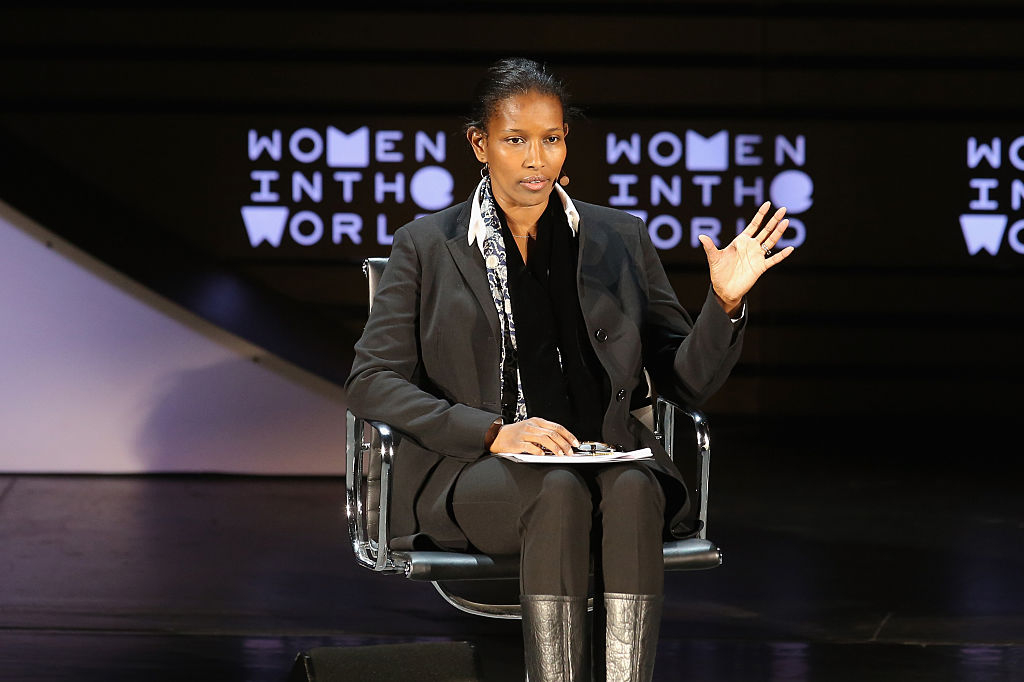
It seems illogical for self-described "progressives" to turn a blind eye to the misery of fellow females forced to endure the kind of unimaginable treatment documented by best-selling authors Ayaan Hirsi Ali and Azar Nafisi. The reason for that is rooted in a regard for "multiculturalism" in which anti-Americanism and anti-Zionism are considered more vital than the victimization of women. In such a value system, the highest priority is the ultimate goal of destroying pluralistic and democratic Western values, which the far-left views as a euphemism for conservative, capitalist, colonialist, imperialist ideals that must be eradicated. They do not even bother to realize that throughout history, Muslim conquests -- not even speaking of Asia -- but of the Christian Byzantine Empire, the Middle East, North Africa, Eastern Europe, Greece, Spain and Northern Cyprus have been even more repressive, brutal and absolute. According to this "liberal," essentially totalitarian, worldview, the United States and Israel are what the Iranian ayatollahs callthe "Great Satan" and the "Little Satan," while radical groups and regimes that oppose America and the Jewish state are supposedly allies. It is thus that Judith Butler, professor of comparative literature at University of California, Berkeley and a "gender and third-wave feminist queer theorist," justifies her support for Islamist terrorist organizations such as Hamas and Hezbollah, which she referred to at a 2006 anti-Israel teach-in as "social movements that are progressive... part of a global Left." This view is exactly upside-down and backwards. Hamas, the Sunni terrorist organization that rules the Gaza Strip, and Hezbollah, the Iran-backed Shiite terrorist group based in Lebanon and with a foothold in Syria, are not only mass murderers, but would subject Butler herself to Sharia (Islamic) law and deny her all human rights, let alone those associated with her womanhood and lesbianism. Butler is living in a fantasy world if she considers radical Islamists "progressive" in any shape or form. As far back as 2001, Bronwyn Winter, a senior lecturer at the University of Sydney and the Director of the Faculty of Arts International and Comparative Literary Studies program, noted that the "'multiculturalist' discourse... legitimates even the most fundamentalist Islamic voices in the name of 'cultural difference.'" This well-intentioned but sadly misguided view -- which then would presumably approve of Aztec human sacrifice, slavery and the former Indian practice of suttee, in which widows were thrown live on their husband's funeral pyre -- was expounded upon by Kay S. Haymowitz in an in-depth 2003 analysis of left-wing feminist attitudes to radical Islamism. Among the groups she examined were the postcolonialists, according to whose outlook: It is not men who are the sinners; it is the West. It is not women who are victimized innocents; it is the people who suffered under Western colonialism, or the descendants of those people, to be more exact. Caught between the rock of patriarchy and the hard place of imperialism, the postcolonial feminist scholar gingerly tiptoes her way around the subject of Islamic fundamentalism and does the only thing she can do: she focuses her ire on Western men.There is, of course, never any mention of the "people who suffered under Eastern colonialism," such as the Iranian victims of the current regime, or the victims of al-Qaeda and ISIS, or the nearly 11,000,000 Muslims killed since 1948. Of these, 90% were killed by other Muslims; only 3% by Israel. Phyllis Chesler, professor emerita of psychology and women's studies at the College of Staten Island (CUNY), put it this way: "Western feminists have become totally Stalinized and Palestinianized." The author of 14 books -- most recently An American Bride in Kabul: A Memoir(2013), about her 1961 marriage to an Afghani and her time spent in his harem -- Chesler strongly counters the message that leftist feminists are conveying to persecuted Muslim women: that the road to their salvation lies in the defeat of Western civilization, rather than in the overthrow of Sharia-dominated cultures and regimes that degrade and dehumanize them. If not for genuine feminist warriors, such Chesler, Hirsi Ali, and Nafisi, Muslim women the world over would feel completely abandoned and betrayed, and justifiably so.
A. Z. Mohamed is a Muslim man born and raised in the Middle East.
© 2017 Gatestone Institute. All rights reserved. The articles printed here do not necessarily reflect the views of the Editors or of Gatestone Institute. No part of the Gatestone website or any of its contents may be reproduced, copied or modified, without the prior written consent of Gatestone Institute.
|
Our goal is to have intelligent discussion of the topics of the day. We realize everyone has their opinion and they should be allowed to express it in a discussion forum without calling each other names. We learn from discussion and not from name calling or argument.We use cookies to personalise content and ads, to provide social media features and to analyse our traffic. We also share information about your use of our site with our social media, advertising and analytics partners. See details
Contact Form
Showing posts with label anti-zionism. Show all posts
Wednesday, September 6, 2017
Western Progressives Do Nothing For Their Muslim Sisters
Thursday, March 30, 2017
Self Hating Jews Cause Division When It Comes To Israel
The Inverted Ideological Pyramids of Anti-Zionist Jews: The Case of Moshe Zuckermann
By Evyatar FrieselMarch 30, 2017

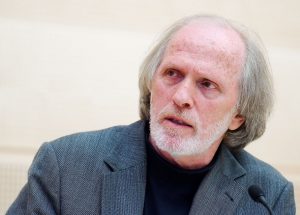
Prof. Moshe Zuckermann by Arne List via Wikimedia Commons
BESA Center Perspectives Paper No. 436, March 30, 2017
EXECUTIVE SUMMARY: Israeli professor Moshe Zuckermann's notions about antisemitism, Israel, and the Israeli-Palestinian conflict are representative of a current in Jewish thinking: anti-Zionism among Jews in both Israel and the Diaspora. Zuckermann's approach to developments in modern Jewry is based on assumptions that do not stand the test of historical analysis. The central factor in his thought is a visceral aversion to the Zionist idea and its realization.
It is remarkable how one remains in the grip of the cultural patterns of the group one was born into without necessarily being aware of it. Among Jews, there can be detected – even in unlikely sources – a distinctly Talmudic approach to logical thought. In this way of thinking, a scholar, building upon religious texts, comes to bizarre conclusions by dint of sheer mental gymnastics.
Professor Moshe Zuckermann, a highly assimilated Jew and a declared Marxist with no known ties to Jewish Orthodox circles, is an interesting example of this cultural power. His political ideas regarding Zionism and Israel follow one of the routes of Talmudic thinking: the pattern of the inverted pyramid, in which a broad, eloquent, and often fierce array of related views is built on a given premise. The problem with Zuckermann’s logic is that his premise – the single point on which the inverted pyramid stands – is a subjective hunch that does not stand up to historical analysis.
Born in 1947 in Tel Aviv, Zuckermann spent part of his youth in Germany and returned in the late 1960s to Israel. He studied at Tel Aviv University, where he later became a professor of history and philosophy, but has remained attuned to the German academic scene. Most of his books and articles are in German, and he is a frequent participant in interviews in the German press and at German academic conventions.
Here we consider an article Zuckermann recently published in a German Marxist review, Neue Welt (no. 34, February 10, 2017), entitled “German Sensitivities” (“Deutsche Befindlichkeiten”). In two interwoven themes in the article, antisemitism and the Israel-Palestinian conflict, Zuckermann repeats positions he has made elsewhere. His basic assumptions regarding both themes – the points on which the inverted pyramid stands – are dubious.
Regarding antisemitism: Zuckermann explains Jew-hatred as a prejudice like any other, such as xenophobia, anti-Islamism, or discrimination against women or homosexuals. This is incorrect. Anti-Judaism is doctrine, Christian doctrine deeply embedded in Western culture. It goes back to a confrontation at the very foundation of Christianity. It started with the Apostle Paul, got a full formulation by Augustine of Hippo in the fourth century, and took on new expressions in the Middle Ages. Jew-hatred underwent an astonishing transformation in modern times through adaptation into a mainly secular framework under the new name antisemitism. This strain contained a radical new goal that was not present in older Judeophobia: the extermination of the Jews, now defined as a pernicious race.
One of the illusions of our times, an understandable case of wishful thinking, is that the horrors of the Holocaust rattled Western culture enough to pave the way to an eventual end to Jew-hatred. Sectors of Western society were indeed rattled (including the Church), but a few decades of soul-searching have not proved sufficient to erase a millennia-old component of the Western spiritual heritage. Like a chameleon, Judeophobia has changed colors and leitmotifs over the centuries, and it continues to do so. Today, before our eyes, it is reformulating itself into anti-Israelism. Although anchored in the broad ideological spectrum of Western society, much of the ideological impulse of Jew-hatred in the nineteenth and twentieth centuries came from the political right and nationalist circles. At present, the main impulse of the new Judeophobia comes from the political left.
Back to Zuckermann: since his starting hypothesis regarding Judeophobia is incorrect, his subsequent conclusions do not make sense. Zuckermann is certainly aware that there is an anti-Jewish trend in modern-day leftist circles, but his reasoning is complicated and unconvincing. The left, for ideological reasons of its own, is straining to find areas of understanding and collaboration with the Islamic camp. The problem is that the fundamental values of the two sides are incompatible. Leftists and Islamists disagree on secularism, human rights, separation between state and religion, equality for women, and more. However, there is one issue on which the two sides are in accord: they both oppose the Jewish state. For Western leftists, it is a case of the old Judeophobic itch again making itself felt, unconsciously or even consciously, under new mottos. It is not so much the Jews, nowadays, but the Jewish state that is in leftist sights.
Regarding the second case of Zuckermann’s inverted-pyramid thinking, the Israeli-Palestinian conflict: one of my teachers at Hebrew University, Shmuel Ettinger, had a parable that is very much to the point. “Imagine a film of a boxing match that is cut lengthwise, so we can only see the movements of one of the fighters,” he said. “What do we think we are seeing? A nut whose behavior defies all common sense.” This is exactly how Zuckermann portrays the Israelis in conflict with the Palestinians: he cuts the film lengthwise. The aims on the Arab side, the intentions of Hamas and of Hezbollah, the threats of Iran, the fact that in the century-old history of the conflict there has not been a single case of a whole-hearted Arab initiative to reach an understanding – all this is cut from his narrative. About Arab behavior in conflicts among themselves (or with non-Muslims), there is similarly not a word. In Zuckermann’s books and articles, one finds only bad Israelis burdening the region with their bad intentions.
How to explain such lopsidedness? Here, in the best Talmudic tradition, there is an additional twist (a drey, in Yiddish) to Zuckermann’s thought. The main factor shaping his views (and the views of similar Jewish intellectuals) with regard to the conflict has nothing to do with the Arabs. What really moves him is a visceral aversion to Zionism.
Where the inverted pyramids meet: Zionism
At first glance, Zuckermann’s views about Zionism seem uncomplicated. As he describes it, Zionism is one of three Jewish answers to antisemitism, the others being assimilation and socialism. Here we find yet another inverted pyramid. Antisemitism was not the main reason for the emergence of the Zionist movement, and nor was Zionism, before the creation of Israel, capable of answering the antisemitic onslaught. In 1939, on the eve of the Shoah, after more than forty years of organized, worldwide Zionist activity, the number of Jews in Mandatory Palestine reached approximately 400,000 – only about 2.5% of world Jewry. And even then, a significant part of the Jewish population in Palestine, including the ultra-Orthodox and others, were not Zionists. Antisemitism might have directed Jews to America, but it brought only a few to Palestine.
Antisemitism undoubtedly played a role in Zionism, but so did the other ways taken by modern Jewry as delineated by Zuckermann. Zionism internalized a measure of assimilation, in the sense that it adopted many of the political concepts of modern Europe. There was also a powerful socialist trend in the Zionist movement that created some of the most interesting social experiments of modern times, such as the kibbutz and the moshav. All three – antisemitism, assimilation, and socialism, as well as nationalism – were ideological elements integrated in the Zionist idea, but none was its driving power.
The thrust impelling Zionism was a potent, specifically Jewish ideal: ahavat-tzion (love-for-Zion) and shivat-tzion (the-return-to-Zion). Admittedly, these are spiritual/ideological concepts difficult to place in Western intellectual categories, and especially into Marxist ones. It was the combining of essential values of traditional Jewry with ideas taken from modern European life that produced the powerful spark contained in Zionism.
That spark was powerful enough to overcome the destruction of European Jewry in the 1940s. It was powerful enough to create a Jewish state and defend it in one of the darkest hours in Jewish history, an amazing feat. From the perspective of broader Jewish history, the creation of Israel repeated a historical pattern that is essential for the continuing existence of the Jewish people. Jewish statehood expresses the repeated adaptation of the Jews to the possibilities and demands of the present time, combined with the preservation of their specificity as a people.
None of this, however, is Zuckermann’s view, and it obviously makes little impression on him. His is not an isolated case. He is part of a community of like-minded Jewish intellectuals inside Israel as well as in the Diaspora. The inverted reading of the modern Jewish condition by certain Jewish academicians is a baffling phenomenon. Among them are intelligent people and trained scholars. How is it that they lose their compass when it comes to Zionism and Israel to the point that they slip into sheer nonsense? Zuckermann, in a classical Marxist inversion, states that Zionism was always interested in the continuation of international antisemitism, since it represented – of course dialectically – a means for its own ends. Micha Brumlik, a German-Jewish soulmate of Zuckermann’s, recently proclaimed that Prime Minister Netanyahu’s call to French Jews to emigrate to Israel was an expression of a “Jewish death wish.” In Brumlik’s considered opinion, this longing “runs like a red thread through Jewish history.” Zionism, then, is a death wish, not an expression of Jewish existential power.
Ideological directions in contemporary Jewry
On the map of present-day Jewish identities, where are anti-Zionist Jews? Admittedly, reflective Jews might have questions about their Jewishness, a result of the internal and external upheavals that befell Jewry in the last century. On the one hand, we have modernization, social integration into non-Jewish environments, massive migrations from one geographic environment to another, the Zionist upheaval, and the emergence of a Jewish state. On the other, we have antisemitism, the Holocaust, and now renewed Jew-hatred from diverse non-Jewish quarters. Furthermore, life does not stand still. New developments, both within Jewish society and without it (the relationship between Jews and non-Jews), are changing the character of Jewry also in our days.
Although the rebirth of the Jewish state is a historical fact for most Jews, the Zionist concept, meaning the attitude towards Israel, represents a major dividing line running through contemporary Jewish life – indeed, one that encompasses the very definition of what it means to be Jewish. Of course, the terms “Zionist” and “non-Zionist” have to be applied carefully, considering Jewish realities, and each camp has its sub-currents. The Zionist current runs from a large, general Jewish sector (inside and outside Israel) to the Judea/Samaria settlers’ movement on the other. The latter is mostly religious and politically extremist-right, and relations between the two sides of the Zionist spectrum are complex and frequently tense. Non-Zionists have their nuances too, but many of those Jews are so assimilated into their general environment that matters Jewish are almost without significance for them. They are close to a human type described by Isaac Deutscher decades ago as the “non-Jewish Jew.” There is also a third camp in contemporary Jewry: the haredi, or ultra-Orthodox, communities. In the last decades, the haredi have been growing into an increasingly substantial, if controversial, presence in Jewish life. Anti-Zionist Jews should be understood as a sub-group by itself. Last, it should be noted that it is in Israel that almost all new spiritual or ideological positions in contemporary Jewry are developing.
In that broad range of positions, running from ultra-Orthodoxy to almost total integration into the non-Jewish world, many anti-Zionist Jews belong to the assimilated fringe of Jewry. Some are perplexing figures who carry with them the hard consequences of Jewish fate in the twentieth century, yet are thoroughly immersed in Western life and culture. Their critics frequently excoriate them as self-hating Jews, a view that is simplistic and inexact: most of them are quite normal persons as long as Zionism is not mentioned. Some define themselves as Jews, most are indifferent to their Jewishness, and one, the Israeli professor Shlomo Sand, recently proclaimed (in a whole book) that he is abandoning Judaism altogether, whatever he means by that. In general, these people show little interest in or understanding of issues that matter to contemporary Jews, such as assimilation or the resurgence of Judeophobia. Although they frequently collaborate with anti-Israel non-Jews, they do not oppose other Jews in the sense that classical antisemites do. Although critical of Israel and Israeli society, several of them live very well in Israel.
A large part of modern Jewry was touched by the Jewish spark, the dream of shivat tsion (the Return), and finds an emotional and conceptual anchor in the new Jewish reality of Israel even if they do not live there. Strangely enough, anti-Zionist Jewish intellectuals were also affected by the Zionist spark – but negatively. Their deeply emotional aversion to Zionism suggests a personal dimension, but that is beyond my expertise as a historian.
Anti-Zionist Jews concentrate primarily on one theme, the Israel-Palestinian conflict, but the solutions they offer are as imaginary as their analyses. Worse, their influence on the debate is highly problematic. The fact that Muslims have a misguided understanding of the connection of the Jews to Palestine is a major reason for their consistent failure to cope with what has become a major political and ideological problem for them. I have not met a single Muslim intellectual who did not repeat the canard that “antisemitism caused Zionism,” the inevitable corollary being: “The persecution of the Jews in Europe was a terrible thing. But why do the poor Palestinians have to pay for it?” Jewish intellectuals who support this approach bestow weight onto an ideological misconstruction, the ultimate effect of which is to perpetuate the conflict between Israel and the Arabs.
Anti-Zionist Jews also have a penchant for the theatrical. “The Destiny of Israel: How Zionism Pursues Its Doom,” thunders Zuckermann in the title of a recent book, in fine prophetic style. Neo-prophetic, actually. Unlike the prophets of old (or the anti-Zionists of the early twentieth-century), these Jewish critics do not sermonize “inside” but “outside”: they preach to non-Jews. Jewish anti-Zionism was once an internal dispute, with Jews debating Jews. Contemporary Jewish anti-Zionism and anti-Israelism is mostly an external affair, with Jews addressing non-Jews, many of them Jew-haters. And those Jews say exactly what many of their non-Jewish listeners want to hear, giving the whole exchange a surreal dimension. I cannot imagine an American intellectual critical of the US government or of American society whose main forum is, let us say, in France.
We live in a time when classical Judeophobia, in the new garb of anti-Israelism, is spreading. Encumbering the search for a solution to the conflict between Israel and the Palestinians is a political and ideological confrontation between most of world Jewry and the Muslims. There is no reason on earth not to believe the Iranian ayatollahs, or any other Islamists, when they declare repeatedly that their aim is to destroy the Jewish state, and that they will do their best to achieve that goal. And they are openly supported by Judeophobic sectors of Western society.
Obviously, it is absolutely legitimate to criticize this or that aspect of Israeli life and politics. Every newspaper in Israel does it every day. To call for the destruction of the Jewish state is something else: it is Judeophobia in contemporary dress. To collaborate with parties, states, or people who support such plans, as many Jewish anti-Zionists do, is sheer irresponsibility. It is one thing when Professor Judith Butler, securely ensconced in her American university, euphemistically proposes “changes” for the Jewish state and describes Hamas as a social movement with leftist characteristics. It is something else when anti-Zionist Israelis, who live well in the country, support those intent on taking over their homes and expelling them from the land.
The “anti”-positions of anti-Zionist Jews provide them with a platform, but one does not find in their utterances an anchor in matters Jewish. Their trumpets are shrill but their analyses are incorrect, and over their message hangs a cloud of hopelessness. A bit more modesty and a dose of reflection may, hopefully, bring these anti-Zionist Jews to a better and more balanced understanding of modern Jewish history and actual Jewish realities.
Evyatar Friesel is professor emeritus of Modern Jewish History at the Hebrew University of Jerusalem.
Saturday, March 18, 2017
Linda Sansour Is Duplicitous and Deceitful
OPINION
Linda Sarsour, you are not my friend
By Jeffrey Salkin |

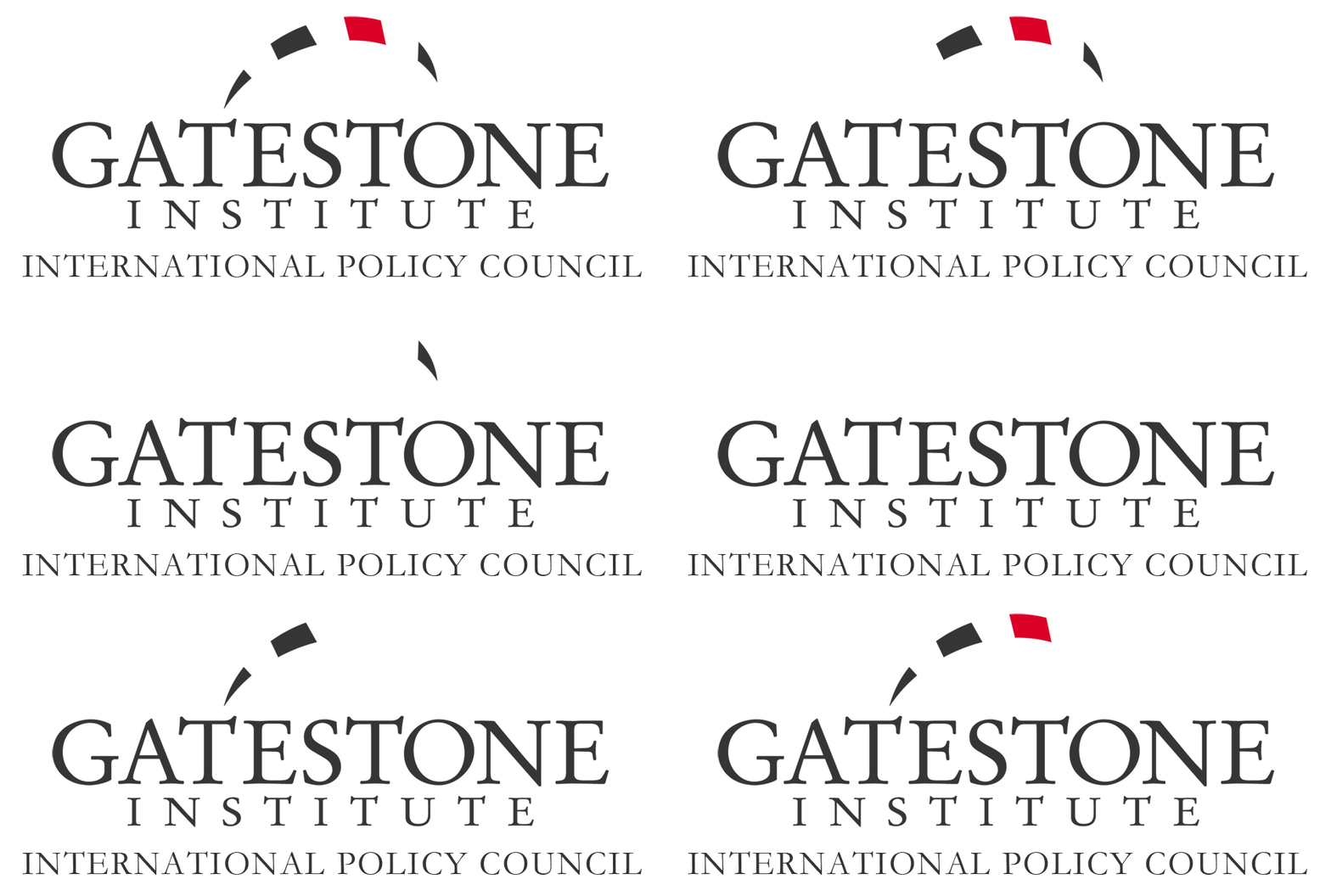
Activist Linda Sarsour addresses the crowd during a protest against President Donald Trump's travel
ban, in New York City on Jan. 29, 2017. Photo courtesy of Reuters/Stephanie Keith
I take back almost everything that I have said about Linda Sarsour.
In the wake of the desecration of the Jewish cemetery in St. Louis, Linda Sarsour, a major Palestinian activist and an organizer of January’s Women’s March on Washington and a planner of the Women’s Strike, spearheaded the campaign to raise money for their restoration. She helped raise more than $150,000 – in an unbelievably short amount of time.
I praised Ms. Sarsour for her efforts, and for what they symbolized: that Jews and Muslims might disagree over issues relating to Israel and the Palestinians, but that we could join together to fight hatred.
I was even beginning to muse about the larger implications of this: perhaps, contrary to everything that I have ever written and taught, it might actually be possible to be anti-Israel, and nevertheless, pro-Jewish.
I was wrong.
Linda Sarsour has declared that support for Zionism and feminism are incompatible. In an interview with The Nation, Sarsour said those who identify as Zionist cannot be feminist because they are ignoring the rights of Palestinian women.
“It just doesn’t make any sense for someone to say, ‘Is there room for people who support the state of Israel and do not criticize it in the movement?’ There can’t be in feminism. You either stand up for the rights of all women, including Palestinians, or none. There’s just no way around it,” Sarsour said.
But, wait, you say.
Didn’t Ms. Sarsour help repair that Jewish cemetery in St. Louis?
I don’t doubt Linda Sarsour’s sincerity in wanting to help the Jewish community.
But this is clear to me: Linda Sarsour is fine with Jews — if we are joined together in being the targets of hatred in America.
But if we have power in a sovereign state, not so much.
Or, to be totally cynical about this: It’s one thing to care about the graves of Jews.
But living Jews, in a Jewish state …
We should not be surprised. This has become the Palestinian’s M.O.
It’s called hijacking.
The PLO got real good at it in the late 1960s, when they began hijacking airplanes.
And when that didn’t work, they got around to hijacking every movement on the Left.
I first noticed this in 1973, right after the Yom Kippur War – how every left wing rally that I attended had an anti-Israel message velcroed (well, there was no Velcro in those days) onto it.
The Palestinians did that with the women’s movement as well.
It goes back at least as far as 1980.
At the World Conference of the United Nations Decade for Women in Copenhagen, women from Third World and Arab countries (where the female condition screamed out for reform) led the charge against Zionism. As the late Robert Wistrich has written:
There were cries of “The only good Jew is a dead Jew” and “The only way to rid the world of Zionism is to kill all the Jews.”One eyewitness overheard other delegates saying that the American women’s movement had a bad name because its most prominent founding figures, Gloria Steinem, Betty Friedan, and Bella Abzug, were all Jewish.The psychologist and feminist author Phyllis Chesler recorded the savage response when one Jewish woman mentioned that her husband had been shot without trial in Iraq and that she had to escape to Israel with her children. The place went wild: “PLO! PLO!” they shouted. “Israel kills babies and women. Israel must die.”Chesler later described this particular world conference as “a pogrom of nonstop words and ideas, an exercise in total intimidation.”“For these left feminists, pro-Palestinianism, anti-Americanism, and anti-Zionism were part of a uniform, politically correct universal language from which no deviations could be tolerated.”
Phyllis Chesler has continued to protest the manufactured link between feminism and anti-Zionism.
As a man who is sympathetic to the goals of feminism, I hope that I am “permitted” to say this.
I hope that my Jewish sisters will utterly reject Sarsour’s grim, cynical binary thinking – that you can be a Zionist or a feminist, but not both.
I hope that they will utterly reject this latest version of the restricted neighborhood and country club of the Left – the one that hangs a sign outside that says “No Zionists allowed!”
Oh, yes – you can be Jewish and feminist, but none of that nasty Zionist stuff.
Which is another cold, calculated way of trying to separate Jews from Zionism.
It will be up to Jewish women, and the men who sympathize with feminism, to say to Linda Sarsour: Forget it. We will support feminism, with or without your blessing.
And, by the way, Linda, while you’re at it: perhaps you would like to weigh in on the plight of women in many Muslim countries; on the mutilation of women in sub-Saharan Africa; on the fact that the Palestinian Authority only got around to outlawing honor killings – in 2014.
We will continue to fight against the Muslim travel ban. Because that’s who we are.
As for who you are — we now know.
Tuesday, March 29, 2016
Pro-Palestinian Movement In Colleges Creates More Anti-Semitism
Anti-Semitism on California Campuses
The California university system seems to have the dubious distinction of being the epicenter of the campus war against Israel. The situation that has apparently reached such intolerable levels that the Board of Regents of the University of California (UC Regents) was forced to take some action. This effort resulted in a study entitled the "Final Report of the Regents Working Group on Principles Against Intolerance." The study attempts to establish guidelines by which any discrimination against a minority group on campus would be identified and censured. The report, however, specifically focused on the thorny issue of anti-Israelism and anti-Semitism as a prevalent and ugly reality throughout the California university system.
The report examined a range of incidents that occurred during the 2014-15 academic year. It cited unfortunate transgressions that "included vandalism targeting property associated with Jewish people or Judaism; challenges to the candidacies of Jewish students seeking to assume representative positions within student government; political, intellectual and social dialogue that is anti-Semitic; and social exclusion and stereotyping." The problem on California campuses, and on campuses across the country, is apparently that pro-Palestinian activists, in their zeal to seek self-affirmation, statehood, and "social justice" for Palestinians, have waged -- presumably as a tactic in achieving those ends -- an extremely caustic cognitive war against Israel and Jews. That, however, appears to be just part of a larger, more invidious intellectual jihad against Israel led by some of those in the Muslim world together with some Western elites who also wish to weaken, and ultimately destroy, the Jewish state. Being pro-Palestinian on campuses today, it turns out, does not necessarily mean that one is committed to helping the Palestinians be productive, live well, build a free and open nation or create a civil society with transparent government, a free press, human rights, and a representative government. Being pro-Palestinian on campus today involves very little that actually benefits or makes more likely the birth of a new Palestinian state that will live side by side in peace with Israel. What being pro-Palestinian seems to have come to mean is continually denigrating and attacking Israel with a false historical narrative and the grotesquely misused language of human rights. The moral uprightness that anti-Israel activists feel in denouncing what they perceive to be Israel's supposedly "racist," "apartheid" character, combined with its purportedly being an "illegal occupier of stolen Muslim land," has manifested itself in ideological assaults against Zionism, Israel, and, by extension, Jews in general. Of great concern to those who have observed the invidious byproduct of this radicalism, including the Regents Working Group, is the frequent appearance of what is claimed to be anti-Israel sentiment, which often rises to the level of raw anti-Semitism, when criticism of Israel bleeds into a darker, more sinister level of hatred. It is enough to make Jewish students, whether or not they care about Israel at all, uncomfortable, unsafe, or even hated on their own campuses.
A 2014 study commissioned by then-UC President Mark G. Yudof, to measure the climate faced by Jewish students, found that "Jewish students are confronting significant and difficult climate issues as a result of activities on campus which focus specifically on Israel, its right to exist and its treatment of Palestinians. The anti-Zionism and Boycott, Divestment and Sanctions (BDS) movements and other manifestations of anti-Israel sentiment and activity create significant issues through themes and language which portray Israel and, many times, Jews in ways which project hostility, engender a feeling of isolation, and undermine Jewish students' sense of belonging and engagement with outside communities."If anything, since that study was written, matters have gone from bad to worse. This latest report only affirmed Yudov's earlier findings, and stated more specifically, that "Anti-Semitism, anti-Zionism and other forms of discrimination have no place at the University of California. Most members of the University community agree with this conclusion and would agree further that the University should strive to create an equal learning environment for all students."The reference to anti-Zionism being henceforth prohibited as unacceptable speech or behavior received immediate and thunderous denunciation from, not surprisingly, those very groups and individuals who have been the worst perpetrators -- groups such as Students for Justice in Palestine, the Muslim Student Association, Jewish Voice for Peace and other groups, students and faculty who supposedly support human rights. They have been joined in their outrage by supposedly "free speech advocates" and others who feel that guidelines proscribing speech about a topic that many see as merely political is contrary to the notion of academic free speech -- not to mention unconstitutional in seeking to censor people's speech at all. However, the guidelines crafted by the Regents were not cobbled together for the purpose of criminalizing or suppressing free speech. One of the difficulties pro-Israel groups and activists have had in making the Regents see the necessity of a workable code for gauging what is, and what is not, anti-Semitism has been the difficulty university officials themselves have had in knowing when pro-Palestinian activism on their campuses has become something more in keeping with the elements of classic anti-Semitism. For that very reason, pro-Israel groups had encouraged the Regents to incorporate in their report the working definition of anti-Semitismused by the U.S. Department of State, which defines anti-Semitism existing as "Using the symbols and images associated with classic anti-Semitism to characterize Israel or Israelis; drawing comparisons of contemporary Israeli policy to that of the Nazis; blaming Israel for all inter-religious or political tensions; ... applying double standards by requiring of it a behavior not expected or demanded of any other democratic nation; ... denying the Jewish people their right to self-determination, and denying Israel the right to exist..."These are exactly the type of attitudes and accusations expressed regularly on California campuses. If the UC system adopts the use of the State Department's working definition of anti-Semitism, and incorporates it into the "principles against intolerance," does that mean, as critics of the principles have suggested, that the free speech of pro-Palestinian activists will be suppressed, censored, or punished? Not even slightly. Pro-Palestinian students and faculty can continue to sponsor virulent "Israel Apartheid Week" events, promote annual divestment and boycott resolutions against Israel, construct mock "apartheid walls," hang blood-strewn Israeli flags, accuse Israel supporters of being racist and genocidal, give tacit support to the murder of Jews by being apologists for Palestinian terror, and continue to chant "Long live Intifada." They can continue supporting murderous Arab campaigns against Israeli civilians, and chanting, "Palestine will be free, from the River to the Sea" -- meaning that a new Palestinian state should displace Israel, not exist in peace beside it. They will still enjoy their constitutionally-protected right to speak freely and in whatever manner they choose, even if that speech is corrosive, factually defective, hate-filled, biased, historically-inaccurate, defamatory, and what is usually defined as "hate speech." The existence of the "principles against intolerance" and the working definition of anti-Semitism will not prevent anyone from spewing forth whatever intellectual sewage he or she chooses. But, importantly, administrators will finally have the ability to identify instances when pro-Palestinian activism crosses the line into anti-Semitism. They can then publicly and immediately condemn that speech when it occurs, just as they regularly -- and appropriately -- do if a hangman's noose is found on campus, or slurs are made against gay students, or if students wear little sombreros at a tequila-fueled off-campus party, or if, in those rare instances, Muslim students are characterized as supporters of terror. University administrators have been reluctant to identify and condemn anti-Semitic behavior and speech when it occurs. Armed with the State Department's working definition and the other language in the "principles against intolerance," school officials will, without moral or ethical qualms, be able to stand up against intolerance when directed at Jewish students and other pro-Israel members of the campus community, as in the past they have been unwilling or unable to do. Pro-Palestinian activists have been trying to elevate the Palestinian cause by degrading Israel and its supporters with virulent language, slanders, blood libels, and racist inversions of history and fact. As former Harvard president Lawrence Summers put it, they have unleashed forms of expression that are "anti-Semitic in their effect, if not their intent." That is the issue here, and why it is both necessary and important that, in the effort to help Palestinians achieve statehood and promote their cause, another group -- Jewish students and pro-Israel individuals on American campuses -- do not themselves become victims in a struggle for another group's self-determination. This is a situation that leaders on campuses, at least, can now prevent from taking place. Richard L. Cravatts, PhD, is author of Genocidal Liberalism: The University's Jihad Against Israel & Jews, and president of Scholars for Peace in the Middle East.
© 2016 Gatestone Institute. All rights reserved. No part of the Gatestone website or any of its contents may be reproduced, copied or modified, without the prior written consent of Gatestone Institute.
|
Subscribe to:
Posts (Atom)