Contact Form

Name

Email *

Message *

Showing posts with label catholics. Show all posts

Tuesday, June 5, 2018

Islam Is All About Conquering Infidels

Tuesday, September 26, 2017

Could This Be A Breakthrough?

  • The Pope's failure vociferously to denounce Islam-based violence concerns many among both Church hierarchy and lay people.
  • The pope's statements regarding Islam and his refusal directly to discuss mounting Christian martyrdom in Muslim lands defy credulity. Whether his words are willful blindness, innocent naiveté, or intellectual ignorance of the nature of Islam itself, it is confusing many of the faithful.
  • One moderate Muslim leader, Yahya Cholil Staquf, head of Indonesia's Nahdlatul Ulama, said that Westerners "should stop pretending that extremism and terrorism have nothing to do with Islam."
The Chief Rabbinates of world Jewry apparently want to partner with the Vatican to combat radical Islam. In a recent letter, they proposed a formal alliance between Judaism and Catholicism, calling "upon the [Catholic] Church to join us in deepening our combat against our generation's new barbarism, namely the radical offshoots of Islam."
This extraordinary alliance would unite Orthodox Jewry and the Holy See against their common enemy, jihadist Islam. The Rabbinates' letter identifies "the very real danger facing many Christians in the Middle East and elsewhere as they are persecuted and menaced by violence and death at the hands of those who invoke God's Name in vain through violence and terror."
The authors of this missive to Pope Francis -- the Chief Rabbinate of Israel (CRI), the Conference of European Rabbis (CER), and the Rabbinical Council of America (RCA) -- represent the vast majority of the world's Orthodox Jews. Representatives of Judaism's Conservative and Reform wings did not sign the letter. Seemingly, any successful efforts by the Orthodox community to elicit the support of Conservative and Reform Jewish leaders would further strengthen the initiative's standing in the Vatican.
The Rabbinates chose the 50th anniversary of the Vatican's publication of the Papal Encyclical "Nostra Aetate" ("In Our Time") to launch their appeal. This document revolutionized relations between the Catholic Church and Judaism, as it formally absolved the Jewish people of any responsibility for Christ's crucifixion. Promulgated by Pope Paul VI on October 28, 1965 during the Second Vatican Council, the encyclical declared:
"His (Jesus') passion cannot be charged against all the Jews, without distinction, then alive, nor against the Jews of today. Although the Church is the new people of God, the Jews should not be presented as rejected or accursed by God, as if this followed from the Holy Scriptures."
The rabbis proposed an alliance to fight Islam-inspired anti-Semitic and anti-Christian narratives. The rabbis also praised Pope Francis for his 2015 Apostolic Exhortation "Evangelii Gaudium" ("Joy of the Gospel") as it acknowledges "that God continues to work among the people of the Old Covenant, bringing forth treasures of wisdom which flow from their encounter with His word." In addition, they complimented Francis for his denunciation "of a new, pervasive, even fashionable form of anti-Semitism."
Notably, after these complimentary references, they were silent about the Pope's apparent reluctance publicly to denounce Islamic terrorism. They also did not address his silence about particular passages in the Koran which have fueled both anti-Semitic and anti-Christian atrocities. Denunciations of Jews and Christians are highlighted in the very first chapter (Sura) of the Koran, in a prayer allegedly taught by Allah to his Messenger, Muhammad:
"Guide us on the Straight Path
The way of those upon whom You have bestowed Your Grace
not (the way of) those who have earned Your anger (Jews)
Nor those who went astray (Christians) "
Koran Sura One: Al-Fatihah (The Opening) Verses (Ayat) 6 and 7
Pope Francis has yet to address this reference and the many other denunciations of Jews and Christians in the Koran.
The following examples illustrate Pope Francis's public approach thus far. Avoiding criticism of Islam, he called the Koran "a prophetic book of peace." Also, on a flight back from Poland, he told reporters "It's not right to identify Islam with violence. It's not right and it's not true." More bewildering however, is his comment following the horrific murders at the satirical magazine Charlie Hebdo in Paris: "in freedom of expression there are limits... you cannot provoke. You cannot insult the faith of others. You cannot make fun of the faith of others."
The Pope's failure vociferously to denounce Islam-based violence concerns many among both Church hierarchy and lay people. Some may wonder what motivates Francis to avoid pointed criticism of the violent excesses committed by the Muslim faithful. Some may also ask why Francis avoids condemning the extremist rhetoric of imams routinely urging attacks against Christians and Jews. The reluctance of Francis to criticize Islamic violence while not hesitating publicly to condemn evil, corruption, and social injustice elsewhere, invites inquiry.
One explanation for the Pope's seeming naïveté about Islam's hostility to Judeo-Christian civilization might be his perception of his role. He may well believe that his mission is to lead all men to Christ. No doubt he also believes that all things are possible in a God-created universe, even the ultimate conversion of Muslims to Christianity. On a human plane, he may understand that there is little hope for the peaceful coexistence of Judaism, Christianity, or secular democracy with Islam. The Church has a long view of the ways God moves in history. In this sense, Catholicism and Islam share a casual view of transient ideologies, governments and nation-states.
Even so, the Pope's statements regarding Islam and his refusal directly to discuss mounting Christian martyrdom in Muslim lands defy credulity. Whether his words are willful blindness, innocent naiveté, or intellectual ignorance of the nature of Islam itself, it is confusing many of the faithful. One moderate Muslim leader, Yahya Cholil Staquf, head of Indonesia's Nahdlatul Ulama, said that Westerners "should stop pretending that extremism and terrorism have nothing to do with Islam."
The Rabbinates' proposal for an alliance will receive a polite hearing, especially by the Vatican's "Commission of the Holy See's Religious Relations with Jews" and "The Pontifical Council for Inter-Religious Dialogue." As yet, however, there is no sign that Francis will alter his outreach to the Muslim world or become more critical of Islam-based extremism. Another possible reason for the Vatican's reluctance might be its concern for minority Christian populations residing in Muslim-majority countries. Still another might be the Vatican's responsibility to secure Christendom's sacred sites in the Holy Land and to protect Vatican property and financial interests.
Pope Francis is no doubt sensitive to possible Muslim misperceptions about his intentions. The Vatican is not game to rejoin a centuries-old battle against Islamic expansionism. Indeed, Francis would want to avoid repeating the anti-Christian violence that followed Pope Benedict's obscure criticism of Islam. Responding to moderate and extremist indignation at Benedict's having quoted a medieval Christian Emperor's critique of Islam, Muslims killed a nun in Somalia, beheaded a priest in Iraq, and attacked churches in the West Bank.
Francis is also aware of the potential of explosive anti-Christian violence that might follow any cooperative effort by Jews and Catholics to combat Islamist violence. Indeed, Islamic leaders such Yusuf al-Qaradawi, the Muslim Brotherhood's principal theologian with a global Muslim following, called for "Al-Youm Al Ghadah" ("Day of Rage") after Pope Benedict XVI's lecture critical of Islam, that he delivered in Regensburg in 2006.[1]
For Jews, religious or secular, particularly in Europe, a partnership with the Vatican would provide a psychological boost, as many have already fled rising anti-Semitic, Islamist violence.
While the Rabbinates' proposal does not have the public endorsement of secular Jews, there is little doubt that many embrace similar sentiments. The document outlines the threat that both radical secularism and extremist Islam pose to religious liberty and the shared values of Judaism and Christianity. The Symposium on "Anti-Semitism and Minority Rights in the Middle East," sponsored by the Institute for the Study of Global Anti-Semitism and Policy (ISGAP)[2], convened in the Vatican on September 13, 2017, may provide Pope Francis a venue to embrace, or at least mention, this appeal for partnership.
Despite the Vatican's cautious approach to Islam-inspired violence, this unprecedented offer of partnership by Jewish religious leaders must tempt some within the Vatican's hierarchy to consider embracing their initiative. The Church is relieved after finally having purged remnants of anti-Semitism in its midst, in part due to the efforts of Pope John Paul II. It is now proud of its improved relations with official Judaism and the Jewish people.
Catholics, especially those who are minorities in Muslim-majority societies, and some of whom suffer persecution by Islamic militants, would presumably like Francis vigorously to defend their rights. The Vatican may nevertheless continue to mollify Muslim sensitivities, while still hoping to limit ongoing martyrdoms of Christians. This cautious approach is likely to endure until a catastrophic anti-Christian Islam-based atrocity precipitates a rebellion within the Church's hierarchy.

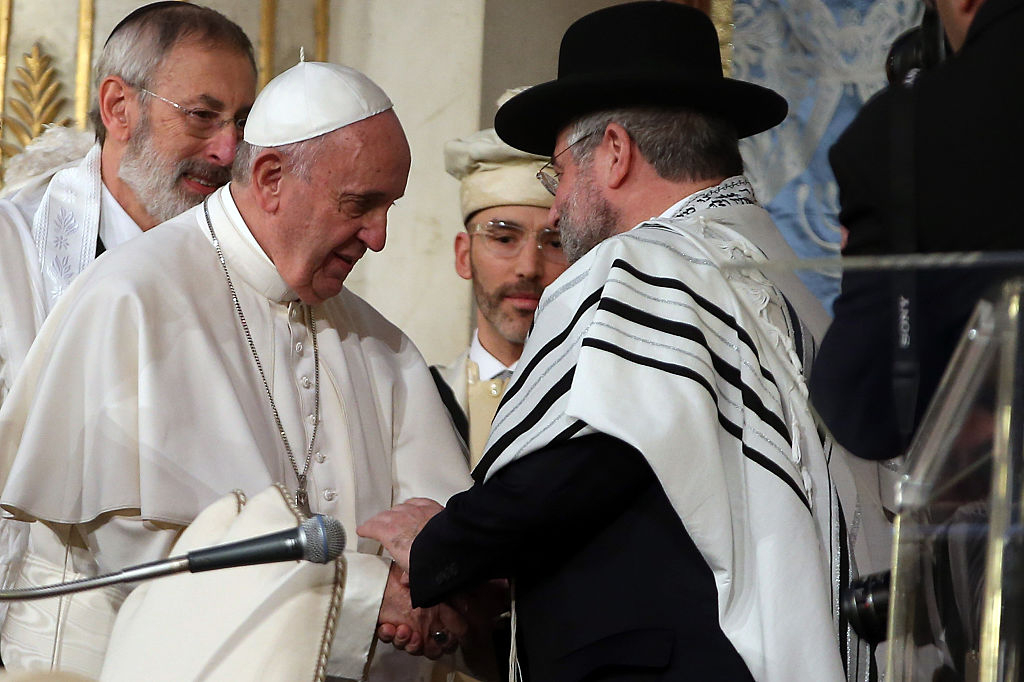
Pictured: Pope Francis visits the Great Synagogue of Rome on January 17, 2016. (Photo by Franco Origlia/Getty Images)

Dr. Lawrence A. Franklin was the Iran Desk Officer for Secretary of Defense Rumsfeld. He also served on active duty with the U.S. Army and as a Colonel in the Air Force Reserve, where he was a Military Attaché at the U.S. Embassy in Israel.

[1] Catastrophic Failure: Blindfolding America in the Face of Jihad by Stephen Coughlin. Center for Security Policy Press: Washington D.C. 2015.
[2] Symposium at the Vatican, "Embargoed Announcement" sent to author by Richard Shonfeld, 7 Sep 2017.
© 2017 Gatestone Institute. All rights reserved. The articles printed here do not necessarily reflect the views of the Editors or of Gatestone Institute. No part of the Gatestone website or any of its contents may be reproduced, copied or modified, without the prior written consent of Gatestone Institute.

Sunday, January 15, 2017

When A Nation Loses Its Religious Footing, Dangerous Things Can Happen


VIDEOObama: Hanukkah a Reminder Freedom Is a Blessing


Pew Report: Religion Plummeted in America During Obama Era


SIGN UP FOR OUR NEWSLETTER

In a new study of President Obama’s legacy, the Pew Research Center found that religious affiliation and practice dropped off dramatically during his two terms in the White House.

“When it comes to the nation’s religious identity, the biggest trend during Obama’s presidency is the rise of those who claim no religion at all,” Pew notes in a report released this week titled “How America Changed During Barack Obama’s Presidency.”
VIDEOObama: Hanukkah a Reminder Freedom Is a Blessing

When Barack Obama took office, those who identified as atheists or agnostics along with those who said their religion was “nothing in particular” totaled only 16 percent of the U.S. adult population. On leaving office 8 years later, the non-religious in America now make up nearly a quarter of the population.
On the contrary, the percentage of Americans who say they believe in God, consider religion to be very important in their lives, pray daily and attend religious services at least monthly have all dropped during the Obama years, Pew found.
America’s largest religious demographic, those who self-identify as Christians, plunged from 78 percent of the U.S. adult population to 71 percent 8 years later, and the majority of these losses taken place among adults who identify with mainline Protestantism and Catholicism. Evangelical Protestantism along with historically black Christian denominations have remained comparably stable.
During his 8 years as president, Obama nettled religious conservatives over and over with moves that seemed calculated to undermine religious liberty.
According to Tim Schultz, the president of the 1st Amendment Partnership, the Obama administration often viewed religion as an enemy standing in the way of their policy objectives.
“They view religious freedom as a kind of inconvenient speed bump on the way to those objectives in some way,” Schultz said.
Last spring, the Obama administration angered many conservatives with a “Dear Colleague” letter from the Department of Justice and Department of Education mandating that public schools had to allow students to use bathrooms corresponding with their gender identity rather than their biological sex.
The most egregious example of the Obama administration’s hostility to religion was what has been called “Obama’s War Against Little Sisters of the Poor.” The Obama administration claimed it had the power to compel church groups to provide abortion-related products and services, and tried to bully the Little Sisters—an order of Catholic nuns—into offering these services against their beliefs.
But the administration’s antipathy toward religious freedom became more explicit still in a 2016 report by the U.S. Commission on Civil Rights (USCCR) attacking religious liberty as a guise for discrimination.
In the rollout of the report, Obama-appointed chairman, Martin R. Castro, stated that religious liberty was simply a justification for bigotry, prejudice and discrimination.
Castro claimed that the phrases “religious liberty” and “religious freedom” were “code words for discrimination, intolerance, racism, sexism, homophobia, Islamophobia or any form of intolerance.”
The Chairman further declared that “today, as in past, religion is being used as both a weapon and a shield by those seeking to deny others equality.”
“We now see ‘religious liberty’ arguments sneaking their way back into our political and constitutional discourse,” Castro said, “in an effort to undermine the rights of some Americans.”
The USCCR’s report “Peaceful Coexistence: Reconciling Nondiscrimination Principles with Civil Liberties” proposed to examine the various legal and constitutional issues that arise when anti-discrimination laws and religious liberty come into conflict.
In its “Findings and Recommendations,” the report sided firmly with anti-discrimination laws over religious liberty, declaring that civil rights protections ensuring nondiscrimination are of “preeminent importance” in American jurisprudence, whereas religious exemptions “significantly infringe upon these civil rights.”
The Commission also stated that religious exemptions from nondiscrimination laws and policies must be “defined narrowly.”
In its majority statement, the Commissioners warned that threats to civil liberties, “cloaked as ‘religious freedom’ protection bills, are emerging in dozens of states and localities across the nation.”

When Barack Obama took office, those who identified as atheists or agnostics along with those who said their religion was “nothing in particular” totaled only 16 percent of the U.S. adult population. On leaving office 8 years later, the non-religious in America now make up nearly a quarter of the population.
On the contrary, the percentage of Americans who say they believe in God, consider religion to be very important in their lives, pray daily and attend religious services at least monthly have all dropped during the Obama years, Pew found.
America’s largest religious demographic, those who self-identify as Christians, plunged from 78 percent of the U.S. adult population to 71 percent 8 years later, and the majority of these losses taken place among adults who identify with mainline Protestantism and Catholicism. Evangelical Protestantism along with historically black Christian denominations have remained comparably stable.
During his 8 years as president, Obama nettled religious conservatives over and over with moves that seemed calculated to undermine religious liberty.
According to Tim Schultz, the president of the 1st Amendment Partnership, the Obama administration often viewed religion as an enemy standing in the way of their policy objectives.
“They view religious freedom as a kind of inconvenient speed bump on the way to those objectives in some way,” Schultz said.
Last spring, the Obama administration angered many conservatives with a “Dear Colleague” letter from the Department of Justice and Department of Education mandating that public schools had to allow students to use bathrooms corresponding with their gender identity rather than their biological sex.
The most egregious example of the Obama administration’s hostility to religion was what has been called “Obama’s War Against Little Sisters of the Poor.” The Obama administration claimed it had the power to compel church groups to provide abortion-related products and services, and tried to bully the Little Sisters—an order of Catholic nuns—into offering these services against their beliefs.
But the administration’s antipathy toward religious freedom became more explicit still in a 2016 report by the U.S. Commission on Civil Rights (USCCR) attacking religious liberty as a guise for discrimination.
In the rollout of the report, Obama-appointed chairman, Martin R. Castro, stated that religious liberty was simply a justification for bigotry, prejudice and discrimination.
Castro claimed that the phrases “religious liberty” and “religious freedom” were “code words for discrimination, intolerance, racism, sexism, homophobia, Islamophobia or any form of intolerance.”
The Chairman further declared that “today, as in past, religion is being used as both a weapon and a shield by those seeking to deny others equality.”
“We now see ‘religious liberty’ arguments sneaking their way back into our political and constitutional discourse,” Castro said, “in an effort to undermine the rights of some Americans.”
The USCCR’s report “Peaceful Coexistence: Reconciling Nondiscrimination Principles with Civil Liberties” proposed to examine the various legal and constitutional issues that arise when anti-discrimination laws and religious liberty come into conflict.
In its “Findings and Recommendations,” the report sided firmly with anti-discrimination laws over religious liberty, declaring that civil rights protections ensuring nondiscrimination are of “preeminent importance” in American jurisprudence, whereas religious exemptions “significantly infringe upon these civil rights.”
The Commission also stated that religious exemptions from nondiscrimination laws and policies must be “defined narrowly.”
In its majority statement, the Commissioners warned that threats to civil liberties, “cloaked as ‘religious freedom’ protection bills, are emerging in dozens of states and localities across the nation.”