Our goal is to have intelligent discussion of the topics of the day. We realize everyone has their opinion and they should be allowed to express it in a discussion forum without calling each other names. We learn from discussion and not from name calling or argument.We use cookies to personalise content and ads, to provide social media features and to analyse our traffic. We also share information about your use of our site with our social media, advertising and analytics partners. See details
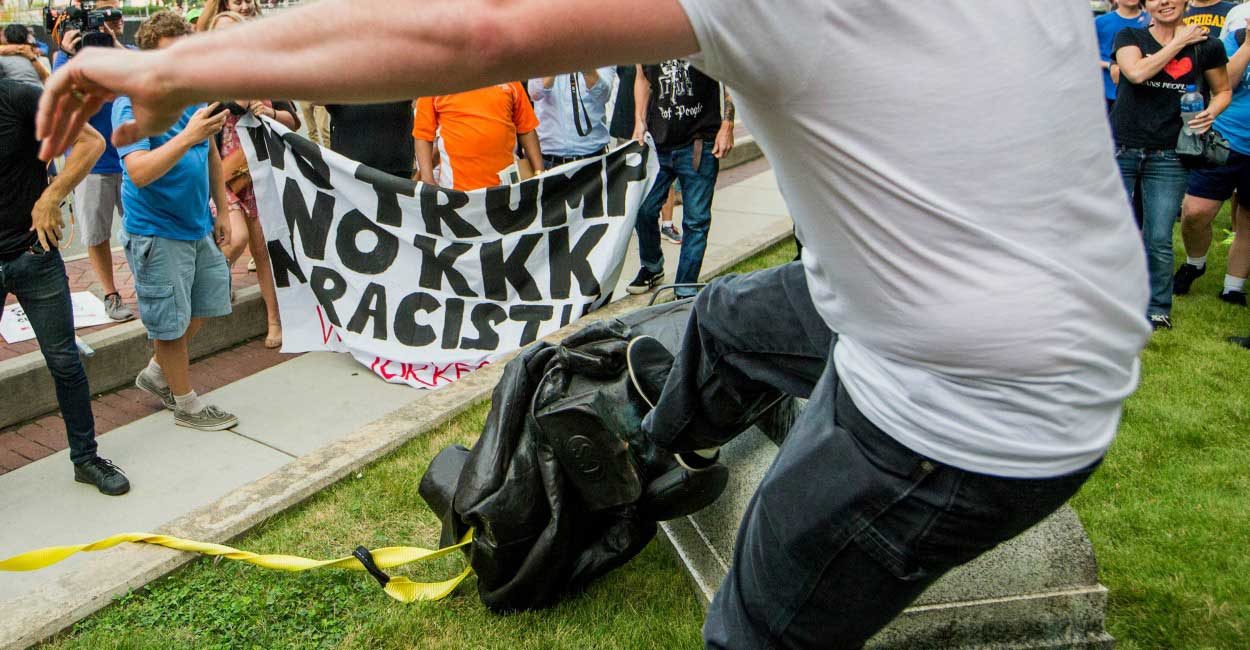
A protester kicks a toppled Confederate soldier statue after it was pulled down in Durham, North Carolina. (Photo: Casey Toth/TNS/Newscom)
Following the ugly incident that
took place in Charlottesville,
Virginia, this past weekend, an
unruly mob took out its anger
on a century-old statue in
North Carolina.
It is a perfect example of how tribal and identity politics are
raging out of control in America,
and how radicals will continue
to ratchet up their tactics to
match one another.
While the media spent its time
connecting riots to the political
right, the hard left continued to
step up its tactics to promote
social discord, as it has been doing for years.
On Monday afternoon, a crowd
of people in an “Emergency
Durham Protest” marched down
Durham’s Main Street, then
made its way to the Durham
County Courthouse.
The Herald Sun reported that
organizations like the “Triangle
People’s Assembly, Workers
World Party, Industrial Workers
of the World, Democratic
Socialists of America, and
the Antifa movement” were
at the rally.
One of the participants, Eva
Panjwani of the Workers
World Party Durham, said in
an interview:
This is really an opportunity,
this moment of Charlottesville,
to see what side of history
we are choosing to side with.
This is not a call to make
someone to feel guilty or
ashamed. This is a call to
say this is an ask from people
of color to say which side
are you on.
“We need to shun passive,
white liberalism,” Panjwani
said.
The larger group was comprised of people
demonstrating with various
left-wing slogans such as a
“No Trump, No KKK, No
Racist USA” banner, pro-
socialist Che Guevara shirts,
and numerous odes to
abolishing capitalism.
One individual held a sign that said, “Cops and clan go hand in hand,” as the group marched past police officers.
The crowd gathered in front of the courthouse and decided to target a statue that was created in memoriam to “the boys who wore the gray.” That is, the North Carolina soldiers who fought for the Confederate Army in the Civil War.
The rage-filled protesters tore down the statue and proceeded to kick and desecrate it. The surging mass of people hooted and hollered as individuals took turns spitting on and flipping off the generic visage of a young Southern soldier.
The act of vandalism continued unabated, as authorities stood by and watched. Durham Police put out a statement saying that they did not interfere with the toppling because it happened on “county property, where county law enforcement officials were staffed.”
In the aftermath, some of the protesters took pictures in front of the crumpled-up bronze statue that had been pulverized in the fall.
Targeting this statue was seemingly an odd choice. It portrayed no individual specifically and was erected as a tribute in 1924 to the young boys, by that time old men, who had donned the uniform of the failed Confederate rebellion.
However, the attack was fitting as a mirror to the “alt-right” march that had taken place at the foot of a Gen. Robert E. Lee statue in Charlottesville. The individuals portrayed by the monuments were simply irrelevant.
This isn’t a battle over ideas or the Confederacy’s place in American history, it’s sheer and mindless identity politics.
American towns and cities are now increasingly being besieged by agitators who flaunt the law, direct their hate toward fellow citizens, and openly attack the crucial principles at the heart of the American way of life.
The resounding message that these events send is that in 2017, it’s impossible for this country to accept people of different creeds and points of views. You are either on the “right side of history,” as President Barack Obama said, or you are on the wrong side.
The narrative is increasingly join us, or be crushed.
Perhaps the protesters should pay more attention to what happened in our Civil War, which claimed more lives than all of our other wars combined.
Perhaps they should study the leaders who, however imperfectly, tried to bind regions and people together to move on from a civil feud that pitted brother against brother and American against American.
And perhaps they should have studied the people, like Lee and President Abraham Lincoln, who tried to piece the shattered puzzle of American nationhood back together.
Alas, those concepts were lost in a sordid trampling of an old, barely noticed statue. Unless leaders pay increased devotion to denouncing and taking action against these lawless demonstrations, mob rule is here to stay.
PHOTO ILLUSTRATION BY ELIZABETH BROCKWAY/THE DAILY BEAST
PINKWASH
Fidel Castro’s Horrific Record on Gay Rights
Concentration camps for gays. Political prisons where they were treated like ‘beasts.’ Listen up, liberals: Before you go celebrating the life of Castro, remember his victims.
Fidel Castro was many things: a revolutionary, a communist, a garrulous orator. Amid the fawning encomia released upon his long-overdue death at the age of 90, it should never be forgotten that he was also an oppressor, torturer, and murderer of gay people.
“We would never come to believe that a homosexual could embody the conditions and requirements of conduct that would enable us to consider him a true revolutionary, a true communist militant,” Castro told an interviewer in 1965. “A deviation of that nature clashes with the concept we have of what a militant communist should be.”
In the eyes of Castro and his revolutionary comrade Che Guevara—who frequently referred to gay men as maricones, “faggots”—homosexuality was inherently counterrevolutionary, a bourgeois decadence. To a traditional Latin American machismo that viewed gayness pejoratively, they married an ideological fixation treating it as politically undesirable.
It wasn’t long after Castro came to power that police began rounding up gay men. In 1965, the regime established prison work camps known as Military Units to Aid Production (UMAP), into which it deposited homosexuals, Jehovah’s Witnesses, and other “undesirable” elements. Alert to this news, the Mattachine Society—one of the earliest gay rights organizations in the United States—held demonstrations outside the United Nations and the White House successively over two days. Four years before the world-famous Stonewall riots, these were two of the first gay rights protests held in the United States. That same year, Allen Ginsberg was expelled from Cuba for spreading rumors that Raul Castro—Fidel’s brother and successor as president—was gay and claiming that Guevara was “cute.”
Putting gays into concentration camps is not the only practice Castro borrowed from the Nazis. During the Cuban missile crisis, according to recently released German intelligence files, this so-called anti-fascist attempted to hire former SS officers to instruct his army.
Though the Cuban regime closed down the UMAPs in the late 1960s, it continued to repress gay men as ideologically subversive elements. Openly homosexual people were prevented from joining the Communist Party and fired from their jobs. One of the country’s most distinguished writers, Reinaldo Arenas, recounted the prison experience he and countless other gay men endured in his memoir Before Night Falls. “It was a sweltering place without a bathroom,” he wrote. “Gays were not treated like human beings, they were treated like beasts. They were the last ones to come out for meals, so we saw them walk by, and the most insignificant incident was an excuse to beat them mercilessly.”
Gays comprised a significant portion of the 125,000 Cubans (“worms,” in Fidel Castro’s words) permitted to leave the island for the United States as part of the 1980 Mariel Boatlift. (The 1984 documentary Improper Conduct, which tells the stories of gay and straight Marielitos, remains one of the starkest indictments of the Castro regime.) When the Human Immunodeficiency Virus hit the island’s gay community in the mid-1980s, the regime’s response was to quarantine all HIV-positive people in sanitariums, referred to as “pretty prisons” by the founder of the World Health Organization’s Global Program for AIDS.
No doubt attuned to the way in which gay rights has become central to the agenda of a global left increasingly sensitive to the claims of identity politics, the Cuban regime in recent years has tried to fashion itself as being in the vanguard of homosexual liberation. In 2010, Fidel Castro belatedly admitted that his revolution’s treatment of gays constituted “a great injustice.” It was, however, a sin of omission rather than commission, transpiring only because he was distracted, too busy fighting off Yankee imperialists to prevent the atrocities being committed in his revolution’s name. Today, Fidel’s niece (Raul’s daughter) Mariela Castro has emerged as an LGBT activist, helming an organization called the Cuban National Center for Sex Education. Coincidentally, she is the focus of a documentary,Mariela’s March: Cuba’s LGBT Revolution, premiering Monday night on HBO.
PHOTO ILLUSTRATION BY ELIZABETH BROCKWAY/THE DAILY BEAST
PINKWASH
Fidel Castro’s Horrific Record on Gay Rights
Concentration camps for gays. Political prisons where they were treated like ‘beasts.’ Listen up, liberals: Before you go celebrating the life of Castro, remember his victims.
Fidel Castro was many things: a revolutionary, a communist, a garrulous orator. Amid the fawning encomia released upon his long-overdue death at the age of 90, it should never be forgotten that he was also an oppressor, torturer, and murderer of gay people.
“We would never come to believe that a homosexual could embody the conditions and requirements of conduct that would enable us to consider him a true revolutionary, a true communist militant,” Castro told an interviewer in 1965. “A deviation of that nature clashes with the concept we have of what a militant communist should be.”
In the eyes of Castro and his revolutionary comrade Che Guevara—who frequently referred to gay men as maricones, “faggots”—homosexuality was inherently counterrevolutionary, a bourgeois decadence. To a traditional Latin American machismo that viewed gayness pejoratively, they married an ideological fixation treating it as politically undesirable.
It wasn’t long after Castro came to power that police began rounding up gay men. In 1965, the regime established prison work camps known as Military Units to Aid Production (UMAP), into which it deposited homosexuals, Jehovah’s Witnesses, and other “undesirable” elements. Alert to this news, the Mattachine Society—one of the earliest gay rights organizations in the United States—held demonstrations outside the United Nations and the White House successively over two days. Four years before the world-famous Stonewall riots, these were two of the first gay rights protests held in the United States. That same year, Allen Ginsberg was expelled from Cuba for spreading rumors that Raul Castro—Fidel’s brother and successor as president—was gay and claiming that Guevara was “cute.”
Putting gays into concentration camps is not the only practice Castro borrowed from the Nazis. During the Cuban missile crisis, according to recently released German intelligence files, this so-called anti-fascist attempted to hire former SS officers to instruct his army.
Though the Cuban regime closed down the UMAPs in the late 1960s, it continued to repress gay men as ideologically subversive elements. Openly homosexual people were prevented from joining the Communist Party and fired from their jobs. One of the country’s most distinguished writers, Reinaldo Arenas, recounted the prison experience he and countless other gay men endured in his memoir Before Night Falls. “It was a sweltering place without a bathroom,” he wrote. “Gays were not treated like human beings, they were treated like beasts. They were the last ones to come out for meals, so we saw them walk by, and the most insignificant incident was an excuse to beat them mercilessly.”
Gays comprised a significant portion of the 125,000 Cubans (“worms,” in Fidel Castro’s words) permitted to leave the island for the United States as part of the 1980 Mariel Boatlift. (The 1984 documentary Improper Conduct, which tells the stories of gay and straight Marielitos, remains one of the starkest indictments of the Castro regime.) When the Human Immunodeficiency Virus hit the island’s gay community in the mid-1980s, the regime’s response was to quarantine all HIV-positive people in sanitariums, referred to as “pretty prisons” by the founder of the World Health Organization’s Global Program for AIDS.
No doubt attuned to the way in which gay rights has become central to the agenda of a global left increasingly sensitive to the claims of identity politics, the Cuban regime in recent years has tried to fashion itself as being in the vanguard of homosexual liberation. In 2010, Fidel Castro belatedly admitted that his revolution’s treatment of gays constituted “a great injustice.” It was, however, a sin of omission rather than commission, transpiring only because he was distracted, too busy fighting off Yankee imperialists to prevent the atrocities being committed in his revolution’s name. Today, Fidel’s niece (Raul’s daughter) Mariela Castro has emerged as an LGBT activist, helming an organization called the Cuban National Center for Sex Education. Coincidentally, she is the focus of a documentary,Mariela’s March: Cuba’s LGBT Revolution, premiering Monday night on HBO.
Mariela has been lauded by many in the West as a force for progressive change, and her decision to push for acceptance of LGBTs may be helping on the margins. But no matter how much life for gay Cubans might have improved from the days of forced labor camps, it’s all occurring within the context of a totalitarian society whose citizens cannot vote, are denied basic freedoms like the right to speak or protest freely, and cannot form organizations independent of the government. Indeed, it tells you everything you need to know about contemporary Cuba that the country’s most visible LGBT activist is the straight daughter of Raul Castro. Mariela is a hard-core communist who skirts around her family’s horrific record of oppressing LGBT people, and her ersatz gay rights crusade reeks of being a vanity project and personality cult.
Some Western progressives nonetheless fall for this pinkwashing charade. Take Canadian Prime Minister Justin Trudeau, a vocal advocate for LGBT rights in his own country, who released a fulsome statement upon Fidel Castro’s death. While allowing that the deceased tyrant was a “controversial figure,” the dauphin pretty boy enthused, “I know my father was very proud to call him a friend and I had the opportunity to meet Fidel when my father passed away...We join the people of Cuba today in mourning the loss of this remarkable leader.”
The death of Fidel Castro is reason to celebrate. But true freedom for Cuban gays will remain elusive as long as political freedom is denied to all Cubans.Mariela has been lauded by many in the West as a force for progressive change, and her decision to push for acceptance of LGBTs may be helping on the margins. But no matter how much life for gay Cubans might have improved from the days of forced labor camps, it’s all occurring within the context of a totalitarian society whose citizens cannot vote, are denied basic freedoms like the right to speak or protest freely, and cannot form organizations independent of the government. Indeed, it tells you everything you need to know about contemporary Cuba that the country’s most visible LGBT activist is the straight daughter of Raul Castro. Mariela is a hard-core communist who skirts around her family’s horrific record of oppressing LGBT people, and her ersatz gay rights crusade reeks of being a vanity project and personality cult.
Some Western progressives nonetheless fall for this pinkwashing charade. Take Canadian Prime Minister Justin Trudeau, a vocal advocate for LGBT rights in his own country, who released a fulsome statement upon Fidel Castro’s death. While allowing that the deceased tyrant was a “controversial figure,” the dauphin pretty boy enthused, “I know my father was very proud to call him a friend and I had the opportunity to meet Fidel when my father passed away...We join the people of Cuba today in mourning the loss of this remarkable leader.”
The death of Fidel Castro is reason to celebrate. But true freedom for Cuban gays will remain elusive as long as political freedom is denied to all Cubans.


took place in Charlottesville,
Virginia, this past weekend, an
unruly mob took out its anger
on a century-old statue in
North Carolina.
tribal and identity politics are
raging out of control in America,
and how radicals will continue
to ratchet up their tactics to
match one another.
connecting riots to the political
right, the hard left continued to
step up its tactics to promote
social discord, as it has been
doing for years.
of people in an “Emergency
Durham Protest” marched down
Durham’s Main Street, then
made its way to the Durham
County Courthouse.
organizations like the “Triangle
People’s Assembly, Workers
World Party, Industrial Workers
of the World, Democratic
Socialists of America, and
the Antifa movement” were
at the rally.
Panjwani of the Workers
World Party Durham, said in
an interview:
white liberalism,” Panjwani
said.
comprised of people
demonstrating with various
left-wing slogans such as a
“No Trump, No KKK, No
Racist USA” banner, pro-
socialist Che Guevara shirts,
and numerous odes to
abolishing capitalism.