Contact Form

Name

Email *

Message *

Showing posts with label heritage foundation. Show all posts

Tuesday, February 19, 2019

When The Presiden't Party Controls The Rules, It Is The End

The Left Wants to Transform Our Election System. It’s a Recipe for 1-Party Rule.
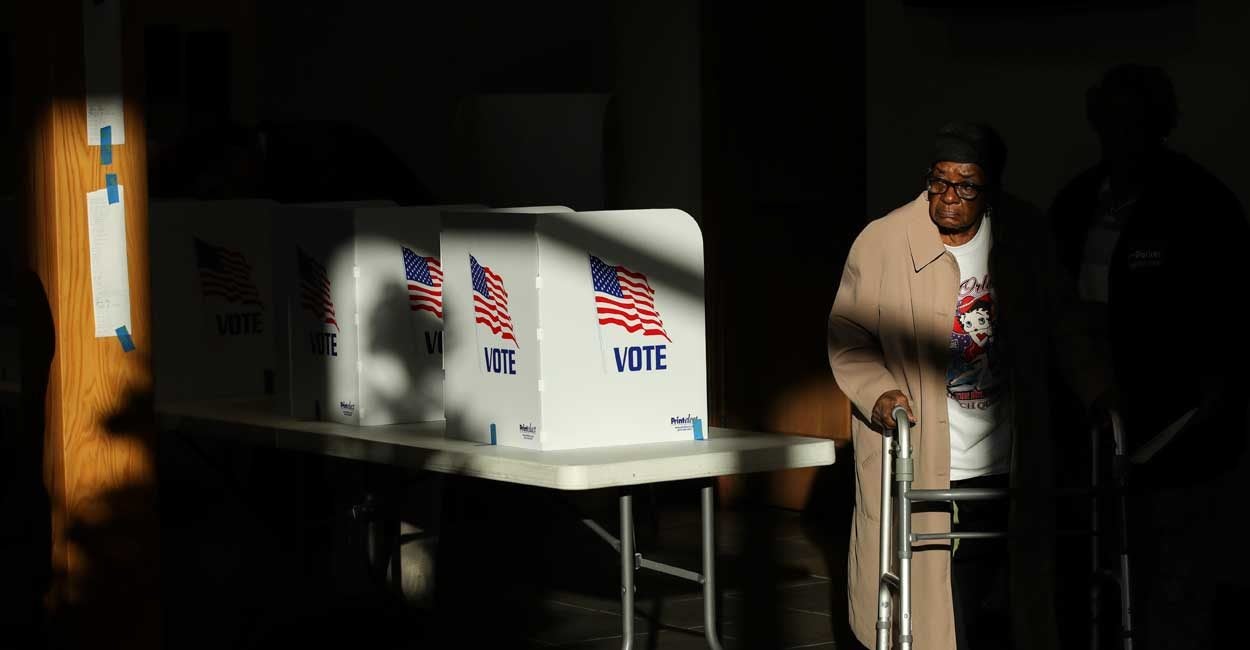
H.R. 1 would dramatically change the American voting system among other things. (Photo: Drew Angerer/ Staff/ Getty Images)
Democrats intend to save “democracy” by putting themselves in charge of elections.
As absurd as that sounds, it really is a part of the inappropriately named “For the People Act of 2019,” or H.R. 1, moving through the House of Representatives.
The Heritage Foundation created a list of the law’s provisions, which you can read here. The Conservative Action Project also provided this quick rundown of the bill:
• Forces states to implement mandatory voter registration, removing civic participation as a voluntary choice, and increasing chances for error.
• Mandates that states allow all felons to vote.
• Forces states to extend periods of early voting, which has shown to have no effect on turnout.
• Mandates same-day voter registration, which encourages voter fraud.
• Limits the ability of states to cooperate to see who is registered in multiple states at the same time.
• Prohibits election observers from cooperating with election officials to file formal challenges to suspicious voter registrations.
• Criminalizes protected political speech by making it a crime to ‘discourage’ someone from voting.
• Bars states from making their own laws about voting by mail.
• Prohibits chief election officials in each state from participating in federal election campaigns.
• Mandates free mailing of absentee ballots.
• Mandates that states adopt new redistricting commissions.
The liberal Left continue to push their radical agenda against American values. The good news is there is a solution. Find out more >>
The bill is more or less a grab bag of progressive priorities, much like the Green New Deal.
Like the misguided movement to abolish the Electoral College, H.R. 1, in the name of democracy, takes a blow torch to the concepts federalism and self-government enshrined in our Constitution.
As the above summary makes clear, H.R. 1 has numerous provisions that would undermine free speech rights, upend the way America conducts elections, encourage voter fraud, and turn election oversight into little more than a partisan weapon to bludgeon foes.
Rep. Alexandria Ocasio-Cortez, D-N.Y., who seems to have positioned herself at the forefront of every piece of radical legislation coming out of the House, dismissed the idea that H.R. 1 is a “power grab” by Democrats.
She had to make an almost immediate correction after that tweet, as the legislation has not yet passed the House. Even if it did, Senate Majority Leader Mitch McConnell, R-Ky., has said it wouldn’t pass in the Senate, where Republicans hold a majority.
Ocasio-Cortez has a penchant for missteps, but she’s a good barometer for where the progressive base in America is.
In this bill, the left has shown it is willing to make a “naked attempt to change the rules of American politics to benefit one party,” as McConnell noted. But beyond that, H.R. 1 is most concerning for the devastating effect it would have on our federal republic.
National Review’s David French summed it up perfectly:
At its essence, the bill federalizes control over elections to an unprecedented scale, expands government power over political speech, mandates increased disclosures of private citizens’ personal information (down to name and address), places conditions on citizen contact with legislators that inhibits citizens’ freedom of expression, and then places enforcement of most of these measures in the hands of a revamped Federal Election Commission that is far more responsive to presidential influence.
Certainly, the effort to get around the Supreme Court’s Citizens United decision through a constitutional amendment to get money out of politics is misguided and an assault on free speech. It is at odds with our right to free speech and, in the end, would mostly benefit insiders and incumbents who know how to play the Washington game of navigating arcane campaign finance laws.
Further, it would require donors to disclose their own private information in the name of “transparency.”
This is how democracy descends into mob rule. It’s why the Founders erected barriers to guard against a tyrannical majority. Given the way progressives brazenly attack and shame dissenters on college campuses—and increasingly in public life—it is all the more urgent that individual privacy rights be protected. Privacy is a cornerstone of liberty.
Perhaps the most concerning aspect of H.R. 1 is what it would do to American election laws and how it would not just undermine, but bulldoze any semblance of federalism left in our political system.
H.R. 1 would stop state legislatures from drawing up their own congressional districts and would mandate independent commissions in their place.
As I’ve written in the past, getting rid of legislative redistricting, sometimes known as “gerrymandering,” is a “cure” worse than the disease. Redistricting will always be partisan, no matter who does it. Laws to prevent this would simply drive partisan redistricting underground, where it would be done in secret by an unelected, uncountable commission rather than openly by a legislature.
Again, even if this were good policy, it assumes that the federal government has the right to dictate how states run their elections. It would take away the right of the citizens of a state to make their own choices on these issues.
H.R. 1 contains other violations of federalism—and the Constitution—including mandates to restore voting rights to felons as soon as they are released from prison and stop states from finding and removing ineligible voters.
And it gets worse.
After nationalizing American election laws, H.R. 1 would put them all under the watchful eye of a “revamped” Federal Election Commission. This is perhaps the most brazenly partisan element of the bill.
The Federal Election Commission currently allows six members (though it currently only has four), with a requirement that four members sign on to any decision in order for it to pass. It has an even number of Republican and Democratic appointees—thus, it takes both parties to agree to prosecute a violation of federal law. This prevents the party in control of the White House from enforcing the law in a partisan fashion.
H.R. 1 would change that by making the commission a five-person body comprised of the president’s appointees, with the president’s party able to appoint three of the five. This would make the commission into a partisan body beholden to the president. 
Proponents say this would end the current “deadlock,” but in reality it would turn the commission into a partisan tool to be used by the president. It would be an egregious concentration of power, especially given the way the rest of the bill would nationalize American elections.
While the Framers weren’t unanimous about how much power states should have relative to the federal government, none would have thought it a good idea to give near-tyrannical power to an unelected body of five people, which is what H.R. 1 would essentially do.
The “For the People Act” really is little more than a progressive power grab intended to manipulate election rules to favor liberals, and it is an anti-democratic bill that would upend America’s electoral system.
As with the Green New Deal, it is a vehicle for introducing ideas that would fundamentally transform our republic into something we would not recognize at all.

Friday, June 15, 2018

British Judge Proves He Is An Idiot

With Knife Crimes on Rise, 

British Judge Recommends

 Duller Kitchen Knives

"Blunt tips for knives seems practically absurd," The Heritage Foundation's Amy Swearer retorts. "You can make a shank out of plastic in prison. Will they regulate plastic next?" (Photo: Brett Stevens/Newscom)
A veteran British judge says Britons should round off the tips of their large kitchen knives as a way to cut down on the rising number of knife attacks in England, which has strict gun controls.
Judge Nicholas Madge made his proposal at his recent retirement ceremony after 77 knife-related incidents, including three deaths, occurred in Bedfordshire, England, over the prior two months, The Telegraph newspaper reported.
“Why do we need 8-inch or 10-inch kitchen knives with points?” Madge said at the May 25 event. “Butchers and fishmongers do, but how often, if at all, does a domestic chef use the point of an 8-inch or 10-inch knife? Rarely, if at all.”
Amy Swearer, legal policy analyst at The Heritage Foundation’s Meese Center for Legal and Judicial Studies, ridiculed the idea as knife control.

Rounding off the tips of kitchen knives, Swearer told The Daily Signal, is “the liberals’ version of gun control in England, 40 years ahead of the United States.”
“Blunt tips for knives seems practically absurd. You can make a shank out of plastic in prison,” Swearer said. “Will they regulate plastic next? Where will the line be drawn?”
The Heritage policy analyst attributes Madge’s “extreme” proposal to England’s gun control policy, in place since the mid-to-late 1990s.
England slowly achieved the dream of American gun control advocates, but it didn’t help curb crime, Swearer said.
“To keep people safe, allow law-abiding citizens to defend themselves,” she said.
Today, England suffers from an epidemic of so-called “hot burglaries.” Hot burglaries occur when an individual enters a house despite knowing that the resident is home.
Swearer said that in the U.S., 14 percent of all burglaries are “hot,” while England’s “hot” rate is 60 percent.
“There was a study that asked burglars why they did or did not commit hot burglaries,” she said. “American burglars said residents were more likely to have a gun, while English burglars knew that the resident didn’t have a gun, and that they could get [the victim] to open [his or her] safe.”
Swearer attributed that to the Second Amendment right to bear arms, a right Britons don’t enjoy:
England didn’t have a gun problem, and did everything [American pro-gun control advocates] wanted. Now, they are in a worse, violent situation than they were already in, even compared to the U.S. By cracking down on the most basic things, liberals are laughing. … Basically, Britain has become a police-protectionism state, so now [the British] have the right to hope that the police arrive in time before they are killed.
Madge’s call for blunting knives stems from the fact that deadly mass attacks may be committed using anything that can serve as a weapon.
England has seen a 21 percent spike in knife and other non-gun related incidents from 2011 to 2017, with an incident occurring every 14 minutes with a sharp object, the Independent reported.
Swearer said that’s because knives in England have become the “new guns.” If British citizens were given their guns back, she said, England would be better off:
We have the Second Amendment, literally, for things like this, and we shouldn’t listen to people who try to diminish it. The Second Amendment protects firearms used by law-abiding citizens for lawful purposes. When we ignore these provisions, that basically removes a very serious protection that prevents us from going down the path that the Founding Fathers did not want, and become just like England.

Monday, January 8, 2018

No Voting Fraud? You Must Be Asleep At The Wheel!


Why Dissolving the Election Fraud Commission Is a True Loss for the Nation


The Trump administration dissolved the Presidential Advisory Commission on Election Integrity this week, citing lack of cooperation from multiple states. (Photo: iStock Photos)


This week, the White House announced the sudden, disappointing news that the Presidential Advisory Commission on Election Integrity was being dissolved.
Liberal advocacy groups, which for months have worked to obstruct the group’s efforts to examine the integrity and security of the ballot box, ecstatically declared victory. But their win is a loss for the nation, which remains blind to the true breadth and scope of fraud in American elections.
As if to emphasize that point, The Heritage Foundation has once again added a slew of new cases to its election fraud database.
Accounting for the new entries, the database now lists 1,107 verified instances of fraud, including 961 criminal convictions of proven fraudsters, 48 cases that ended in civil penalties, 76 cases that resulted in defendants entering diversion programs, and 22 that ended with either a judicial or official finding of fraud.

That’s quite a tally for a problem that supposedly doesn’t exist. But as alarming as that figure is, it’s only the tip of the iceberg.
Heritage’s database is not comprehensive, so for every case we identify and track through to conclusion, many more likely go undetected or hidden in court records that are not easily accessible.
That sad reality is a result of the lack of adequate safeguards in many states—policies such as voter identification and proof of citizenship requirements—that make it possible to detect fraud. Even when fraud is detected, many prosecutors opt not to pursue cases for the simple fact that their priorities lie elsewhere.
As long as these two facts are true, there’s little to deter fraudsters from undermining the core of American democracy. Simply put, they know our elections are vulnerable, and they are not above exploiting those weaknesses to advance their careers and causes.
Those weaknesses no doubt will persist now that liberal advocacy groups have pre-empted the election fraud commission’s efforts to investigate them and propose solutions.
Here are some of this week’s additions to the Heritage database.
Deszi Marquis Hayes
Deszi Marquis Hayes voted in the 2016 election—from jail. Hayes, a Florida resident, was serving a nine-month sentence following a felony traffic conviction. Nevertheless, he received and cast a mail-in ballot from the Indian River County Jail.
Florida state law does not permit convicted felons to vote, but his vote was accepted nonetheless because the process of removing him from the state’s voter rolls had not yet been completed.
Awais Jamil
Awais Jamil, a Pakistani immigrant residing in Ohio, voted in the 2016 presidential election despite not being a citizen. Jamil had initially indicated on Bureau of Motor Vehicle forms that he was not a citizen, but the state of Ohio nevertheless sent him a voter registration packet.
Jamil then falsely claimed citizenship in order to register. He pleaded guilty to a fourth-degree felony illegal-voting charge, and was sentenced to one year of probation, with an underlying 14-month prison sentence. He now faces possible deportation as a result of the felony conviction.
Brandon Dean
Brandon Dean was elected mayor of Brighton, Alabama, in 2016, but he was ordered to vacate the office after a judge determined that 46 fraudulent absentee votes had been cast for him in the election.
Of those ballots, 21 were not signed by the voter, while 22 were actually mailed to Dean’s address, rather voters’ homes. Two absentee ballots were cast by people who were actually present at City Hall on Election Day, and one person voted despite not living within Brighton city limits.
Deducting those votes dropped Dean’s tally below the threshold needed to avoid a mandatory runoff, which Brighton must now hold.
Ultimately, all three of these—and the 1,100-plus other instances of fraud in the Heritage database—speak to the need for states to adopt, and vigorously enforce, election-integrity measures designed to secure the ballot box against fraud.
One vital policy is the routine inspection of state voter rolls and the purging of inaccurate registrations. The National Voter Registration Act, commonly known as the “motor voter” law, requires states to maintain the accuracy of voter registration records—and with good reason.
Inaccuracies create avenues for fraud and abuse, and risk permitting ineligible voters and noncitizens to cast ballots.
Despite this, voter rolls are riddled with inaccuracies. A 2012 Pew studyconcluded that nationwide some 24 million voter registrations—nearly 1 in 8—were inaccurate, out-of-date, or duplicative. In 2017, the Public Interest Legal Foundation identified 248 counties in 24 states where the number of registered voters exceeds the number of adult residents.
The consequences of shoddy record keeping are real. The Public Interest Legal Foundation recently identified 5,556 noncitizens who had, since 2011, successfully registered to vote in the critical swing state of Virginia. Even more alarming, this same report identified 1,852 noncitizens who collectively cast 7,474 ballots in the state.
Another recent study, by the Government Accountability Institute, concluded with “high confidence” that as many as 45,000 duplicate votes were cast nationwide in last year’s presidential election. In an era of tight elections, even a handful—let alone thousands—of fraudulently cast ballots could alter the course of major races.
Given the importance of free and fair elections, it is eminently reasonable and commonsensical for states to devise procedures for identifying and purging records that are inaccurate or out-of-date.
Unfortunately, a case soon to be heard in the U.S. Supreme Court makes clear that even this is a bridge too far for some on the left.
The case, Husted v. A. Philip Randolph Institute, involves a challenge to Ohio’s procedure for removing ineligible voters, a process which requires years to complete. The state first sends notices to registered voters who have not voted in two years, seeking to confirm their residency. If voters do not return the confirmation, and fail to vote for four more years, Ohio removes them from the rolls.
The 6th U.S. Circuit Court of Appeals struck down Ohio’s process for cleaning up its voter rolls as a violation of the National Voter Registration Act. Two Meese Center scholars called the opinion “a sad example of statutory misinterpretation (including using a canon of construction that at least one Supreme Court justice has called ‘made up’).”
Ohio appealed, and the Supreme Court will hear oral arguments in the case on Jan. 10.
At the end of the day, it is the responsibility of all the states to take seriously their role in preserving the integrity of our electoral process.
Some on the left may wish to bury their heads in the sand, dismiss the evidence, and reflexively resist election-integrity measures, but Americans should not pay them any mind.
There are far too many cases of documented, proven fraud to ignore. Election fraud is a serious problem demanding serious solutions, and it is high time we tackle it
.