Is Radical Islam Horrifying the West into Paralysis?
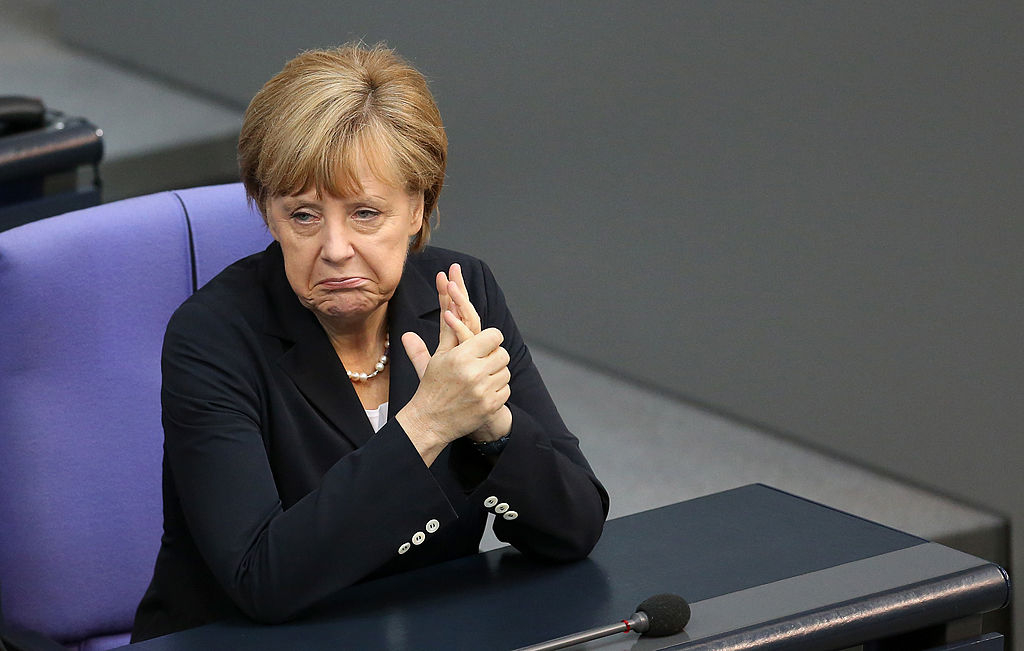
September 2015. Thousands of Syrian migrants crossing the Balkan route were heading toward Germany. Chancellor Angela Merkel was on the phone with Interior Minister Thomas de Maizière, talking about a number of measures to protect the borders, where thousands of policemen were secretly located along with buses and helicopters. De Maizière turned for advice to Dieter Romann, then head of the police. "Can we live with the images that will come out?" de Mazière asked. "What happens if 500 refugees with children in their arms run toward the border guards?"
De Maiziére was told that the appropriate use of the measures to be taken would have be decided by the police on the field. When de Maizière relayed Romann's response to the Chancellor, Merkel reversed her original commitment. And the borders were opened for 180 days. "For historical reasons, the Chancellor feared images of armed German police confronting civilians on our borders," writes Robin Alexander, Die Welt's leading journalist, who revealed these details in a new book, Die Getriebenen ("The Driven Ones"). Alexander reveals the real reason that pushed Merkel to open the door to a million and a half migrants in a few weeks: "In the end, Merkel refused to take responsibility, governing through the polls." This is how the famous Merkel's motto "Wir schaffen das" was born: "We can do it." According to Die Zeit: "Merkel and her people are convinced that the marchers could only be stopped with the help of violence: with water cannons, truncheons and pepper spray. It would be chaotic and the images would be horrific. Merkel is extremely wary of such images and of their political impact, and she is convinced that Germany wouldn't tolerate them. Merkel once said that Germany wouldn't be able to stand the images from the dismal conditions in the refugee camp at Calais for more than three days. But how much more devastating would images be of refugees being beaten as they try to get to Austria or Germany?"Merkel's refugee policy was not a masterpiece of humanitarian politics; it was dictated by the fear of television images spread all over the world. In so many key moments, it is the photograph that dictates our behavior: the image that dishonors us, that makes us cringe in horror.
Now, the main German sentiment that seems to be driving public opinion and politics is a dramatic sense of guilt. It is a "secular sin", according to a new book by German sociologist Rolf Peter Sieferle that is topping the German bestseller list, "Finis Germania". The behavior of Germans during the current migrant crisis, however, is symbolic of a more general Western condition. On April 30, 1975, the fall of Saigon was part of a war fought and lost by the United States as much on television as in the Vietnamese forests and rice paddies. It ended with the the escape of helicopters from the rooftop of the US embassy. In 1991, the imagery of the "highway of death" of Saddam Hussein's bombed army of thugs fleeing a plundered Kuwait also shocked the public in the West, and led to calls for an immediate cessation of the fighting in Iraq and Kuwait. The result was that Saddam Hussein's air force and Republican Guard divisions were spared; during the "peace" that followed, it was these troops who butchered Kurds and Shiites. The photograph of a dead American soldier dragged through the streets of Mogadishu after the "Black Hawk Down" incident pushed President Bill Clinton to order a shameful retreat from Somalia. That photograph also led the US Administration to rethink and cancel plans to use US troops for United Nations peace operations in Bosnia, Haiti and other strategic points. General David Petraeus would describe America's engagement in Afghanistan as a "war of perception". Even the suffering of our enemies disturbs us, in the humanitarian culture of the West. We are therefore increasingly amenable to policies of appeasement, censorship and retreat, in order not to have to face the possibility of such horribleness and actually having to fight it. That is why radical Islam has been able to horrify the West into submission. We have paralysed ourselves. We censor the cartoons, the graphic photos of the terrorists' victims and even the faces and names of the jihadists. The Islamic terrorists, on the other hand, are not publicity-seekers; they are soldiers ready to die and kill in the name of what they care about. This week, the German media was shocked by the revelation that the German air force will probably come under fire during its Syrian mission. "Endangering German soldiers!" -- with an exclamation point -- wrote Bild, the largest-selling newspaper in Germany. The statement exposed the anxiety of what John Vinocur of the Wall Street Journal called a "country where the army and air force basically do not fight". A pacifist Germany is now a source of trouble also for its own neighbors, such as Poland. "For centuries, our main worry in Poland was a very strong German army", said former Polish Defense Minister Janusz Onyszkiewicz. "Today, we're seriously worried about German armed forces that are too weak." The Western establishment censors images of our enemies' crimes while giving prominence to our "guilt". The French government censored the "gruesome torture" of the victims at the Bataclan Theater, who were castrated, disemboweled and had their eyes gouged out by the Islamist terrorists. It was a mistake: it was in the public interest to know exactly what enemy we are facing. The FBI and Department of Justice released a transcript of the Orlando jihadist's 911 call, but omitted all reference to the terror group ISIS and to Islam. These authorities did not want the public to know that Omar Mateen identified himself as an "Islamic soldier". The European Commission against Racism and Intolerance then told the British press it should not report when terrorists are Muslim. The CEO of Twitter, Dick Costolo, suspended accounts that showed photographs of the beheading of John Foley, along with other Islamist beheadings and savagery. But Twitter did not mind being flooded by images of a little dead boy, Alan (Aylan) Kurdi on a beach. The mainstream media in the US fought hard to lift the photo ban on military coffins during the war in Iraq. Its goal, apparently, was to humiliate and intimidate the public, to lower the support for the war. Images, as in Guantanamo and Abu Ghraib, are published only if they amplify the West's sense of guilt and turn the "war on terror" into something more even more dangerous than the jihad causing the war. Amnesty International's Secretary General, Irene Khan -- referring to concentration camps in the Soviet Union, where millions of people perished -- infamously called Guantanamo "the Gulag of our time". The result is to erase our enemy from our imagination. This is how the "war on terror" has become synonymous with lawlessness throughout the West. Ten years ago, after the brave surge in Iraq, US soldiers discovered Al Qaeda's torture chambers. No one -- not ABC, not CBS, not the New York Times -- published one photo of them; they just filled our eyes with naked bodies at Abu Ghraib. We are utopian technophiles and, contrary to the traditional Western view that we are flawed human beings in a tragic world. We now believe in Mark Zuckerberg's brave new world where no one should ever suffer and everyone should be happy and peaceful all the time. That is an exorbitant dream. For a short time we can afford it, as with Angela Merkel and Europe's migrant crisis. Unfortunately, that fantasy will not last. The conflicts at our gates, together with our aversion to making hard choices, will exact a far higher price. Giulio Meotti, Cultural Editor for Il Foglio, is an Italian journalist and author.
© 2017 Gatestone Institute. All rights reserved. The articles printed here do not necessarily reflect the views of the Editors or of Gatestone Institute. No part of the Gatestone website or any of its contents may be reproduced, copied or modified, without the prior written consent of Gatestone Institute.
|