Contact Form

Name

Email *

Message *

Showing posts with label Administration. Show all posts

Wednesday, December 14, 2016

We Would Love To See Carly Fiorina In Trump Adminstration


Fiorina Meets With Trump, Discusses China, Hacking

She's reportedly a candidate for director of national intelligence.

 Print

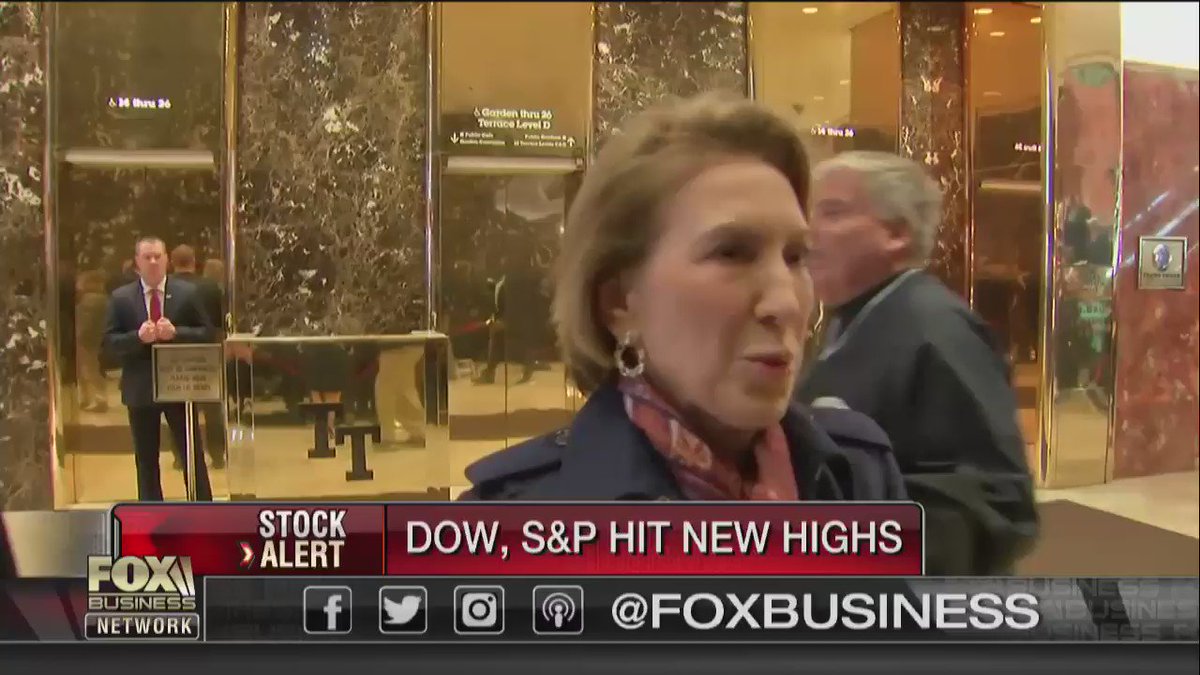
Former Republican presidential candidate Carly Fiorina spoke with reporters Monday at Trump Tower after a meeting with President-elect Donald Trump.
We “spent a fair amount of time talking about China as probably our most important adversary,” the former Hewlett-Packard chief executive told reporters afterward.
“We talked about hacking, whether it’s Chinese hacking or purported Russian hacking,” she said, most likely referring to the call from a bipartisan group of senators for an investigation into Russia’s alleged attempts to influence the election.

The New York Times reported Monday that Fiorina was being considered for director of national intelligence.


Fiorina also spoke about the unique opportunity Trump has to “literally reset things.”

She said he will be able “to reset the trajectory of this economy, to reset the role of government, to reset America’s role in the world and how we are perceived in the world.”
“I think it’s why he’s getting such fantastic people in his administration,” Fiorina concluded. “It says that people recognize the opportunity that our new president-elect has to make a huge impact on people’s lives in this country and on events around the world.”
The pro-life Susan B. Anthony List released a positive statement in reaction to Fiorina’s meeting with Trump.
“We are excited about President-elect Trump’s meeting with Carly Fiorina,” the group’s president, Marjorie Dannenfelser, said in a statement on Friday. “Nominating Carly for an important role would be a smart choice for President-elect Trump to advance his pro-life priorities. We are encouraged by this meeting and confident about Carly’s future in public service.”

Fiorina also told reporters she was impressed with the sports memorabilia in Trump’s office, especially the presence of Shaquille O’Neal’s “huge” shoe.
“I guess it takes a champion to know a champion,” she said.
Trump was criticized during the campaign for appearing to insult Fiorina’s appearance, saying, “Look at that face! Would anyone vote for that? Can you imagine that, the face of our next president?”
However, he later said he was talking about her “persona.”
“I think she’s got a beautiful face and she’s a beautiful woman,” Trump said.
What do you think?

Friday, January 3, 2014

Congress, Cabinet Departments And The Administration Continue To Steal Your Rights. Why Are You Still Sitting There?

Big Nanny Government Strikes Again

January 3, 2014 by  
 34 7
 
 1 276
Big Nanny Government Strikes Again
PHOTOS.COM

If you like your light bulb, you can keep your light bulb.
Actually, just like Barack Obama’s promise regarding health insurance, this one’s not true either. As of Jan. 1 (Happy New Year, by the way!), the import or manufacture of 40-watt or 60-watt light bulbs is now forbidden in the United States. This follows the ban on 75-watt and 100-watt bulbs, which had already been implemented.
I wish we could blame this on the current Administration, but actually this assault on our freedom of choice goes back to 2007, when Congress passed the Energy Independence and Security Act and it was signed into law by President George W. Bush.
Yep, the prohibition on incandescent bulbs is actually six years old. It just didn’t get much publicity until replacement light bulbs began disappearing from store shelves. Now that more consumers realize what’s happening, a whole bunch of people are stockpiling the ones that remain. If this is the first you’re learning of it and you want to keep some incandescent bulbs on hand, good luck finding some.
The experts who’ve decided they know what’s good for us say that, in time, we’ll learn to appreciate the wisdom of their policies. After all, the new compact fluorescent bulbs (CFLs) and light-emitting diodes (LEDs) that we’re being forced to use are much more energy-efficient than the trusty old favorites. The new bulbs last so much longer — up to 23 years, we’re told — that we’ll save money in the long run. So what if they cost 10 times more money than the old, familiar light bulbs that we’ve used for the past 100 years?
And so what if we hate the way these new light bulbs look? Or the weird kind of light many of them give out? Your not-so-friendly Federal government has decided that it doesn’t matter what your preferences might be. No consumer choice here — except which kind of new, energy-efficient light bulb you’re going to buy.
Welcome to one more way that Big Nanny government manages to intrude into the bedroom — not to mention the kitchen, living room and anyplace else where you flip a switch and expect a light to come on.
Oh, and how do you like how long it takes for some of these bulbs to come to full strength? I went into a guest bathroom recently. When I turned on the switch, it was still so dark in the room that I could barely find the toilet. In time, the room got a little bit brighter. But forget about bringing any reading material in with you.
Don’t look to Congress for any relief from these edicts. The House tried twice, back in 2007, to let us keep our incandescent bulbs. But two alternatives offered up by conservative lawmakers, the Better Use of Light Bulbs Act or the Light Bulb Freedom of Choice Act, failed to pass the House.
Facing the inevitable, General Electric has closed the last factory in the U.S. that manufactured incandescent bulbs. The shutdown of the plant in Winchester, Virginia cost 200 employees their jobs. And don’t count on the forced demand for CFLs and LEDs creating a bunch of new jobs in this country. All of those are being manufactured abroad, mostly in China. Thanks, Uncle Sam, for helping export even more U.S. jobs.
The assault on the light bulb is mere trifle, however, compared to the job losses and financial costs of Obama’s war on coal. And this isn’t happening because of any laws passed by Congress. No, the culprits here are the bureaucrats in the Environmental Protection Agency, who simply decree whatever regulations they deem necessary to achieve their goals.
Estimates are that some 600,000 jobs will be lost because of the EPA directives, mostly in Kentucky and West Virginia. Last week, both Kentucky Senators, as well as all five of the State’s Representatives, filed a friend-of-the-court brief in the Supreme Court, in support of a lawsuit challenging the EPA’s authority to regulate coal plants.
Senator Rand Paul (R-Ky.) said the case is “an egregious example of the EPA’s violation of the law in pursuit of its overzealous, anti-coal agenda.” And he added, “The ability to create laws is the purview of Congress and the EPA has clearly overstepped its authority.”
We’ll find out later this year if the Supreme Court agrees with him and does anything to retard the EPA’s onslaught against the coal industry. If not, you can expect to pay a lot more for electricity in this country. Nicolas Loris, an economist at the Heritage Foundation, warned that the EPA assault on coal-fired power plants “will deliver a blow to the economy and raise costs for consumers.” He added: “Any way you shake this, it’s a no-win for our economy.”
And speaking of a no-win, how about the latest on Obamacare? Just before Christmas, the Obama Administration announced that it was waiving the individual mandate for people who have had their existing health insurance policies canceled.
Geez, wasn’t it only a few weeks ago that the Democrats allowed a partial shutdown of the Federal government, rather than pass any Republican-endorsed measure to delay the individual mandate? Now it seems that Obama and his allies are tacitly admitting that Senator Ted Cruz and the House Republicans were right in demanding a delay.
This is just one more example of how the Obama Administration is changing the law without bothering to get Congress involved. Columnist John Fund says delaying the individual mandate “is at least the 14th unilateral change to Obamacare that’s been made without consulting Congress.”
Ho-hum, another crisis, another unConstitutional edict from the folks in the White House.
Considering all of the attacks on our freedoms, is it any wonder that the latest Gallup poll says that 72 percent of Americans now say that Big Government is a threat to our liberties? That number is a new record high, by the way.
As I said last week, there are some encouraging signs that more and more Americans are standing up and speaking out in defense of their principles. It was wonderful to see the furor that erupted when A&E Networks suspended “Duck Dynasty” patriarch Phil Robertson.
Let’s hope the new year will bring us some more such victories. I hope that one of your resolutions will be to do your part in making it happen.
Until next time, keep some powder dry.

Saturday, September 7, 2013

Double Dealin With The Government

Anyone who pays attention to the government, would know that the S&P suit, is 

retribution for the downgrade by the company of the US economy.  Our leaders 

(especially this administration) say one thing and do another. They want companies to be

upright and "do the right thing" however, when they do and it involves the government, 

as in this case, they become  unbridled.


When S&P downgraded the economy, we knew this would happen and it sent a shiver up 

our spine. We feared the use of government  power would telegraph a message to the 

rest of the industry. So far it has worked!


If a private company used the same technique against a rating agency, the government 

would jump down their throat in a nanosecond.  Why should the Administration be

treated any differently?  This double standard stinks, but so does this group of goofs

who want us to believe they are doing what is best for us.


As Sarah Palin asked "how's this hopey-changey thing working out for you?"  It isn't working

out for the US. She was so right!


Conservative Tom


S&P to Fight for Evidence U.S. Suit Was Political Payback

Standard & Poor’s is trying to show it was unfairly singled out in a $5 billion fraud lawsuit 18 months after it downgraded U.S. sovereign debt. Getting the government to provide supporting evidence will prove difficult.
McGraw Hill Financial Inc. (MHFI) and its S&P unit are seeking information from the Justice Department about the decision to target the company in the first federal case against a ratings firm for grades related to the credit crisis. S&P also wants a look at the government’s investigative files on other raters as part of a defense strategy to show it was unfairly sued.
Standard & Poor's signage is displayed outside of the company's building in New York. Photographer: Michael Nagle/Bloomberg
Sponsored Links
If you owe less than $729k, you probably qualify for ...
Send checks through your phone. GoBank handles it all...
Pay what you want for your monthly membership fee. Cl...
Buy a link
S&P in the coming months will seek to defeat government attempts to shield internal discussions and evidence as the case heads for a first round of procedural deadlines that will determine what evidence eventually goes before the jury.
Even with the judge in the case sounding sympathetic in court to S&P’s desire to know why the U.S. sued it and not other ratings firms, it’s highly unlikely the government will be forced to reveal its internal discussions on the matter, said Wayne Gross, a former federal prosecutor now with Greenberg Gross LLP in Costa Mesa, California.
“It is important that the government be able to conduct investigations confidentially to protect the subjects of investigations who may never be charged,” Gross said in a phone interview.
Having lost a pretrial bid to get the case dismissed in federal court in Santa Ana, California, S&P now must prepare a defense that will persuade a jury to reject allegations that it defrauded investors by falsely claiming its ratings were independent and free of conflicts of interest.

Retribution Theory

U.S. District Judge David Carter hinted at a retribution theory at a July 29 court hearing, saying that S&P may seek to interview government officials about whether they sued because of the company’s downgrade of U.S. debt two years ago. While the judge described himself as a believer in transparency with a “pretty wide open” philosophy about pretrial evidence sharing, he made no promises S&P will get what it wants.
“You’re going to have a very difficult time with some of the government agencies,” Carter told S&P’s lawyers.
U.S. Attorney General Eric Holder said Feb. 5, the day after the complaint was filed against S&P, that it was unrelated to the downgrade. Holder made the comment in Washington as some financial professionals said publicly the targeting of S&P looked suspicious because the company’s two primary competitors, Moody’s Corp. (MCO) and Fitch Ratings, awarded the same top grades to troubled mortgage bonds and didn’t downgrade the U.S. debt.
“There’s no connection between the two,” Holder said. “They did what they did, assessing what the creditworthiness was of this nation. We looked at the facts, the law and the investigation” and determined the lawsuit was “appropriate.”

‘Slashing,’ ‘Smashing’

S&P lawyer John Keker, the founding partner of San Francisco-based Keker & Van Nest LLP, may not let Holder have the last word. Keker, whose self-described approach to white-collar crime trials and corporate litigation is “slashing and smashing,” said at the July 29 hearing the company’s legal team will eventually seek to question a number of high-level government officials at the Justice Department as well as at the U.S. Treasury and the Securities and Exchange Commission.
“We anticipate highly contentious motion practice,” Keker told the judge, adding that he would focus on getting documents first and interrogating officials later. “They’re going to fight like mad.”
The Justice Department is seeking as much as $5 billion in civil penalties for losses to federally insured financial institutions that relied on S&P’s investment-grade ratings for mortgage-backed securities and collateralized debt obligations.

Central Theme

It will be a central theme of S&P’s defense to convince jurors that the government isn’t acting as an advocate of the interest of the American people in this case, said John Hueston, a former federal prosecutor now with Irell & Manella LLP in Los Angeles.
Gathering evidence about the government’s motivation to bring the lawsuit might also put S&P in a better position to negotiate a settlement, Hueston said in a phone interview.
“It is a brilliant move to try to obtain documents that go as high as possible,” Hueston said. “If the government becomes uncomfortable and it becomes a trial of the Justice Department, it could be a highly effective leverage strategy.”
While the congressionally appointed Financial Crisis Inquiry Commission blamed all three of the leading U.S. credit raters for inflated ratings that helped cause the worst financial crisis since the Great Depression, Moody’s and Fitch said after the Justice Department filed its complaint against S&P that they had no reason to believe they would be sued too.

AAA Rating

S&P has said nothing in court filings drawing a link between the lawsuit against it and its August 2011 decision to downgrade the U.S.’s 60-year-running AAA credit rating to AA+ with a negative outlook.
S&P said at the time that the Obama administration and Congress failed to take sufficient steps to reduce the record budget deficit. Moody’s and Fitch the same month affirmed their AAA ratings. All three firms are based in New York.
The Treasury Department said S&P had made a $2 trillion error in its analysis. S&P said there was no mistake and the discussion hinged on which baseline assumption should be used from the nonpartisan Congressional Budget Office.
S&P’s move roiled the markets, contributing to a global stock-market rout that erased about $6 trillion in value from July 26 to Aug. 12, 2011. The firm changed its outlook for the U.S. to “stable” in June from “negative,” citing “tentative improvements” in the debt burden.

Credit Crisis

The government alleged in its Feb. 4 complaint against S&P that the firm knowingly downplayed the risk on securities before the credit crisis in a desire to win business from investment banks that sought the highest possible ratings to sell them.
In other probes of abuses that fueled the collapse of the U.S. housing market starting in 2007 and led global credit markets to freeze in 2008, the Justice Department and Securities and Exchange Commission this month sued Charlotte, North Carolina-based Bank of America Corp., the nation’s second-biggest lender, while New York-based JPMorgan Chase & Co. (JPM), the biggest U.S. bank, disclosed that it’s under federal criminal investigation for practices tied to to sales of mortgage-backed bonds.
S&P’s first line of defense failed when it asked Carter to dismiss the lawsuit on the grounds that its statements about the objectivity of its ratings were so generic that reasonable investors wouldn’t have relied on them.

‘S&P’s Objectivity’

“If no investor believed in S&P’s objectivity,” the judge wrote in a July 16 ruling, “is S&P asserting that, as a matter of law, the company’s credit ratings service added absolutely zero material value as a predictor of creditworthiness?”
The company also has argued that its ratings were the same as those of its competitors and that the government’s complaint failed to specify what the correct ratings should have been.
S&P said in a July 24 filing that it would seek transcripts of all testimony the government took in its investigation, all materials about interactions the Justice Department had with other federal and state agencies about its investigation, and about “the government’s decision to authorize the filing of this litigation.”
The Justice Department’s initial discovery will focus on identifying those CDOs and mortgage-backed securities that it believes were affected by the alleged fraud and that will serve best as evidence to present to a jury when the case goes to trial, government lawyers said in a July 27 filing. The judge gave the government a Nov. 18 deadline to complete that task.
Carter set a Dec. 16 hearing to determine how much additional time both sides need for discovery. The government has proposed a trial start date of Feb. 17, 2015.
Keker was asked by the judge at the July 29 hearing about the prospects for a settlement.
“The impediment is that the government has a view of this case that makes it impossible to settle,” Keker said.
The case is U.S. v. McGraw-Hill Cos., 13-cv-00779 U.S. District Court, Central District of California (Santa Ana).