Democrats’ ‘Medicare for All’ plan won’t screw just the ‘rich’
WASHINGTON — Thirty trillion dollars, even in U.S. budget terms, is a lot of money.
That’s the rough estimate from some analysts of the 10-year cost of Sen. Bernie Sanders’ “Medicare for All” plan, just one of many expensive social programs that some of the 21 Democrats seeking to replace President Donald Trump have proposed.
To pay for those programs, the candidates have focused on taxing the rich. But many of the plans they’ve put on the table would require across-the-board tax increases that would hit middle-earners as well as the wealthy, public policy analysts say. None more than Medicare for All.
Raising the more than $30 trillion needed to fund Sanders’s health plan over a decade would require doubling all personal and corporate income taxes or tripling payroll taxes, which are split between employees and employers, said Marc Goldwein, a senior vice president at the nonpartisan Committee for a Responsible Federal Budget.
“There is a lot of money out there, but there isn’t $30 trillion sitting around from high earners,” he said. “It just doesn’t exist.”
Sanders has backed the concept for years, and when he proposed similar legislation in 2013 it attracted no co-sponsors. But when he offered his Medicare for All legislation in April, 14 other Democratic senators signed on, including Kamala Harris, Cory Booker, Kirsten Gillibrand and Elizabeth Warren, four of his rivals for the Democratic nomination.
Still, many Democrats have balked at the price tag for Sanders’ proposal. The $3 trillion estimate annual cost for Sanders’ plan compares with the $582 billion cost for Medicare in fiscal 2018, and would be a substantial addition to the current federal budget of about $4.4 trillion.
Other Democrats, while generally favoring a way to provide universal health care coverage, are pursuing scaled-back versions, such as a “public option” that would allow people to buy into Medicare or Medicaid, but not do away with private insurance. Harris, Booker and Gillibrand also are co-sponsoring one of the alternative plans.
Warren has also touted public relief of college debt — $1.25 trillion — and subsidizing child care — $700 billion, while former Rep. Beto O’Rourke has proposed creating new programs to combat climate change for $5 trillion — all while promising to lower middle-class taxes.
Democrats have defended the tax increases needed to pay for their plans by promising the brunt would be borne by top earners or that most Americans will end up paying less overall than they do for those services currently.
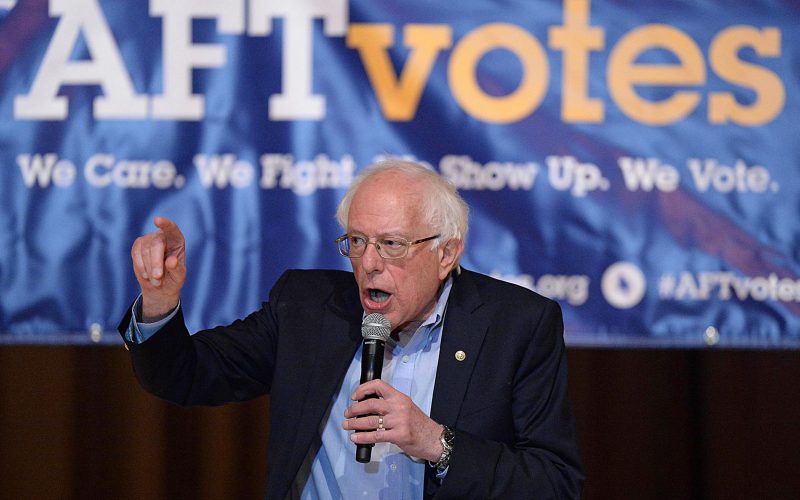
“You’re going to pay more in taxes,” Sanders said at a CNN town hall last month. “But at the end of the day, the overwhelming majority of people are going to end up paying less for health care because they’re not paying premiums, co-payments and deductibles.”
Even though the government would have to increase payroll tax rates from the current 15.3 percent to about 45 percent to fund Medicare for All, the average family would see their tax burden increase about 2 percent to 3 percent, said Ernie Tedeschi, a managing director for research firm Evercore ISI. Payroll tax bills are split between employees and employers.
Sanders hasn’t yet said how he plans to pay for his proposal to transition to a government-run system that covers hospital visits, primary care, prescription drugs, vision and dental. His plan offers benefits more generous than many receive from private insurance and those currently on Medicare.
In 2017, he released a paper that includes several options, including a wealth tax, a bank levy and having employers and employees pay premiums — a cost he recently said people wouldn’t face under his plan. This list, however, only comes up with about $16.2 trillion worth of tax increases, half of what is needed.
The Congressional Budget Office says in a May report that of the $3.5 trillion spent on health care in 2017, slightly more than half came from public sources, including both federal, state and local funding.
The cost to provide health care for approximately 330 million people living in the U.S. comes to roughly $10,000 a person annually. But a middle-class family of four, for example, isn’t going to be expected to pay an extra $40,000, making the financing politically challenging, said Chuck Blahous, a senior research strategist at the conservative Mercatus Center.
“It seems unlikely that every person in America will have to pony up $10,000,” he said. “The funding options look ugly and unrealistic.”
Sanders is not alone in shying away from campaigning on big tax increases. Several of his Democratic rivals have proposed plans with price tags that extend into the trillions of dollars that don’t advertise where the money is coming from to pay for them.
O’Rourke has a $5 trillion plan to reach net-zero emissions in the next 30 years to be funded by unspecified tax increases on corporations and the wealthy. Harris has proposed to repeal the entire 2017 Republican tax law and replace it with a $2.8 trillion plan to direct refundable tax credits to low- and middle-income families.
Warren has taken the opposite tactic. She’s proposed two large new levies — an annual wealth tax on households worth at least $50 billion and a 7 percent corporate surtax on companies with more than $100 million in profits. She says those new taxes will pay to make child care universally accessible and to eliminate college debt for millions of Americans.
However, those programs cost a fraction of what a large health care overhaul would amount to. The money is out there, but it can’t come from just the wealthy, Tedeschi said.
“Raising the amount of revenue for these programs is a surmountable challenge. The key here is figuring out what the distribution of the burden is going to be,” Tedeschi said. “It’s not going to be easy or cheap to transfer it from the private sector pocket to the public sector one.”
— Laura Davison
Bloomberg News
Bloomberg News




“groups” of people, but when it gets
down to individual persons, not so
much. You’re about to see this play
out in spades as Democrats cry
crocodile tears over the coming
repeal of Obamacare.
“This will be catastrophic for the
20 million people who were
previously uninsured but now have
coverage! You can’t take away their
health care!”
doing that. Any repeal legislation
will have a transition period for
those who got coverage through
Obamacare to move to new plans.
And second, they will have more
choices and better options. Win. Win.
quantity, how many millions we’ve
given something to, versus quality,
what does that “gift” mean for individual
people.
Dear reader:
there are few publications that
Americans can rely on to learn the
“other” side of the issues.
of more than 100 journalists and
policy experts solely funded by the financial support of the general public.
continue to provide The Daily Signal
for free.
news and analysis on key issues,
please take one minute to help
make a difference. Thank you.
million more Americans today have
health care due to Obamacare. The
reality is that when you look at the
actual net gains over the past two years
since the program was fully implemented,
the number is 14 million, and of that, 11.8
million (84 percent) were people given the
“gift” of Medicaid.
will be left without insurance after the repeal
of Obamacare. Numbers are still being
crunched, but between statistics released
by the Congressional Budget Office and
one of the infamous architects of Obamacare,
the Massachusetts Institute of Technology’s
Jonathan Gruber, it’s estimated that anywhere
from 2 to 7 million people now on Medicaid
would have qualified for the program even
without Obamacare.
of 20 million more Americans having health
insurance because of Obamacare.
those who are uninsured often have better
outcomes than those with Medicaid. A
University of Virginia study found that for
eight different surgical procedures, Medicaid
patients were more likely to die than privately
insured or uninsured patients. They were also
more likely to suffer complications.
focused on procedures done from 2003-2007,
prior to the geniuses in Washington deciding
it was a good idea to put even more people
on the already overburdened Medicaid system.
law promised, there is little evidence to show
that the use of emergency rooms, which have
a higher level of medical errors, has decreased
due to Obamacare.
handed out millions of new Medicaid cards, that
does not mean the recipients now have quality
health care. In fact, it doesn’t ensure they have
health care at all. That’s because increasing
numbers of doctors aren’t accepting Medicaid.
“My Medicaid card is useless for me right now.
It’s a useless piece of plastic. I can’t find an
orthopedic surgeon or a pain management
doctor who will accept Medicaid.”
senators pull out the Kleenex boxes bemoaning
the fact Republicans are the ones trying to take
people’s health care away.
Obamacare is how many truly needy and disabled
Americans are NOT getting the services they need
because of the expansion of Medicaid for able-
bodied adults (aka healthy) of prime working age,
19-54.
Obamacare is helping, it neglects to mention
that over half a million disabled people, from those
with developmental disabilities to traumatic brain
injuries, are on waiting lists for care.
Obamacare gives states more money to enroll
able-bodied adults than it does to take care of
disabled children and adults who qualified for
Medicaid prior to Obamacare.
perverse impact, note this. Since Arkansas
expanded its Medicaid program under
Obamacare, it’s rolls have grown by 25 percent.
During that same time, 79 people on the
Medicaid waiting list who suffered from
developmental disabilities have died. I would
encourage you to read my former Heritage
Foundation colleague Chris Jacob’s full piece on this.
that are finding fewer health care provider options.
For people who now have health plans through the
Obamacare exchanges, new Heritage Foundation
research shows that this year, in 70 percent of
counties across the country, those consumers
will have only one or two insurers to choose from.
doctors and health plans they liked and are now
paying higher premiums for less coverage, and
you can see that quality health care and anything
resembling “choice” has quickly disappeared for
an increasing number of Americans due to
Obamacare.
tries to take the moral high ground about the
millions of people the law has helped, ask
them to define what “help” looks like.