Contact Form

Name

Email *

Message *

Showing posts with label Daesh. Show all posts

Wednesday, March 1, 2017

ISIS Now Using Stray Dogs--Isn't That Ironic?


Video: Shiite Militia Finds Puppy Strapped with Islamic State Explosives


SIGN UP FOR OUR NEWSLETTER

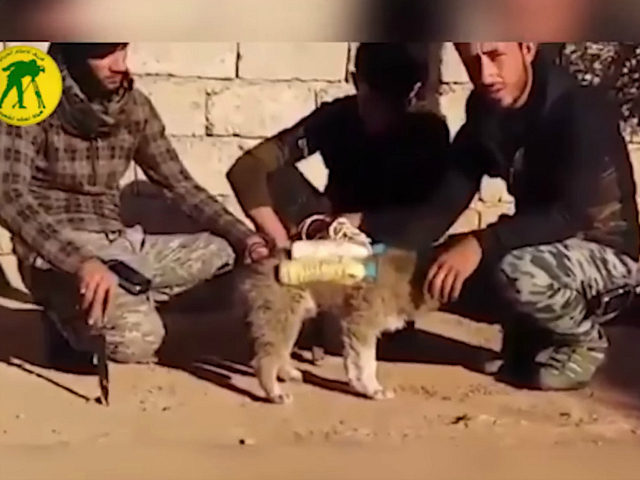
Islamic State (ISIS/ISIL) jihadists are strapping bombs on stray dogs, including a puppy, to use them against U.S.-backed coalition forces in Iraq, a video posted by Iraqi government-sanctioned paramilitary fighters purportedly shows.

Alleged members of the predominantly Shiite Popular Mobilization Forces (PMF), an Iran-allied umbrella network of militias fighting ISIS in Iraq that is also known as the Popular Mobilization Units (PMF) and al-Hashd al-Shabi, posted the video.
VIDEO Inside the luxury Mosul hotel that housed ISIS elite

The footage shows three PMF fighters crouching near a puppy allegedly wired by ISIS with several bottles filled with explosive materials.
“This is the latest from Daesh [Islamic State], abusing an animal,” one fighter said, referring to the dog, according to Iraqi News.
Another PMF fighter asked, “What sin did it commit?”
Daily Mail points out: “Jihadis wanted the dog to cross the front lines towards rival forces where the device would have been detonated by remote control, according to rebels who posted video of the animal online.”
The British news outlet adds that the PMF fighters defused the improvised explosive device (IED) tied to the puppy before it was detonated.
Breitbart News is unable to verify the authenticity of the video.
ISIS also has “booby-trapped” sheep, reports Iraqi News, adding:
Islamic State [IS] has largely relied on booby-trapped vehicles, landmines, weaponized drones and human suicide bombers in facing Iraqi troops, but it has also resorted to other extraordinary deceptive tactics such as using decoy military equipment and camouflage-dressed mannequins, and lately, booby-trapped animals. Some local observers believe the tactics signal desperation and the waning combat resources on Islamic State’s behalf.
Although most fighters are Shiite, there are Sunni tribesmen and even Christians fighting among the PMF.
The Iran-linked force, which has been legalized by the Iraqi parliament, is participating in the ongoing U.S.-backed offensive to push ISIS out of Mosul.
PMF fighters have reportedly captured territory in an around Mosul and are expected to seize more.
Amnesty International and other human rights groups have accused the mainly Shiite militiamen of committing war crimes against the Sunni ISIS jihadists and Sunni civilians.
Nevertheless, the PMF is reportedly receiving U.S. assistance in Iraq.
The U.S.-backed Iraqi government forces and their allies have liberated eastern Mosul and are currently fighting to push the jihadists out of the western half. Mosul, Iraq’s second-largest city, is considered the last major ISIS stronghold in the country.

Tuesday, February 28, 2017

Destroyed Jonah's Tomb Yields Another Discovery


ISIS Destruction of Jonah's Tomb Incredibly Reveals Ancient Palace of Biblical King Sennacherib


“Should not I have pity on Ninveh that great city wherein are more than sixscore thousand persons that cannot discern between their right hand and their left hand and also much cattle?’” Jonah 4:11 (The Israel Bible™)
The palace of the Biblical King Sennacherib, long buried underneath the tomb of the prophet Jonah in the Biblical city of Nineveh, has incredibly been discovered by Iraqi archaeologists as a result of efforts by the Islamic State (ISIS) to destroy the site and loot its priceless antiquities.
The shrine is, according to tradition, built on the burial site of Jonah, known as Nabi Yunis in the Koran. Located in the northern Iraqi city of Mosul, the structure was destroyed by ISIS in July 2014. When the city was liberated by Iraqi troops a few weeks ago, archaeologist were dismayed to find that not only had ISIS used dynamite to destroy the shrine, but the terror group had tunneled underneath and carried away hundreds of artifacts to sell on the black market.
However, the tunnels revealed a completely unexpected treasure: the 2,300-year-old palace of King Sennacherib, mentioned in the Bible. During Sennacherib‘s reign, Nineveh was one of the richest cities in the world. His military campaign against the Kingdom of Judah is described in the Bible.
After these things, and this faithfulness, Sancheriv king of Ashur came, and entered into Yehudah, and encamped against the fortified cities, and thought to make a breach therein for himself. II Chronicles 32:1
The palace, built by Sennacherib, who ruled Assyria from 705 BCE to 681 BCE, was later expanded by his son, Esarhaddon (681-669 BC). The palace was partly destroyed during the Sack of Nineveh in 612 BCE.
Archaeologists are working desperately to save whatever they can, as the tunnels are unstable.
“I can only imagine how much Daesh (ISIS) discovered down there before we got here,” Iraqi archaeologist Layla Salih, who is supervising the team carrying out the emergency exploration, told the Telegraph. “We believe they took many of the artifacts, such as pottery and smaller pieces, away to sell. But what they left will be studied and will add a lot to our knowledge of the period.”
The destructive efforts did bring some benefit to archaeologists. The site was largely unexplored, and though two previous efforts at excavation were carried out, the most recently in the 1950s, archaeologists had never reached as far as the palace.
“The objects don’t match descriptions of what we thought was down there, so [ISIS’s] destruction has actually led us to a fantastic find,” Salih said.
Archaeologists have discovered in the palace a rare cuneiform slab they believe was made during Sennacherib’s reign.
In another part of the tunnel they discovered Assyrian stone sculptures of an Assyrian demi-goddess, depicted sprinkling the “water of life” to protect humans in her care.  
“There’s a huge amount of history down there, not just ornamental stones,” Salih said. “It is an opportunity to finally map the treasure-house of the world’s first great empire, from the period of its greatest success.”
After ISIS destroyed the structure, archaeologists discovered the Muslim shrine had been built on the ruins of a church, originally called The Monastery of Jonah, dating back from the fourth century Christian Syriac denomination. According to tradition, the church contained a piece of Noah’s Ark. The Shrine of Jonah was closed to Christians in 1902.
It is unclear why ISIS destroyed the mosque of a prophet venerated by Islam. It is believed that ISIS, as part of the Salafi movement, rejects the concept of worshipping at shrines and therefore destroyed it to prevent Muslims from worshipping there. Some have speculated that the destruction of the site was intended to wipe out vestiges of Christianity and Judaism, even those connected to Islam.
Even within Islam, the site is not universally accepted as the Biblical prophet’s burial place. In the Jewish tradition, Jonah returned to his hometown of Gath-Hepher in the Galilee after his mission to Nineveh and was buried there. Another Islamic shrine in Halhul near Hebron is claimed by the Muslims to be the Jewish prophet’s burial site.

Read more at https://www.breakingisraelnews.com/84367/palace-biblical-king-sennacherib-discovered-beneath-isis-destruction-jonahs-tomb/#d8BkZ0HyOY4CRhup.99ddess, depicted sprinkling the “water of life” to protect humans in her care.  
“There’s a huge amount of history down there, not just ornamental stones,” Salih said. “It is an opportunity to finally map the treasure-house of the world’s first great empire, from the period of its greatest success.”
After ISIS destroyed the structure, archaeologists discovered the Muslim shrine had been built on the ruins of a church, originally called The Monastery of Jonah, dating back from the fourth century Christian Syriac denomination. According to tradition, the church contained a piece of Noah’s Ark. The Shrine of Jonah was closed to Christians in 1902.
It is unclear why ISIS destroyed the mosque of a prophet venerated by Islam. It is believed that ISIS, as part of the Salafi movement, rejects the concept of worshipping at shrines and therefore destroyed it to prevent Muslims from worshipping there. Some have speculated that the destruction of the site was intended to wipe out vestiges of Christianity and Judaism, even those connected to Islam.
Even within Islam, the site is not universally accepted as the Biblical prophet’s burial place. In the Jewish tradition, Jonah returned to his hometown of Gath-Hepher in the Galilee after his mission to Nineveh and was buried there. Another Islamic shrine in Halhul near Hebron is claimed by the Muslims to be the Jewish prophet’s burial site.

Read more at https://www.breakingisraelnews.com/84367/palace-biblical-king-sennacherib-discovered-beneath-isis-destruction-jonahs-tomb/#d8BkZ0HyOY4CRhup.99

Tuesday, February 21, 2017

ISIS Is NOT Wonderful

Harrowing tales of three women who escaped Islamic State

Published: July 14, 2015
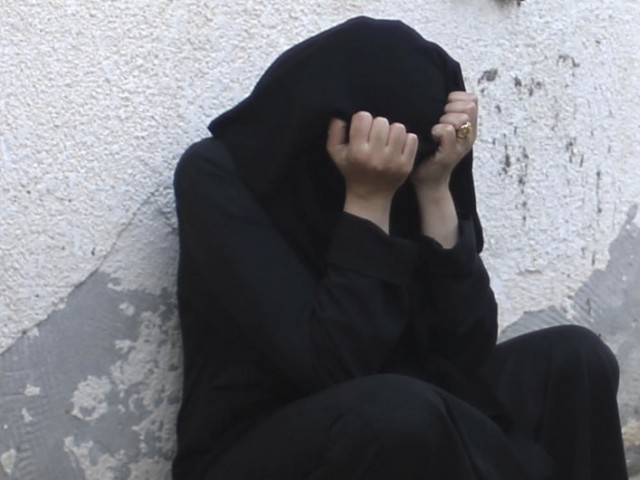
File photo of a woman. PHOTO: REUTERS
Saltley Academy in Birmingham is battling radicalisation by hosting talks from Iraqi women narrating horrifying tales of their lives as prisoners of the Islamic State.
Amidst stories of young British students running away to join IS, Saltley Academy has launched an anti-radicalisation campaign to counter the terrorist organisation’s propaganda.
The students sat riveted as they listened to three young Yazidi women in the school’s library. The women, who had come from refugee camps, related their terrifying experiences to deter girls from leaving home and marrying IS men. “I want [young people] not to believe what they see on Facebook,” said 21-year-old Bushra, who is one of the three women. “There is no life with IS apart from rape and killing.”
The ‘Open Your Eyes’ campaign was launched by the Birmingham and Bradford-based anti-extremism charity Upstanding Neighbourhoods with the support of the Amar Foundation and aims to use social media in the same way as IS to combat its propaganda.
“You only need to look around to see why their work is needed so urgently,” said Henna Rai from Upstanding Neighbourhoods. “IS’s propaganda machine is so vast that there needs to be a counter-narrative.”
Open Your Eyes hopes to recruit 10,000 young people to reach out to those who may be drawn to IS, as well as providing a platform for victims to tell their own stories.
Amena Saeed Hassan, a Yazidi Iraqi MP, who helped rescue the girls and bring them to the UK, said, “Daesh (IS) has nothing to do with any religion or morals. It carries out evil crimes against innocents, killing the elderly, men, and babies, taking turns in raping girls they hold prisoner hundreds of times a day. Anyone who has any decent morals and manners wouldn’t join Daesh (IS) but would instead help in freeing their victims.”
Munira, 16
Munira was only 15 when was taken away from her family by IS fighters when they invaded her village. “They separated me from my baby sisters, they were only five months and four, and my eight-year-old brother,” she said. “I was devastated, particularly about the baby. I was very sacred, I wanted to die.”
She was taken by a 60-year-old man called Abu Muhammad who kept her imprisoned in a remote house. “However hard I screamed, yelled and cried there was no one to help us. When he raped me he told me ‘you are slaves, you are our slaves of war’.”
Munira was sold between men several times and repeatedly raped. “I was in captivity for three months and 20 days,” she said, eyes downcast. “I used to think I would rather be dead than living through this.”
She finally escaped by jumping out a second floor window and was later reunited with her parents in a refugee camp. Her younger sisters are still in captivity. “I am living in the camp now with my family, waiting. There is nowhere else to go. I don’t have hope for anything any more,” she said. “I want my family and all the Yazidis to be taken away now, because this will happen again and again and again unless we move away. No Yazidi can feel safe at all.”
Bushra, 21
Bushra and her family fled for the mountains when the IS men took over their village. A young man, who had been a friend of her brother’s told them to go home. When her brother refused, the man held a gun to his head. The IS men then took Bushra, who was 18 then, to another city along with her 14-year-old sister.
When they were told that they would be married, a friend of Bushra’s from the village went to the village and attempted suicide by slitting her wrists. “They knew I was closest to her; they made me go into the bathroom,” she said. “She was covered in blood and I couldn’t look at her. They wrapped her in a blanket and threw her in the street like a piece of rubbish.”
“I thought it would be better to kill my sister and myself. I put a scarf around our necks, but I was too scared. I couldn’t go through with it,” she said when she and her sister were chosen by the same man who had once been the friend of the family.
One night, as she was being raped in his house by another soldier, she could hear her sister being raped by the former friend in the next room. “I could hear her screams filling my ears but I couldn’t do anything to help her,” she said.
Bushra and her sister managed to escape and live in a refugee camp but nine members of her family are still missing. “I want the whole world to hear our story and do something about it, to help free the Yazidi people who are still held captive,” she said. “I wish they would give us asylum, because we can no longer live in Iraq.”
Noor, 22
Noor was 18 when she was taken away by the IS men along with her 14-year-old niece. The IS fighters had killed all of the men in the village. They took all the younger women to warehouse filled with Yazidi girls and women.
“A woman told us that every day Daesh [IS] men would come and have their pick of the girls, they took them, raped them, sold them on,” Noor related.
The 18-year-old was chosen by a leader. “He went to fight. And when he came back he dipped his big toe into a jar of honey and forced it into my mouth. After that he raped me.”
Once when Noor tried to escape, she was caught. “He opened the door and allowed the six guards into the room,” she said. “He told the six guards to rape me. All of them, all kinds of ways, everything. I was made to do disgusting things. For two whole days I couldn’t move any part of my body.”
She was then sold to many differently men before finally escaping. “You can’t imagine what it was like. I want them to be punished. I have no hope for the future, as long as there are women and girls being held by Daesh [is]. I can’t think about it.”
* Names have been changed and images disguised to protect identities of the women involved.
This article originally appeared on The Guardian

Saturday, February 18, 2017

The West Needs To Awaken To The Threat Of Radical Islam. Saudi Arabia Has!

Islamophobic Saudi Arabia Deports 40,000 Muslim Pakistanis, Citing Terrorism Concerns

Asif Hassan/AFP/Getty Images
FEBRUARY 15, 2017
2629539075103 Comments269858
Saudi Arabia has deported a staggering 40,000 Pakistani migrant workers in
the span of just four months, citing terrorism concerns.
The Saudi Gazette reported last week that “a number of Pakistanis were
 held in the crimes of drug trafficking, thefts, forgery and physical assault.”
 Authorities feared that some of the migrant workers were linked with ISIS,
or as the Saudis call the terror group, Daesh. Other migrants were deported
due to expired residency and work permits.
VIDEOInside Iraq's reform center for teen jihadists


Mute
Current Time0:19
/
Duration Time1:50
Loaded: 0%
Progress: 0%
“Against this backdrop, Abdullah Al-Sadoun, chairman of the security committee
 of the Shoura Council, called for thoroughly scrutinizing the Pakistanis before
 they are recruited for work in the Kingdom,” added the Gazette. “He asked
for more closer coordination with the concerned authorities in Pakistan to
 thoroughly check those coming to work in the Kingdom due to the
involvement of a number of Pakistanis in security issues.”
While the Kingdom has long exported the jihadist ideological cancer of
 Wahhabism to mosques and Islamic centers across the West, it has prided
 itself in its effort to rid the homeland of terrorists threatening to undermine
the stability and sovereignty of the monarchy.  
Counter-terrorism raids are not uncommon in Saudi Arabia. In fact, counter-
terrorism agents recently arrested 15 Pakistanis in the Al-Harazat and
Al-Naseem districts of Jeddah on terrorism-related charges.
Pakistanis have mostly traveled to Saudi Arabia looking for work. Many of
them take low-paying and dangerous jobs in the construction industry.
But leave it to Saudi Arabia to treat its migrant labor force with appalling apathy.
“Official Saudi statistics say that 243,000 Pakistanis were deported between
 2012 – 2015,” reportsThe Independent. “Mass deportations of migrant
workers - which Human Rights Watch and other rights organisations say
often involve illegal beatings and detainment in poor conditions -
 are fairly common.”
This all begs the question: Is Saudi Arabia Islamophobic? Well, if you’re
 claiming that President Trump’s falsely identified “Muslim ban” (recently
 rendered unconstitutional by a federal appellate court) is Islamphobic
because of the fact that it places a temporary freeze on the acceptance
 of incoming refugees from just seven (out of dozens) of the high-risk
Muslim-majority countries in the world, then surely Saudi Arabia’s mass
deportation of tens of thousands of Muslims due to terrorism concerns
 should ring some alarm bells.
Is Saudi Arabia immune from the charge of Islamophobia because its
leaders are Muslim? Or, better yet, is the Left’s entire hysterical crusade
 against Trump’s “Islamophobia” a red herring meant to delegitimize the
 political opposition?
The bottom line is every sovereign state, whether it be Saudi Arabia,
 Israel, or the United States, has a right to defend its borders and regulate
 who comes into the country. Every sovereign state has a right, perhaps
 even a duty, to protect its citizens against foreign threats, particularly
terrorist threats.