Contact Form

Name

Email *

Message *

Showing posts with label Iraqi. Show all posts

Saturday, March 4, 2017

Is This The Type Of "Immigrant" That You Want In The US?


Iraqi Asylum Seeker Jailed for Raping Drunk Woman in London

3

SIGN UP FOR OUR NEWSLETTER

An Iraqi asylum seeker has been jailed for luring a “vulnerable”, drunk woman into his basement and raping her after she missed the last bus home.

Ismael Ali Omer, 32, approached the “clearly drunk” woman in August last year, after seeing her stranded at a bus stop following a night out in Shepherd’s Bush, West London.
Mr. Omer claimed asylum in the UK after being tortured by Saddam Hussain’s regime. He is still unable to return because his hometown is now controlled by Islamic State.
On the night of the crime, he persuaded the “naïve” victim she would be safe with him in his nearby home in Notting Hill, Court News reports. She soon realised “something was wrong” once inside, but was unable to fend him off as he raped her in the cramped room, said to be “little more than a cupboard”.
When she fled and pressed charges, Mr. Omar attempted to exploit her memory loss by claiming she had made advances towards him. However, CCTV footage of the “vulnerable” women stumbling near his house revealed she had not initiated any sexual activity.
He denied the allegation against him but was convicted of one count of rape following a trial at Southwark Crown Court. He cried as he was jailed for five years.
Detective Inspector Ash Hornsby of the Sexual Offences Exploitation and Child Abuse Command said in a statement:
“This was a violent assault on a lone female and that is reflected in the sentence. Londoners should feel safer today as a dangerous offender has been taken off the streets.”
Judge Martin Beddoe said: “On that evening in August last year you came across a very drunk, rather naive, and thus vulnerable young lady who was lost, who had lost her mobile phone and because of that circumstance and because of her condition could not find her way or get back to where she really wanted to be.
“Having watched the CCTV material on a number of occasions in the course of the trial I’m in no doubt that the reality is that at the bus stop you spotted her and gave her the indication that you could help her with her predicament, and you took the lead as to where she then went.
“I’m in no doubt that she didn’t come on to you as you falsely described in your evidence and she didn’t then make sexual overtures towards you.
“You have exploited her memory loss to try and portray her as the initiator of the sexual activity that subsequently resulted between you.”
He continued: “This lost young woman who missed her bus… and you led her to believe that she was safe with you. I have no doubt that when you persuaded her into what is little more than a cupboard she realised something was wrong.
“You then took advantage of her drunkenness and vulnerability. The sex is the only sex there was and which she tried to persuade you not to perform.”

Wednesday, February 22, 2017

Any Supporter Of ISIS Should Be Disgusted

Captured ISIS Militant Freely Admits Raping 200 Women From Iraqi Minorities, Says It Was 'Normal'


Mute
Loaded: 0%
Progress: 0%
Remaining Time-0:11


ISIS fighter Amar Hussein looks out from his prison cell in Sulaimaniya, Iraq on Feb. 15, 2017.Reuters
This captured Islamic State (ISIS) militant does not see any anything wrong with raping helpless women and killing other defenceless captives.
"This is normal," said Amar Hussein, a 22-year-old captured ISIS militant, who was presented recently by Kurdish intelligence authorities to a Reuters news crew in his cell in Sulaimaniya, Iraq.
Hussein said he had raped more than 200 minority women in Iraq, mostly Yazidis—and he had no regrets whatsoever.
He said he was only following orders from the "emirs," the commanders of his unit, who told him and other militants that they could rape as many Yazidis and other women as they wanted.
"Young men need this," Hussein told Reuters.
Advertisement
It was also "normal" for ISIS militants like Hussein to kill people. He said he had killed about 500 people since he joined the terrorist group in 2013.
"We shot whoever we needed to shoot and beheaded whoever we needed to beheaded," he said matter-of-factly.
"Seven, eight, ten at a time. Thirty or 40 people. We would take them in desert and kill them," he said, adding that he had become highly efficient in his "job" and had never once hesitated in pulling the trigger.
"I would sit them down, put a blindfold on them and fire a bullet into their heads," he said. "It was normal."
It has long been recognised that the ISIS has institutionalised sexual violence and is using it to systematically advance its "key strategic objectives."
In May 2015, the U.N. Special Representative on Sexual Violence in Conflict, Zainab Bangura, said there is no doubt that ISIS is using sexual violence as a "tactic of terrorism" in its bid to establish a caliphate in the Middle East.
"Girls are literally being stripped naked and examined in slave bazaars...categorized and shipped naked off to Raqqa or Mosul or other locations to be distributed among [ISIS] leadership and fighters," Bangura said.
ISIS has reportedly even issued guidelines on how female slaves are to be raped. One instruction states that ISIS fighters are free to have intercourse even with girls who haven't yet reached puberty.
As a result of the atrocities being committed on women by ISIS brutes, Amnesty International said in 2014 that some young women in ISIS-occupied areas had committed suicide rather than be defiled by the jihadists.

Tuesday, February 21, 2017

ISIS Is NOT Wonderful

Harrowing tales of three women who escaped Islamic State

Published: July 14, 2015
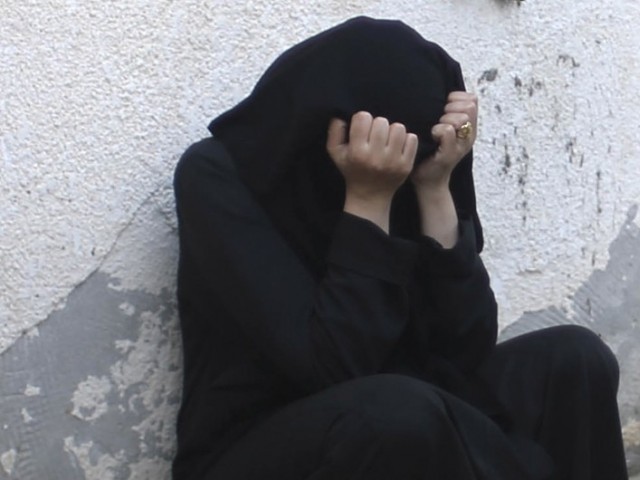
File photo of a woman. PHOTO: REUTERS
Saltley Academy in Birmingham is battling radicalisation by hosting talks from Iraqi women narrating horrifying tales of their lives as prisoners of the Islamic State.
Amidst stories of young British students running away to join IS, Saltley Academy has launched an anti-radicalisation campaign to counter the terrorist organisation’s propaganda.
The students sat riveted as they listened to three young Yazidi women in the school’s library. The women, who had come from refugee camps, related their terrifying experiences to deter girls from leaving home and marrying IS men. “I want [young people] not to believe what they see on Facebook,” said 21-year-old Bushra, who is one of the three women. “There is no life with IS apart from rape and killing.”
The ‘Open Your Eyes’ campaign was launched by the Birmingham and Bradford-based anti-extremism charity Upstanding Neighbourhoods with the support of the Amar Foundation and aims to use social media in the same way as IS to combat its propaganda.
“You only need to look around to see why their work is needed so urgently,” said Henna Rai from Upstanding Neighbourhoods. “IS’s propaganda machine is so vast that there needs to be a counter-narrative.”
Open Your Eyes hopes to recruit 10,000 young people to reach out to those who may be drawn to IS, as well as providing a platform for victims to tell their own stories.
Amena Saeed Hassan, a Yazidi Iraqi MP, who helped rescue the girls and bring them to the UK, said, “Daesh (IS) has nothing to do with any religion or morals. It carries out evil crimes against innocents, killing the elderly, men, and babies, taking turns in raping girls they hold prisoner hundreds of times a day. Anyone who has any decent morals and manners wouldn’t join Daesh (IS) but would instead help in freeing their victims.”
Munira, 16
Munira was only 15 when was taken away from her family by IS fighters when they invaded her village. “They separated me from my baby sisters, they were only five months and four, and my eight-year-old brother,” she said. “I was devastated, particularly about the baby. I was very sacred, I wanted to die.”
She was taken by a 60-year-old man called Abu Muhammad who kept her imprisoned in a remote house. “However hard I screamed, yelled and cried there was no one to help us. When he raped me he told me ‘you are slaves, you are our slaves of war’.”
Munira was sold between men several times and repeatedly raped. “I was in captivity for three months and 20 days,” she said, eyes downcast. “I used to think I would rather be dead than living through this.”
She finally escaped by jumping out a second floor window and was later reunited with her parents in a refugee camp. Her younger sisters are still in captivity. “I am living in the camp now with my family, waiting. There is nowhere else to go. I don’t have hope for anything any more,” she said. “I want my family and all the Yazidis to be taken away now, because this will happen again and again and again unless we move away. No Yazidi can feel safe at all.”
Bushra, 21
Bushra and her family fled for the mountains when the IS men took over their village. A young man, who had been a friend of her brother’s told them to go home. When her brother refused, the man held a gun to his head. The IS men then took Bushra, who was 18 then, to another city along with her 14-year-old sister.
When they were told that they would be married, a friend of Bushra’s from the village went to the village and attempted suicide by slitting her wrists. “They knew I was closest to her; they made me go into the bathroom,” she said. “She was covered in blood and I couldn’t look at her. They wrapped her in a blanket and threw her in the street like a piece of rubbish.”
“I thought it would be better to kill my sister and myself. I put a scarf around our necks, but I was too scared. I couldn’t go through with it,” she said when she and her sister were chosen by the same man who had once been the friend of the family.
One night, as she was being raped in his house by another soldier, she could hear her sister being raped by the former friend in the next room. “I could hear her screams filling my ears but I couldn’t do anything to help her,” she said.
Bushra and her sister managed to escape and live in a refugee camp but nine members of her family are still missing. “I want the whole world to hear our story and do something about it, to help free the Yazidi people who are still held captive,” she said. “I wish they would give us asylum, because we can no longer live in Iraq.”
Noor, 22
Noor was 18 when she was taken away by the IS men along with her 14-year-old niece. The IS fighters had killed all of the men in the village. They took all the younger women to warehouse filled with Yazidi girls and women.
“A woman told us that every day Daesh [IS] men would come and have their pick of the girls, they took them, raped them, sold them on,” Noor related.
The 18-year-old was chosen by a leader. “He went to fight. And when he came back he dipped his big toe into a jar of honey and forced it into my mouth. After that he raped me.”
Once when Noor tried to escape, she was caught. “He opened the door and allowed the six guards into the room,” she said. “He told the six guards to rape me. All of them, all kinds of ways, everything. I was made to do disgusting things. For two whole days I couldn’t move any part of my body.”
She was then sold to many differently men before finally escaping. “You can’t imagine what it was like. I want them to be punished. I have no hope for the future, as long as there are women and girls being held by Daesh [is]. I can’t think about it.”
* Names have been changed and images disguised to protect identities of the women involved.
This article originally appeared on The Guardian

Friday, March 25, 2016

It Appears As If Brussels And Paris Are ONLY The First Of What Will Be Many ISIS Attacks On Europe. Can The US Be Far Behind?

IS TRAINS 400 FIGHTERS TO ATTACK EUROPE IN WAVE OF BLOODSHED


PARIS (AP) -- The Islamic State group has trained at least 400 fighters to target Europe in deadly waves of attacks, deploying interlocking terror cells like the ones that struck Brussels and Paris with orders to choose the time, place and method for maximum chaos, officials have told The Associated Press.
The network of agile and semiautonomous cells shows the reach of the extremist group in Europe even as it loses ground in Syria and Iraq.
The officials, including European and Iraqi intelligence officials and a French lawmaker who follows the jihadi networks, described camps in Syria, Iraq and possibly the former Soviet bloc where attackers are trained to target the West. Before being killed in a police raid, the ringleader of the Nov. 13 Paris attacks claimed he had entered Europe in a multinational group of 90 fighters, who scattered "more or less everywhere."
But the biggest break yet in the Paris attacks investigation - the arrest on Friday of fugitive Salah Abdeslam - did not thwart the multipronged attack just four days later on the Belgian capital's airport and subway system that left 31 people dead and an estimated 270 wounded. Three suicide bombers also died.
Just as in Paris, Belgian authorities were searching for at least one fugitive in Tuesday's attacks - this time for a man wearing a white jacket who was seen on airport security footage with the two suicide attackers. The fear is that the man, whose identity Belgian officials say is not known, will follow Abdeslam's path.
After fleeing Paris immediately after the November attacks, Abdeslam forged a new network back in his childhood neighborhood of Molenbeek, long known as a haven for jihadis, and renewed plotting, according to Belgian officials.
"Not only did he drop out of sight, but he did so to organize another attack, with accomplices everywhere. With suicide belts. Two attacks organized just like in Paris. And his arrest, since they knew he was going to talk, it was a response: 'So what if he was arrested? We'll show you that it doesn't change a thing,'" said French Senator Nathalie Goulet, co-head of a commission tracking jihadi networks.
Estimates range from 400 to 600 Islamic State fighters trained specifically for external attacks, according to the officials, including Goulet. Some 5,000 Europeans have gone to Syria.
"The reality is that if we knew exactly how many there were, it wouldn't be happening," she said.
More than four sources with access to tallies of fighters tasked with Europe attacks independently corroborated the numbers of fighters who trained for specific attacks in Europe, including some who have spoken to fighters directly. Others have cross checked information regarding fighters leaving or returning.
Two of the suicide bombers in Tuesday's attacks, Belgian-born brothers Ibrahim and Khalid El Bakraoui, were known to authorities as common criminals, not anti-Western radicals until an apartment one of them rented was traced to Abdeslam last week, according to Belgian state broadcaster RTBF. Similarly, an Algerian killed inside that apartment on March 15 had nothing but a petty theft record in Sweden - but he'd signed up as an Islamic State suicide bomber for the group in 2014 and returned to Europe as part of the Nov. 13 plot.
In claiming responsibility for Tuesday's attack, the Islamic State group described a "secret cell of soldiers" dispatched to Brussels for the purpose. The shadowy cells were confirmed by the EU police agency, Europol, which said in a late January report that intelligence officials believed the group had "developed an external action command trained for special forces-style attacks."
French speakers with links to North Africa, France and Belgium appear to be leading the units and are responsible for developing attack strategies in Europe, said a European security official who spoke on condition of anonymity because he was not authorized to discuss briefing material. He is also familiar with interrogations of former fighters who have returned to Europe. Some were jailed after leaving IS while others were kicked out of the terror group, and they include Muslims and Muslim converts from all across Europe.
Fighters in the units are trained in battleground strategies, explosives, surveillance techniques and counter surveillance, the security official said.
"The difference is that in 2014, some of these IS fighters were only being given a couple weeks of training," he said. "Now the strategy has changed. Special units have been set up. The training is longer. And the objective appears to no longer be killing as many people as possible but rather to have as many terror operations as possible, so the enemy is forced to spend more money or more in manpower."
Similar methods had been developed by al-Qaida but IS has taken it to a new level, he said. Another difference is that fighters are being trained to be their own operators - not necessarily to be beholden to orders from the IS stronghold in Raqqa, Syria, or elsewhere.
Several security officials have said there is growing evidence to suggest the bulk of the training is taking place in Syria, Libya and elsewhere in North Africa.
In the case of Tuesday's attacks, Abdeslam's arrest may have been a trigger for a plot that was already far along.
"To pull off an attack of this sophistication, you need training, planning, materials and a landscape," said Shiraz Maher, a senior research fellow at the International Centre for the Study of Radicalisation at Kings College in London, which has one of the largest databases of fighters and their networks.
"Even if they worked flat out, the attackers in Brussels would have needed at least four days," said Maher, who has conducted extensive interviews with foreign fighters.
The question for many intelligence and security officials is now turning to just how many more fighters have been trained and are ready for more attacks.
A senior Iraqi intelligence official who was not authorized to speak publicly said people from the cell that carried out the Paris attacks are scattered across Germany, Britain, Italy, Denmark and Sweden. Recently, a new group crossed in from Turkey, the official said.
On Wednesday, Turkish authorities said one of the Brussels suicide attackers, Ibrahim El Bakraoui, was caught last June near the Syrian border and deported to the Netherlands, with Ankara warning Dutch and Belgian officials that he was a "foreign terrorist fighter." But he was released from Dutch custody due to lack of evidence of involvement in extremism.
Belgian Justice Minister Koen Geens said Wednesday that authorities had no reason to detain El Bakraoui because he was "not known for terrorist acts but as a common law criminal who was on conditional release."
The latest new name to surface this week, Najim Laachraoui, turned out to be the bombmaker who made the suicide vests used in the Paris attacks, according to French and Belgian officials. Attackers used an explosive known as Triacetone Triperoxide, or TATP, made from common household chemicals. DNA evidence indicates he died on Tuesday in the suicide attack on the airport, two officials briefed on the investigation told AP.
Fifteen kilos of TATP were found in an apartment linked to the Brussels attackers, along with other explosive material.
The unidentified man seen on security footage wearing a white jacket and black hat at the Brussels airport on Tuesday remains at large, a fugitive link in a chain still being forged.
---
Dodds reported from London. Qassim Abdul-Zahra contributed from Baghdad.

© 2016 The Associated Press. All rights reserved. This material may not be published, broadcast, rewritten or redistributed. Learn more about our Privacy Policyand Terms of Use.