Contact Form

Name

Email *

Message *

Showing posts with label Die Welt. Show all posts

Saturday, December 30, 2017

Anti-Semitism Rears Its Ugly Head Again In Germany.


German Jewish Leader Warns That Jews May Require Police Protection As Anti-Semitism Escalates


Former president of the Central Council of Jews in Germany Charlotte Knobloch claims that Jews are increasingly under threat in public and may require police protection to lead a normal life without harassment and violence.

Ms Knobloch, who is now the President of the Jewish Community of Munich and Upper Bavaria, said that Jews are increasingly under threat, Die Welt reports.
“Aggressive anti-Semitism, from verbal hostility on the Internet and in the analogue world to desecration and destruction to physical attacks are commonplace in Germany,” she said.
“Jewish life can only take place in public under police protection and the strictest security precautions, or it must be completely cancelled for security reasons,” Knobloch added.
The Jewish leader spoke about several recent anti-semitic cases including the vandalism of a Menorah in the city of Heilbronn, and the cancellation of a public Menorah lighting in Mülheim/Ruhr due to security issues.“Anti-Semitism is strengthening on the right and the left, in the Muslim community and also in the middle of society. That’s why we need an anti-Semitism commissioner,” Knobloch said, requesting that the German Federal government appoint an official with “strong powers”.
Many have blamed the influx of Muslim migrants under Chancellor Angela Merkel for the growth in anti-Semitic incidents. Fashion mogul Karl Lagerfeld blamed  Ms Merkel directly earlier this year, saying: “One cannot – even if there are decades between them – kill millions of Jews and then bring millions of their worst enemies in their place.”


In a survey of Jews in Germany, many said that most of the violent attacks they experienced came from Muslims, while far-right and far-left attacks were mostly limited to verbal harassment or harassment online.
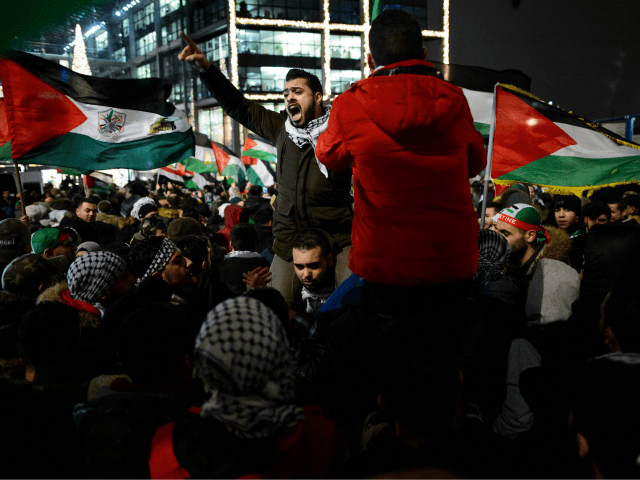
After U.S. President Donald Trump announced he would be moving the U.S. Israeli embassy to Jerusalem and recognizing the city as the capital of Israel, Germany saw anti-Semitic protests which were denounced by the Chancellor and her government.
Despite the opposition to the protests, some, like German police union head Rainer Wendt, slammed Merkel.
“The same politicians who continue this immigration and deportation drama by illegally allowing in more and more foreigners from the most anti-Semitic region of the world and not even deporting the offenders among them, then proclaim that they are doing everything against anti-Semitism,” Wendt observed.

Thursday, April 20, 2017

In 50 Years, Europe Has Forgotten How To Defend Itself


  • "The problem in Europe is that there are far too many people in uniform, and too few of them able to go into action." — NATO Secretary General Lord Robertson.
  • "A majority of the German public opposes combat missions, and supports the Bundeswehr [German military] only as a quasi-humanitarian organization, a kind of Médecins Sans Frontières with guns". — Konstantin Richter, Politico.eu.
  • The relative abundance enjoyed by the Western post-war generations have created a kind of shame instead of pride.
It has been said that when German Chancellor Konrad Adenauer signed the reconstitution of the military in 1955, he proclaimed: "It is crazy, gentlemen, that I have to create a German army, it is just crazy".
Sixty years have passed, but that sentiment still seems very strong in Germany. A few days ago Sigmar Gabriel, the German foreign minister, said: "We have to be a bit careful here that we don't over-interpret the 2 percent target." Gabriel then became clearer: "Maintain perspective, stay focused on the target, but avoid being consumed by the bliss of a new rearmament spiral!"
A few days earlier, Germany had made an announcement: to raise the number of soldiers from 170,000 to 198,000 by 2024 -- a modest "rearmament".
It is a direct consequence of the Trump Administration's important pressure on European allies, urging them to invest more in defense and security. European armies have become, to quote The Economist, "Potemkin Euro-armies". Germany's views are crucial to understanding Europe's attitude about security and defense. Germany, the world's fourth-largest economy and Europe's financial giant, is a military dwarf, proud of being weak and disarmed.
Take the countries which suffered most of terror attacks in the last two years. Belgium? It spends 0.85% of its gross domestic product on defense. France? 1.78%. Germany? 1.19%. Spain, which in 2004 experienced the most severe attack in Europe's recent history? 0.94%.
Europe is enjoying a big siesta. It is disarmed not only militarly but also mentally. Seventy-five percent of Belgium's military spending goes to pay army pensions. As NATO's Secretary General Lord Robertson put it, "The problem in Europe is that there are far too many people in uniform, and too few of them able to go into action."
Another NATO official, Joseph Ralston, the former supreme commander for Europe, defined European armies as "fat and redundant".
These countries have all embraced the moral vanity of pacifism.
Thanks to it, Germany's military supply depots are now almost completely empty, according to the newspaper, Die Welt. Possibly fearing a "rearmament spiral", Germany in fact ended up with a shy army with no drums.
The German population is unwilling to defend itself. A survey by the research firm TNS Emnid showed that 73% of the Germans remain opposed to higher military spending by NATO countries. Manfred Güllner, head of the Berlin-based pollster, Forsa, said that many Germans "would rather have the military not be operational and stay at home". For most Germans, "history is over". After the reunification of the country, they seem to mean, they have no more enemies or threats; only friends and opportunities to build a better world, all together. According with Der Spiegel, "Germany is experiencing a relapse into pacifism".
Born in the years of a Cold War that could become hot, the Bundeswehr, the German army, was the backbone of NATO forces. Today, it is Europe's military soft underbelly. In contrast to its European neighbors (Belgium, Denmark, France and the Netherlands), Germany refused to deploy its military jets to attack Islamic State positions in Iraq. When, last September, German Defense Minister Ursula von der Leyen visited Iraq to talk to the German officers training Kurdish fighters, she assured her troops that they would not be close to the battle zones. She added that for the German army, "Security is the highest priority".
John Vinocur wrote in the Wall Street Journal that Germany, one of the largest manufacturers of weapons in the world, has made it clear again that even facing a barbaric enemy, such as ISIS, it is a non-lethal actor. "Diplomats in uniform" is how German soldiers have been called. In Germany, sending fighting troops abroad looks unthinkable today.
The military no longer figures in the German public's consciousness. If a German chief of staff can be pressured to resign after a raid in Afghanistan did not go as well as planned, it means that he did not have the backing of his society and government.
The German army is now just 20% of what it was in 1990. The country is the economic leader in Europe, but Berlin refuses to invest in security and defense -- even less so than the UK, France and other European nations.
Konstantin Richter wrote:
"In the decades since World War II, Germans have turned into genuine pacifists, enjoying their role on the sidelines of global conflicts. A majority of the German public opposes combat missions, and supports the Bundeswehr only as a quasi-humanitarian organization, a kind of Médecins Sans Frontières with guns.".
In a recent Foreign Policy article, Hans Kundnani found that "a simple comparison between the American and German military budget illustrates the problem". In 2015, according to the International Institute for Strategic Studies, the U.S. defense budget was $597.5 billion. Germany's was $36.7 billion, one-twentieth the size of America's. The same is true for the number of soldiers: Germany army has shrunk to 176,752 active military personnel, a seventh of the 1.3 million of the United States.
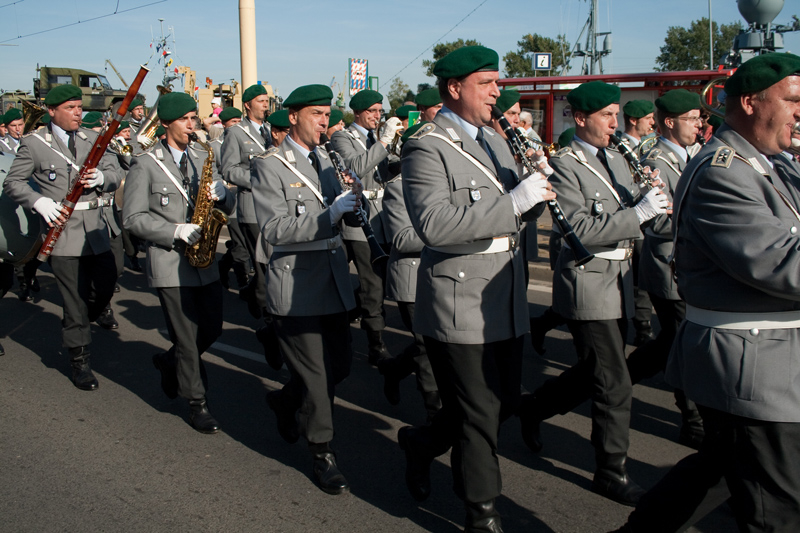

Soldiers of the German army on parade in 2009. (Image source: Włodi/Flickr)

That is why Jochen Bittner of Die Zeit wrote: "For the foreseeable future, don't count on us Germans". The late Guido Westerwelle, as Germany's foreign minister from 2009 to 2013, made the withdrawal of American nuclear weapons from Germany one of his top priorities.
According Kundnani, this military dysfunction reflects a cultural one:
"In the first decade after reunification in 1990, Germany seemed to be converging with France and the U.K. on the question of the use of military force. This incremental shift culminated in Germany's participation in the Kosovo War in 1999. 'Never again Auschwitz' seemed to have replaced 'never again war' as a fundamental principle of German foreign policy. But in the 2000s, against the backdrop of the deployment of the Bundeswehr to Afghanistan and the perceived failures of military interventions elsewhere, Germans seemed to revert to the principle of 'never again war.' Germany refused to participate in the military intervention in Libya in 2011 — a decision that many Germans feel has been vindicated. And even the strategic shock of the Ukraine crisis hasn't changed German attitudes about the use of military force."
"Pacifism became the German lifestyle". So a few weeks ago, a German MEP expressed his anger after his 16-year-old daughter received a letter from the army in search of volunteers. "It is outrageous that people so young are being targeted", said Ã–zcan Mutlu to the news website taz.de. "Young people need protection". And what does a modern Western society need to be protected? Germany and Europe are not able to answer this question. That is why they are all desperate about Trump's request to invest more in defending themselves, as if they hope to continue their siesta forever.
The relative abundance enjoyed by the Western post-war generations have created a kind of shame instead of pride. Being born in Europe after the Second World War meant belonging to the dregs of humanity, an execrable society that, for centuries, oppressed almost all the rest of the planet. Europe's commitment for the Third World and the "wretched of earth" is accompanied by a strange fatalism: Why defend the feeble Western democracies, since the path of history requires their disappearance? We are supposedly at "the end of history". That is the moral arrogance pervading the Europeans today: at the time of twilight, we just have to work to our own downfall. That is the mentality through which "pacifism, sometimes in a self-righteous manner, has become part of the German DNA".
What did Spain do after al-Qaeda bombed Madrid's trains? It withdrew its army from Iraq. What did France do after the carnage at the Bataclan Theater? It played John Lennon's "Imagine". What did Belgium do after the bombings in Brussels? It lit candles. What Germany did after the massacre at the Christmas market in Berlin? It cried, "Je suis Berlin". There is something so tragic and despairing in the Germany's lack of will to hunt down and eradicate the Islamic State.
See Germany, which destroyed Europe with its arms race under the Nazis. It is now putting Europe at risk again -- but this time out of the fear of a supposed "rearmament spiral". It is as if they think that just because you do not have an army, this means there can be no fight. But there is good news: the US Marines have just arrived in Syria to fight the Islamic State!
Giulio Meotti, Cultural Editor for Il Foglio, is an Italian journalist and author.
© 2017 Gatestone Institute. All rights reserved. The articles printed here do not necessarily reflect the views of the Editors or of Gatestone Institute. No part of the Gatestone website or any of its contents may be reproduced, copied or modified, without the prior written consent of Gatestone Institute.

Thursday, April 28, 2016

"Muslim Control" Policy In Germany, Can They Control Their Invasion?


  • "All imams need to be trained in Germany and share our core values. ... It cannot be that we are importing different, partly extreme values ​​from other countries. German must be the language of the mosques. Enlightened Europe must cultivate its own Islam." – Andreas Scheuer, the General Secretary of the Christian Social Union party (CSU).
  • The Turkish government has sent 970 clerics — most of whom do not speak German — to lead 900 mosques in Germany that are controlled by a branch of the Turkish government's Directorate for Religious Affairs. Turkish clerics in Germany are effectively Turkish civil servants who do the bidding of the Turkish government.
  • Erdogan has repeatedly warned Turkish immigrants not to assimilate into German society. During a trip to Berlin in November 2011, Erdogan declared: "Assimilation is a violation of human rights."
A senior German politician has called for an "Islam law" that would limit the influence of foreign imams and prohibit the foreign financing of mosques in Germany.
The proposal — modelled on the Islam Law promulgated in Austria in February 2015 — is aimed at staving off extremism and promoting Muslim integration by developing a moderate "European Islam."
The move comes amid revelations that the Turkish government is paying the salaries of nearly 1,000 conservative imams in Germany who are leading mosques across the country. In addition, Saudi Arabia recently pledged to finance the construction of 200 mosques in Germany to serve migrants there.
In an interview with the newspaper Die Welt, Andreas Scheuer, the General Secretary of the Christian Social Union (CSU), the Bavarian sister party to German Chancellor Angela Merkel's Christian Democrats (CDU), said that Berlin should restrict Turkish financing of mosques in Germany and begin training and certifying its own imams. Otherwise, he argued, Muslim integration will be difficult or impossible to achieve. He said:
"We need to become more critical in our dealings with political Islam, because it hinders Muslim integration in our country. We need an Islam Law. The financing of mosques or Islamic kindergartens from abroad, e.g. from Turkey or Saudi Arabia, should be banned. All imams need to be trained in Germany and share our core values.
"It cannot be that we are importing different, partly extreme values ​​from other countries. German must be the language of the mosques. Enlightened Europe must cultivate its own Islam.
"We are still at the beginning of our efforts. We must start now. We cannot on the one hand enact an Integration Law and on the other side close our eyes to what is being preached in mosques and by whom."
Scheuer's comments come amid reports that the Turkish government has sent 970 clerics — most of whom do not speak German — to lead 900 mosques in Germany that are controlled by the Turkish-Islamic Union for Religious Affairs (DITIB), a branch of the Turkish government's Directorate for Religious Affairs, known in Turkish as Diyanet.
Successive German governments are responsible for this state of affairs. An essay in Der Tagesspiegel states: "Over past decades, the federal government has welcomed the fact that the Turkish religious authority exercises a great influence on German mosques. Turkey was considered a secular state, and their influence was viewed as a shield against religious extremism."
This was before Turkish President Recep Tayyip Erdogan embarked on a mission to turn the formerly secular nation an Islamic country.
According to Die Welt, Erdogan has increased the size, scope and power of the Diyanet, which now has a budget of 6.4 Turkish lira ($2.3 billion; €1.8 billion), which is more than the budgets of 12 Turkish government ministries, including the interior ministry and the foreign ministry. TheDiyanet now has 120,000 employees, up from 72,000 in 2004.
The Turkish clerics in Germany are effectively Turkish civil servants who do the bidding of the Turkish government. Critics accuse Erdogan of using DITIB mosques to prevent Turkish migrants from integrating into German society.
German politician Cem Özdemir, co-chairman of the Green Party, said that DITIB is "nothing more than an extended arm of the Turkish state." He added: "Rather than being a legitimate religious organization, the Turkish government has turned DITIB into a political front organization of Erdogan's AKP party. Turkey must let go of the Muslims in Germany."
Erdogan has repeatedly warned Turkish immigrants not to assimilate into German society.


The Cologne Central Mosque, run by DITIB, is used as a key base in Germany for Turkey's intelligence agency, where they run a local "thug squad" to mete out "tough punishments" to Turkish dissidents in Germany. (Image source: © Raimond Spekking/CC BY-SA 4.0, via Wikimedia Commons)

During a trip to Berlin in November 2011, Erdogan declared: "Assimilation is a violation of human rights." In February 2011, Erdogan told a crowd of more than 10,000 Turkish immigrants in Düsseldorf: "We are against assimilation. No one should be able to rip us away from our culture and civilization." In February 2008, Erdogan told 16,000 Turkish immigrants in Cologne that "assimilation is a crime against humanity."
For his part, Saudi Arabia's King Salman recently announced a plan to finance the construction of 200 mosques in Germany to provide for the spiritual needs migrants and refugees who arrived there in 2015. The mosques would, presumably, adhere to Wahhabism, the official and dominant form of Sunni Islam in Saudi Arabia. Wahhabism is an austere form of Islam that insists on a literal interpretation of the Koran.
On April 11, Hans-Georg Maassen, the head of Germany's domestic intelligence agency (BfV), expressed alarm at the growing number of radical Arab-language mosques in Germany. "Many mosques are dominated by fundamentalists and are being monitored because of their Salafist orientation," Maassen said in an interview with Welt am Sonntag. He added that many of the mosques were being financed by donors in Saudi Arabia.
It remains uncertain, however, whether Merkel will back the "Islam Law," which is certain to antagonize Erdogan, who effectively controls the floodgates of Muslim mass migration to Europe. If Merkel were openly to support a ban on foreign financing of mosques in Germany, Erdogan likely would threaten to pull out of the EU-Turkey deal on migrants, a deal Merkel desperately needs to stanch the flow of mass migration to Germany. It is yet another indication of the tremendous leverage Erdogan has gained over Merkel and German policymaking.
Germany's coalition government has, however, reached a compromise deal on a new "Integration Law."
On April 14, Merkel announced the broad outlines of the law, which will spell out the rights and responsibilities of migrants in Germany. Under the law, the text of which will be finalized by May 24, asylum seekers must attend German language classes and integration training or have their benefits cut.
The government pledged to make it easier for asylum seekers to gain access to the German labor market by promising to create 100,000 new "working opportunities." The government will also suspend a law requiring employers to give preference to German or EU job applicants over asylum seekers.
In an effort to prevent the spread of migrant ghettoes in Germany, the new law, which is expected to enter into force this summer, will prohibit refugees from choosing where they live until they have secured asylum. Migrants who abandon state-assigned housing would face unspecified sanctions.
The new law also includes a counter-terrorism provision, which would allow German intelligence agencies to work more closely with their European, NATO and Israeli counterparts.
"We will have a German law on integration," Merkel said. "This is the first time in post-war Germany that this has happened. It is an important, qualitative step."
But critics say the proposed law does not go far enough because it does not threaten with deportation those migrants who refuse to integrate. In his interview with Die Welt, Scheuerinsisted that Muslim immigrants must integrate or be deported:
"Anyone who fails to attend integration and language courses attests that they are not prepared to integrate and accept our values. Moreover, it is important that people who want to stay in Germany register with the Federal Employment Agency [Bundesagentur für Arbeit] and provide for their own livelihood. The message is clear: Those who are not integrated cannot stay here. We need to cease having romantic views of integration. Multiculturalism has failed. Those who are not integrated must count on deportation."
Soeren Kern is a Senior Fellow at the New York-based Gatestone Institute. He is also Senior Fellow for European Politics at the Madrid-based Grupo de Estudios Estratégicos / Strategic Studies Group. Follow him on Facebook and on Twitter. His first book, Global Fire, will be out in 2016.


© 2016 Gatestone Institute. All rights reserved. No part of the Gatestone website or any of its contents may be reproduced, copied or modified, without the prior written consent of Gatestone Institute.

Sunday, November 1, 2015

Is The Nature Of Germany Being Changed? Will Refugees Turn The Country Into A Third World Mess?

  • "We are importing Islamic extremism, Arab anti-Semitism, national and ethnic conflicts of other peoples, as well as a different understanding of society and law." — From a leaked German intelligence document.
  • "We need to be clear that there must be limits and quotas for immigration -- we cannot save the whole world." — Markus Söder, Finance Minister of Bavaria.
  • "The migration crisis has the potential to destabilize governments, countries and the whole European continent. ... What we have been facing is not a refugee crisis. This is a migratory movement composed of economic migrants, refugees and also foreign fighters" — Hungarian Prime Minister Viktor Orbán.
  • "Meanwhile, refugees are still heading into Germany -- at a rate of around 10,000 a day. ... The decade after Ms. Merkel first came to power in 2005 now looks like a blessed period for Germany, in which the country was able to enjoy peace, prosperity and international respect, while keeping the troubles of the world at a safe distance. That golden era is now over." — Gideon Rachman,Financial Times.
Germany's Muslim population is set to nearly quadruple to an astonishing 20 million within the next five years, according to a demographic forecast by Bavarian lawmakers.
The German government expects to receive 1.5 million asylum seekers in 2015, and possibly even more in 2016. After factoring in family reunifications -- based on the assumption that individuals whose asylum applications are approved will subsequently bring an average of four additional family members to Germany -- that number will swell exponentially. This is in additionto the 5.8 million Muslims already living in Germany.
According to the president of the Bavarian Association of Municipalities (Bayerische Gemeindetag), Uwe Brandl, Germany is now on track to have "20 million Muslims by 2020." The surge in Germany's Muslim population represents a demographic shift of epic proportions, one that will change the face of Germany forever, "but we are just standing by, watching it happen."
Addressing an expo in Nuremburg on October 14, Brandl warned that untrammeled migration will entail heavy costs for German taxpayers and may also lead to social unrest. He said:
"A four-member refugee family receives up to 1,200 euros per month in transfer payments. Plus accommodation and meals. Now go to an unemployed German family man who has worked maybe 30 years, and now with his family receives only marginally more. These people are asking us whether we politicians really see this as fair and just."
Brandl said this also applies to the electronic health card, which provides asylum seekers with the same benefits as Germans who have paid into the health insurance system for many years. To criticize this as unfair has "nothing to do with racism or right-wing extremism."
Brandl's concerns are echoed in a leaked intelligence document, which warns that the influx of more than one million migrants from the Muslim world this year will lead to increasing political instability in Germany.
The document -- portions of which were published by Die Welt on October 25 -- reveals growing alarm within the highest echelons of Germany's intelligence and security apparatus about the consequences of Chancellor Angela Merkel's open-door immigration policy.
The so-called non-paper (the author of the document remains anonymous) warns that the "integration of hundreds of thousands of illegal migrants will be impossible given the large numbers involved and the already-existing Muslim parallel societies in Germany." The document adds:
"We are importing Islamic extremism, Arab anti-Semitism, national and ethnic conflicts of other peoples, as well as a different understanding of society and law. German security agencies are unable to deal with these imported security problems, and the resulting reactions from the German population."
An unidentified high-ranking security official told Die Welt:
"The high influx of people from other parts of the world will lead to the instability of our country. By allowing this mass migration, we are producing extremists. Mainstream society is radicalizing because the majority does not want migration, which is being forced by the political elites. In the future, many Germans will turn away from the constitutional state."
The warnings come amid mounting criticism of Merkel, whose September 4 decision to open the door to migrants in Hungary exacerbated the crisis.
The Minister-President of Bavaria, Horst Seehofer, who also heads the Christian Social Union (CSU), the sister party to Merkel's Christian Democratic Union (CDU), has emerged as one of Merkel's most vocal critics. "I am convinced that the chancellor has chosen another vision for Germany," he said. "This has been a mistake that will occupy us for a long time. I see no way of putting the genie back into the bottle," he added.
In an interview with Bild, Seehofer said:
"We explicitly believe that immigration must be controlled and limited if Germany wants to cope with it. The seriousness of the situation is becoming clearer every day. The population does not want clever sayings or inconclusive site visits. It wants action!"
After months of attacking critics of Merkel's immigration policies as right-wing xenophobes, Vice Chancellor Sigmar Gabriel and Foreign Minister Frank-Walter Steinmeier conceded that the migration crisis risks tearing German society apart. In a joint essay published by Der Spiegel, the two wrote: "We cannot indefinitely absorb and integrate more than one million refugees each year."
Bavarian Finance Minister Markus Söder said: "We need to be clear that there must be limits and quotas for immigration — we cannot save the whole world. The refugee influx will not be stopped unless we secure our borders and send a clear signal that not everyone can come to Germany."
Former Interior Minister Hans-Peter Friedrich (CSU) described Merkel's immigration policy as an "unprecedented political blunder" that will have "devastating long-term consequences." He said the job of politics is to think beyond the present and make decisions for the future. In view of the massive flows of migrants into Germany without any police checks, Friedrich concluded: "We have lost control." He added:
"It is totally irresponsible that tens of thousands of people are flowing into the country uncontrolled and unregistered, and we can only unreliably estimate exactly how many of them are Islamic State fighters or Islamist sleepers. I am convinced that no other country in the world would be so naive and starry-eyed to expose itself to such a risk."
CDU lawmaker Michael Stübgen said: "The disagreement [with Merkel] is fundamental. Our capacities are exhausted and there is concern that the system will implode if we do not regain control of our borders. But the chancellor disagrees and so the conflict is unsolved."
On October 21, more than 200 mayors in North-Rhine Westphalia signed an open letter to Merkel, in which they warned they were no longer capable of taking in any more migrants. The letter states:
"We are seriously concerned for our country and the cities and towns we represent. The reason: the massive and mostly uncontrolled flow of migrants to Germany and our cities and towns.
"All available housing possibilities are exhausted, including tents and shipping containers. Managing the migrant shelters is so time intensive that our personnel can no longer attend to other municipal responsibilities."

According to a report by German public broadcaster Deutsche Welle, the Berlin refugee center pictured here received up to 2000 applications for asylum per day in August -- before the migrant flow increased substantially. (Image source: Deutsche Welle video screenshot)

Speaking at an October 22 gathering of the European People's Party in Madrid, Hungarian Prime Minister Viktor Orbán warned of the consequences of Merkel's immigration policies. He said:
"We are in deep trouble. The migration crisis has the potential to destabilize governments, countries and the whole European continent....
"What we have been facing is not a refugee crisis. This is a migratory movement composed of economic migrants, refugees and also foreign fighters. This is an uncontrolled and unregulated process.... I also want to underline that there is an unlimited source of supply of people, after Syria, Iraq, Pakistan, Afghanistan, Africa is now also on the move. The dimension and the volume of the danger is well above our expectations....
"Our moral responsibility is to give back these people their homes and their countries. It can't be our objective to provide them with a new European life. Right to human dignity and security are basic rights. But neither the German, Austrian nor the Hungarian way of life is a basic right of all people on the Earth. It is only a right of those ones who have contributed to it. Europe is not able to accept everyone who wants a better life. We have to help them to get back their own lives with dignity and we have to send them back to their own countries....
"We cannot avoid speaking about the quality of our democracies. Is it freedom of information and speech when the media usually show women and children while 70% of the migrants are young men and they look like an army? How could it happen that our people feel that their opinion is not being taken into consideration? And we have to address the question of whether our people want what has been happening. Did we get authorization from them to allow millions of migrants to enter our continent? ... No, distinguished delegates, we did not.
"We cannot hide the fact that the European left has a clear agenda. They are supportive of migration. They actually import future leftist voters to Europe hiding behind humanism. It is an old trick but I do not understand why we have to accept it. They consider registration and protection of borders as bureaucratic, nationalist and against human rights. They have a dream about the politically constructed world society without religious traditions, without borders, without nations. They attack core values of our European identity: family, nation, subsidiarity and responsibility."
In an October 26 column for the Financial Times, titled "The End of the Merkel Era is Within Sight," Gideon Rachman wrote:
"The refugee crisis that has broken over Germany is likely to spell the end of the Merkel era. With the country in line to receive more than a million asylum-seekers this year alone, public anxiety is mounting — and so is criticism of Ms. Merkel, from within her own party. Some of her close political allies acknowledge that it is now distinctly possible that the chancellor will have to leave office, before the next general election in 2017. Even if she sees out a full term, the notion of a fourth Merkel administration, widely discussed a few months ago, now seems improbable...
"The trouble is that Ms. Merkel's government has clearly lost control of the situation. German officials publicly endorse the chancellor's declaration that 'We can do this'. But there is panic just beneath the surface: costs are mounting, social services are creaking, Ms. Merkel's poll ratings are falling and far-right violence is on the rise.
"As the placid surface of German society is disturbed, so arguments about the positive economic and demographic impact of immigration are losing their impact. Instead, fears about the long-term social and political effect of taking in so many newcomers — particularly from the imploding Middle East — are gaining ground. Meanwhile, refugees are still heading into Germany — at a rate of around 10,000 a day. (By contrast, Britain is volunteering to accept 20,000 Syrian refugees over four years.)...
"Some voters seem to have concluded that Mutti [a German familiar form of 'mother'] has gone mad — flinging open Germany's borders to the wretched of the earth...
"The refugee crisis marks a turning point. The decade after Ms. Merkel first came to power in 2005 now looks like a blessed period for Germany, in which the country was able to enjoy peace, prosperity and international respect, while keeping the troubles of the world at a safe distance. That golden era is now over."
Soeren Kern is a Senior Fellow at the New York-based Gatestone Institute. He is also Senior Fellow for European Politics at the Madrid-based Grupo de Estudios Estratégicos / Strategic Studies Group. Follow him on Facebook and on Twitter. His first book, Global Fire, will be out in early 2016.
© 2015 Gatestone Institute. All rights reserved. No part of this website or any of its contents may