Contact Form

Name

Email *

Message *

Showing posts with label Africa. Show all posts

Wednesday, September 18, 2019

So Why Are We Banning Straws?

90 PER CENT OF PLASTIC WASTE POLLUTING EARTH’S OCEANS COMES FROM ASIA AND AFRICA

So why are westerners being lectured?

Despite westerners being lectured by climate activists like Greta Thunberg, a study has found that around 90 per cent of plastic waste polluting earth’s oceans comes from Asia and Africa.
During her U.S. tour, Thunberg cited “horrifying pictures of plastic in the oceans,” as one of the primary reasons why Americans should listen to her.
However, researchers at Germany’s Helmholtz Centre for Environmental Research discovered that a small number of rivers account for the vast majority of plastic pollution and none of them are located in western countries.
“The 10 top-ranked rivers transport 88-95 percent of the global load into the sea,” Dr. Christian Schmidt, a hydrogeologist who led the study, told the Daily Mail. “The rivers with the highest estimated plastic loads are characterized by high population – for instance the Yangtze with over half a billion people.”
Out of the top ten rivers that produce the most pollution, eight are in Asia and two are in Africa. The Yangtze River in China and the Ganges River in India were responsible for the most plastic pollution.
While westerners are being told to alter their lifestyles and have fewer children to save the planet, virtually nothing is being said about or to the people in the countries responsible for the vast majority of pollution.
This is probably one of the main reasons why many in the west remain skeptical about the true motives of the environmentalist movement.
As we reported earlier, only 38 per cent of Americans believe global warming is man made.

Friday, July 27, 2018

Straws Will End The World Or At Least That What The Lefties Want You To Think

WALSH: Quit The Hysterics. America Is Responsible For Almost None Of The Plastic In The Ocean.

Photo by Andrew Aitchison / In pictures via Getty Images
There is nothing wrong with trying to cut down on waste. There is nothing wrong with trying to cut down on the amount of straws we use. But when you use fake statistics to whip up hysteria, and you indulge in extreme exaggeration and blatant falsehood, and especially when you use these exaggerations and falsehoods as the basis for unnecessary laws, then it becomes incumbent on honest people to step in and correct the record.
In reality, your straw usage has almost no impact on the ocean whatsoever. That's partly because the "500 million straws a day statistic" is invented, and partly because the United States as a whole contributes very, very little to the plastic waste problem. About 60% of the plastic in the Ocean comes from five Asian countries: China, Indonesia, the Philippines, Vietnam, and Thailand. Indonesia's Citarum River, the most polluted river on Earth, is essentially a massive trash heap on a giant aquatic conveyor belt. Every day, 20,000 tons of waste and 340,000 tons of wastewater are dumped into it and then ferried to the ocean. In places like Vietnam, plastic in the water is the least of anyone's concerns. Raw sewage is discharged directly into water ways, turning the rivers toxic.
In all, and speaking just of plastic pollution, Asia and Africa account for 95% of the problem. That leaves only 5% of the ocean's plastic debris to be split between the continents of Europe, North America, South America, and Australia. According to this chart, Brazil is the worst plastic offender outside of Asia and Africa. 23 European countries, collectively, are 18th on the list. The United States comes in 20th. America, with its population of 330 million, is dwarfed on the plastic pollutant list by countries like Sri Lanka with 310 million fewer people.
We could collect all of the straws in North America, bundle them together and shoot them into the Sun, and the state of the ocean would hardly be improved at all. Indeed, we could stop using plastic altogether and it would barely make a dent in the problem. Does that mean we should be totally unconcerned about our own waste? No, but it does mean that our waste is, comparatively, not a significant problem. The ocean is being destroyed by Asia and Africa. Until they get their acts together, only minimal progress can be made.
And, as far as straws go, it's a near total non-issue. The United States accounts for a tiny fraction of the plastic in the ocean and straws account for a tiny fraction of that tiny fraction. Go ahead and refrain from straws if you wish. More power to you. But you are accomplishing very little for the environment. That's just the reality, in case anyone cares about reality anymore.

Tuesday, March 6, 2018

Take Care Of Your Citizens Before You Taking Care Of Others

ISRAEL DEPORTING DREAMERS TO AFRICA

Israelis giving priority to citizens before migrants

0
0
In a stunning contrast to US policy, Israel is quickly deporting its own “Dreamers” back to various African countries.
Israel is hosting thousands of “Dreamers,” mainly African women and children who entered the country illegally in the past decade, but now Israeli officials are no longer hesitant to deport them.
According to the Washington Post:
Alam Godin fled to Israel as a boy, escaping war in Sudan more than a decade ago with his family.
Now, he’s among thousands of African men who could be given a choice by the Israeli government: Take $3,500 to relocate to an unnamed “third country” — widely reported to be Uganda or Rwanda — go back to their home country, or go to jail.
The Israelis are giving priority to its own citizens before migrants.
“As wise men have taught us: ‘Take care of the poor in your city before taking care of the poor in other cities,’” Interior Minister Aryeh Deri told the Post.
And Israel isn’t alone in its immigration policy; numerous countries across the world are quick to deport illegal immigrants.
Yet only the US – and some Western Europoean countries like Germany and Sweden – are somehow expected to provide amnesty and welfare for economic migrants who entered the country illegally:

Tuesday, January 30, 2018

She Won't Be Missed. Maybe She Should Spend Some Time In Haiti!

Another Democrat Cries Racism From Trump

Rep. Frederica Wilson (D-FL) is just another Democrat to come forward stating she too will boycott President Donald Trump’s first State of the Union address. She is claiming the POTUS was “so hateful towards black people.”
Wilson is claiming, “I’m not going because to go would be to honor the president, and I don’t think he deserves to be honored at this time, after being so hateful towards black people and then black countries, Haiti and the whole continent of Africa, It hurts. It hurts, and he has brought the White House to the lowest, and I don’t think he needs to be honored with my presence.”
“It hurts. It hurts me. My father was a civil rights icon, and I cannot find it in my heart to sit through this. Africa is my ancestral home, and I feel a real closeness to Haiti where thousands of my constituents emanated from. So I would rather skip this than listen to the rhetoric coming from a White House that has done away with decency. I will be watching the State of the Union with my local constituents, with my local Muslims and DREAMers and local Mexicans and local Haitians and victims of sexual abuse and local Gold Star families and local Africans who are Nigerians and South Africans. So we will be watching the State of the Union, but I will not enter the chamber.”

Sunday, October 29, 2017

Are We Foolishly Trying To Stop The Leaks In The Dike?

  • It isn't only Niger. American troops are deployed in more than 150 countries, working with local partners to help them become better soldiers and meet their own threats. What is happening in Niger is happening in all the countries of the second tier of Africa -- volatile and insecure countries of mixed Christian, Muslim and traditional indigenous religions. American soldiers are there to help governments more effectively control their own territory and borders, reducing the likelihood of transnational jihad.
  • Iran's massive infusion of funds supports Sunni Hamas, al-Qaeda, ISIS, Boko Haram and others. Instability, chaos, anti-Americanism, anti-Westernism, and anti-Christianism are what Iran seeks -- and they are what Sunni jihadists seek. In Iraq and Syria, ISIS did the destabilizing and Iran reaped the benefits.
At the end of White House Chief of Staff John Kelly's moving briefing about the four American Special Forces soldiers killed in Niger earlier in October, he took questions. The first was, "Why are we in Niger?"
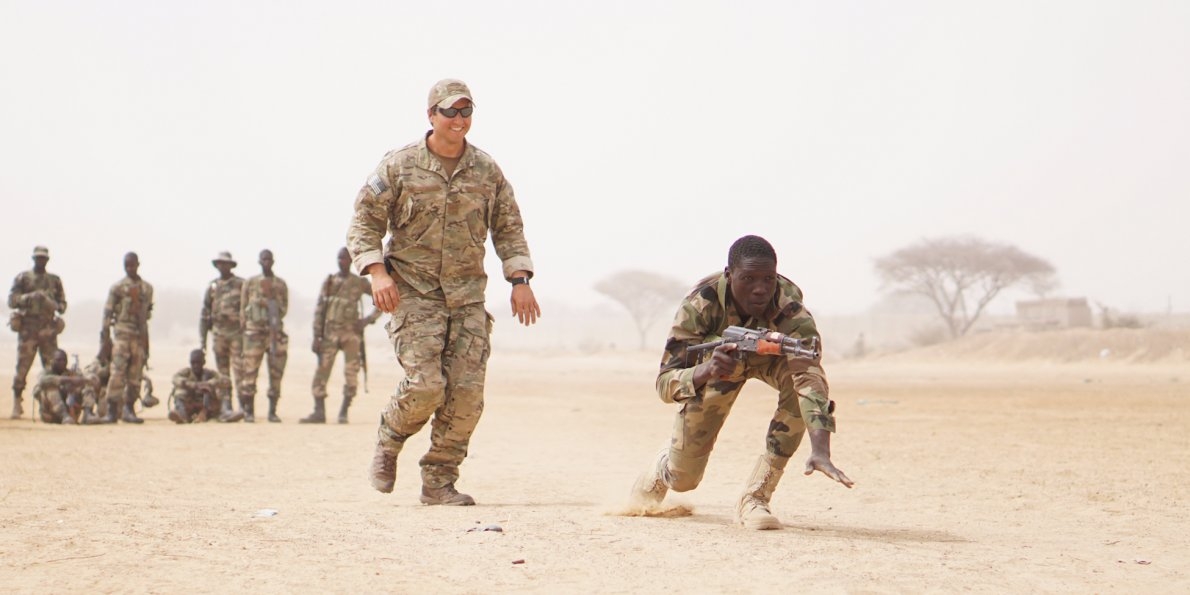
The question was too narrow; it isn't only Niger. Tens of thousands of American troops are deployed in more than 150 countries, working with America's local partners to help them become better soldiers and meet their own threats. We are on every continent except Antarctica. While we are unlikely to ever know precisely who killed the four soldiers, what is happening in Niger is happening in all the countries of the second tier of Africa -- volatile and insecure countries of mixed Christian, Muslim and traditional indigenous religions. American soldiers are there to help governments more effectively control their own territory and borders, reducing the likelihood of transnational jihad.

A U.S. Army Special Forces weapons sergeant observes a Nigerien soldier in a drill during Exercise Flintlock 2017 in Diffa, Niger, March 11, 2017. (U.S. Army photo by Spc. Zayid Ballesteros)

Two broad forces are shaking the Middle East and Africa: Sunni jihadist radicalism embodied by ISIS and al-Qaeda along with smaller groups; and Shiite supremacism controlled and financed by Iran. Iran's arms transfers to Africa are well documented, as is Iran's support for Sunni jihad, including incubating both al-Qaeda and ISIS. Separately and together, they threaten not only countries, but also the Red Sea and the Mediterranean Sea, the two prime waterways that allow countries, including Israel and Egypt, to pursue trade with Asia and Europe.
The mullahs in Iran are not Iranian or Persian nationalists, they are Shiite supremacists. When the Ayatollah Khomeini returned to Tehran in 1979 after fourteen years of exile, he condemned all nationalism as "sherk," which means associating other beings or things with God. He said what mattered was Islam, not Iran or any other country, according to the Iranian journalist Amir Taheri, Chairman of Gatestone Europe. Khomeini declared war on the United States, on Israel, and on the West. The declaration was real and has military as well as political implications, but it was also a way of deflecting attention from Iran's declaration of war on Sunni Islam.
It was a bold move, because although Shiites are the majority in Iran and Iraq (though not in Syria), they represent less than 15% of Muslims world-wide. Iran's primary targets are the Sunni governments of Saudi Arabia, which controls the holy sites in Mecca and Medina, and Egypt, the historic intellectual center of Sunni Islam.
The 2003 overthrow of the secular-but-Sunni president of Iraq, Saddam Hussein, allowed the majority Shiite Iraqi population to rule, but the precipitous American military withdrawal in 2012 allowed Iran to move steadily into areas of more influence. Iranian-sponsored Shiite militias are now inside the Iraqi national military pushing against the Kurds in the north. In Syria, Iranian-sponsored militias are pushing Sunnis north and out of the country on behalf of the Shiite/Alawite regime of Bashar al-Assad.
But while American focus has been on Iranian expansionism to the north and west of Iran -- a "Shiite crescent" over the tops of American allies Saudi Arabia, Jordan and Israel -- less attention has been paid to Iranian activity to the south of those countries, through the Red Sea and into Africa toward the Mediterranean.
Following naval harassment of U.S. ships in the Persian Gulf, Iran announced that it will "defend its interests" in the Red Sea, using its position as benefactor of the Houthis in Yemen as a starting point. If successful, this would allow Iran to threaten the Red Sea and the Bab-el-Mandeb Strait, the access point for Saudi Arabia, Israel, Jordan, and Egypt to the Gulf of Aden and then to the Indian Ocean and to Asia.
Iran ships weapons to and through Eritrea and Somalia on the Red Sea coast. This is important because U.S. Expeditionary Forces are based in Djibouti, which juts out into the sea. North of Djibouti and our forces is Eritrea; south of Djibouti and our forces is Somalia. Well-armed and unstable, they present a problem for the Americans.
Iran's interests are not limited to the countries along the coast.
The other waterway that concerns the United States, Israel and the West is the Mediterranean Sea. The countries along the north coast of the Mediterranean are European, all of which are in NATO. The countries facing them along the south shore of the Mediterranean, along the northern African coast, are Sunni Muslim, and, except Libya, partners in NATO's Mediterranean Dialogue. The arrangement helps keep the Mediterranean calm and free for shipping. The 2011 ouster of Libya's Moammar Qaddafi caused chaos in a previously stable -- if repressive -- country. Released weapons and fighters resulted in war in Mali, which had been an ally of the United States and France. Additional instability would make NATO's arrangements less effective and provide additional routes for African migrants seeking to reach Europe.
One way to make North Africa less stable is to make the row of countries just beneath it less stable. Chad, Mali, Somalia, Eritrea, Sudan, and yes, Niger, are all targets.
They are, to be sure, as much targets of Sunni jihad as they are of Iran, but Iran's massive infusion of funds supports Sunni Hamas, al-Qaeda, ISIS, Boko Haram and others. Iran's support for al-Qaeda goes back to the early 1990s. Instability, chaos, anti-Americanism, anti-Westernism, and anti-Christianism are what Iran seeks -- and they are what Sunni jihadists seek. In Iraq and Syria, ISIS did the destabilizing and Iran reaped the benefits.
General Kelly made a sober, passionate defense of American military honor and sacrifice. It is incumbent on the rest of us -- including journalists -- to understand where our troops serve and sacrifice, including why Niger.
Shoshana Bryen is Senior Director of the Jewish Policy Center.
© 2017 Gatestone Institute. All rights reserved. The articles printed here do not necessarily reflect the views of the Editors or of Gatestone Institute. No part of the Gatestone website or any of its contents may be reproduced, copied or modified, without the prior written consent of Gatestone Institute

Thursday, September 14, 2017

The Mysteries Of The Past Are Tied To The Present In The Mediterranean

Geography Still Commands the Mediterranean World

By September 14, 2017


BESA Center Perspectives Paper No. 587, September 14, 2017
EXECUTIVE SUMMARY: The migrant crisis in Europe that followed the wars in Libya and Syria exposed the Mediterranean world’s long-dormant interconnectedness. That unity is deeply rooted in the geography of the region.
The Mediterranean world as it was originally constituted – a world that was obscured for centuries by the prevailing political and economic systems in the Middle East and North Africa on the one hand and the European continent on the other – is now reasserting itself. This process is largely explained by the region’s geography.
A look at the map shows that although the Mediterranean Sea borders three continents (Europe, Asia, and Africa), it is essentially a closed sea with only narrow outlets to the oceans (through the Gibraltar Strait and the Suez Canal). The Mediterranean is full of peninsulas and islands, and those geographical features enable the nations that control them to be dominant maritime and economic powers.
If we look around the sea, we can see that geographical barriers close it off from the heart of Africa, the rest of the Middle East, and Central and Northern Europe. The barrier in North Africa is the Sahara Desert, while in the Middle East it is the Syrian Desert and the rugged land of Anatolia, along with the Euphrates River. In Europe, the Mediterranean is closed off by the Alps, the Balkan mountainous territory, and, further afield, the Rhine and Danube Rivers.
From a geographical perspective, North Africa does not quite belong to the rest of the African continent, as there is hardly any infrastructure or economic activity in the Sahara. North Africa has always been more influenced by the Mediterranean region, particularly southern Europe.
The same goes for Syrian territory, which is disconnected from the rest of the Middle East by a desert that stretches to Mesopotamia (modern Iraq) and the Arabian Peninsula. The only connection Syria has to the region is through northern Iraq.
Modern technologies may make the Apennine, Balkan, and Pyrenees barriers more penetrable, but those geographical features – which shaped the behavior of the Mediterranean peoples for centuries – are still there. Geography integrated the territories of three continents into one economic space, a dynamic that played out over millennia in the Mediterranean.
Take, for example, the Phoenicians, who established their colonies in North Africa and modern Spain and controlled many islands in the Mediterranean. Their colonies and territories, which were more related to one another than to the inland territories of either the Middle East or North Africa, came to comprise a veritable trade empire.
The same was accomplished by the Greeks, who colonized the Mediterranean and Black Seas. Connectivity by sea facilitated the creation of a trade empire, with metropolises in mainland Greece reaping most of the benefit.
However, the Phoenicians, the Greeks, and, later, the Carthaginians lacked sufficient human resources to politically dominate the Mediterranean coastline. These seafaring peoples did not manage to shut off the Mediterranean from other rising powers.
This brings us to the Romans. The Roman Empire, which essentially closed off the sea to outside powers, perfectly demonstrated the geographical interconnectedness of the Mediterranean world.
The extent to which geography dominates the Mediterranean world can be determined by examining the extent of the Roman conquest. Roman legions did not go beyond the rich North African provinces, as the territories deep in the heart of Africa were not economically worth the effort to control. Caesar, Augustus, Diocletian, and other Roman leaders were also not particularly keen to capture all of Germany, as the Rhine and Danube Rivers were viewed as good defensive barriers. The same could be said about the Middle East, where the Romans did not (for the most part) attempt to permanently occupy lands beyond the Euphrates River.
Connecting to the Modern Epoch
The Mediterranean region was united in the past. For the Phoenicians, the Greeks, and especially the Romans, what was going on in North Africa and the Middle East was very important, as the lands were connected to one another both economically and militarily.
The Arab conquests disrupted this connection. In the seventh century, North Africa and the Middle East became Islamic while the rest of the Mediterranean remained Christian. In the centuries to follow, the economic and military development of these regions diverged. In some instances – the Crusades, for example – the regions came into direct conflict.
Their paths diverged further in the eighteenth and nineteenth centuries. During that period, Europe industrialized while the Middle East and North Africa lagged behind.
European colonization followed by two devastating world wars caused Mediterranean interconnectedness to reassert itself, with Germans and Italians in Africa and the British defending themselves in Egypt. During that period, what happened in North Africa was again of consequence to Europeans. But that interconnectedness receded once more – until the Syrian and Libyan conflicts of the early 2010s reignited the idea.
We live in a highly connected world in which modern technologies sometimes trump geography – but geographical features still play a powerful role in shaping human behavior. Today’s Mediterranean migrant crisis echoes events that occurred in the region centuries ago, with varying intensity. It is once again clear that Italy, Spain, and Greece, although all part of a grand European project (the EU), are nevertheless inextricably linked to events in North Africa and the Middle East.
Emil Avdaliani teaches history and international relations at Tbilisi State University and Ilia State University. He has worked for various international consulting companies and currently publishes articles focused on military and political developments across the former Soviet space.
BESA Center Perspectives Papers are published through the generosity of the Greg Rosshandler Family