Contact Form

Name

Email *

Message *

Showing posts with label Niger. Show all posts

Monday, October 30, 2017

Were ISIS Fighters Part Of The Ambush Of American Soldiers In NIger

Niger Villagers Set Up Ambush of US Soldiers

U.S. intelligence officials increasingly believe the militant ambush in Africa that led to the deaths of four American soldiers was the result of a setup by local villagers sympathetic to the jihadists.
On October 4, four Green Berets were killed in Niger when a local affiliate of the Islamic State terrorist group executed a surprise attack. Details on the attack have since been slow to trickle in.
According to NBC News, U.S. officials briefed on the matter believe the militants were likely tipped off by at least one local villager.
Almou Hassane, the mayor of Tongo Tongo, the village at the center of the attack, told the U.S. government-sponsored news organization Voice of America that villagers sympathetic to the Islamic State group may have delayed the Green Berets, giving the militants time to prep.
“The attackers, the bandits, the terrorists have never lacked accomplices among local populations,” he said.
Amid accusations that the military was withholding information about the deadly ambush, Chairman of the Joint Chiefs of Staff Gen. Joseph Dunford conducted a news conference on Monday to offer more details on how events unfolded.
“We owe you more information. More importantly, we owe the families of the fallen more information,” Dunford told reporters.
“Did the mission change?” he said. “It’s a fair question.”
On October 3, 12 members of the U.S. Special Operations Task Force joined 30 Nigerien soldiers on a mission to an area near Tongo Tongo, a remote village.
On October 4, the small coalition of Nigerian and American soldiers met with local leaders to gather intelligence information. A few soldiers stayed back to guard the vehicles.
The troops started to grow suspicious when, as the meeting drew to a close, the local leaders appeared to stall and attempted to keep discussions going.
As U.S. troops began to walk back to their vehicles by mid-morning, they were ambushed by around 50 militants. Catching the Nigerian and American soldiers by surprise, the enemies carried out the attack with small arms, rocket-propelled grenades and machine guns.
According to Dunford, the group of local tribe fighters were likely affiliated with the Islamic State group.
An hour into the firefight, American troops requested backup. A drone few overhead within minutes of the request to asses the situation. Within an hour, a French Mirage fighter arrived. Later in the afternoon, a Nigerien quick reaction force along with French attack helicopters arrived at the scene.
French military Super Puma helicopters later evacuated U.S. soldiers wounded in the firefight. Soldiers killed in action were also transported away.
Altogether, four Green Berets lost their lives that day: Staff Sgt. Bryan Black, Staff Sgt. Dustin Wright, Staff Sgt. Jeremiah Johnson and Sgt. La David Johnson.
The attack set off a firestorm of unrelated controversy. The family of one of the slain soldiers, La David Johnson, accused the President Donald Trump of making inappropriate remarks during a condolence call, accusations that both Trump and White House Chief of Staff John Kelly deny.
Key senators, including Democrat Pennsylvania Sen. Bob Casey and Republican South Carolina Sen. Lindsey Graham, subsequently admitted that they were unaware that American forces were even stationed in Niger.
The United States currently has around 1,000 troops operating in the country.

Sunday, October 29, 2017

Are We Foolishly Trying To Stop The Leaks In The Dike?

  • It isn't only Niger. American troops are deployed in more than 150 countries, working with local partners to help them become better soldiers and meet their own threats. What is happening in Niger is happening in all the countries of the second tier of Africa -- volatile and insecure countries of mixed Christian, Muslim and traditional indigenous religions. American soldiers are there to help governments more effectively control their own territory and borders, reducing the likelihood of transnational jihad.
  • Iran's massive infusion of funds supports Sunni Hamas, al-Qaeda, ISIS, Boko Haram and others. Instability, chaos, anti-Americanism, anti-Westernism, and anti-Christianism are what Iran seeks -- and they are what Sunni jihadists seek. In Iraq and Syria, ISIS did the destabilizing and Iran reaped the benefits.
At the end of White House Chief of Staff John Kelly's moving briefing about the four American Special Forces soldiers killed in Niger earlier in October, he took questions. The first was, "Why are we in Niger?"
The question was too narrow; it isn't only Niger. Tens of thousands of American troops are deployed in more than 150 countries, working with America's local partners to help them become better soldiers and meet their own threats. We are on every continent except Antarctica. While we are unlikely to ever know precisely who killed the four soldiers, what is happening in Niger is happening in all the countries of the second tier of Africa -- volatile and insecure countries of mixed Christian, Muslim and traditional indigenous religions. American soldiers are there to help governments more effectively control their own territory and borders, reducing the likelihood of transnational jihad.

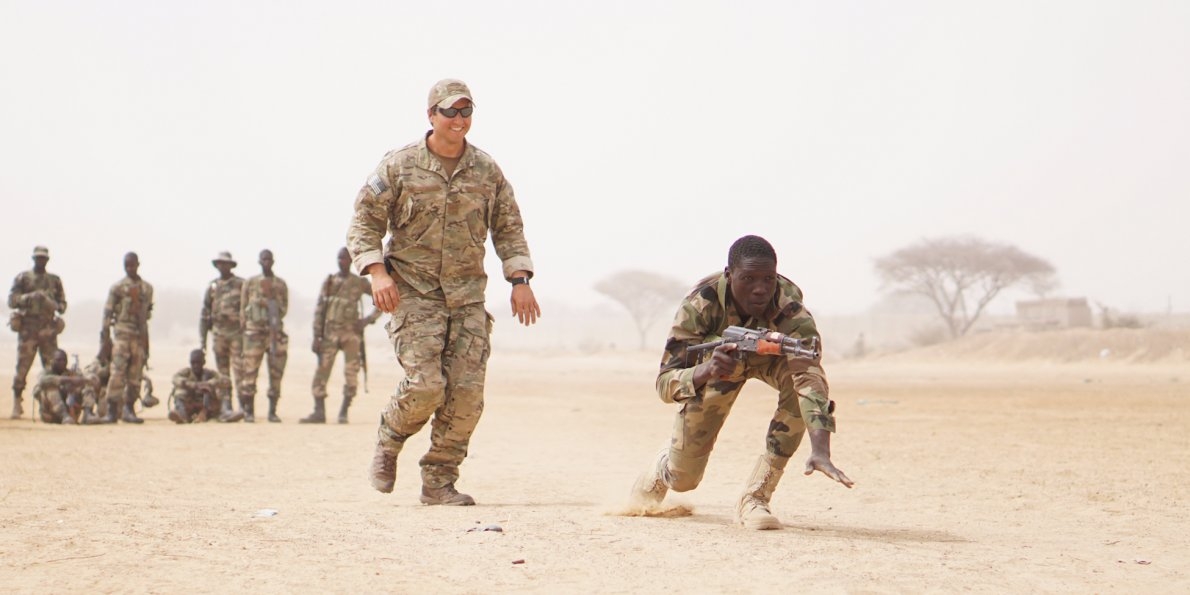
A U.S. Army Special Forces weapons sergeant observes a Nigerien soldier in a drill during Exercise Flintlock 2017 in Diffa, Niger, March 11, 2017. (U.S. Army photo by Spc. Zayid Ballesteros)

Two broad forces are shaking the Middle East and Africa: Sunni jihadist radicalism embodied by ISIS and al-Qaeda along with smaller groups; and Shiite supremacism controlled and financed by Iran. Iran's arms transfers to Africa are well documented, as is Iran's support for Sunni jihad, including incubating both al-Qaeda and ISIS. Separately and together, they threaten not only countries, but also the Red Sea and the Mediterranean Sea, the two prime waterways that allow countries, including Israel and Egypt, to pursue trade with Asia and Europe.
The mullahs in Iran are not Iranian or Persian nationalists, they are Shiite supremacists. When the Ayatollah Khomeini returned to Tehran in 1979 after fourteen years of exile, he condemned all nationalism as "sherk," which means associating other beings or things with God. He said what mattered was Islam, not Iran or any other country, according to the Iranian journalist Amir Taheri, Chairman of Gatestone Europe. Khomeini declared war on the United States, on Israel, and on the West. The declaration was real and has military as well as political implications, but it was also a way of deflecting attention from Iran's declaration of war on Sunni Islam.
It was a bold move, because although Shiites are the majority in Iran and Iraq (though not in Syria), they represent less than 15% of Muslims world-wide. Iran's primary targets are the Sunni governments of Saudi Arabia, which controls the holy sites in Mecca and Medina, and Egypt, the historic intellectual center of Sunni Islam.
The 2003 overthrow of the secular-but-Sunni president of Iraq, Saddam Hussein, allowed the majority Shiite Iraqi population to rule, but the precipitous American military withdrawal in 2012 allowed Iran to move steadily into areas of more influence. Iranian-sponsored Shiite militias are now inside the Iraqi national military pushing against the Kurds in the north. In Syria, Iranian-sponsored militias are pushing Sunnis north and out of the country on behalf of the Shiite/Alawite regime of Bashar al-Assad.
But while American focus has been on Iranian expansionism to the north and west of Iran -- a "Shiite crescent" over the tops of American allies Saudi Arabia, Jordan and Israel -- less attention has been paid to Iranian activity to the south of those countries, through the Red Sea and into Africa toward the Mediterranean.
Following naval harassment of U.S. ships in the Persian Gulf, Iran announced that it will "defend its interests" in the Red Sea, using its position as benefactor of the Houthis in Yemen as a starting point. If successful, this would allow Iran to threaten the Red Sea and the Bab-el-Mandeb Strait, the access point for Saudi Arabia, Israel, Jordan, and Egypt to the Gulf of Aden and then to the Indian Ocean and to Asia.
Iran ships weapons to and through Eritrea and Somalia on the Red Sea coast. This is important because U.S. Expeditionary Forces are based in Djibouti, which juts out into the sea. North of Djibouti and our forces is Eritrea; south of Djibouti and our forces is Somalia. Well-armed and unstable, they present a problem for the Americans.
Iran's interests are not limited to the countries along the coast.
The other waterway that concerns the United States, Israel and the West is the Mediterranean Sea. The countries along the north coast of the Mediterranean are European, all of which are in NATO. The countries facing them along the south shore of the Mediterranean, along the northern African coast, are Sunni Muslim, and, except Libya, partners in NATO's Mediterranean Dialogue. The arrangement helps keep the Mediterranean calm and free for shipping. The 2011 ouster of Libya's Moammar Qaddafi caused chaos in a previously stable -- if repressive -- country. Released weapons and fighters resulted in war in Mali, which had been an ally of the United States and France. Additional instability would make NATO's arrangements less effective and provide additional routes for African migrants seeking to reach Europe.
One way to make North Africa less stable is to make the row of countries just beneath it less stable. Chad, Mali, Somalia, Eritrea, Sudan, and yes, Niger, are all targets.
They are, to be sure, as much targets of Sunni jihad as they are of Iran, but Iran's massive infusion of funds supports Sunni Hamas, al-Qaeda, ISIS, Boko Haram and others. Iran's support for al-Qaeda goes back to the early 1990s. Instability, chaos, anti-Americanism, anti-Westernism, and anti-Christianism are what Iran seeks -- and they are what Sunni jihadists seek. In Iraq and Syria, ISIS did the destabilizing and Iran reaped the benefits.
General Kelly made a sober, passionate defense of American military honor and sacrifice. It is incumbent on the rest of us -- including journalists -- to understand where our troops serve and sacrifice, including why Niger.
Shoshana Bryen is Senior Director of the Jewish Policy Center.
© 2017 Gatestone Institute. All rights reserved. The articles printed here do not necessarily reflect the views of the Editors or of Gatestone Institute. No part of the Gatestone website or any of its contents may be reproduced, copied or modified, without the prior written consent of Gatestone Institute

Thursday, March 19, 2015

The Slaughter Continues In Nigeria Even For The "Wives" Of Fighters


Boko Haram 'slaughter wives' in NE Nigeria: witnesses


AFP

The leader of the Islamist extremist group Boko Haram Abubakar Shekau
.
View gallery

  • .
  • .
Maiduguri (Nigeria) (AFP) - Dozens of Nigerian women who were forced to marry Boko Haram fighters were reportedly slaughtered by their "husbands" before a battle with troops in the northeast town of Bama, multiple witnesses said Thursday.
Five witnesses who recounted the massacres to AFP said the Islamist militants feared they would be killed by advancing soldiers or separated from their wives when they fled the town.
They killed the women to prevent them from subsequently marrying soldiers or other so-called non-believers, they added.
"The terrorists said they will not allow their wives to be married to infidels," said Sharifatu Bakura, 39, a mother of three.
Nigeria's military along with forces from neighbouring Cameroon, Chad and Niger have claimed huge victories over the insurgents in recent weeks but defenceless civilians still face serious threats.
- 'Dozens' of corpses -
According to Bakura's account, which was supported by others, Boko Haram fighters received word of a military assault on Bama, formerly an Islamist stronghold in Borno state.
The insurgents had decided to flee to the nearby town of Gwoza before the troops' arrival but first decided "to kill their wives so that nobody will remarry them", she said.
Bukara's husband was killed by the insurgents four months ago but she was spared from a forced marriage because she was visibly pregnant.
Boko Haram forcibly married scores of women in Bama after seizing it in September. Nigeria's military announced the recapture of the town on Monday.
Witnesses who were taken under military protection this week to Borno's capital Maiduguri, 73 kilometres (45 miles) away, said the killing of women began 10 days before Bama was liberated.
The Islamists said "if they kill their wives, they would remain pious until both of them meet again in heaven, where they would re-unite", said Salma Mahmud, another witness.
A vigilante who fought alongside the military in the battle to retake Bama, Abba Kassim, said he saw "dozens of women corpses" in the town.
- Commander's instructions -
While other witnesses reportedly a similarly high casualty figure the numbers were impossible to verify.
Fanna Aisami, 52, also in Maiduguri after escaping Bama this week, said the executions followed a warning from Boko Haram's top commander in the town.
"He informed them of the situation and ‎the consequence of the takeover of the town by the advancing troops.
"He warned them that when soldiers killed them they would take their wives back to the society where they would be forced to marry and live with infidels," the mother of seven said, speaking by phone to AFP in Kano.
The commander "said it would be better for them to kill their wives and send them to heaven," Aisami added.
A number of women were shot dead in front of the commander's house, she further said.
Yagana Mairambe, 58, reported similar details but told AFP that "some Boko Haram men refused" and fled with their wives towards neighbouring Yobe state.
Nigeria's national security spokesman Mike Omeri told AFP he would try to verify the reports while the military could not immediately be reached for comment.
With Boko Haram gunmen facing heavy military pressure across northeast Nigeria, attacks, including suicide bombings, have persisted, even as the government in Abuja tries to assure voters that March 28 elections will be secure.
The Islamist uprising has claimed more than 13,000 lives since 2009 and President Goodluck Jonathan has faced fierce criticism over failure to contain the violence.
The latest reported atrocities in Bama recall similar massacres at high schools and colleges across northeast Nigeria, where Boko Haram has executed scores of students learning a so-called infidel curriculum.

Friday, January 9, 2015

Where Is The Rage? Where Is The News Media? Why Do We Have To Get The Information From Al Jazeera

'Burned to the ground': Boko Haram razes at least 16 Nigerian villages

Ahmed Khalifa, a lawmaker in Borno state, said 2,000 could be dead and 'the whole area is covered in bodies'

Boko Haram razed at least 16 towns and villages in northern Nigeria and may have killed up to 2,000 people since the weekend, officials said Thursday.
After capturing a key military base in northeast Nigeria on Saturday, members of the feared armed group used crude bombs to level entire towns, according to local authorities.
District head Baba Abba Hassan said most victims are children, women and elderly people who could not run fast enough when insurgents drove into Baga, firing rocket-propelled grenades and assault rifles on residents. 
"The human carnage perpetrated by Boko Haram terrorists in Baga was enormous," Muhammad Abba Gava, a spokesman for poorly armed civilians in a defense group that fights Boko Haram, told The Associated Press.
He said civilian fighters gave up on trying to count all the bodies. "No one could attend to the corpses and even the seriously injured ones who may have died by now," Gava said.
Musa Bukar, head of the Kukawa local government area, told BBC News 16 communities were “burned to the ground” and that corpses were strewn across Baga, the site of a Nigerian military base.
Ahmed Khalifa, another Borno state lawmaker, told NBC News that the "towns are just gone." More than 2,000 people, he said, were missing, and "the whole area is covered in bodies.”
The 2,000 death toll hasn't been officially confirmed. 
The 5-year insurgency killed more than 10,000 people last year alone, according to the Washington-based Council on Foreign Relations. More than a million people are displaced inside Nigeria and hundreds of thousands have fled across its borders into Chad, Cameroon and Nigeria.
Abubakar Gamandi, head of Borno's fish traders union and a Baga native, confirmed the attacks and said that hundreds of people were now trapped on islands on nearby Lake Chad.
"They told me that some of them are dying from lack of food, cold and malaria on the mosquito-infested island," he said. "I was in constant touch with them until this morning when the phone they were using went off, which I assume was due to dead battery.”
Boko Haram fighters on Saturday captured Baga, which houses the headquarters of the Multinational Joint Task Force (MNJTF) made up of troops from Nigeria, Niger and Chad.
Security analysts this week said that Baga was of strategic importance for Boko Haram, as it was thought to be the last town in northern Borno under federal government control.
The fighters, who have seized more than two dozen towns in northeast Nigeria in the last six months, now control all three of Borno's borders with Niger, Chad and Cameroon.
News of the latest attacks came as Nigeria's President Goodluck Jonathan, who has been criticized for his inability to end the insurgency, formally launched his re-election campaign.
Nigeria's military — West Africa's largest — has come under scrutiny for its inability to fight the armed group after reports of a lack of adequate weaponry and even bullets.
Boko Haram, in contrast, has been seen with advanced weapons, including rocket-propelled grenades, heavy machine guns and even a tank.
Al Jazeera and wire services