Our goal is to have intelligent discussion of the topics of the day. We realize everyone has their opinion and they should be allowed to express it in a discussion forum without calling each other names. We learn from discussion and not from name calling or argument.We use cookies to personalise content and ads, to provide social media features and to analyse our traffic. We also share information about your use of our site with our social media, advertising and analytics partners. See details
A major stockpile of US weapons used by ISIS was reportedly found in Syria, a discovery which indicates the Obama administration and the Deep State were arming jihadis to topple the Syrian government.
Weapons found include US-made TOW missiles, American artillery and M16s, all of which would be difficult to procure in mass quantities unless the US was directly sending munitions to the Middle East.
“The Syrian Army has repeatedly found boxes containing weapons that read ‘US Property,’ hence statements suggesting these were Chinese copies are probably incorrect,” reported Sputnik. “In addition, Daesh terrorists have also used Heckler & Koch’s MP5 submachine gun, popular with US and European law enforcement agencies.”
Other equipment used by ISIS included gear manufactured to Israeli and NATO specifications as well as a cache of Glock 19s originally sent to Iraqi security forces starting in 2003.
The discovery of US-manufactured TOW missiles is not surprising; in late 2015, ISIS released a video showing its militants use a US TOW missile to shoot down a Russian helicopter:
Earlier that year, the Obama administration worked with Turkey to train and arm so-called “Syrian rebels,” yet by then there were very few – if any – rebel groups independent of ISIS left in Syria.
Since 2013, ISIS has grown into the dominant power fighting the Syrian government after continuously absorbing smaller sects of rebels who couldn’t compete in munitions and manpower, according to Middle Eastern media.
“We have reached a point where we have to collaborate with anyone against unfairness and injustice,” said a Free Syrian Army commander, Abu Khaled, when asked why his unit was fighting alongside ISIS.
Another commander made a similar statement.
“We are collaborating with the Islamic State and the Nusra Front by attacking the Syrian Army’s gatherings in… Qalamoun [in Syria],” Bassel Idriss, the commander of a Free Syrian Army rebel brigade, told the Lebanese Daily Star in 2014. “ISIS wanted to enhance its presence in the Western Qalamoun area.”
“After the fall of Yabroud and the FSA’s retreat into the hills, many units pledged allegiance to ISIS.”
Even the left-leaning Huffington Post reported that ISIS had “taken advantage of a power vacuum in rebel-held areas to assert its authority over more moderate elements of the armed opposition.”
In 2012, Hillary Clinton’s State Dept. started backing al-Qaeda in Iraq, which morphed into ISIS, and other Islamic extremist groups as a proxy army to topple Syrian President Bashir al-Assad, an Alawite Muslim who was at odds with Sunni-dominated Saudi Arabia and other Gulf states.
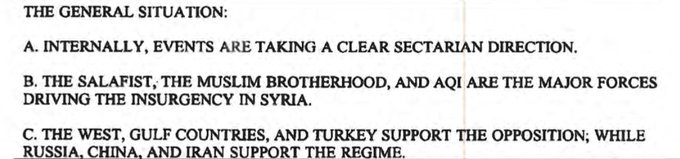
“The Salafist [sic], the Muslim Brotherhood and AQI [al-Qaeda in Iraq] are the major forces driving the insurgency in Syria,” a leaked memo between her State Dept. and the Pentagon stated. “The West, Gulf countries, and Turkey support [this] opposition, while Russia, China and Iran ‘support the [Assad] regime.’”
ISIS also released another video showing American-made weapons airdropped into territory it controlled in 2014, which collaborates with the leaked memo:
The memo likely stemmed from a discussion during the 2012 Bilderberg conference in which participants envisioned a Syrian puppet government taking orders from the U.S. State Department, the European Union and NATO.
Additionally, Saudi Arabia and other Gulf states wanted Assad out of power due to the centuries-old conflict between Sunni and Alawite Muslims and the trillions of dollars in potential oil and gas revenue in Syria that the Gulf states could tap into if they replaced Assad with a puppet.
Syria also rivals Turkey as one of the most strategic locations for natural gas pipelines to flow into Europe from Asia.
“Syria is the site of the proposed construction of a massive underground gas pipeline that, if completed, could drastically undercut the strategic energy power of U.S. ally Qatar and also would cut Turkey out of the pipeline flow,” Aaron Klein of WND reported. “Dubbed the ‘Islamic pipeline,’ the project may ultimately favor Russia and Iran against Western energy interests.”
It isn't only Niger. American troops are deployed in more than 150 countries, working with local partners to help them become better soldiers and meet their own threats. What is happening in Niger is happening in all the countries of the second tier of Africa -- volatile and insecure countries of mixed Christian, Muslim and traditional indigenous religions. American soldiers are there to help governments more effectively control their own territory and borders, reducing the likelihood of transnational jihad.
Iran's massive infusion of funds supports Sunni Hamas, al-Qaeda, ISIS, Boko Haram and others. Instability, chaos, anti-Americanism, anti-Westernism, and anti-Christianism are what Iran seeks -- and they are what Sunni jihadists seek. In Iraq and Syria, ISIS did the destabilizing and Iran reaped the benefits.
At the end of White House Chief of Staff John Kelly's moving briefing about the four American Special Forces soldiers killed in Niger earlier in October, he took questions. The first was, "Why are we in Niger?"
The question was too narrow; it isn't only Niger. Tens of thousands of American troops are deployed in more than 150 countries, working with America's local partners to help them become better soldiers and meet their own threats. We are on every continent except Antarctica. While we are unlikely to ever know precisely who killed the four soldiers, what is happening in Niger is happening in all the countries of the second tier of Africa -- volatile and insecure countries of mixed Christian, Muslim and traditional indigenous religions. American soldiers are there to help governments more effectively control their own territory and borders, reducing the likelihood of transnational jihad.
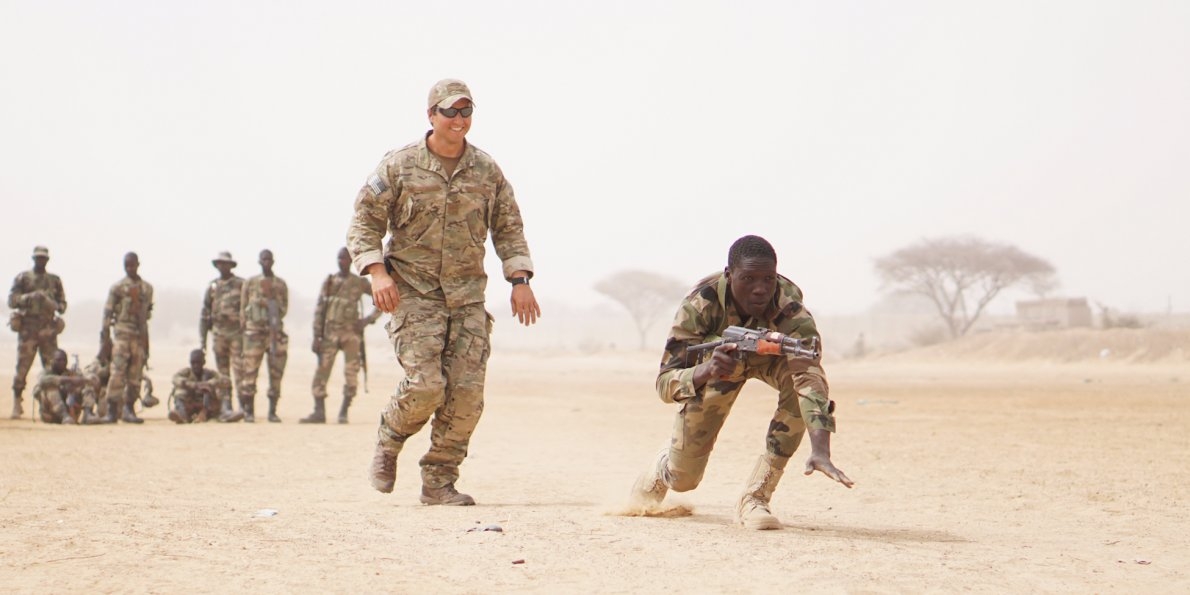
A U.S. Army Special Forces weapons sergeant observes a Nigerien soldier in a drill during Exercise Flintlock 2017 in Diffa, Niger, March 11, 2017. (U.S. Army photo by Spc. Zayid Ballesteros)
Two broad forces are shaking the Middle East and Africa: Sunni jihadist radicalism embodied by ISIS and al-Qaeda along with smaller groups; and Shiite supremacism controlled and financed by Iran. Iran's arms transfers to Africa are well documented, as is Iran's support for Sunni jihad, including incubating both al-Qaeda and ISIS. Separately and together, they threaten not only countries, but also the Red Sea and the Mediterranean Sea, the two prime waterways that allow countries, including Israel and Egypt, to pursue trade with Asia and Europe.
The mullahs in Iran are not Iranian or Persian nationalists, they are Shiite supremacists. When the Ayatollah Khomeini returned to Tehran in 1979 after fourteen years of exile, he condemned all nationalism as "sherk," which means associating other beings or things with God. He said what mattered was Islam, not Iran or any other country, according to the Iranian journalist Amir Taheri, Chairman of Gatestone Europe. Khomeini declared war on the United States, on Israel, and on the West. The declaration was real and has military as well as political implications, but it was also a way of deflecting attention from Iran's declaration of war on Sunni Islam.
It was a bold move, because although Shiites are the majority in Iran and Iraq (though not in Syria), they represent less than 15% of Muslims world-wide. Iran's primary targets are the Sunni governments of Saudi Arabia, which controls the holy sites in Mecca and Medina, and Egypt, the historic intellectual center of Sunni Islam.
The 2003 overthrow of the secular-but-Sunni president of Iraq, Saddam Hussein, allowed the majority Shiite Iraqi population to rule, but the precipitous American military withdrawal in 2012 allowed Iran to move steadily into areas of more influence. Iranian-sponsored Shiite militias are now inside the Iraqi national military pushing against the Kurds in the north. In Syria, Iranian-sponsored militias are pushing Sunnis north and out of the country on behalf of the Shiite/Alawite regime of Bashar al-Assad.
But while American focus has been on Iranian expansionism to the north and west of Iran -- a "Shiite crescent" over the tops of American allies Saudi Arabia, Jordan and Israel -- less attention has been paid to Iranian activity to the south of those countries, through the Red Sea and into Africa toward the Mediterranean.
Following naval harassment of U.S. ships in the Persian Gulf, Iran announced that it will "defend its interests" in the Red Sea, using its position as benefactor of the Houthis in Yemen as a starting point. If successful, this would allow Iran to threaten the Red Sea and the Bab-el-Mandeb Strait, the access point for Saudi Arabia, Israel, Jordan, and Egypt to the Gulf of Aden and then to the Indian Ocean and to Asia.
Iran ships weapons to and through Eritrea and Somalia on the Red Sea coast. This is important because U.S. Expeditionary Forces are based in Djibouti, which juts out into the sea. North of Djibouti and our forces is Eritrea; south of Djibouti and our forces is Somalia. Well-armed and unstable, they present a problem for the Americans.
Iran's interests are not limited to the countries along the coast.
The other waterway that concerns the United States, Israel and the West is the Mediterranean Sea. The countries along the north coast of the Mediterranean are European, all of which are in NATO. The countries facing them along the south shore of the Mediterranean, along the northern African coast, are Sunni Muslim, and, except Libya, partners in NATO's Mediterranean Dialogue. The arrangement helps keep the Mediterranean calm and free for shipping. The 2011 ouster of Libya's Moammar Qaddafi caused chaos in a previously stable -- if repressive -- country. Released weapons and fighters resulted in war in Mali, which had been an ally of the United States and France. Additional instability would make NATO's arrangements less effective and provide additional routes for African migrants seeking to reach Europe.
One way to make North Africa less stable is to make the row of countries just beneath it less stable. Chad, Mali, Somalia, Eritrea, Sudan, and yes, Niger, are all targets.
They are, to be sure, as much targets of Sunni jihad as they are of Iran, but Iran's massive infusion of funds supports Sunni Hamas, al-Qaeda, ISIS, Boko Haram and others. Iran's support for al-Qaeda goes back to the early 1990s. Instability, chaos, anti-Americanism, anti-Westernism, and anti-Christianism are what Iran seeks -- and they are what Sunni jihadists seek. In Iraq and Syria, ISIS did the destabilizing and Iran reaped the benefits.
General Kelly made a sober, passionate defense of American military honor and sacrifice. It is incumbent on the rest of us -- including journalists -- to understand where our troops serve and sacrifice, including why Niger.
Shoshana Bryen is Senior Director of the Jewish Policy Center.
Farewell tawaf around the Kaaba at end of Hajj, photo by Fadi El Binni, Al Jazeera, via Flickr CC
BESA Center Perspectives Paper No. 573, August 29, 2017
EXECUTIVE SUMMARY: The ethnic Sunni-Shiite rift parallels the Saudi-Iranian political rift, the Wahhabi-Muslim Brotherhood ideological rift, and the historic rift between Turkey and Saudi Arabia. Tensions over Islamic hegemony arising from these rifts are likely to come to a boil at the 2017 Hajj.
Wednesday, August 23, 2017, is the first day of Zhu–l-Hijjat, the Muslim month in which two important events take place: the pilgrimage to Mecca, one of the most central of the five Islamic commandments; and the Holiday of the Offering, Id al-Adha, with which it comes to an end. This month is notable in the Muslim world as a result of its religious content, but also due to the political aspects that accompany that content.
It is well known that in Islam, there can be no separation between religion and state, between religious factors, public issues, and politics.
The Hajj ceremonies in Mecca and its environs last for nine days, from the first to the ninth of the month, with each day having its own specific rituals. The tenth day marks the start of Id al-Adha, the holiday of the offering, which lasts for four days, until the 13th.
The House of Saud appointed itself “guardian of the holy places” in 1925 when it took over the Hajj. It manages the Hajj with a powerful hand, making sure that all pilgrims observe the rituals in the traditional Islamic manner as interpreted by the Saudi monarchy. This fact is of great significance, because it proves that the Saudi ruler, and no one else, is the most important figure in the Islamic world.
The decision about when the month of the Hajj begins is an example of this power. The first day of each of the months making up the Islamic year is set by the Sharia court in each country, using the testimony of witnesses who see the new moon with their own eyes and testify to the court. That naturally leads to the months and the 30-day Ramadan fast beginning on different days in various countries, because if it is cloudy and the moon cannot be seen in a specific country, the month is 30 days long, while somewhere else it might be of only 29 days’ duration. That is why Ramadan, which begins on the first day of the ninth Hajjidic month, does not start on the same day everywhere in the Islamic world.
In addition, there are cities, such as Baghdad, where there are both Sunni and Shiite residents with separate courts. Sometimes the Sunnis begin a new month on the last day of the previous month for the Shiites living in the same city or vice versa, depending on the different decisions of their respective courts. This is most conspicuous during Ramadan, when one sect begins to fast while the other is still eating; then, at the end of the month, when the Eid al Fitr holiday begins, the first group celebrates with food and drink while the second is still fasting.
The month of the Hajj differs from other months because the entire Islamic world takes part in the pilgrimage and has to accept the Saudi calendar in order to participate in the date-dependent ceremonies. This includes the Shiites, who refuse to recognize Sunni hegemony over holy Islamic sites but have no choice but to accept Saudi dictation.
The Saudis take advantage of their power and stress the unity of Islam achieved during the period of their control. There were years when the Shiites, mainly Iranians, refused to accept Saudi rule and carried out rituals foreign to Sunni tradition, leading to riots and the deaths of a large number of pilgrims.
Rising tensions between Iran and Saudi Arabia as a result of their major conflicts over Syria, Yemen, Iraq, and Lebanon caused Iran’s Supreme Leader, Ayatollah Ali Khamenei, to fear a bloodbath at the Hajj of 2016. He accordingly moved the pilgrimage site to Karbala, Iraq, where in 680 C.E. Mohammed’s grandson Hussein ben Ali was beheaded by the Sunni Caliph Yazid ben Mu’awiya’s army. One million Iranian pilgrims arrived in Karbala and celebrated the holiday in memory of Hussein ben Ali.
Sunni elders, including Egyptian Sheikh Alazar, publicized opinions criticizing the Iranian move, accusing Khameini of deepening the schism in Islam. Other Sunnis, mostly Saudi, said the Shiites had followed the devil, not Allah, in moving the Hajj from Mecca.
The import of this remark is that it implies that the Shiites are not part of Islam and their blood can be spilled with impunity. Last year’s dispute poured oil on the fire of inter-Islamic hate and on the wars between Saudi Arabia, representing the Sunnis, and Iran, representing the Shiites.
What can we look forward to this year as the Hajj to Mecca approaches? I do not know, but I will not be surprised if the political tension between the Saudis and Iran, particularly after the Sunni ISIS defeats, Shiite Hezbollah victories, and moves by Iran into Iraq, Syria, and Lebanon, finds an outlet during the Hajj. It could be in the form of a Shiite boycott of Mecca or Saudi violence against Shiites who attempt the pilgrimage to Mecca.
In June, Jerusalem became the site of the struggle (“ribat”) between Islam, the religion that expects to take the place of Judaism and Christianity, and Judaism, which is in the midst of a return to its former status as a living, worthy religion. The background of the struggle is the renewal of Jewish sovereignty on the Temple Mount. During the short period of Muslim demonstrations for the right to enter the Al Aqsa Mosque without “Jewish” security checks, Saudi Arabia’s voice was conspicuously absent.
The reason for the Saudi silence was the fear that the Muslim Brotherhood and those over whom they hold sway would raise the Al Aqsa Mosque to a level of importance that could contest the centrality of Mecca in Islam.
This plan has been heard in Muslim Brotherhood media pronouncements. In 2012, for example, Safwat Higazi, the Muslim Brotherhood’s chief spokesman in Egypt, said the capital of the Islamic Caliphate that can unite all the Arab nations “is not Mecca, not Medina, not Cairo, but Jerusalem:”
A similar pronouncement was made in 2014, at a demonstration in Jerusalem, by Kamal Khatib, Deputy Head of the Northern Branch of the Islamic Movement in Israel, headed by Sheikh Raad Salah:
Sheikh Raad Salah himself declared that he intends to bring water from the Zamzam spring in Mecca to pour into the cistern on the Temple Mount in order to sanctify the Al Aqsa Mosque with the holiness of Mecca. The Saudis see this as unacceptable competition and did not permit Salah to attend the Hajj in Mecca.
Jerusalem’s challenge to Mecca is also evident in the boycott the Saudis have declared on Qatar. Qatar publicly supports the Muslim Brotherhood’s offshoots, such as Hamas, for whom the struggle for Jerusalem and Falestin – which they call Aknaf Bayt al-Maqdis, or “the sectors of Jerusalem” – is the raison d’être.
Qatar has even set aside half a billion dollars for the purpose of removing Jerusalem from within Israel’s boundaries. It is using those funds to buy the media, political figures, and organizations like UNESCO.
Turkey’s Erdoğan is also playing a role in the struggle for Islamic hegemony by working ceaselessly to strengthen his status as the all-powerful Sultan bringing Turkey back to its status prior to WWI. Erdoğan’s hegemonic aspirations clash with the Saudis on points of Muslim memory. They know full well that for 400 years, Turkey ruled the Hijaz – the territory that included Mecca and Medina – until it was defeated by Christian heretics (i.e., the British). The victors promptly handed over the Hijaz (Iraq and historic Palestine, which includes today’s Jordan) to the Arabs who had cooperated with them, stabbing the Turks in the back. Today, unsurprisingly, Erdoğan supports Qatar, the country the Saudis are trying to bring to its knees.
Saudi sensitivity over the Hijaz stems from the fact that the ruling Al-Saud family is not originally from the part of the Hijaz situated in the western Arabian Peninsula, but from the centrally located Najd Heights. They conquered the area in 1925 from the Sharif’s Notables, who claim to be direct descendants of Mohammed. This history casts a shadow on the Saud family’s legitimacy, and is the reason the Saudi king calls himself “Protector of the holy sites” – a title intended to grant him “kosher” Islamic status.
However, many people in the Sunni world do not buy that. They do not entirely accept the Saud family’s right to rule and force their Wahhabi Islamic traditions to be the norm at sites that are holy to all Muslims.
The Saudis invest large sums to maintain the sites so as to gain legitimacy for their rule over Mecca and Medina. They build roads, bridges, railways, and amenities to ensure the comfort and security of the two million Muslims whose annual pilgrimages they allow. Saudi Arabia also imports hundreds of thousands of sheep, mainly from Australia, and hands them out to the pilgrims for the holiday celebrated on the tenth of the Hajj month.
Next month, the Hajj is likely to bring tensions over Islamic hegemony to a boil, as the ethnic Sunni-Shiite rift parallels the Saudi-Iranian political rift, the Wahhabi-Muslim Brotherhood ideological rift, and the historic rift between Turkey and Saudi Arabia.
Hopefully, these deep differences will not lead once again to dead and wounded pilgrims, most of whom come only in order to be close to Allah, keep the fundamental commandments connected to the Hajj, and obtain forgiveness for their transgressions. They are not interested in the ethnic, political, ideological, and historical considerations; all they desire is to come closer to the heavens, keep Allah’s commandments, and do Allah’s will.
I wish the pilgrims to Mecca Hajmabroor wa-saiy mashkoor wa-dhanb maghfoor – a pure holiday, hearts full of gratitude, and forgiven sins. May they return safely to their homes.
Lt. Col. (res.) Dr. Mordechai Kedar is a senior research associate at the Begin-Sadat Center for Strategic Studies. He served for 25 years in IDF military intelligence specializing in Syria, Arab political discourse, Arab mass media, Islamic groups, and Israeli Arabs, and is an expert on the Muslim Brotherhood and other Islamist groups.
BESA Center Perspectives Papers are published through t