Contact Form

Name

Email *

Message *

Showing posts with label Moroccans. Show all posts

Thursday, January 26, 2017

Islam Has The Upper Hand In Western Nations. Political Correctness Guarantees It.


  • While it is not surprising to find Muslims offended by certain words or images, it is distressing to find Western courts and other bodies only too willing to turn "Islamophobia" into a criminal offence in countries that otherwise value free speech and open expression.
  • When the Dutch politician Geert Wilders was brought to court on a hate speech charge, all he had done in fact was to ask a simple question about Moroccan immigrants -- should the Netherlands take in more or fewer? That is a question with many potential answers based on political, social, or demographic grounds. It is a rational question that is, almost by definition, one that could be asked in the Home Office of any state that receives immigrants.
  • "Forty percent of Moroccan immigrants in the Netherlands between the ages of 12 and 24 have been arrested, fined, charged or otherwise accused of committing a crime during the past five years, according to a new report commissioned by the Dutch Ministry of Interior." – Dutch-Moroccan Monitor 2011.
  • We, and not our opponents, must place ourselves in a position to define what is and what is not real "Islamophobia." If we cannot do that, others will conflate criticism and hatred, and clamp down on both at once.
If we had to choose one thing that has obstructed many Westerners from understanding modern Islam and undermined our ability to handle its excesses, it would be our perception of Islamophobia. How many times have fair and honest criticisms of one aspect or another of Islam, rebukes of behaviour, or literary and artistic expressions of Muhammad or other figures been loudly shouted down or banned on the grounds that such criticism was "Islamophobic"? In Europe, individuals have been arrested, tried and sentenced for "Islamophobic" utterances. As Judith Bergman recently commented, in Europe it is becoming a criminal offence to criticize Islam.
In 2011, Elisabeth Sabaditsch-Wolff, for example, a former Austrian diplomat and teacher, was put on trial for "denigration of religious beliefs of a legally recognized religion [Islam]," found guilty twice, and ordered to pay a fine or face 60 days in jail. Some of her comments may have seemed extreme, but the court's failure to engage with her historically accurate charge that Muhammad had sex with a nine-year-old girl and continued to have sex with her until she turned eighteen -- its regarding the historical record as somehow defamatory -- and the judge's decision to punish her for saying something that can be found in Islamic sources, illustrates the betrayal of Western values of free speech. A charge of "Islamophobia" was enough to confine the freedoms that most Westerners take for granted.


Elisabeth Sabaditsch-Wolff, a former Austrian diplomat and teacher, was put on trial for "denigration of religious beliefs of a legally recognized religion [Islam]," found guilty twice, and ordered to pay a fine or face 60 days in jail, simply because she made the historically accurate statement that Muhammad had sex with a nine-year-old girl -- something that can be found in Islamic sources. (Image source: ICLA video screenshot)

Sabaditsch-Wolff is not the only person to suffer for this "offence". Danish author Lars Hedegaard suffered an attack on his life and lives in a secret location. Kurt Westergaard, a Danish cartoonist, suffered an axe attack that failed, and is under permanent protection by the security services. In 2009, in Austria, the politician Susanne Winter was found guilty of "anti-Muslim incitement", for saying, "In today's system, the Prophet Mohammad would be considered a child-molester." She was fined 24,000 euros ($31,000) and given a three-month suspended sentence. The phrase "child molester", like the charge made by Sabaditsch-Wolff was based on the fact, recorded by Muslim biographers, that Muhammad had sexual relations with his new wife A'isha when she was nine years old (after marrying her when she was six).
Neither historical fact nor literary sophistication (as the British author Salman Rushdie learned to his cost) are able to deflect charges of Islamophobia.
What is worse is that, while it is not surprising to find Muslims, especially those from unsophisticated backgrounds and little education, offended by certain words or images, it is distressing to find Western courts and other bodies only too willing to genuflect to those charges and turn "Islamophobia" into a criminal offence in countries that otherwise value free speech and open expression.
Recently, the Dutch politician Geert Wilders, a man who could very well become Prime Minister of the Netherlands in 2017, was found guilty of "inciting discrimination and insulting a minority group," merely for asking voters whether they favoured larger or fewer numbers of Moroccan immigrants – a legitimate if controversial political question. Wilders, of course, is known for his antipathy towards Islam, but pertinent concerns about its influence in a democracy do not make him an "Islamophobe", despite repeated accusations of it.
Fear of being "Islamophobic" affects not just the lives of outspoken individuals but the lives of whole populations. Because leading politicians are desperate not to offend Muslims, they often shape public and foreign policies to avoid even the appearance of "Islamophobia". This is, at the domestic level, done to avoid giving offence to growing numbers of Muslims in countries in Europe and North America. Giving offence invariably results in outraged Muslims chanting death threats in the streets; outraged but well-controlled leaders of Muslim organizations appearing in radio and TV interviews masquerading as victims of government or police intolerance, and demands for banning this newspaper, that book, or the resignation of a politician who said something unwise.
A careless word of offence may ruin trade relations with a Muslim state or threaten the cancellation of lucrative arms sales to a human rights-abusing, obscenely rich oil-state in the Gulf. A controversy like this happened to the British Foreign Secretary Boris Johnson in early December, when he condemned Saudi Arabia and Iran for their sectarian proxy wars in Yemen and elsewhere -- only to have his views angrily rejected by the Prime Minister, who had just returned from the Gulf on a visit to promote British goods and services. In a shifting world -- with Britain pulling out of the EU and desperate for trade deals anywhere it could find them - hurting the feelings of people who can buy you up and spit you out is hardly advisable.
And this is where accusations of "Islamophobia" come into their own. Fear of it results in leaders such as Barack Obama, John Kerry, David Cameron, and Pope Francis repeating "Islam is a religion of peace" or "terrorism has nothing to do with Islam", when, in fact, Islam has never been free of religiously-inspired violence and the terror attacks we see around the world today have everything to do with Islam and its call to jihad. Denying that involvement for fear of giving offence or encouraging further violence means that Western powers have handicapped their own ability to recognize the source of conflict, target it, and end it. President Obama's history of avoiding offence and staying apart from direct action in the Middle East was the result of such woolly thinking -- not just woolly thinking but lying through his teeth.
Those of us who express sincere concerns about Islam in general or specific beliefs and actions committed in the name of the religion, yet wish to have respect for Muslims as people and for those aspects of their lives that are not a cause for concern (prayer, alms-giving, celebrations, pilgrimages, social work, mysticism and so forth), have to speak and write in a manner that shows we are not "Islamophobes". We need to do this if we are to be taken seriously, allowing our thoughts the chance to be heard and not dismissed as "bigoted" or "racist".
Much critical work is, however, greatly undermined by a vast quantity of bigoted, racist and genuinely Islamophobic comment on social media and elsewhere. This material, some of which will be quoted here, comes from a deeply worrying trend associated with the far-right, as well as associations of white supremacists. While a great many of these comments or videos on YouTube clearly come from people who seem semi-literate or poorly educated, this is by no means universally true. Many have obviously made limited efforts to educate themselves about Islam. But their efforts at self-education fall short. They repeatedly make factual errors or leap to wild assumptions. They do not know an Islamic language, have never consulted primary sources, nor have they read serious academic studies or reference books such as the Encyclopedia of Islam. But when someone with qualifications challenges their ignorance, they become angry and call their critics "apologists for Islam", something that has happened to the present writer more than once. It is never enough to point out that one may be personally critical of Islam, for they do not seek rational debate or moderate opinion, only hardline condemnation.
For such people, it is never acceptable to point out that a majority of Muslims are good people, honest, charitable, spiritual. No, for them, all Muslims must be evil, Satanic (a common term), liars and murderous terrorists. Both their language and attitudes betray them as being close to, if not at times, also anti-Semites. Much the same sort of slurs, falsehoods, and calls for murder are increasingly used again about Jews; and it is an understanding of anti-Semitism that acts as a measure for judging these anti-Muslim rants. Anti-Semites create stereotypes about Jews, that they are liars, money-grabbers, conspiratorial enemies of Gentile society. So too, real Islamophobes stereotype Muslims, claiming they are all violent, bent on the overthrow of Western governments, deceivers using the principle of taqiyya [dissimulation] to lie to non-Muslims. Both forms of hatred stem from fear of people who are different, both find their most loyal following in the same parts of society where the Nazi party found its supporters.
In 2015, an Australian body named the Online Hate Prevention Institute, led by Andre Oboler, a British Zionist who has fought hard against anti-Semitism, carried out research on anti-Muslim hate on social media sites. On December 10, 2015, the Institute published an interim statement entitled the Spotlight on Anti-Muslim Internet Hate Report and intended to publish a full report in March 2016. Sadly, the Institute has been unable to find further funding for this work with the result that this valuable research may never be made fully public or available to government ministries.
In the introduction to the interim report, we read:
This report is based on over 1,100 items of anti-Muslim hate in social media reported and categorised by the public through our FightAgainstHate.com reporting tool. The vast majority of the hate this report is based on was found on Facebook. The report indicates the volume of content by category, and how effective Facebook has been in responding to content in each category. The vast majority of this hate has not yet been removed.
This author was given access to a considerable part of these 1,100 items and can testify that many of them are genuinely disgusting and filled with hatred. Here is a short selection of comments taken from them and from other websites, including YouTube. They are self-explanatory. Even to suggest that there are reform movements within Islam is beyond the pale to someone whose username is "IzlamIsTyranny". Some of the milder comments include:
Repeated calls to drop a nuclear bomb on Mecca, for example, or calling on others to stab Muslims, calling Muslims "sandmonkeys" -- statements one can find in several places -- are deeply offensive. Have these bigots forgotten how many Muslim preachers call Jews "the sons of apes and pigs"? Imitating the people you despise can hardly be an intelligent policy or one calculated to win friends in places of influence.
When the Dutch politician Geert Wilders was brought to court on a hate speech charge, all he had done in fact was to ask a simple question about Moroccan immigrants, should the Netherlands take in more or fewer. That is a question with many potential answers based on political, social, or demographic grounds. It is a rational question that is, almost by definition, one that could be asked in the Home Office of any state that receives immigrants. Governments make such decisions regularly, and many have to answer similar questions since the influx of vast numbers of refugees into Europe since 2015. Wilders's concern about Moroccans has a rational basis in the Dutch-Moroccan Monitor 2011:
Forty percent of Moroccan immigrants in the Netherlands between the ages of 12 and 24 have been arrested, fined, charged or otherwise accused of committing a crime during the past five years, according to a new report commissioned by the Dutch Ministry of Interior.
In Dutch neighborhoods where the majority of residents are Moroccan immigrants, the youth crime rate reaches 50%. Moreover, juvenile delinquency among Moroccans is not limited to males; girls and young women are increasingly involved in criminal activities.
But when someone says we should stab Muslims in the throat or, "slaughter all Muslims", there can be no question that this is hate speech, and hate speech with murderous intent. Our problem is that politicians, church leaders, and decent people in general may be led to conflate the two forms of utterance -- the intelligent and critical as against the bigoted and violent. For Wilders and others who want to criticize Islam or ask questions about some Muslim behaviour, the presence of genuine Islamophobia is no help at all. It muddies the waters everywhere. Before the matter gets out of hand, responsible critics of Islam badly need to act to silence this hate speech by joining forces with governmental and social media administrations to clamp down heavily on it. We, and not our opponents, must place ourselves in a position to define what is and what is not real "Islamophobia." If we cannot do that, others will conflate criticism and hatred, and clamp down on both at once.
Dr. Denis MacEoin is the author of a forthcoming book on causes of concern about Islam. He has degrees in Islamic studies and is a Distinguished Senior Fellow at the Gatestone Institute.

© 2017 Gatestone Institute. All rights reserved. The articles printed here do not necessarily reflect the views of the Editors or of Gatestone Institute. No part of the Gatestone website or any of its contents may be reproduced, copied or modified, without the prior written consent of Gatestone Institute.

Friday, December 9, 2016

Freedom Of Speech Sacrificed On the Alter Of Political Correctness

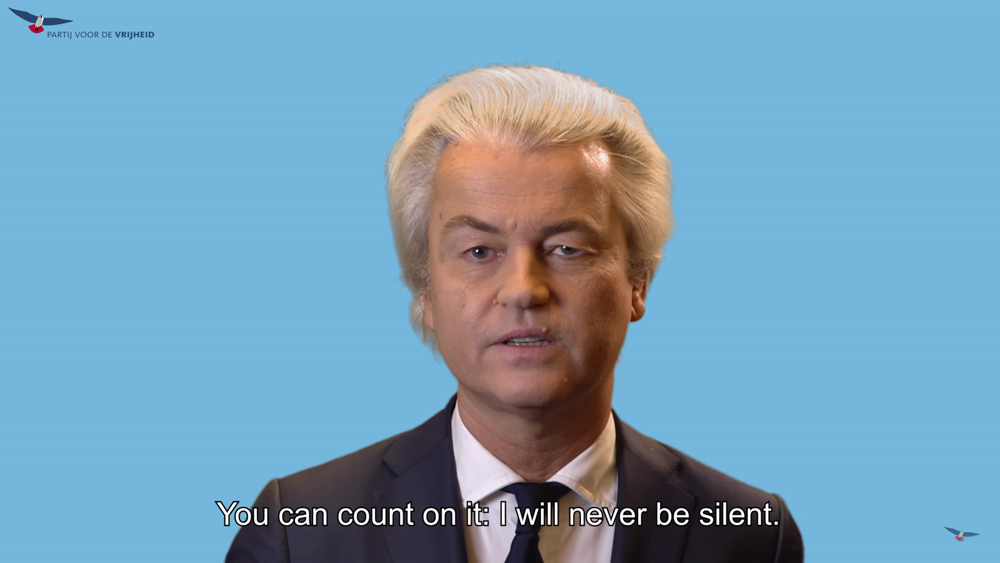
Dear friends, I still cannot believe it, but I have just been convicted. Because I asked a question about Moroccans. While the day before yesterday, scores of Moroccan asylum-seekers terrorized buses in Emmen and did not even had to pay a fine, a politician who asks a question about fewer Moroccans is sentenced.
The Netherlands have become a sick country. And I have a message for the judges who convicted me: You have restricted the freedom of speech of millions of Dutch and hence convicted everyone. No one trusts you anymore. But fortunately, truth and liberty are stronger than you. And so am I.


I will never be silent. You will not be able to stop me. And you are wrong, too. Moroccans are not a race, and people who criticize Moroccans are not racists. I am not a racist and neither are my voters. This sentence proves that you judges are completely out of touch.
And I have also a message for Prime Minister Rutte and the rest of the multicultural elite: You will not succeed in silencing me and defeating the PVV. Support for the Party for Freedom is stronger than ever, and keeps growing every day. The Dutch want their country back and cherish their freedom. It will not be possible to put the genie of positive change back in the bottle.
And to people at home I say: Freedom of speech is our pride. And this will remain so. For centuries, we Dutch have been speaking the unvarnished truth. Free speech is our most important possession. We will never let them take away our freedom of speech. Because the flame of freedom burns within us and cannot be extinguished.
Millions of Dutch are sick and tired of political correctness. Sick and tired of the elite which only cares about itself and ignores the ordinary Dutchman. And sells out our country. People no longer feel represented by all these disconnected politicians, judges and journalists, who have been harming our people for so long, and make our country weaker instead of stronger.
But I will keep fighting for you, and I tell all of you: thank you so much. Thank you so much for all your support. It is really overwhelming; I am immensely grateful to you. Thanks to your massive and heartfelt support, I know that I am not alone. That you back me, and are with me, and unwaveringly stand for freedom of expression.
Today, I was convicted in a political trial, which, shortly before the elections, attempts to neutralize the leader of the largest and most popular opposition party. But they will not succeed. Not even with this verdict. Because I speak on behalf of millions of Dutch. And the Netherlands are entitled to politicians who speak the truth, and honestly address the problems with Moroccans. Politicians who will not let themselves be silenced. Not even by the judges. And you can count on it: I will never be silent.
And this conviction only makes me stronger. This is a shameful sentence, which, of course, I will appeal. But I can tell you, I am now more vigorous than ever. And I know: together, we aim for victory.
Standing shoulder-to-shoulder, we are strong enough to change the Netherlands.
To allow our children to grow up in a country they can be proud of.
In a Netherlands where we are allowed to say again what we think.
Where everybody can safely walk the streets again.
Where we are in charge of our own country again.
And that is what we stand for. For freedom and for our beautiful Netherlands.

Geert Wilders is a member of the Dutch Parliament and leader of the Party for Freedom (PVV).
© 2016 Gatestone Institute. All rights reserved. The articles printed here do not necessarily reflect the views of the Editors or of Gatestone Institute. No part of the Gatestone website or any of its contents may be reproduced, copied or modified, without the prior written consent of Gatestone Institute.

Monday, October 24, 2016

Freedom Of Speech In Netherlands, Non-Existent

  • It is deeply troubling that the court already before the criminal trial has even begun, so obviously compromises its own impartiality and objectivity. Are other European courts also quietly submitting to jihadist values of curtailing free speech and "inconvenient" political views?
  • If you are a politician and concerned about the future welfare of your country, you should be able to discuss the pertinent issues of the day, including problems with immigrants and other population groups.
  • Article 10 of the European Convention on Human Rights states that: "Everyone has the right to freedom of expression. This right shall include freedom to hold opinions and to receive and impart information and ideas without interference by public authority and regardless of frontiers..."
  • In its case law, the Court has stated that Article 10 "...protects not only the information or ideas that are regarded as inoffensive but also those that offend, shock or disturb; such are the demands of that pluralism, tolerance and broad-mindedness without which there is no democratic society. Opinions expressed in strong or exaggerated language are also protected".
  • Wilders did not incite to violence or prosecution (or humiliation), nor did he jeopardize national security or public safety.
  • Clearly, in the Netherlands, justice is no longer blind and the courts no longer independent and impartial state institutions.
A court in The Hague decided on October 14 that the charges of hate speech against Dutch politician Geert Wilders, for statements he made in March 2014 at a political rally, are admissible in a court of law. It thereby rejected the Wilders' appeal to throw out the charges as inadmissible in a court of law on the grounds that these are political issues and that a trial would in fact amount to a political process. The criminal trial against Wilders will begin on Monday, October 31.
While campaigning in The Hague in March 2014, Wilders argued the need for fewer Moroccans in the Netherlands. At an election meeting in The Hague, he asked those present a number of questions, one of which was "Do you want more or fewer Moroccans?" After the crowd responded "fewer" Wilders said, "We're going to organize that."

Geert Wilders during his March 2014 speech, where he asked "Do you want more or fewer Moroccans?" (Image source: nos.nl video screenshot)

Because of the "fewer Moroccans" statements, repeated again in an interview a few days later, Wilders will be prosecuted on two counts: First for "deliberately insulting a group of people because of their race." Second, for "inciting hatred or discrimination against these people."
Wilders' defense attorney, Geert Jan Knoops, has argued that the trial amounts to a political trial against Wilders and his party, the PVV: "Sensitive issues must be judged by public opinion or through the ballot box,", Knoops said "The Prosecutor is indirectly asking for a ruling over the functioning of the PVV and its political program. The court must not interfere with this."
As a politician, Wilders can say more than an ordinary citizen, Knoops said, arguing that Wilders used his statements to point out shortcomings in the Dutch state. "It is his duty to name shortcomings. He takes that responsibility and proposes solutions." Knoops argued that the prosecutor is limiting Wilders' freedom of speech by prosecuting him for his statements.
The court's response was that although politicians are entitled to freedom of expression, they should "avoid public statements that feed intolerance" and that the trial would determine where the border lies between politicians' freedom of expression and their obligation, as the court sees it, to avoid public statements that feed intolerance.
Other politicians, notably all from the Labour Party, have uttered the following about Moroccans without being prosecuted:
The court discarded Wilders' defense attorney's argument that the failure to prosecute any of these politicians renders the trial against Wilders discriminatory. The court said that because of the different time, place and context of the statements of other politicians, they cannot be equated with the statements of Mr. Wilders and for that reason, the court considers that there has been no infringement of the principle of equality.
The statements of those other politicians, however, were, objectively speaking, far worse in their use of language ("sh*t Moroccans") and what could be considered direct incitement ("We must humiliate Moroccans"). What other time, place and context could possibly make the above statements more acceptable than asking whether voters would like more or fewer Moroccans? And what circumstances render it legitimate to call someone "sh*t" because of their ethnic origin?
It is deeply troubling that the court already in its preliminary ruling, and before the criminal trial itself has even begun, so obviously compromises its own impartiality and objectivity. To the outside world, this court no longer appears impartial. Are other European courts also quietly submitting to jihadist values of curtailing free speech and "inconvenient" political views?
The Netherlands is a party to the European Convention of Human Rights. This means that Dutch courts are obligated to interpret domestic legislation in a way compatible with the ECHR and the case law of the European Court on Human Rights. Article 10 of the European Convention on Human Rights states:
1. Everyone has the right to freedom of expression. This right shall include freedom to hold opinions and to receive and impart information and ideas without interference by public authority and regardless of frontiers...
2. The exercise of these freedoms, since it carries with it duties and responsibilities, may be subject to such formalities, conditions, restrictions or penalties as are prescribed by law and are necessary in a democratic society, in the interests of national security, territorial integrity or public safety, for the prevention of disorder or crime, for the protection of health or morals, for the protection of the reputation or rights of others, for preventing the disclosure of information received in confidence, or for maintaining the authority and impartiality of the judiciary.
In its case law, the European Court of Human Rights has stated[1] that Article 10
"...protects not only the information or ideas that are regarded as inoffensive but also those that offend, shock or disturb; such are the demands of that pluralism, tolerance and broad-mindedness without which there is no democratic society. Opinions expressed in strong or exaggerated language are also protected".
Even more important in the context of the trial against Wilders is the fact that according to the European Court of Human Rights' case law,
"...the extent of protection depends on the context and the aim of the criticism. In matters of public controversy or public interest, during political debate, in electoral campaigns... strong words and harsh criticism may be expected and will be tolerated to a greater degree by the Court". [emphasis added]
Let us review what Wilders said and the context in which he said it: "Do you want more or fewer Moroccans?" After the crowd responded "fewer" Wilders said, "We're going to organize that." He repeated that statement in a subsequent interview, where he said, "The fewer Moroccans, the better."
The context in which he said it was an election campaign in March 2014 against the backdrop of considerable problems with Moroccans in the Netherlands. According to Dutch journalist Timon Dias:
Statistics show that 65% of all Moroccan youths have been arrested by police, and that one third of that group have been arrested more than five times.
Wilders emphasizes the inordinate costs associated with the disproportionately high number of Dutch Moroccans registered as social welfare beneficiaries and who are implicated in welfare fraud.
Now, if you are a politician and concerned about the future welfare of your country, you should, logically, be able to discuss the pertinent issues of the day, including existing problems with immigrants and other population groups. This discussion will only make sense in a democratic society if it takes place in public, and certainly with voters at a political rally during an election campaign. Asking whether voters want fewer Moroccans in their city or country may seem crude to some and offensive to others. However, in the light of the case law of the European Human Rights Court, which specifically protects political speech with a very wide margin, especially that of political actors and political campaigns, it is very difficult to see, if not impossible, how the question Wilders posed could legitimately be covered by article 10 (2).
According to article 10 (2), freedom of speech can be limited when
"necessary in a democratic society, in the interests of national security, territorial integrity or public safety, for the prevention of disorder or crime, for the protection of health or morals, for the protection of the reputation or rights of others, for preventing the disclosure of information received in confidence, or for maintaining the authority and impartiality of the judiciary."
Wilders did not incite to violence or prosecution (or humiliation), nor did he jeopardize national security or public safety or any of the other concerns noted above.
It is more difficult to see how the statement, "We must humiliate Moroccans" by Labour politician Hans Spekman, who was not prosecuted, could be legitimized, as it constitutes direct incitement to some form of humiliating action towards Moroccans. Then again, Hans Spekman is not Geert Wilders.
Clearly, in the Netherlands, justice is no longer blind and the courts no are longer independent and impartial state institutions. This should deeply concern all Dutch citizens.
Judith Bergman is a writer, columnist, lawyer and political analyst.

[1] Monica Macovei: A guide to the implementation of Article 10 of the European Convention on Human Rights, p 16, (Human rights handbooks, No. 2, 2004).
© 2016 Gatestone Institute. All rights reserved. The articles printed here do not necessarily reflect the views of the Editors or of Gatestone Institute. No part of the Gatestone website or any of its contents may be reproduced, copied or modified, without the prior written consent of Gatestone Institute.

Tuesday, March 29, 2016

If Geert Wilders Is Convicted Of Insulting Muslims, Freedom Of Speech Is Gone In The Netherlands


  • Freedom of speech is the ultimate liberal value -- and it is the first value that people who wish to control us would take away.
  • If a court in a Western society decides to censor or punish Geert Wilders or others for non-violent speech, the court not only attacks the very humanistic values and liberal society we claim to hold dear; it brings us a step closer to totalitarianism. Even the idea of having an "acceptable" range of views is inherently totalitarian.
  • But what does one do if immigrants prefer not to assimilate? Europeans may be faced with a painful choice: What do they want more, the humanistic values of individual freedom or an Islamized Europe?
  • Censorship is not a path we should wish to take. While we may rightly fear those on the political right, we would do well to fear even more the autocratic thought-police and censorship on the political left.
You are not truly a proponent of free speech unless you defend speech you dislike as fervently as speech you like.
There are many issues concerning the views of the Dutch MP, Geert Wilders, head of rapidly growing political party, the Freedom Party (Partij voor de Vrijheid, or PVV). Dutch prosecutors have charged Wilders with insulting deliberately a group of people because of their race and inciting hatred. Wilders's trial focuses on a speech he gave, in which he asked a crowd of supports whether they wanted more or fewer Moroccans in the Netherlands. In another instance, Wilders is reported to have stated that The Hague should be "a city with fewer burdens and if possible fewer Moroccans." Wilders admits to having made the remarks.


Geert Wilders during his March 2014 speech, where he asked "Do you want more or fewer Moroccans?" (Image source: nos.nl video screenshot)

The remarks Wilders made about Moroccans, as they target only one nationality rather than immigration in general, may sound ill-judged or distasteful to some. But do Wilders's comments, that there should be fewer Moroccans, actually incite hatred or violence? His remarks do not suggest that people attack Moroccans or that people should hate Moroccans; they simply suggest that there should be lower levels of immigration from Morocco.
While Wilder's comments could certainly be convincingly portrayed as preying on people's anti-immigration sentiment, does that actually make them an insult to Moroccans, or is he simply supporting policies he thinks would benefit his country? As Wilders himself said in court last week, "What if someone had said, 'Fewer Syrians?'"
As a society, individuals are responsible for their actions, so if someone acts upon a distortionof Wilders's words, or is violent because of them, Wilders should not be held responsible for their actions, even if he might choose his words more carefully in the future. A line is dangerous to draw: if we start criminalizing people who have anti-immigration views, poorly expressed or not, then where do we stop?
Is it also possible that because Wilders is labelled as politically "far right," people on the political "left," instead of proposing counterarguments, would like to shut him up by branding him a "racist"?
Here are several more statements, none from Wilders; no one who said them has been prosecuted:
  • "We also have s*** Moroccans over here." Rob Oudkerk, a Dutch Labour Party (PvDA) politician.
  • "We must humiliate Moroccans." Hans Spekman, PvDA politician.
  • "Moroccans have the ethnic monopoly on trouble-making." Diederik Samsom, PvDA politician.
One can see that these statements by politicians of the Labour Party, which is one of the current governing parties of the Netherlands, are more inciting, condemnable statements against Moroccans than anything Wilders has said. Yet no prosecution has been initiated against these individuals.
Would it not be better to discuss a nuanced immigration policy openly, like adults, and thereby eliminate prejudice through rational argument?
Prosecuting Wilders has only emboldened the anti-immigrationists, making them less responsive to reason and discussion. Ironically, this trial has moved many left-liberals, who might be criticizing his views, instead to defend his fundamental rights.
On limiting immigration in general, some critics consider that calling for a moratorium on immigration is illiberal -- often other groups such as Christians and Yazidis might be fleeing from ISIS or other extremist Islamic organizations. Basing immigration on nationality might also bring back memories of Nazi Germany, when restrictions often were based on crude religious, ethnic and national caricatures. Other critics seem uncomfortable with calls for the dominance of "Christian, Jewish and humanist traditions" within Dutch culture. How, they ask, can one effectively police a "culture" without seemingly authoritarian restrictions on those who might not fit into it?
Still other critics argue that prohibiting the construction of new mosques restricts religious freedom, and could cause further tension with members of the Islamic community, instead of working with them to solve their conflicts with the West.
But what does one do if immigrants prefer not to assimilate?
That, for example, is not an anti-immigration argument; it is a legitimate question that needs to be answered. There are also many questions that pertain to what a society might look like if there is a tectonic demographic shift, along with a tectonic shift in culture that might accompany it.
As one commentator explained, if you have an apple pie with a few cranberries, it is still an apple pie; but if you keep adding more and more cranberries, at some point it is no longer an apple pie, it is a cranberry pie. That is what the Aztecs faced when the Spaniards arrived in South America. That is what Christianity faced in Turkey when the Muslim Turks arrived. Today, in much of the Middle East, Judaism and Christianity have virtually ceased to exist.
Hard as it might be to contemplate, Europeans might at some point be faced with a painful choice: Which do they want more, the humanistic values of individual freedom or an Islamized Europe?
Whether or not one agrees, especially with the tone, this is the dilemma Wilders has chosen to face -- before a transformation becomes so fundamental that it cannot be reversed.
Although he has come down on the side of liberal values, this is seen by critics as violating other liberal values, such as not to judge one culture superior to another.
But what should one tolerate, if the other culture advocates stoning women to death for adultery? Or, without four male witnesses attesting to the contrary, regarding rape as adultery? Or executing people for having a different sexual preference, or religion, or for leaving the religion? Or beating one's wife? Or condoning slavery? Or officially regarding women as worth half a man? Is it a humanistic, liberal value to stay silent -- to condemn at least half the population to that?
What if before the Civil War in the United States people had said, "Slavery? But that is their culture!" The British in India outlawed suttee -- a ritual in which widows are thrown live onto their husband's funeral pyre. Is it humanistic say "but that is their culture"?
These are values over which wars have been fought.
So even if many of the policies of Wilders might drastically differ even from those of this author, in a truly liberal, humanistic society, it is one's duty defend Wilders's right to express his views without fear of retribution.
If we fail to do that, what we end up with is an authoritarian state in which government agencies decide which views are acceptable and which are not. We have lived through that before with the Soviet Union, and we are now living through it again with countries such as Saudi Arabia, Russia, China, Pakistan and Iran. A happy picture, they are not.
As history shows, as in the French or Russian or Cuban Revolutions, when one person's views are suppressed, eventually everyone's views are suppressed. Who decides on the deciders?
If a court in a Western society decides to censor or punish Geert Wilders or others for non-violent speech, the court not only attacks the very humanistic values and liberal society we claim to hold dear; it brings us a step closer to totalitarianism. Even the idea of having an "acceptable" range of views is inherently totalitarian.

"Acceptable" thoughts, by definition, do not need protecting. It is the "unacceptable" thoughts that do. The reason the right to freedom of speech exists is to protect the minority from the majority -- so we can openly, freely exchange opinions and have discussions.
If we wish to have any kind of democracy in more than just name, people need to able openly to challenge ideas that are considered unquestionable, even sacred, as well as people who are considered sacred.
Only open discussion can have a beneficial influence by highlighting problems and shaping policy. In discussing even outlandish views, we are reaffirming our right to say them, justifying why liberal values of freedom are paramount. Freedom of speech is the ultimate liberal value -- and it is the first freedom that people who wish to control us would take away. As the historian Clare Spark wrote, "Most of European history, with the exception of England, repressed speech that was anti-authoritarian. One might think of Plato, the Spanish Inquisition, and the career of Spinoza for just a few examples."
Therefore, no proponent of democracy, humanism or liberal values should call for Wilders to be punished or censored for his remarks, even if they might be thought questionably expressed. When you defend the fundamental right of another to express his view, it does not mean that you agree with the view. It does not mean that you would refrain from attacking that view if it seemed based on flawed premises -- or even if it did not. Freedom of speech means opposing someone with counterarguments, not trying to silence him.
If Wilders' views are thought to be anti-humanistic, criminalizing his right to speak freely is even more so. Criminalizing speech only harks back to Giordano Bruno, who was burned at the stake for "blasphemy," for saying there were a plurality of worlds; or to the trial of Galileo Galilei for claiming that the earth moves around the sun; or the Scopes trial, which attempted to criminalize Darwin's theory of evolution.
It is restrictions on free speech that are producing many of the worst mockeries of justice today, in countries such as China, North Korea, Pakistan, Bangladesh, Russia, and Iran.
Repressing speech only dangerously hinders the liberal cause. Groups that, in an authoritarian manner, call for censorship and the suppression of debate are being allowed to thrive. We are seeing this now in America on campuses and in the authoritarian attempts to prevent voters from hearing presidential candidates by disrupting speeches. When one fails to answer difficult questions or tries to silence their proponents, instead of solving the problem of prejudice, you are in reality feeding their prejudices and allowing them to grow unchallenged.
We urgently need be concerned about laws that would make "being insulted," a criminal offense. Where does an "insult" start or stop? In addition, people who claim to be offended might just be using the law to try to silence others with whom they disagree. The culpatory aspect of these laws should probably be reconsidered, and possibly revised by the Dutch government, the United Nations in its UNHRC Resolution 16/18, and others trying to restrict free speech.

Finally, criminalizing views such as those of Wilders does not extinguish them. Yes, people might feel intimidated from raising ideas for fear of reprisals, but the suppressed ideas will continue to fester, often with an even stronger force.
It is completely understandable why many are not quick to come to the aid of Wilders because they deem him an opponent. However, if there is one rallying call to those who are in doubt of whether to support Wilders, it is this: authoritarianism is our enemy, whether it comes from Islamism, or laws restricting speech. We may not like that we have to defend people we may even regard as racists or xenophobes, but if we do not defend the rights of all, then who will be next among us to have his rights eroded?
Censorship is not a path we should wish to take. While we may rightly fear those on the political right, we would do well to fear even more the autocratic thought-police and censorship on the political left.
Wilders should not be standing trial for what he has said. Could there be a question of the case against Wilders being political? It sure looks like that.
Robbie Travers, a political commentator and consultant, is Executive Director of Agora, former media manager at the Human Security Centre, and a law student at the University of Edinburgh.

© 2016 Gatestone Institute. All rights reserved. No part of the Gatestone website or any of its contents may be reproduced, copied or modified, without the prior written consent of Gatestone Institute.