Contact Form

Name

Email *

Message *

Showing posts with label NORAD. Show all posts

Monday, May 29, 2017

North Korea Just Keeps Pushing The Envelope. Launches Another Missile.

(3rd LD) N. Korea fires 'Scud-type' ballistic missile: S. Korea

2017/05/29 08:54
Article View Option
(ATTN: UPDATES throughout with PACOM's statement, Scud missile, background info; MODIFIES headline; ADDS photo)
SEOUL, May 29 (Yonhap) -- North Korea fired a ballistic missile from its eastern coast early Monday morning, dealing another blow to efforts by South Korea's new government to improve inter-Korean ties.
The missile, presumed to be a Scud type, was launched eastward from the vicinity of Wonsan, Gangwon Province, at around 5:39 a.m., according to the Joint Chiefs of Staff (JCS).
"The flight distance is around 450 kilometers," it said.
The North's latest action was immediately reported to President Moon Jae-in, who ordered related government officials to convene a National Security Council meeting, said the JCS.
The session started at 7:30 a.m., presided over by Moon's national security adviser Chung Eui-yong.
The U.S. Pacific Command also confirmed the launch occurred near Wonsan Airfield, saying the missile was tracked for six minutes until it landed in the East Sea.
"The North American Aerospace Defense Command (NORAD) assessed that the missile launch from North Korea did not pose a threat to North America," the Hawaii-based command said in an emailed statement. "U.S. Pacific Command stands behind our ironclad commitment to the security of our allies in the Republic of Korea and Japan."
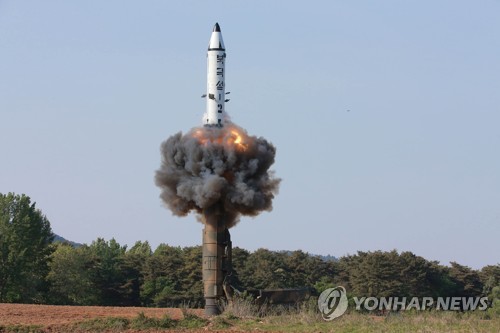
  
North Korea launches a mid-range ballistic missile in this undated file photo. (For Use Only in the Republic of Korea. No Redistribution) (KCNA-Yonhap)North Korea launches a mid-range ballistic missile in this undated file photo. (For Use Only in the Republic of Korea. No Redistribution) (KCNA-Yonhap)
U.S. President Donald Trump was also briefed on the North's provocation, a White House official said.
The Japanese government strongly denounced the North as the missile appears to have landed in waters near its territory.
"This ballistic missile launch by North Korea is highly problematic from the perspective of the safety of shipping and air traffic, and is a clear violation of United Nations Security Council resolutions," Chief Cabinet Secretary Yoshihide Suga said.
The North's Scud missiles using liquid fuel is known to have a range of 300-500 km, mainly targeting the South.
It has recently developed a Scud variant, called Scud-ER (extended range), capable of traveling as far as 1,000 km. It means Japan is within its range.
There's speculation that the reclusive state may be trying to develop anti-ship ballistic missiles against American aircraft carriers.
Monday's launch marked the communist nation's ninth missile test this year and the third since the launch of the Moon administration on May 10, which is seeking to reach out to the communist neighbor.
The North fired a mid-range missile, known as the Pukguksong-2, on May 21 and conducted a KN-06 surface-to-air guided missile test Saturday.
It came as the South is flexing its muscles to resume humanitarian assistance for the North.
Last week, the Unification Ministry approved an application by a local civic group to contact the North for the delivery of mosquito nets and insect repellents.
The decision was viewed as reflecting the liberal Moon administration's desire to reopen dialogue with Pyongyang despite increased military tensions.
"The government will respond strongly to any North Korean provocations, but at the same time, we are flexibly reviewing ways to allow humanitarian and civilian exchanges without compromising international sanctions," a ministry official said.
The international community has intensified pressure on the defiant North.
Wrapping up a meeting in Italy on the weekend, the leaders of the Group of Seven (G-7) member countries agreed that North Korea "increasingly poses new levels of threat of a grave nature to international peace and stability."

   They urged the North to "immediately and fully comply with all relevant U.N. Security Council resolutions, and abandon all nuclear and ballistic missile programs in a complete, verifiable and irreversible manner."

   The North is banned from conducting any launches using ballistic missile technology under the resolutions.

Thursday, May 4, 2017

With All The ObamaCrapCare News, This Escalation Of Russian Flybys Is Dangerous

Russian bombers, fighter jets fly near Alaska, prompting Air Force escort

NOW PLAYING
Russian fighter jets, bombers intercepted off Alaskan coast
Two Russian Bear bombers -- escorted for the first time by a pair of Su-35 "Flanker" fighter jets -- entered Alaska's Air Defense Zone on Wednesday night, U.S. officials told Fox News.
The Russian formation was intercepted by a pair of U.S. Air Force F-22 stealth fighter jets that were already flying a patrol about 50 miles southwest of Chariot, Alaska. A NORAD spokesperson told Fox News the intercept began at 9 p.m. ET on Wednesday and a defense source said it also occurred into Thursday.
It was the first time the U.S. Air Force has seen advanced Russian Su-35 fighter jets escort Russian Cold War-era bombers near Alaska.
The Russian fighter jets were unarmed and remained in international airspace, officials said.
Late last month, Russian bombers flew near Alaska over four consecutive days for the first time since 2014.
This week's latest episode comes one day after President Trump spoke over the phone with Russian President Vladimir Putin. The White House said the conversation focused on crises in the Middle East and North Korea, with no mention of recent Russian provocations.
The conversation was described in a readout as "a very good one."
Trump in April said U.S. relations with Russia were at an "all-time low," and Secretary of State Rex Tillerson also described the relationship between the countries as being at a "low point."
National Security Adviser H.R. McMaster was not as pessimistic, however, telling "Fox News Sunday" that "I don't think they have gotten either better or worse."

Lucas Tomlinson is the Pentagon and State Department producer for Fox News Channel. You can follow him on Twitter: @LucasFoxNews

Saturday, April 22, 2017

Are The Russians Poking At The Trump Tiger?

Russian Military Planes Crowd the U.S. for a Fourth Day

U.S., Canadian fighters intercept long-range bombers

A Norad spokesman said Russian Tu-95 bombers were in international airspace near the coasts of Alaska and Canada.
A Norad spokesman said Russian Tu-95 bombers were in international airspace near the coasts of 
Alaska and Canada. PHOTO: LYSTSEVA MARINA/ZUMA PRESS
WASHINGTON—Russia flew long-range combat aircraft near American airspace
 for the fourth consecutive day, the Pentagon said Friday, marking the first such string 
of incursions since 2014, but prompting little concern from the White House.
American and Canadian jet fighters intercepted a pair of Russian “Bear” long-range 
bombers in international airspace near Alaska on Thursday, said John Cornelio, a 
spokesman for North American Aerospace Defense Command, or Norad. The
 interception was the latest incident between American and Russian aircraft, coming 
amid tension between the two powers over Syria and other issues.
At a press briefing Friday, White House Spokesman Sean Spicer said the administration
 is aware of the situation but said it isn’t unusual.
“As long as those are conducted in accordance with international protocols and rules, 
then that’s obviously -- but we monitor everything,” Mr. Spicer said. “Any further
 comment on that I would refer to the Department of Defense.”
U.S. military officials declined to speculate about Russia’s motives for the flights, 
which came amid an increase in tension between the two countries following U.S.
 cruise missile strikes earlier this month targeting Syria’s military aircraft. Syria and
 Russia are allies.
Asked to comment on the flights,
 Russia’s U.S. embassy pointed to 
a Defense Ministry statement
 carried earlier this week in
 government-controlled media.
“All flights of the Aerospace Force were carried out and are carried out in strict
 accordance with the international rules of using the airspace over the neutral waters
 without violation of borders of other states,” the statement said.
In the latest incident, two U.S. F-22 jets along with two Canadian CF-18 Hornets, 
scrambled Thursday to meet a pair of Russian Tu-95 bombers which were in 
international airspace near the coasts of Alaska and Canada, Mr. Cornelio said.
“Those aircraft identified and intercepted two Russian bombers and stayed with them 
until they departed the identification zones,” he said. “It’s the fourth day in a row
 that we’ve seen Russian activity in our air defense identification zone.”
On Monday, two F-22s intercepted a pair of Bear bombers near the Aleutian Islands, 
the same vicinity. The next day, Bear bombers made a similar flight, though the U.S.
 didn’t scramble fighters, instead choosing to monitor the situation.
On Wednesday, Russian IL-38 anti-submarine planes made a flight into international 
airspace near Alaska, though they weren’t intercepted, and on Thursday, the Bears
 were again in the air, prompting the joint U.S.-Canadian interception.
At no point in any of the flights did the Russians enter U.S. or Canadian airspace, 
officials said.
Before Monday’s interception, Russian aircraft had not made such flights since 2015,
 Mr. Cornelio said. The last time Russians strung together a series of consecutive flights
 in this manner was in 2014.
“That is unusual in the sense that that hasn’t happened here since 2014, but not 
unprecedented,” he said of the series of flights near U.S. airspace. He added that
 the Russian and North American pilots conducted all flights in a professional manner
 with no threats to each other.
“There is nothing provocative in the way they are conducting their flights in
 international airspace,” Mr. Cornelio said.
The Canadian military declined to comment further on the matter, referring all 
questions to Norad, which is a U.S./Canadian joint command.

Tuesday, July 7, 2015

Russians Keep Probing Our Airspace. What Is Their Purpose? Are They Planning Something?

US jets intercepted Russian bombers off the California and Alaska coasts on July 4

Business Insider 
View gallery
.
Russian Air Force Tu-95
(commons.wikimedia.org) On Saturday, two pairs of Russian Tupolev Tu-95 bombers approached the US West Coast, causing the Air Force to scramble to intercept the planes before they breached US airspace, two senior defense officials told Fox News.
The first incident reportedly occurred at 10:30 a.m. ET off the coast of Alaska, when Norad identified the Russian planes and two F-22s hurried to intercept them. Another incident occurred at 11 a.m. ET off the coast of central California and was responded to by two F-15s.
The Russian bombers they intercepted are capable of carrying nuclear weapons, but sources do not indicate whether they were armed.
The Air Force intercepted the bombers before they entered America's sovereign air space, which extends 12 miles out from the coast, but the presence of the bombers is an ominous sign during the heightened tensions between Russia and the US.
As retired Air Force Lt. Gen. Thomas McInerney, who formerly commanded the North American Aerospace Defense Command (Norad) told The Washington Free Beacon: "It's becoming very obvious that Putin is testing Obama and his national-security team."
The type of warfare being teased is reminiscent of the Cold War not only in theory, but in practice.
"These long-range aviation excursions are duplicating exercises I experienced during the height of the Cold War when I commanded the Alaska Norad region," McInerney told The Free Beacon.
View gallery
.
Tupolev_Tu 95K 22,_Russia_ _Air_Force_AN1791187
(Parfaits via Wikimedia Commons) The Tupolev Tu-95.
Pentagon officials haven't given the exact location of the interceptions, but ABC News citesone official as saying it could have taken place as "far out as 200 miles."
The Pentagon's John Kirby told The Free Beacon that the US assessed the flight of the Russian bombers as another training activity.
Since the start of the crisis in Ukraine, Russia has flown increasingly aggressive aircraft missions throughout Europe and the Pacific. From May 2014 to September 2014, the US intercepted Russian bombers over Guam and off the coast of California and Alaska. In September, two Russian aircraft carried out a mock cruise-missile attack on the US.
Throughout 2014, the European Leadership Network estimated that Russia and the West had up to 40 military encounters. Among these, three were designated as high-risk incidents that could have led to casualties or a military confrontation.
In April, Adm. Bill Gortney, the general at the head of Norad, told reporters that Russia was using its long-range bomber fleet to "message" the US about Moscow's international military capabilities.
"They are messaging us. They are messaging us that they are a global power," Gortney said, noting that the US did "the same sort of thing" to Russia in Europe.