For a time, one could not open a newspaper or visit an online news site without finding yet another scandal about sexual harassment. Lawyers are presumably going to have a field day for years to come. In the UK, a further
wave of accusationshas shaken an already shaky parliament and the Government, whose Cabinet is increasingly in disarray. In the US Congress, Hollywood and elsewhere,
similar claims are still being made, with #MeToo stories being shared by women, while there is an unknown number of accusations
in US statehouses.
Sex scandals in the West are far from new.
[1] The irony is that this brings us face to face with attitudes to the same problem in the Islamic world.
For many years in the West, it was common practice for sexual harassment and rape among celebrities and public figures to be hushed up. To secure silence, abusers often used bribes or threats. Young women feared the loss of their careers or reputations; in many instances, the police would reject claims of abuse. This happened more than once
in the UK, when young victims of "Asian" grooming gangs were not believed by social workers and police;
in Europe authorities tried -- and still try (see
here,
here and
here) -- to cover up harassment and rape committed by Muslim migrants. There will be a lot of work to do to protect women and children from the excesses of so many men.
Just watch and marvel at this
short clip from a debate on Egypt's al-Assema TV, aired on October 19, 2017, or read an
English transcript. The Director-General of al-Assema is Brigadier-General Muhammad Samir, a former spokesman for the Egyptian armed forces. His
appointment has been criticized on the grounds that it is "a miserable attempt by the military regime authorities to nationalize the media, unify its message, and block any opposing voices against the government". In that sense, al-Assema represents a semi-official voice.
The debate on Egypt's al-Assema TV included a lawyer,
Nabih [el] Wahsh, an Islamist who has filed countless
hesba [2] cases against intellectuals, artists, religious leaders and government ministers for acts he deems immoral or blasphemous. With Wahsh on air were three women:
Shadia Thabet, a member of the Egyptian parliament, Abeer Soleiman, a women's rights activist, and Ashgaan Nabil, a life coach.
Wahsh began by stressing that, regardless of Egypt being a civil state, it had to conform to Islamic religious rules and norms. On that basis, he engages in an argument which leads him to the following confrontation with Soleiman, whom he effectively silences by bullying her:
Nabih Wahsh: "Are you happy when you see a girl walking down the street with half of her behind showing?"
Abeer Suleiman: "Do you think that we don't care about our girls?"
Nabih Wahsh: "I say that when a girl walks about like that, it is a patriotic duty to sexually harass her and a national duty to rape her."
Abeer Suleiman: "No, no, no, no! I totally oppose this kind of talk. This is sexual harassment live on air..."
Nabih Wahsh: "It is a national duty to rape such a girl! What she allows herself to do constitutes depravity."
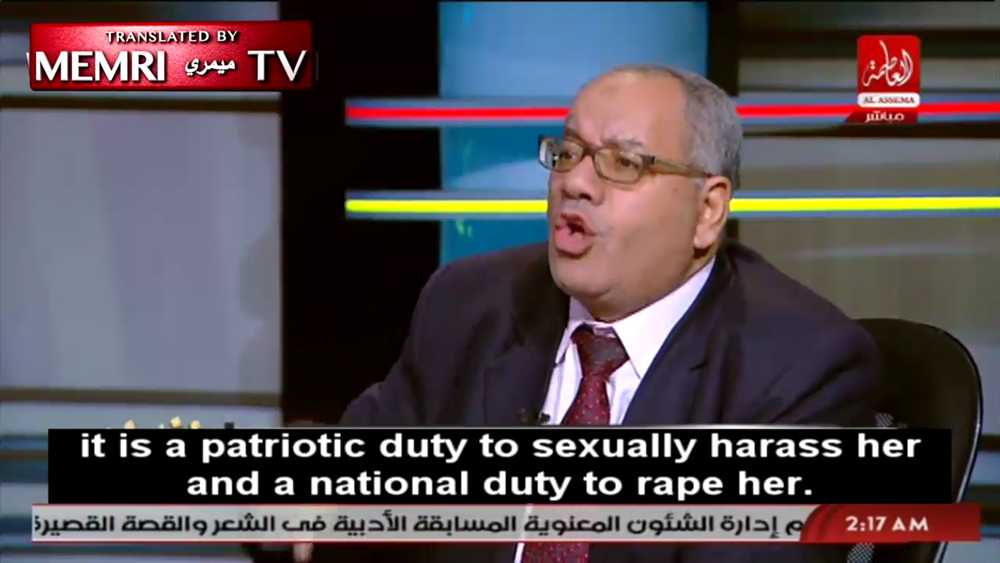
Egyptian lawyer Nabih Wahsh recently advocated on television for sexual harassment and rape in retaliation for the temptation caused by uncovered women. (Image source: MEMRI)
|
This open espousal by a lawyer of sexual harassment and rape in retaliation for the temptation caused by uncovered women was backed by a heavily-covered member of parliament and followed by a "life coach" urging ten-year prison terms for homosexuals -- all during a television broadcast -- would, of course, finish their careers anywhere in the Western world within minutes. Men behave badly in Europe and the United States, and some very badly indeed; but to boast publicly about wishing to do so would be unthinkable.
[3]
In the West, however, women have been fighting back for generations. The rise of sane feminism (as distinct from its shrill and politically-correct cousin)
[4] has elevated the status of women in all the democracies and given courage to the many women who now find themselves empowered to call out powerful men who have sexually abused, groped and raped them.
There are feminists in the Islamic world. Countless books have been written about them and the growth of feminism in countries from Egypt and Iran to Indonesia. During the twentieth century, progress in establishing women's rights was made in several places: the veil was abandoned, more women moved into professional life and even into politics -- notably, the assassinated
Benazir Bhutto, the first Muslim woman democratically elected (twice) as Prime Minister of Pakistan.
Real advances, nevertheless, have been slow. Even as things were starting to improve for women, religious minorities, and others in some countries, such as Turkey, the Salafi style of fundamentalist Islam, based on a demand to return to the practices of the Islamic prophet Muhammad and the first three generations of his followers (
salaf means "predecessors"), was already underway from the early years of the twentieth century, notably through the work of the Egyptian writer
Rashid Rida. For Rida, and later for Salafis down to the Islamic State enterprise, reform meant turning away from the Western models that had inspired new legislation, and back to the earliest days of Islam as embodied in the Qur'an, the
ahadith (sayings and acts of the prophet), and the biographies of Muhammad. In 1928, another Egyptian, the schoolteacher Hasan al-Banna, established the
Muslim Brotherhood, the leading revivalist movement in Islam since the 1920s, which remains to this day a major international force for reviving fundamentalist Islam.
Ironically, one prominent individual to have been caught up in the current wave of harassment revelations is
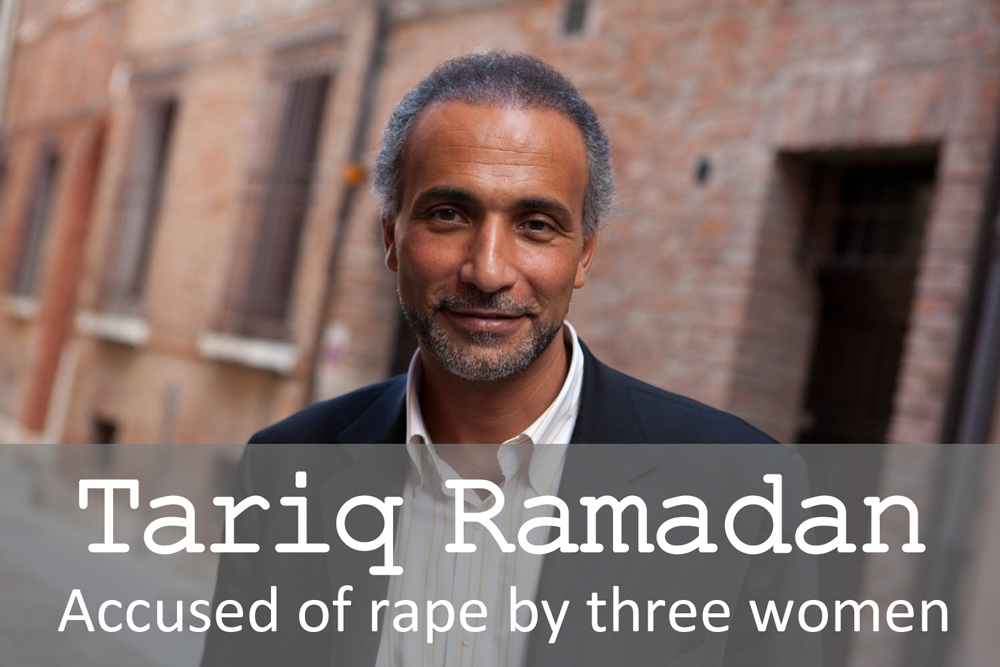
Tariq Ramadan, Professor of Contemporary Islamic Studies at Oxford University. Ramadan's grandfather was none other than Hasan al-Banna, founder of the Muslim Brotherhood. Masquerading as the respectable voice of modern Islamic thought and practice, Ramadan has been exposed by several writers as a front for the Brotherhood and its anti-Western values. French journalist Caroline Fourest published an exposé,
Brother Tariq: The Doublespeak of Tariq Ramadan, in which she shows how he says one thing to his Western audience and quite another to Muslims in France and abroad.
The American author Paul Berman wrote clearly of this in a
long article about Tariq Ramadan in
New Republic:
Ramadan's harsher critics would argue that in speaking... the way he did on these abstract and historical questions, not to mention on his grandfather's ideals, he was cagily deploying a "double discourse" — a language intended to deceive Western liberals about the grain of his own thought. An accusation of "double discourse" has dogged Ramadan for many years in France. It is a chief complaint against him, and a big source of anxiety among his critics. Fourest, in Brother Tariq, documents what appears to be rather a lot of "double discourse," instances in which Ramadan appears to have said one thing to the general public and something else to his Muslim audiences.
In his many books and lectures, Ramadan has promoted the worldview of the hardline Brotherhood while posing as a Western-style philosopher in tune with modern liberal values. That is the basis for his duplicity: the Islam he promulgates in carefully phrased and disingenuous terms has nothing in common with Western values at all. It is this ability to pull the wool over the eyes of thinkers and politicians, a deception that has given him a professorship at Oxford University, that makes him a truly dangerous individual.
In addition to Caroline Fourest's
series of articles in the French journal
Marianne, detailing Ramadan's use of sexual harassment, rape, and general misogynist practices, he has also
been accused by the American academic Phyllis Chesler "of having violently raped, battered, humiliated, confined, and death threatened them [his victims] if they talked".
In response to these claims,
Oxford University acted promptly, placing him on leave while his predations are investigated and, as seems likely, subjected to criminal charges. Not surprisingly, as the journalist
Abigail Esman has pointed out:
Tariq Ramadan's many fans – more than 600,000 people follow him on Twitter and he has more than 2 million Facebook followers – have had plenty to say. He is innocent, they are certain. In their comments on both social media sites, they assure him that Allah will protect him. The women are liars, or part of a conspiracy: against Muslims, against the Muslim leader himself, against Islam – all the insidious, but entirely predictable, work of the world's Jews.
The Iranian Revolution of 1979 sparked off increasingly more revolutionary movements across the Islamic world, and in the process saw women in many countries, across the Islamic world, denied the freedoms they had started to acquire under earlier regimes. The veil returned widely, notably in Turkey, following the growing power of authoritarian and fundamentalist President
Recep Tayyip Erdogan, with
women's rights being increasingly denied.
Erdogan recently condemned Saudi Crown Prince Muhammad ibn Salman's vow to engender a "moderate Islam," calling it a fake Islam supposedly imposed by the West.
Men in Western democracies certainly have much to be ashamed of; the women who call out predators are right to do so. If identifying powerful figures who manipulate vulnerable women will help create a more level playing field for both sexes in countries that have worked hard to put all citizens on a basis of equality, it cannot but be a boon for democracy. Whatever we have done wrong, we have also done much to rectify distortions in our societies. The very fact that in the West, such men are considered shameful and contrary to our better values is itself a sign of how far things have changed.
The Islamic world in general remains enmeshed in ancient attitudes, going backwards rather than forwards, despite sterling efforts by various reformers to
confront patriarchy in several Muslim countries, efforts backed by
many Muslim women.
[5] Those attitudes are rooted in a wide range of assaults on women and their lives: female genital mutilation (FGM)
sanctioned by religious tradition;
honor killings even for girls who have been raped; legally-enforced
marriage to a woman's rapist;
floggings and stonings for women suspected of marital or pre-marital adultery, or even who have been raped; veiling;
marital rape; and denial of independence (a woman must always be
subject to a male guardian – father, brother, uncle, male cousin -- whose permission is needed for most things). Beyond this, it has always been permissible for Muslim men to capture or buy non-Muslim women as
sex slaves, as we have seen recently with Boko Haram and Islamic State, and in
Saudi Arabia,
Mauritania, Singapore, Sudan, Mauritius, Libya, the United States and Europe.
Muslim men, however, have enormous freedoms. They may marry four women; they can divorce a wife by merely pronouncing "I divorce you"; if they are Shi'is, they can take temporary wives through
nikah mut'a,
[6] ("pleasure marriage"), that can be contracted for hours or months or years, and as easily terminated. If they are Sunnis, they can take temporary wives through
nikah misyar, ("traveller's marriage"), used in Saudi Arabia and the Gulf to allow men to keep wives in towns they visit from time to time or, more widely, by married men who seek legal mistresses.
Polygamy continues to be popular, even for Muslim men living in the West. A website set up by British businessman Azad Chaiwala, "
Secondwife.com", which enables men to find further wives in the way non-Muslims use dating sites, has over 100,000 members, including 25,000 in the UK. Although polygamy in Britain carries a seven-year prison term for men, the Muslim version is seemingly exempt as it is considered a religious arrangement. Muslim men in Britain and on the Continent are never prosecuted as polygamists, even though Islamic marriage laws place women in jeopardy in respect of divorce and child custody. The government has even encouraged polygamous marriages to be contracted abroad, and at one point
offered £10,000 in benefits for families with four wives.
We urgently need to drop our unwillingness to contrast Western and Islamic values -- whether regarding violence, treatment of religious minorities, anti-Semitism, or treatment of women. It is not only non-Muslim Westerners who are entitled to make such comparisons -- there are also growing numbers of Muslims, as we are seeing today in Iran, who find wider Islamic attitudes abhorrent and work hard, mostly against the odds, to bring their faith closer to modern values.
Many Western politicians, churchmen and sundry do-gooders choose to find no fault in Islam and describe any form of criticism as "Islamophobia" -- even punishing honest critics of the religion or the actions of some of its followers for daring to breach the code of silence and multicultural acquiescence. These would-be moralists do no favours to us, to Muslim women and children, or to Muslim reformers. Ours is not a perfect civilization. But crying
mea culpa, while passing over the problems of a civilization that also has faults, does not seem the way to assuage a communal guilt.
Dr. Denis MacEoin taught Islamic Studies at a UK university, has published books and articles on Islamic themes, and contributed to academic encyclopedias dealing with the subject, such as the second edition of the massive Encyclopedia of Islam. He is a Distinguished Senior Fellow at the Gatestone Institute.
[1] The harm they do has been dissected by Northwestern University professor Laura Kipniss, in her study
How to Become a Scandal: Adventures in Bad Behavior, New York, 2010, and in her recent exposure of witch hunts in US colleges,
Unwanted Advances: Sexual Paranoia Comes to Campus, New York, 2017.
[2] Hesba or
hisba is the duty to identify and prevent or punish contraventions of Islamic law in Muslim states.
[3] To give credit to the Egyptian government, Wahsh was arrested for these remarks and is currently serving a three-year prison term. See
here.
[4] For an intelligent discussion of the differences, see Christina Hoff Sommers,
Who Stole Feminism?: How Women Have Betrayed Women, New York, 1995.
[5] Note, in particular, Ida Lichter,
Muslim Women Reformers: Inspiring Voices against Oppression, Amherst, NY, 2009. See
here.
[6] For a full academic account, see Shahla Haeri,
Law of Desire: Temporary Marriage in Shi'i Iran, rev. ed., Syracuse University Press, 2014; and see Sachiko Murata,
Temporary Marriage in Islamic Law, privately published, 2017.