Contact Form

Name

Email *

Message *

Showing posts with label gun safety. Show all posts

Thursday, January 2, 2020

Guns Save Lives

That Time The CDC Asked About Defensive Gun Uses


Last month, I discussed the need for more robust and intellectually balanced research into gun use in the United States. In particular, I proposed that “Any Study Of ‘Gun Violence’ Should Include How Guns Save Lives.”
In particular, a 2013 study ordered by the Centers for Disease Control and Prevention (CDC) and conducted by The National Academies’ Institute of Medicine and National Research Council reported that, “Defensive use of guns by crime victims is a common occurrence”:
Almost all national survey estimates indicate that defensive gun uses by victims are at least as common as offensive uses by criminals, with estimates of annual uses ranging from about 500,000 to more than 3 million, in the context of about 300,000 violent crimes involving firearms in 2008.
Subsequently, I learned of a recent paper by Florida State University professor Gary Kleck, “What Do CDC’s Surveys Say About the Frequency of Defensive Gun Uses?“

Kleck looked at some previously unpublished results from the CDC surveys conducted in the 1990s and concluded:
Today In: Opinion
In 1996, 1997, and 1998, the Centers for Disease Control and Prevention (CDC) conducted large-scale surveys asking about defensive gun use (DGU) in four to six states. Analysis of the raw data allows the estimation of the prevalence of DGU for those areas. Estimates based on CDC’s surveys confirm estimates for the same sets of states based on data from the 1993 National Self-Defense Survey (Kleck and Gertz 1995). Extrapolated to the U.S. as a whole CDC’s survey data imply that defensive uses of guns by crime victims are far more common than offensive uses by criminals. CDC has never reported these results.
Subsequently, Kleck removed this version of the paper, although a copy of the original can be found here. As reported by Reason editor Brian Doherty:
You will note the original link doesn’t work right now. It was pointed out to me by Robert VerBruggen of National Review that Kleck treats the CDC’s surveys discussed in this paper as if they were national in scope, as Kleck’s original survey was, but they apparently were not. From VerBruggen’s own looks at CDC’s raw data, it seems that over the course of the three years, the following 15 states were surveyed: Alaska, Colorado, Hawaii, Kentucky, Louisiana, Maryland, Mississippi, Montana, Ohio, New Hampshire, New Jersey, New York, North Dakota, Pennsylvania, and West Virginia. (Those states, from 2000 census data, contained around 27 percent of the U.S. population.) Informed of this, Kleck says he will recalculate the degree to which CDC’s survey work indeed matches or corroborates his, and we will publish a discussion of those fresh results when they come in. But for now Kleck has pulled the original paper from the web pending his rethinking the data and his conclusions.
Furthermore, economist Alex Tabarrok has noted an interesting issue of statistics in his blog post, “Defensive Gun Use and the Difficult Statistics of Rare Events“:
People answering surveys can be mistaken and some lie and the reasons go both ways. Some people might be unwilling to answer because a defensive gun use might have been illegal (Would these people refuse to answer?). On the other hand, mischievous responders might report a defensive gun use just because that makes them sound cool.
The deep problem, however, is not miscodings per se but that miscodings of rare events are likely to be asymmetric. Since defensive gun use is relatively uncommon under any reasonable scenario there are many more opportunities to miscode in a way that inflates defensive gun use than there are ways to miscode in a way that deflates defensive gun use...
The bottom line is that it’s good to know that the original Kleck and Gertz survey replicated — approximately 1% of adult Americans did report a defensive gun use in the 1990s — but the real issue is the interpretation of the survey and for that a replication doesn’t help.
So what can Americans interested in rational gun policy make of this?
My own preliminary conclusions:
1) We still don’t really know how many defensive gun uses (DGUs) there are each year.
Doherty offers his own analysis of reasons why reported numbers might be both too low or too high in his 2015 article, “How to Count the Defensive Use of Guns.”
2) The number of DGUs has likely increased since the 1990s.
The numbers of Americans with legal concealed weapons permits has increased dramatically from the 1990s to today, as more states have adopted laws allowing such permits. It would make sense that the numbers of DGUs has likely increased as well.
CDC′s “Tom Harkin Global Communications Center” located on the organization′s Roybal Campus in... [+] Atlanta, GA. (Public domain image, courtesy Wikipedia.)
(PUBLIC DOMAIN IMAGE, COURTESY WIKIPEDIA.)
3) We don’t know why the CDC chose not to publish that data from the 1990s.
Kleck offers some ideas in his original paper. One possible explanation:
Another factor, however, might also have played a role in the decision of CDC personnel to not report the DGU findings. For CDC’s own surveys to generate high estimates of DGU prevalence was clearly not helpful to efforts to enact stricter controls over firearms, since it implies that some such measures might disarm people who otherwise would have been able to use a gun for self-protection.
One CDC official in the 1990s openly told the Washington Post that his goal was to create a public perception of gun ownership as something “dirty, deadly — and banned.” Given that history, I can’t dismiss Kleck’s critique.
4) The right to self-defense does not depend on statistics (echoing a point I made last month).
I especially like Doherty’s discussion on this:
However interesting attempts to estimate the inherently uncountable social phenomenon of innocent DGUs (while remembering that defensive gun use generally does not mean defensive gun firing, indeed it likely only means that less than a quarter of the time), when it comes to public policy, no individual’s right to armed self-defense should be up for grabs merely because a social scientist isn’t convinced a satisfyingly large enough number of other Americans have defended themselves with a gun.
In summary, the topics of “gun violence” and defensive gun uses are still topics worthy of objective scientific research. And again, any study of ‘gun violence’ should include how guns save lives.

Wednesday, November 29, 2017

If This Passes, The Left Will Go Nuts (More Than They Already Are!)


National concealed carry bill advances in key committee


title

Personal Liberty Poll

Exercise your right to vote.
Legislation that would validate law abiding Americans’ concealed carry permits across state lines just gained major steam.
The House Judiciary Committee advanced the NRA-backed National Concealed Carry Reciprocity Act Wednesday, bringing the nation one step closer to allowing concealed carry permit holders to cross state lines without fear of politically motivated legal troubles.
Currently, concealed carry permits are handled differently in every U.S. state, creating confusion for Americans traveling with their self defense firearms.
Because of the confusing legal landscape, many Americans have found themselves in serious trouble with authorities for mistakenly believing their home state’s concealed carry permit would legally allow them to carry in states with more restrictive firearm regulations.
The legislation, which would require each U.S. state to recognize concealed carry permits from other states, would solidify the 2nd Amendment right to carry a firearm in self-defense nationwide regardless of harsh state and local restrictions in areas with heavy anti-firearm sentiments.
During an appearance on Fox and Friends Wednesday, NRA spokesperson Dana Loesch said the measure promotes “pro-choice defense.
“This is all about making sure that everyone has equal access to the — to any ability to defend themselves,” she said. “This is why millions of law-abiding Second Amendment practitioners went to the polls in November, because our rights should not end where a state line ends.
“This solves a lot of problems. And it makes sure it is about the equal access of your pro-choice defense. That’s all it’s about,” she continued.
Democrats disagree, complaining that the measure would effectively invalidate harsh gun laws in many states.
Democratic Rep. Jamie Raskin of Maryland accused Republicans of wiping out “our state law.”
The legislation has also drawn fire from anti-2nd Amendment groups like the Michael Bloomberg funded Everytown for Gun Safety, which claims that the legislation will ” force every state to allow people to carry hidden, loaded guns, even if they’ve never passed a background check or had gun safety training.”
As the legislation makes its way to a full vote, it will continue to garner massive push-back from the left.
Still, with Republicans in control and the NRA vowing to hold legislators’ feet to the fire on what it deems its “highest legislative priority in Congress,” there’s plenty of reason to believe approval in both chambers is just around the corner.

Thursday, June 2, 2016

Gun Free Zone Did NOT Stop The UCLA Shooter. Isn't It Time For The Do Gooders To Realize This Policy Is Plain Foolish

UCLA SHOOTING: ANOTHER GUN FREE ZONE

Victim disarmament policy claims more lives

32
At least two people were killed during a shooting on UCLA campus today in yet another victim disarmament gun free zone.
“A UCLA police spokesperson said officers responded to an engineering lab and asked students to go to a secure location after the campus-wide alert system issued a notification,” reports NBC News.
At time of press, the gunman is still on the loose and has not been apprehended.
According to California state law, gun ownership is strictly regulated on the campus of UCLA.
Under Penal Code 626.9 PC, known as California’s Gun-Free School Zone Act, which was enacted in 1995, students are prohibited from carrying a gun within 1,000 feet of school grounds.
UCLA’s own campus policy also, “Prohibits the transportation and possession of firearms and other dangerous weapons on the grounds of UCLA campus, off-campus buildings owned or operated by the University, areas adjacent to University Property or to activities of or programs conducted by the University, whether on or off University Property.”
In October last year, California Gov. Jerry Brown also signed into law SB707, which banned students from carrying concealed weapons on school grounds and college campuses.
Of course, criminals don’t tend to obey laws, so the only impact of such measures is to disarm potential victims.

Monday, May 23, 2016

US Military Being Propagandized Against Guns. Scaila's Importance Is Being Missed

Veterans Horrified To See This Antigun Article In Famous Military Magazine

Screen Shot 2016-05-16 at 11.35.23 AMIt’s interesting how our military has changed over the past century.
At one point in time our military and its leadership, as well as auxiliary support systems were worth respecting. Now things have changed as our military leadership caves beneath political correctness and other components of military life seem to be invaded by liberals who want to fundamentally alter how our military thinks and acts.
That’s why it’s not surprising, but no less horrifying to see one of the leading military magazines issues a glowing review of Katie Couric’s new anti-gun documentary.
The NRA writes about this on their blog:

Gun owners have come to expect a certain amount of anti-gun bias from the mainstream press and entertainment industry. Unfortunately, in recent years this noxious prejudice has found its way into a wider variety of media, even some directed at members of our armed services.
Late last week, Military Press published a movie review on a new Katie Couric-produced gun control documentary titled, “Under the Gun.” To describe the review as “glowing” (it labeled the documentary a “must-see”) would be a severe understatement.
The California-based reviewer fawns over the film’s producer and content, and notes appearances by representatives from gun control groups such as Michael Bloomberg’s Everytown for Gun Safety, Brady Campaign, Law Center to Prevent Gun Violence (formerly Legal Community Against Violence), and Americans for Responsible Solutions. Finally revealing the scale of her bias, near the end of the piece the reviewer notes, “I am all for hearing gun-owners out and speaking with a cool head and I heard what they said in the documentary. That being said, I still don’t understand their reasoning behind safely, security and precautions.”
While the critic is entitled to her opinions (even if arrived at without critical thinking), the piece veers wildly off-course when she presents several gun control talking points to the reader as undisputed fact.
First, the author notes, “The rise of mass shootings has become an epidemic.” This is not the case. As we have noted before, mass shootings have been, and remain, rare. A 2015 Congressional Research Service study, which defined a “mass shooting” as “a multiple homicide incident in which four or more victims are murdered with firearms, within one event, in one or more locations in close proximity,” found that shootings covered by the study accounted for a mere 0.66 of all murder victims from 1999 to 2013. As for a purported increase in frequency, respected criminologist James Alan Fox of Northeastern University has repeatedly made clear that there has not been a dramatic rise in mass shooting incidents. In 2013, Fox wrote a piece for USA Today where he explained, “it is important to dispel the widely held notion that mass shootings are on the rise.” Following the release of the CRS study, Fox reiterated that in regards to mass shootings, “There’s no solid trend,” and, “No matter how you cut it, there’s no epidemic.”
Later, the author uses a well-worn gun control talking point, noting, “Gun violence is the second leading cause of death in children from 10-19.” This is a slight variation on a misleading classic that we have repeatedly exposed. In short, gun control advocates mislabel 18 and 19-year-old young adults as “children” and purposefully exclude certain ages in order to concoct a favorable statistic.
The critic then goes on to state the ridiculous claim perpetuated by handgun prohibitionist organization Violence Policy Center that, “The manufacturing and distribution of teddy bears is more tightly regulated for health and safety than handguns.” Firearms are not subject to the authority of the Consumer Product Safety Commission, thanks to the efforts of gun rights activists and our friends in Congress. Firearms are specifically exempted from CPSC’s authority because some have shown an interest in using the agency to ban entire classes of firearms. Instead, firearms manufacturing and distribution are extensively regulated by the Bureau of Alcohol, Tobacco, Firearms and Explosives. Anyone who doubts the rigor with which the manufacture and distribution of firearms are regulated should take a moment to peruse ATF’s Federal Firearms Regulations Guide.
This is not the first time Military Press has revealed an anti-gun ignorance and bias. The April 1, 2013 edition of the publication contained an item titled, “Gun control debate rages on.” In part, the article discusses the debate over whether the Second Amendment protects an individual right to keep and bear arms or merely a state’s right to maintain a militia. Incredibly, the article makes no mention of the landmark U.S. Supreme Court cases District of Columbia v. Heller and McDonald v. City of Chicago, both of which made clear that the Second Amendment protects an individual right to arms. Rather than confront reality, the article states, “so far, probably to both sides’ frustration, the courts have never fully defined the Second Amendment and its implications.”
It should come as no surprise that those with anti-gun views would seek to influence members of the armed forces with their political propaganda. Current and former members of the military are, as a group, almost universally well-respected, and on a more individual basis, are often pillars of our communities. Further, those who would restrict our rights are aware of the deep support the military community and NRA provide each other.
Current and former members of the armed forces comprise an indispensable segment of NRA membership, and as such, NRA understands a special obligation to pursue issues that uniquely affect this group. In this effort, NRA has worked to enact Right-to-Carry laws that waive training requirements and fees for those with military experience. NRA has also fought for changes that would allow military personnel to carry the means of self-defense while on military installations. Most importantly, NRA has led the fight to reform the Department of Veterans Affairs’ unconscionable practice of stripping veterans of their gun rights based solely on a determination that the veteran needs financial assistance managing his VA benefits.
The anti-gun community’s efforts to misinform the unsuspecting public are distasteful, however, these efforts take on a particularly repugnant character when the propaganda targets those who fought to protect the very liberties they would destroy. NRA will continue to expose these attempts wherever they arise.
Quite a few people reading and commenting on the original article are worried this kind of propaganda could desensitize our military to the point where they’d have no issue coming to your door and demanding you give them your weapon.
Former and current military members say this is how liberals are trying to change the culture of our military, and based on what we’re seeing in terms of top down reorganizations of our military it’s hard to say the fear isn’t warranted.

Monday, March 14, 2016

An Armed Child Is Threatened By Armed Thugs. Result Is Not Good For The Idiots


Mr. "Din du Nuffin" met his match in a 13-year old

6 Time Felon Killed In Shootout By 13 Year Old During Home Invasion

By Dylan -
Mar 9, 2016
Inline image 1
A brave 13-year-old Ladson boy fended off two hardened felons who were attempting to break into his house by using his mother’s gun to protect himself while home alone.
The boy saw the men breaking into the back of his home, “at which time he feared for his safety” and grabbed his mother’s gun, the document states. He began firing at them, and the Sheriff’s office reported that they returned fire.
In a heated shootout, he shot Brown three times, and Bennett drove him to the hospital where he later died. The gray Chevy Sonic they were driving had bullet holes in it from the boy chasing them, the affidavit states.
Where is the media coverage of this brave young man. Without the protection of his mother’s gun the boy, and probably his mother when she got home, would both be dead.
Guns Reports:
Two convicted felons intent on breaking into a Ladson, South Carolina, home last week were met with surprise when they came face to face with 13-year-old armed with a gun.
According to reports from The Post and Courier, the young boy, who is not being identified, was home alone when he grew suspicious of a car that pulled up outside around 1:30 p.m. Moments later, the two suspects went to the back of the house and attempted to break in, at such time, the boy, fearing for his safety, grabbed his mother’s handgun.
As the suspects tried to make their way into the house, the boy opened fire, but the suspects reacted by returning fire before fleeing from the scene.
The boy chased the suspects out of the home and continued to fire as they fled in their vehicle. The boy, who was uninjured, then called his mother, who instructed him to call the police.
Neighbor Debbie Griffin said she called police after hearing about six shots ring out. She added that her son was outside at the time and heard more shots and witnessed the attempted burglary. He told her he saw the suspects’ car parked behind the house.
Investigators combed the area around the boy’s home and discovered a Colt .45 pistol, which was believed to belong to the suspects.
A short time later, one of the suspects, who was later identified as Lamar Anthwan Brown, 31, was dropped off outside the emergency room of a nearby hospital. Brown, who was shot three times, died at the medical facility. The second suspect, Ira Bennett, 28, later turned himself in to authorities. He was charged with first-degree burglary and possession of a weapon during the commission of a violent crime.

Monday, February 22, 2016

Gun Handling At Any Age Takes Preparation, Practice And Knowledge.


Rules for older shooters: Understand that things change during your golden years


One of the recurring themes of questions we receive here at the USCCA has to do with older shooters and some of our training tips. Basically, readers and viewers continue to ask questions like the following: “Can you provide any training tips for those of us who can’t move the way you do? Some of us are no longer so limber.”
The short answer is “No.” But the longer answer is far more important from a personal safety and legal standpoint.
So let’s get to the short answer first.
There are so many different people with different physical abilities that I could not possibly create enough training drills to adequately address even a small portion of all the questions people have. It is with this consideration of the vast differences in human ability in mind that we must address the legal concept of what are calledvictim/subject factors. Remember this term. You are the victim. Your attacker is the subject. (We used to use the term suspect, but lawyers have said naming someone as a suspect violates the idea of innocent-until-proven guilty by attaching a negative label before the individual is judged in a court of law.)
In a nutshell, the concept of victim/subject factors allows a victim to attempt to stop an attack by using more force sooner than another person in similar circumstances, so long as the factors giving the attacker an advantage can be clearly articulated to investigators or a jury.
Let’s look at an exaggerated example. Suppose a 25-year-old Army Ranger is walking through the parking lot of a local supermarket and a man who says, “Give me your wallet or I’ll punch you in the face and take it,” approaches him.
Now suppose a 75-year-old retiree is walking through the parking lot of a local supermarket and a man who says, “Give me your wallet or I’ll punch you in the face and take it,” approaches him.
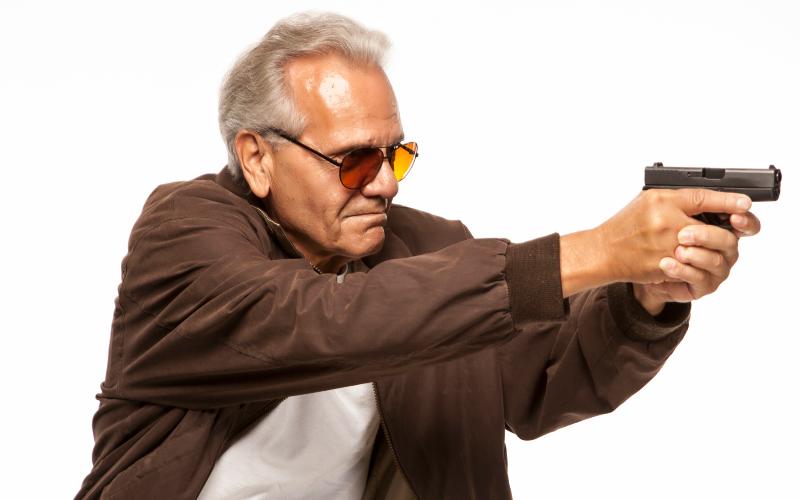
In the second example, the 75-year-old man is less able to escape. He is less able to move to cover. He may be less able to quickly access a cell phone and call for help. He is certainly less able to engage in a physical fight. As a result, he is given greater leeway in when he can employ his firearm to defend himself.
Certainly the attacker, using only his fists and feet, has the ability to inflict death or great bodily harm on the 75-year-old man. The threat is imminent in that the attacker has a weapon, intent, and means to carry out his threat.
Remember, you can only use your firearm against an imminent deadly threat. Well, here you have one.
In this case, I would tell the Army Ranger to attempt to move to cover, provide a verbal challenge in hopes the subject would back down, attempt to leave the area, and perhaps even employ some sort of lesser level of force. In this case, I love ultra-bright flashlights since they temporarily disorient the attacker and allow the victim a chance to escape.
BUT, because the 75-year-old is not as quick, limber, or strong, I would advocate for the older person to immediately draw the defensive firearm while simultaneously issuing a stern verbal challenge: “Get back. I will defend myself.”
This needs to be done early enough in the encounter to keep the subject at what the victim considers a safe distance. If the subject continues to press the attack, deadly force is an option. If the subject decides to leave the area, that’s great. Now the victim needs to call 911 and report the incident to ensure the subject doesn’t call police and say, “Some crazy old guy pointed a gun at me.”
The most important element is not your physical ability but your ability to articulate why you chose to use the level of force you employed.
We here at the USCCA cannot teach you to be more limber. We cannot teach you training drills that will shave 20 years off your reaction time. We can and do advise you to take decisive action sooner and to be able to articulate exactly why you did so.
The sad truth is that after such an incident, you may need a lawyer to help you deal with the police; your USCCA membership will help you with that.
Don’t wait for the attack to come to you. Action defeats reaction, every time. We can’t make you any younger or stronger. But we can show you how your age and wisdom can protect you against a younger, stronger attacker.
–Kevin Michalowski