Contact Form

Name

Email *

Message *

Showing posts with label job growth. Show all posts

Friday, February 2, 2018

The Hits Just Keep Coming

Job growth up 200,000 in January, better than expectations, and wages up

  • Nonfarm payrolls rose by 200,000 in January, beating analyst estimates, while the unemployment rate held at 4.1 percent.
  • More importantly, average hourly earnings increased 2.9 percent on an annualized basis, the best gain since the early days of the recovery in 2009.
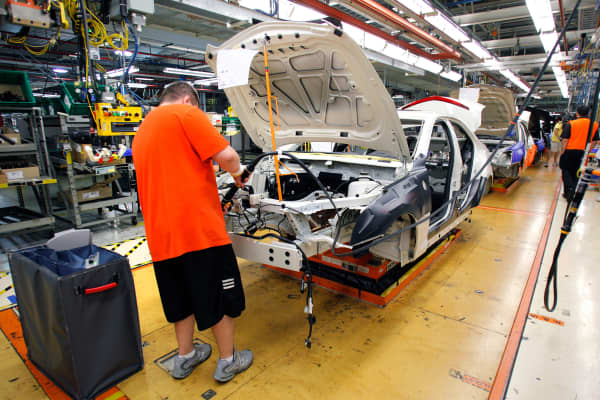
Nonfarm payrolls grew by 200,000 in January and the unemployment rate was 4.1 percent, while wages saw their biggest jump since the end of the Great Recession, the Bureau of Labor Statistics said in a closely watched report from Friday.
Economists surveyed by Reuters had been expecting jobs growth of 180,000 and an unemployment rate of 4.1 percent. A broader measure of unemployment that includes discouraged workers and those holding part-time jobs for economic reasons edged higher to 8.2 percent, the highest level since September.
In addition to the solid payroll growth, average hourly earnings were up 0.3 percent for the month, matching estimates and reflecting an annualized gain of 2.9 percent. That was the best since mid-2009 as the two-year economic slump was coming to a close. However, the average work week fell two-tenths to 34.3 hours.
Markets were unimpressed with the report, with stock futures continuing to point to a sharply lower open on Wall Street and bond yields rising.
"Overall, it was really fabulous," said JJ Kinahan, chief market strategist at TD Ameritrade. "People are just looking for an excuse to sell."
The prospect of rising interest rates due to inflation pressures could be just that catalyst, he said.
"We've all talked for many years saying we're going to raise rates, that raising rates will be good for the economy," Kinahan added. "I find it quite odd that the narrative around the market has changed quite a bit."
The numbers come amid an expected acceleration in growth for the U.S. economy. The Atlanta Federal Reserve is expecting a GDP gain of 5.4 percent in the first quarter, which would be the best increase since the recovery began in mid-2009.
Within the jobs report, Wall Street and policymakers are watching wage numbers closely. While job gains have been solid and consistent, salary growth has been elusive. This report could change the narrative and might push the Fed to get more aggressive with interest rate hikes.
The report comes after a disappointing 160,000 in December (revised up from 148,000) and two days after ADP said private payrolls increased by 234,000. The November gain of 252,000 was cut from 252,000 to 216,000, making the net from the two revisions minus-24,000.
The household survey showed an even bigger gain in employment, with a gain of 409,000. The rolls of the unemployed grew by 108,000.
Construction reported by the biggest gain by sector with 36,000. Bars and restaurants added 31,000 and health care was up 21,000. Manufacturing also showed a gain of 15,000 and durable goods-related industries added 18,000.
"Perhaps the biggest positive surprise on hiring is the continued surge for the goods-producing sector with manufacturing and construction leading the way," said Mark Hamrick, Bankrate.com's senior economic analyst.
While the labor force participation rate held steady at 62.7 percent, those counted as not in the labor force popped, jumping 153,000 to 95.7 million.

Wednesday, April 5, 2017

Job Numbers Jump Significantly. Guess Trump Really Is Ruining The Economy!

Private payrolls grew 263K in March vs. 185K est.: ADP


The year's fast start for job creation showed no signs of letting up in March as private payrolls saw another big boost, according to a report Wednesday.
Companies added 263,000 jobs for the month, ADP and Moody's Analytics said. That was well above the 185,000 expected from economists surveyed by Reuters and also better than the 245,000 reported for February.
The February number was revised significantly lower, however, from the originally reported 298,000.
In addition to the big gain on the headline number, the month also continued a trend away from services-oriented positions dominating job creation. Goods-producing firms contributed 82,000 to the total, as construction led the way with 49,000 new jobs.
Professional and business services was the leading sector, with 57,000, while leisure and hospitality added 55,000 and health care was up 46,000. Manufacturing payrolls grew by 30,000 and trade, transportation and utilities rose by 34,000.
In terms of company size, fewer than 50 employees was the biggest growth area, with 118,000. Firms that employ 50 to 499 workers added 100,000.
"Job growth is off to a strong start in 2017," Mark Zandi, chief economist of Moody's Analytics, said in a statement. "The gains are broad-based but most notable in the goods producing side of the economy including construction, manufacturing and mining."
The report comes amid hopes that President Donald Trump can deliver on his pro-growth agenda of lower taxes, less regulation and more infrastructure spending. Economic data points have been mixed lately, with sentiment surveys outpacing actual hard data of activity.
Job growth has been a particular strength so far, and the ADP report could fuel higher expectations.
The report comes two days before the Labor Department releases its closely watched employment report for March.
This is a breaking story. Check back here for updates.

Wednesday, October 16, 2013

Will Reform Come From Government Shutdown? If So, That Would Be Wonderful. What Are The Odds?

David Malpass: The Bigger Battle Behind the Shutdown
A staggering $250 billion per month, 80% of spending, runs on autopilot without congressional control.
By DAVID MALPASS
The Wall Street Journal, October 10, 2013
At its core, the shutdown is part of a much bigger battle to restrain the federal government. It is spending $3.6 trillion per year without a budget, and its expenditures are expected to increase rapidly in the years ahead.
Meanwhile, the government has piled up $17 trillion in debt and $60 trillion more in unfunded spending promises. The Federal Reserve will borrow $1.1 trillion in 2013 alone to buy bonds—and it reserves the right to borrow unlimited amounts for future bond purchases without congressional or presidential permission.
These are crisis-level problems. Whether the government is open or closed, they are surely grounds for immediate talks between the president and Congress on ways to pare ineffective federal programs, restrain spending and reduce borrowing.
Ducking governance decisions year after year will leave the U.S. too weak to face global challenges. Big government has meant slow growth, painfully high youth and minority unemployment and falling median incomes—except in the Washington, D.C., area, which recent census data show is growing ever richer.
Under current law, the federal government and Federal Reserve are in a sharp upward trajectory in their power and the riskiness of their policies. Federal domination of the economy and financial markets is only increasing. The government shutdown reflects a Republican demand for permanent new checks and balances—to restrain a government that spends wildly without a budget, buys $1 trillion per year in overpriced bonds from an already-rich Wall Street, and micromanages federal medical care but exempts unions and Congress from the sting of regulations that affect others.
Washington’s panic prior to the budget sequester that took effect earlier this year gave a glimpse of the truth: Much federal spending can’t be justified. The government shutdown is giving more insight into the problem — a staggering $250 billion per month, 80% of spending, runs on autopilot without any congressional involvement or control. So much for the Constitution’s bedrock principle that “No Money shall be drawn from the Treasury, but in Consequence of Appropriations made by Law.”
To break the impasse, and to address the government’s disastrous finances, the president must lead the way. Mr. Obama has made clear that he will not change ObamaCare, but given the challenges the country faces, a blanket insistence on keeping the whole government unchanged isn’t defensible.
One good starting point for presidential leadership is the fraud-plagued federal disability programs that cost taxpayers $200 billion annually. There are innumerable other such programs, as well as roughly 200 independent federal agencies, many with little purpose and certainly not enough purpose to justify more debt.
To avoid future stalemates like the current one, making a legislative change is clearly imperative: The current debt-limit law, despite its name, operates to make the debt larger, not smaller. The law should be rewritten to mandate continuous spending restraint when debt exceeds the ceiling.
Fortunately, an actual default is a red herring. The president has sweeping powers through Treasury to continue paying the national. Mr. Obama alluded to this on Tuesday by listing the non-debt obligations that might be paid late, including government contractors, veterans and Social Security recipients (whose checks are due Nov. 1). In effect, the government would choose to pay them late and use newly arrived tax revenues to maintain debt payments.
Treasury Secretary Jack Lew’s weekend appearances on four major networks made the same point. He complained about Republicans extorting the president—then defined default as “choosing not to pay bills on time.”
The administration is frustrated that Wall Street is largely ignoring its talk of default, hence the president’s cautioning the stock and bond markets—on Tuesday afternoon, in the heart of the trading day—about the potential for catastrophe.
Democrats are hoping that the political consequences of a broader shutdown of government payments, what the president is calling an economic shutdown, will force House Republicans to allow a vote on a short-term extension of the debt limit.
Maybe so, but the president might have a tough time convincing House Democrats to vote for more debt with no reforms. The better course would be to agree on reforms now—there’s ample common ground—and put an end to the downward spiral in rhetoric.
Rather than discuss restraint, the administration has increasingly turned to the Federal Reserve as a crutch. The Fed is borrowing and spending $85 billion per month on bonds, and it claims the legal authority to increase its debt at will. Wall Street is intensely focused on supporting this profligacy and profiting from it. The Fed’s debt will reach $4 trillion at year-end, with at least $200 billion of it not counted properly in the national debt.
The Fed is choosing to buy long-term bonds with short-term debt. The result is a rapid shortening in the effective maturity of the national debt that benefits current politicians but puts taxpayers at risk. Like an adjustable-rate mortgage, the borrower, in this case the government, gets a lower interest rate now but will have to refinance at higher rates later.
Compounding the taxpayer risk, Treasury has scheduled a November launch of a new class of floating-rate debt that will compete with the Fed’s debt when interest rates begin to normalize. This leaves a huge portion of the national debt exposed to higher interest rates. And as Europe’s weak southern flank demonstrated in their 2010-12 crisis, financial markets treat floating-rate and short-term debt like blood in the water.
The president keeps telling the public that Republicans would, in effect, “burn down your house” if he doesn’t negotiate. Republicans should ignore the outrageous charges of extortion and blackmail coming from the other side and continue to seek positive change. The upside is clear: Growth, jobs, the dollar and financial markets would surge if the shutdown leads to restraint.
Mr. Malpass is president of Encima Global LLC. He served as deputy assistant Treasury secretary in the Reagan administration.

Friday, January 6, 2012

Obama's Re-Election Plan

A lot of people, pundits and non-pols alike have suggested that Obama will be a one term President due to the unemployment situation and the poor state of the economy.  We say: "hold the presses!"  To declare Obama dead is a bit premature. 

As you know  we are not fans of the President but we are realists. We understand the power of the Presidency and incumbency. Domestically, if the economy is still in the tank and unemployment over 8%, the President will have a rough time getting re-elected. Whereas if the statistics indicate a 5% unemployment and GDP growth, it would be a different story.

Likewise, in  foreign affairs, if Iran gets its nuclear weapons and the Middle East is still a mess, once again Obama will have problems. On the other hand if there is a Israeli-Palestinian agreement or the world decides to terminate the Iranian nuke plant, the election will be different.

Our prediction is that all the positives we stated above will occur. Unemployment will be around 5-5.5%,  GDP growth will be around 3% per year and there will be foreign affairs successes.   Why? Because he can make it so.  For example, the following article by AP today.  Unemployment down to 8.5%, the lowest in 3 years!

Isn't it interesting, the election is eleven months away and all of a sudden the rate start moving down.  Call it paranoia but I smell a skunk. Also buried in these numbers, why do they not count those who have stopped looking for work? Are they not unemployed? Why don't we have some way of counting those who have taken a lower paying job just to bring in some money?

Another issue, why does the CPI not include gas and food?  The official answer is that these items are too volatile and make the index move too much. That might be true in "politics-world" but to the everyday Tom and Thomasina, these items effect our lives greater than any other purchase.  To ignore them is to ignore the real "cost of living" for regular citizens. In other words, the index has been manipulated to come up with the results the leaders want.

There is an old saying that "figures don't lie, but liars figure."  Government statistics are examples of the latter and Obama will take full advantage of them.

We assume that the word has been sent to the Commerce Department (unofficially of course) to make sure that the numbers reflect a decline in unemployment and GDP growth in the year before the election.  We would like to see that communication!

Watch the news in the upcoming months and we believe you will see this scenario appear.

Conservative Tom

Unemployment rate falls, lowest in nearly 3 years

The Labor Department said Friday that employers added a net 200,000 jobs last month and the unemployment rate fell to 8.5 percent, the lowest since February 2009. The rate has dropped for four straight months.
The hiring gains cap a six-month stretch in which the economy generated 100,000 jobs or more in each month. That hasn't happened since April 2006.
The steady drop is a positive sign for President Barack Obama, who is bound to face voters with the highest unemployment rate of any sitting president since World War II. Unemployment was 7.8 percent when Obama took office in January 2009.
Still, the level may matter less to his re-election chances if the rate continues to fall. History suggests that presidents' re-election prospects hinge less on the unemployment rate itself than on the rate's direction during the year or two before Election Day.
For all of 2011, the economy added 1.6 million jobs, better than the 940,000 added in 2010. The unemployment rate averaged 8.9 percent last year, down from 9.6 percent the previous year.
Economists forecast that the job gains will top 2.1 million this year.
The December report painted a picture of a broadly improving job market. Average hourly pay rose, providing consumers with more income to spend. The average work week lengthened, a sign that business is picking up and companies may soon need more workers. And hiring was strong across almost all major industries.
Manufacturing added 23,000 jobs. Transportation and warehousing added 50,000 jobs. Retailers added 28,000 jobs. Even the beleaguered construction industry added 17,000 workers.
A more robust hiring market coincides with other positive data that show the economy ended the year with some momentum.
Weekly applications for unemployment benefits have fallen to levels last seen more than three years ago. Holiday sales were solid. And November and December were the strongest months of 2011 for U.S. auto sales.
Many businesses say they are ready to step up hiring in early 2012 after seeing stronger consumer confidence and greater demand for their products.