Contact Form

Name

Email *

Message *

Showing posts with label korea. Show all posts

Wednesday, October 30, 2019

Is This You?

THIS IS US...

 
The typical U.S. household headed by a person age 65 or older has a net worth 47 times greater than a household headed by someone under 35, according to an analysis of census data released Monday.
 
They like to refer to us as senior citizens, old fogies,   geezers, and in some cases dinosaurs. Some of us are "Baby Boomers" getting ready to retire Others have been retired for some time. We walk a little   slower these days and our eyes and hearing are not what they once were. We     worked hard, raised our children, worshiped our God and have grown old together.
 
In school we studied English, history, math, and science,  which enabled us to lead America into the technological age. Most of us remember what outhouses were, many of us with firsthand experience. We    remember the days of telephone party-lines, 25 cent gasoline, and milk and ice being delivered to our homes.
 
We are probably considered old fashioned and outdated by many. But there are a few things you need to remember before completely   writing us off. We won World War II, fought in Korea and Viet Nam. We can quote The Pledge of Allegiance, and know where to place our hand while doing so. We wore the uniform of our country with pride, and lost many friends on    the battlefield. We didn't fight for the Socialist States of America; we    fought for the "Land of the Free and the Home of the Brave." We wore different uniforms but carried the same flag.
 
We know the words to the “Star    Spangled Banner,” “America,” and “America the Beautiful” by heart, and you may even see some tears running down our cheeks as we sing. We have lived what many of you should have read in history books and we feel no obligation to apologize to anyone for America .
 
Yes, we are old and slow these days but rest assured, we have    at least one good fight left in us. We have loved this country, fought for it, and died for it, and now we are going to save it. It is our country and    nobody is going to take it away from us. We took oaths to defend America    against all enemies, foreign and domestic, and that is an oath we plan to    keep. There are those who want to destroy this land we love but, like our   founders, there is no way we are going to remain silent.
 
It was mostly the young people of this nation who elected   Obama and the Democratic Congress. You fell for the "Hope and Change" which in reality was nothing but "Hype and Lies” from your college professors. You youngsters need to taste socialism and see evil face to    face to understand  you don't like it after all. You make a lot of noise,most are all too interested in their careers or "Climbing the Social    Ladder" to be involved in such mundane things as patriotism and voting. Many    of those who fell for the "Great Lie" in 2008 are now having buyer's   remorse. With all the education we gave you, you didn't have sense enough to    see through the lies and instead drank the 'Kool-Aid.' 
 
Well, don't worry youngsters, the Grey-Haired Brigade is here,    and in 2016 we took back our nation. We may drive a little slower than you would like, but we get where we're going, and in 2020 we're driving tothe polls again by the millions.
 
So the next time you have the chance to say the    Pledge of Allegiance, stand up, put your hand over your heart, honor your country, and thank God for the old geezers of the "Gray-Haired Brigade."
 
Footnote:  This is spot on.  I am another Gray-Haired Geezer    signing on.  I will circulate this to other Gray-Haired Geezers all over    this still great country.
 
Can you feel the ground shaking? It's not an earthquake, it is a  STAMPEDE.
 
You and I are Members. Don't Delete. Just Read and Pass it on!!
 
In God we STILL trust!

Friday, May 4, 2018

Trump Approval Numbers Keep Climbing!

Trump’s Average Job Approval Reaches Highest Level In A Year

How is it possible? says the Never Trumper to himself.
No, actually, I think this is easily explained.
It’s not out of the blue, remember. Two weeks ago I noticed that Democrats’ lead on the generic ballot had shrunk to its smallest level in nearly a year, due mainly to Trump’s improving job approval. After slogging along at 38-39 percent for most of the second half of last year, POTUS had crept up to 41-42 percent. Not a world of difference, but a few points can mean a lot in the midterms.
Today he’s at 43.5 percent in the RCP “poll of polls.” The last time he was that high was 363 days ago: May 4, 2017. He fired James Comey five days later and went splat. It took him this long to fully recover, something he’ll hopefully bear in mind the next time he gets the itch to can Bob Mueller.
That’s a pretty dramatic little spike over the past week or so. On April 28 he was at 41.9 percent, in line with where he’s been for most of this year. The next day he leaped four-tenths of a point. The day after that, six-tenths. The day after that, another four-tenths. Today he’s up another two-tenths. What gives? If 59 Michael Avenatti appearances on CNN can’t tank Trump’s approval, what are they good for?
Simple answer: The Korean peninsula suddenly — if only momentarily — looks more stable than it has in ages and Trump is being given lots of credit for it. The already famous handshake between Kim Jong Un and Moon Jae In at the border inside the DMZ came on April 27. That day was filled with chatter, and not just from righties, that Trump would deserve a Nobel prize if the peace between North and South stuck. Some liberals went so far as to admit that Obama would be praised to the skies by global media if a momentous detente like that had happened on his watch. Getting Kim to calm down, however briefly, is the biggest achievement of Trump’s presidency so far and there may be more to come. His own summit with Kim might go well; a formal end to the Korean War might be in the works. And for once, Trump’s belligerence on Twitter looks strategic and crafty, the “madman theory” of foreign policy at work, rather than weird and scattershot. “Little Rocket Man” may have concluded that POTUS is nuttier than he himself is and that the nuking of Pyongyang could be very much on the table. Time to make nice. If, if, if, if North Korea were somehow convinced to denuclearize peacefully (which is unlikely in the extreme, granted), it’d be the biggest foreign policy win for the U.S. since the end of the Cold War.
And all of that followed a successful state visit in the days before by Emmanuel Macron, which gave Trump serial opportunities for dignified presidential photo ops for the better part of a week. With the North Korea news then following, how could his job approval not go up?
More importantly, can it stay up? If he parlays the Kim/Moon summit into something more significant and durable, I think his baseline approval really might move north a bit and stick. Not everyone who rates him unfavorably does so because they dislike him. Some think he’s just not fit for the job. Brokering an end to the Korean War and a period of quiescence by the North would naturally lead those people to rethink. But if the Korean peace process falls apart or if POTUS does something newly weird and distracting, like trying to fire the Supreme Court or making Kanye the new head of the VA or whatever, it’ll be back down the tubes. To some extent the direction his numbers go isn’t up to him, but to some extent it is. And if he goes the right way, rumors of the Democrats’ House takeover might be greatly exaggerated.

Monday, February 19, 2018

The News Media Again Shows Their Hate For The Trump Administration

HYPOCRITES: Same Media That Cheered Kneeling For American Flag Rips Pence For Sitting For United Korean Flag

Pence Kim
Getty Images
Over the weekend, the media paid tribute to the wonders of North Korea. They praised their cheer squad, who clap and smile in exact unison — a result, no doubt, of the fact that they could be shot if they betray actual human emotion. They praised Kim Jong Un’s sister, who did not strangle a puppy in public. And they criticized Vice President Mike Pence for having the temerity to sit while the unified Korean national team walked into the stadium, because he didn’t want to pay homage to North Korea.
David Meeks of USA Today wrote, “By not standing for Korea at the 2018 Winter Olympics, VP Mike Pence embarrassed America.” He stated, “By declining to stand and recognize athletes of the Korean unified team as they walked together during the opening ceremony, Pence not only offended the host country, he sent a message that to the Trump Administration, not even common courtesy matters more than childish politics.” Cody Benjamin of CBSSports.com complained, “After refusing to stand and recognize a united Korean team, the VP passes on an Olympic dinner.” The BBC whined, “US Vice-President Mike Pence has skipped a dinner at which he was due to share a table with North Korea’s ceremonial head of state Kim Yong-nam.” The New York Times suggested that Ms. Kim “managed to outflank Mr. Trump’s envoy to the Olympics, Vice President Mike Pence, in the game of diplomatic image-making … while the unified Korean Olympic team received a standing ovation as they marched into the stadium Friday night, Mr. Pence remained seated, which critics said was disrespectful of the athletes and his host, Mr. Moon.”
Odd. For two years, we’ve heard from the exact same outlets that kneeling for the American national anthem is a sign of decency and courage. We’ve heard that NFL players aren’t criticizing the flag or the anthem itself, they’re just calling on America to better represent those symbols. We’ve heard that those who oppose anthem-kneeling might be racist. At no point did we hear that those who knelt for the anthem were disrespecting the flag and the country.
Yet when Pence decides to sit for the obvious mockery of North Korea marching in unity with South Korea, that’s the end of the world. According to America’s media, it’s great when Americans kneel for the American national anthem, but terrible when Americans sit for the lie of a unified Korea.
The media’s hatred for the Trump administration is on display every single day, but it’s never been clearer than in their open embrace of one of the worst tyrannies in human history — an embrace meant simply to demonstrate opposition to an American administration they despise.

Wednesday, March 22, 2017

Re-Arming Japan Would Be A Big Mistake


  • In return for abolishing the Japanese military, the United States guaranteed peace and stability in Japan, Korea and, to a lesser degree, in various areas of the Pacific, in place of a not-yet-functioning United Nations.
  • A new U.S. Secretary of State, Rex Tillerson, perhaps unintentionally suggested upsetting this arrangement, which has worked so well for so many years. According to reports, Tillerson "refused to rule out increased weaponization and even nuclearization of America's East Asian allies to deter North Korean aggression."
Seventy years ago, a defeated and devastated Japan, fed and clothed by America, organized itself to put together a new constitution that enshrined the famous "Article 9":
"Aspiring sincerely to an international peace based on justice and order, the Japanese people forever renounce war as a sovereign right of the nation and the threat or use of force as means of settling international disputes.
"In order to accomplish the aim of the preceding paragraph, land, sea, and air forces, as well as other war potential, will never be maintained. The right of belligerency of the state will not be recognized."
Little known, but outlined in a recently published book in Japanese, The Special Country, the Japanese constitution was written by a secret group of legal scholars and lawyers, hidden during the war, and then adopted by the administration of General Douglas McArthur as the new Japanese constitution.
Article 9 came about when the Japanese Prime Minister, Kijuro Shidehara, arriving back by train through the utterly destroyed city of Tokyo, went straight from the station to meet with General McArthur and requested that an article be put in the Japanese Constitution forbidding not only a military but war itself.


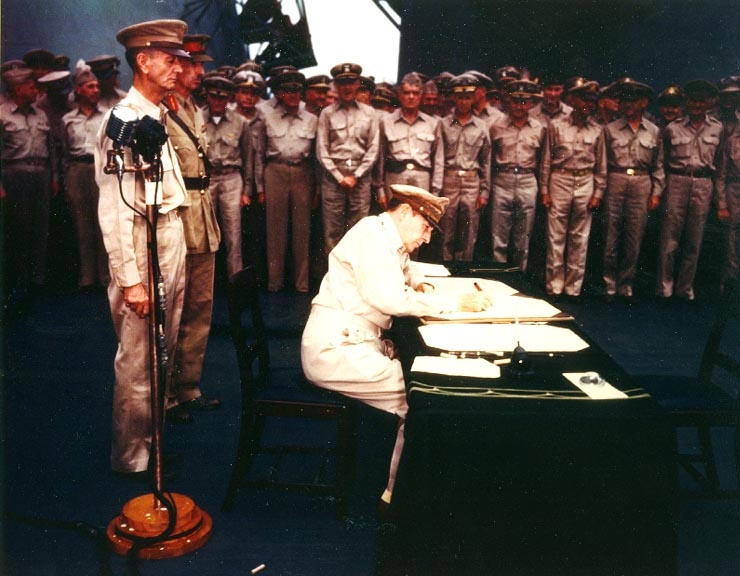
U.S. General Douglas McArthur signs the Japanese Instrument of Surrender on board USS Missouri, on September 2, 1945.

Contrary to views that the concept of not having a standing army is foolish, the Japanese constitution rested its future on a functioning United Nations to fulfill its responsibility for collective defense; in other words, the UN would provide the "force" needed to begin a new system in which nations meeting and working together would be able to head off conflicts such as those that had led to two world wars.
Japan, a warmonger of a nation that had trampled across much of Asia and the Pacific rim, leaving up to 20 million dead, including an estimated two million of its own, was transformed by an eight-year program.
The Japanese people fell in love with peace.
From cigarettes named "Peace" and "Hope" to a complete cultural change, Japan rebuilt itself, and set an example to a war-weary world that, in fact, national prosperity could be accomplished without violence.
In return, the United States guaranteed peace and stability in Japan, Korea and to a lesser degree in various areas of the Pacific, in place of a not-yet-functioning United Nations.
In each country, the host-nation pays the costs of the US military, and it is less expensive for American taxpayers to have troops stationed overseas than in the US. The rewards in trade have far outweighed the costs.
A new U.S. Secretary of State, Rex Tillerson, perhaps unintentionally suggested upsetting this arrangement, which has worked so well for so many years. According to reports, Tillerson "refused to rule out increased weaponization and even nuclearization of America's East Asian allies to deter North Korean aggression."
The absolute worst possible thing to happen in a finally peaceful Asia would be a nuclear arms race to rekindle the flames of the past.
Nearly a half million brave Americans and many Japanese gave their lives in World War II: the world has had 70 years of peace and prosperity. It is to their memory and the many who suffered so terribly that the world owes a debt of gratitude.
On the 70th anniversary of the most precious gift America could give to Japan, which she fed, clothed and rebuilt, is the time to reaffirm the role of America as the guardian, the "United Nations", whose role is to keep alive freedom in the world.
Amir George, based in Japan, is author of the book, "Liberating Iraq."

© 2017 Gatestone Institute. All rights reserved. The articles printed here do not necessarily reflect the views of the Editors or of Gatestone Institute. No part of the Gatestone website or any of its contents may be reproduced, copied or modified, without the prior written consent of Gatestone Institute.

Monday, December 7, 2015

How Much More Damage Can Obama Do In The Last Year Of His Presidency. He Has Yet To "Fundamentally Change" America And That IS Coming

Obama Has Just Begunby VICTOR DAVIS HANSON November 24, 2015 4:00 AM @VDHANSON 

How much damage can he do in his last year in office? 

Insidiously and inadvertently, Barack Obama is alienating the people and moving the country to the right. If he keeps it up, by 2017 it will be a reactionary nation. But, counterintuitive as it seems, that is fine with Obama: Après nous le déluge.

 By sheer force of his personality, Obama has managed to lose the Democratic Senate and House. State legislatures and governorships are now predominantly Republican. Obama’s own favorable ratings rarely top 45 percent. In his mind, great men, whether Socrates or Jesus, were never appreciated in their time. So it is not surprising that he is not, as he presses full speed ahead. 

Obama certainly has doubled down going into his last year, most recently insisting on letting in more refugees from the Middle East, at a time when the children of Middle Eastern immigrants and contemporary migrants are terrorizing Europe. What remaining unpopular executive acts might anger his opponents the most? Close down Guantanamo, let thousands more refugees into the United States, free thousands more felons, snub another ally, flatter another enemy, weigh in on another interracial melodrama, extend amnesty to another million illegal aliens, make global warming laws by fiat, expand Obamacare, unilaterally impose gun control? In lieu of achievement, is the Obama theory to become relevant or noteworthy by offending the public and goading political enemies?

 An Obama press conference is now a summation of all his old damn-you clichés — the fantasy strawman arguments; the caricatures of the evil Republican bogeymen; the demagogic litany of the sick, the innocent, and the old at the mercy of his callous opponents; the affected accentuation (e.g., Talîban; Pakîstan, ÃŽslám, Latînos, etc.) that so many autodidacts parade in lieu of learning foreign languages; the make-no-mistake-about-it and let-me-be-clear empty emphatics; the flashing temper tantrums; the mangled sports metaphors; the factual gaffes; and the monotonous I, me, my, and mine first-person-pronoun exhaustion. What Obama cannot do in fact, he believes he can still accomplish through invective and derision. 

Getting under his critics’ skin is about all that is left of a failed presidency. In the 2016 election campaigns, most Democratic candidates in swing states will have distanced themselves from the last eight years. Otherwise, they would have to run on the patently false premise that American health care is more affordable and more comprehensive today than it was in 2009; that workforce participation is booming; that scandals are a thing of the past; that the debt has been addressed; that Obama has proved a healer who brought the country together; that immigration at last is ordered, legal, and logical; that the law has never been more respected and honored; that racial relations are calmer than ever; that the campuses are quiet; that the so-called war on terror is now over and won with al-Qaeda and ISIS contained or on the run; that U.S. prestige aboard has never been higher; that our allies appreciate our help and our enemies fear our wrath; that Iran will now not go nuclear; that Israel is secure and assured of our support; and that, thanks to American action, Egypt is stable, Libya is ascendant, Iraq is still consensual, and the Middle East in general is at last quiet after the tumultuous years of George W. Bush.

 The hordes of young male migrants abandoning the Middle East for the West are merely analogous to past waves of immigrants and should be uniformly welcome. For Obama,  there is no connection between them and his slashing of American involvement in the Middle East — much less any sense of responsibility that his own actions helped produce the crisis he now fobs off on others. 

If an American president saw fit to attack fellow Americans from abroad, and lecture them on their illiberality, there are better places from which to take such a low road than from Turkey, the embryo of 20th-century genocide, and a country whose soccer crowds were recently shouting, “Allahu akbar!” during what was supposed to be a moment of silence offered to the Paris dead. Surely an American president might suggest that such grassroots religious triumphalism about mass death is much more reprehensible behavior than are his own fellow citizens’ demands to vet the backgrounds of refugees.

If you suggested to Obama that, in his search for a contrarian legacy, he should do something to stop the slaughter in the Middle East and be careful about letting in more unexamined refugees, in answer, he would be more likely to do less than nothing abroad and vastly expand the influx of migrants. Getting under his critics’ skin is about all that is left of a failed presidency.

 Many of our observers still do not quite grasp that Obama will end his presidency by seeking to get his opponents’ goat — and that his resentment will lead to some strange things said and done.

Few foresaw this critical element of the Obama character. The tiny number of prescient pundits who warned what the Obama years would entail were not the supposedly sober and judicious establishment voices, who in fact seemed to be caught up in the hope-and-change euphoria and missed entirely Obama’s petulance and pique: the Evan Thomases (“he’s sort of god”), or the David Brookses (“and I was looking at his pant leg and his perfectly creased pant, and I’m thinking, a) he’s going to be president and b) he’ll be a very good president.” “It is easy to sketch out a scenario in which [Obama] could be a great president.”), or the Chris Matthewses (“the feeling most people get when they hear Barack Obama’s speech. My, I felt this thrill going up my leg. I mean, I don’t have that too often.”), or the Michael Beschlosses (“Uh. I would say it’s probably — he’s probably the smartest guy ever to become President.”), or the Chris Buckleys (“He has exhibited throughout a ‘first-class temperament,’ pace Oliver Wendell Holmes Jr.’s famous comment about FDR. As for his intellect, well, he’s a Harvard man”), or the Kathleen Parkers (“ . . . with solemn prayers that Obama will govern as the centrist, pragmatic leader he is capable of being”), or the Peggy Noonans (“He has within him the possibility to change the direction and tone of American foreign policy, which need changing; his rise will serve as a practical rebuke to the past five years, which need rebuking; his victory would provide a fresh start in a nation in which a fresh start would come as a national relief.”). 

Obama feels liberated now that he is free from further elections. He thinks he has a legitimate right to be a bit vindictive and vent his own frustrations and pique. In truth, it was the loud, sometimes shrill, and caricatured voices of talk radio, the so-called crazy Republican House members, and the grassroots loudmouths of what would become the Tea Party who had Obama’s number. They warned early on that Barack Obama’s record was that of a petulant extremist, that his writing presaged that he would borrow and spend like no other president, that his past associations gave warning that he would use his community-organizing skills cynically to divide Americans along racial lines, that nothing in his past had ever suggested anything other than radicalism and an ease with divisive speech, that his votes as a state legislator and as a U.S. senator suggested that he had an instinctual dislike of the entrepreneur and the self-made businessman, and that his past rhetoric advised that he would ignore settled law and instead would rule by fiat — that he would render immigration law null and void, that he would diminish the profile of America abroad, and that he would do all this because he was an ideologue, with no history of bipartisanship but a lot of animus toward his critics, and one who saw no ethical or practical reason to appreciate the more than 60 years of America’s postwar global leadership and the world that it had built. Again, the despised right-wingers were right and the more moderate establishment quite wrong. 

Abroad, from Obama’s post-Paris speeches, it is clear that he is now bored with and irritated by the War on Terror. He seems to have believed either that Islamist global terror was a minor distraction with no potential for real harm other than to bring right-wingers in backlash fashion out of the woodwork, or that it was an understandably radical manifestation of what was otherwise a legitimate complaint of Islam against the Western-dominated global system — thus requiring contextualization rather than mindless opposition.

  A lot of ambitious and dangerous powers are watching Obama assume a fetal position, and may well as a consequence act foolishly and recklessly this next year. Not only Russia, China, and North Korea, but also Hamas, Hezbollah, Iran, ISIS, and assorted rogue states may take chances in the next 14 months that they would otherwise never have entertained (given that America is innately strong and they are mostly in comparison far weaker) — on the premise that such adventurism offers tangible advantages without likely negative consequences and that the chance for such opportunities will not present itself again for decades to come.

 At home, Obama feels liberated now that he is free from further elections. He thinks he has a legitimate right to be a bit vindictive and vent his own frustrations and pique, heretofore repressed over the last seven years because of the exigencies of Democratic electioneering. Obama can now vent and strike back at his opponents, caricaturing them from abroad, questioning their patriotism, slandering them for sport, and trying to figure out which emblematic executive orders and extra-legal bureaucratic directives will most infuriate them and repay them for their supposed culpability for his failed vero possumus presidency.

 The more contrarian he becomes, and the more he opposes the wishes of the vast majority of the American people, all the more Obama envisions himself speaking truth to power and becoming iconic of something rather than the reality that he is becoming proof of nothing.

 Hold on. We haven’t seen anything yet. —

 NRO contributor Victor Davis Hanson is a senior fellow at the Hoover Institution and the author, most recently, of The Savior Generals.

Read more at: http://www.nationalreview.com/article/427522/obamas-most-dangerous-year

Friday, January 2, 2015

The Threats Facing The US In 2015

Author(s):  Unknown
Source:  glennbeck.com.     Article date: December 30th, 2014


0
On last night’s Glenn Beck Program, Buck Sexton looked at the top ten threats according to the Council of Foreign Relations.
Here’s how the CFR’s list broke down:
1.    The intensification of the conflict in Iraq
2.   A large-scale attack on the U.S. homeland or ally
3.   A cyberattack on U.S. critical infrastructure
4.  A severe North Korean crisis
5.   The renewed threat of Israeli military strikes against Iran
6.   An armed confrontation in the South China Sea
7.  The escalation of the Syrian civil war
8.   Rising violence and instability in Afghanistan
9.   Increased fighting in eastern Ukraine
10.   Heightened Israeli-Palestinian tensions
Buck added the threat posed by America’s open borders, one that he believes will only intensify given this administration’s immigration policies.
“We definitely cannot forget about a major problem in 2015 that we’re 100% going to be dealing with, the border—still not secured, and given the administration’s policy, given the executive amnesty, it’s very likely to get worse, isn’t it? You see, many people fear America’s weakened borders means an increased likelihood of some kind of attack as well,” Buck said.
The Council of Foreign Relations website explained how they came up with the list:
This fall, CFR’s Center for Preventive Action (CPA) solicited suggestions from the general public on potential conflicts that could erupt or escalate next year. CPA narrowed down the nearly one thousand suggestions to the top thirty, and invited more than 2,200 government officials, academics, and foreign policy experts to rank them by their potential effects on U.S. interests and likelihood of occurring in 2015. CPA then categorized the scenarios into three tiers, in order of priority for U.S. leaders.

Saturday, November 30, 2013

Lessons Not Learned From Korean Debacle. Will Obama Learn Them Now In Iran?

North Korea Offers Lessons for Iran Nuclear Talks

Unknown - Unknown,  November 29th, 2013

Korean Central News Agency via Korean News Service
Recent negotiations on Iran’s nuclear program failed to reach a comprehensive agreement. U.S. Secretary of State John Kerry, however, remains determined to move forward despite congressional misgivings. These nuclear negotiations with Iran are reminiscent of North Korea and the Six-Party Talks.
It has been 10 years since the U.S., North Korea, South Korea, China, Japan, and Russia first sat at the negotiation table over Pyongyang’s nuclear program. However, the Six-Party Talks never achieved their aim of denuclearizing North Korea, since Pyongyang never implemented its commitments. North Korea has proposed coming back to the negotiating table but as an acknowledged nuclear state. Under those circumstances, the U.S. has no chance of achieving great success.
Bruce Klingner, Heritage senior fellow for Northeast Asia, was interviewed inThe Wall Street Journal and made four points regarding the lessons the U.S. should learn from its North Korean experiences:
  1. The U.S. should maintain sanctions while engaging in conditional diplomacy. The punitive measures should continue as long as the behavior that triggered them remains.
  2. The U.S. needs precise language in any agreement to not let its opponents take advantage of loopholes.
  3. There should be a requirement for vigorous verification measures to ensure compliance. This needs to include not only technical samplings but also short-notice challenge inspections of non-declared facilities.
  4. The U.S. needs to establish deadlines and consequences for failure to meet them.
In addition to these four points, the U.S. needs to ensure sufficient military defenses against the full spectrum of North Korean military threats. North Korea’s provocations, such as its nuclear tests and missile launches, show continually improving military capabilities. However, it seems that the U.S. does not consider North Korea or Iran as serious threats. The U.S. should ensure sufficient deterrence and not allow North Korea or Iran to gain advantage through diplomacy.
When negotiating, the U.S. should figure out how to deal with states that lack table manners. Otherwise, the U.S. could face yet another nuclear threat somewhere else in the world.Th