Contact Form

Name

Email *

Message *

Showing posts with label mideast peace. Show all posts

Friday, January 12, 2018

Is This The Opportunity For Mideast Peace?

Securing a Jewish Future in the West Bank Following Trump’s Jerusalem Declaration

By January 12, 2018


BESA Center Perspectives Paper No. 714, January 12, 2018
EXECUTIVE SUMMARY: The domestic and international outcry at President Trump’s recognition of Jerusalem as Israel’s capital suggests that Israel’s position in the West Bank is far from secure. If Israel wishes to secure a future for Jews in the West Bank, ordinary Palestinians there must also benefit from – and express their support for – coexistence with Jews.
President Trump’s recognition of Jerusalem as the capital of Israel roused euphoria in Zionist milieus. This euphoria was not justified. It is true that no new intifada has broken out, as Israel’s enemies had hoped one would. Still, Trump’s Jerusalem declaration might turn out to have been a Pyrrhic victory for Israel.
Since 1948, support for Israel has garnered overwhelming bipartisan support in the US and a near-unanimous consensus in the Jewish Diaspora. It should thus ring alarm bells that Trump’s recognition of the historical capital of the Jewish People drew outspoken opposition from leading Democratic politicians and Jewish communal leaders. If Israel can no longer rely on the head of the American Reform movement to advance its rights in Jerusalem, how will it overcome far stronger opposition when the time comes to defend Jewish interests in the West Bank?
Israel is perilously isolated. Except for the current tenant of the White House, Christian Zionists, and right-wing Jews, just about everybody else in the world seems to think a peace agreement between Israel and the Palestinians must be predicated on the mass expulsion of Jewish families who have been residing peacefully in the West Bank for three generations.
The recent brouhaha over Jerusalem highlights the strength of the international consensus on a solution to the conflict based on two states along 1967-equivalent borders. Even President Trump, the staunchest friend Israel has, made clear that his recognition of Jerusalem as Israel’s capital is not intended to determine the city’s boundaries in a future peace treaty. It is scarcely realistic to believe American diplomats will stand up for West Bank Jews against the whole world.
Those who think this does not matter are deluding themselves. It matters because Israeli leaders cannot count forever on Palestinian stupidity. Hamas, for instance, made a tremendous strategic blunder in using its foothold in Gaza to immediately declare jihad, build terror tunnels, and launch missiles in a bid to replace Israel with an Islamic state. Thanks to Hamas’s fanaticism, Israeli diplomats have persuaded key actors on the international stage that the status quo in the West Bank is tolerable and the time has not yet come for Palestinian statehood to be recognized.
Had Hamas thought pragmatically, it would have honored a long-term ceasefire in Gaza and refused to recognize the Oslo Accords with the politically savvy argument that it supports a binational state in the Holy Land rather than the two-state solution advocated by Israel and the Palestinian Authority. If Hamas had chosen that strategy, it is far from certain that the international community would today consider it a valid reason not to recognize Palestinian independence in the West Bank and East Jerusalem.
Unfortunately for Israel, Hamas can learn from its mistakes. There is no reason to assume it will be as foolhardy in the future as it has been so far. Israel must therefore brace itself for a future when international elites – not just foreign journalists and world public opinion – lay the brunt of the blame for the conflict on Israel’s presence in the West Bank.
It is essential that Israel justify Jewish residential rights in the West Bank primarily in terms of democracy and human rights rather than in Biblical language. But even if Israeli hasbara began to defend the rights of Jewish residents in the West Bank intelligently, just doing so would probably not suffice to secure a Jewish future in the area over the long run.
Forward-thinking Israelis such as Dr. Mordechai Kedar and Jewish Home leader Naftali Bennett have realized that Israel needs a long-term plan to secure its historical and security interests in the West Bank. Their recommendations to establish sovereign emirates in the West Bank and grant Israeli citizenship to Arabs in Area C is pragmatic and serves the material and security interests of both Israelis and Palestinians.
The shortcoming of these plans is their disregard for the need to secure Palestinian support. Without that support it will be very hard to counter charges that Kedar’s “emirates” are just Levantine Bantustans and that Bennett’s offer of “partial self-determination” to West Bank Palestinians amounts to permanent semi-apartheid.
The challenge for Israeli strategists is to secure Palestinian support for Jewish vital interests in the West Bank. Without it, the legitimacy of Israeli interests in this sphere will be near-zero, and not just in Brussels, Moscow, and Beijing, but in New York City and Washington DC as well. Indeed, only the acceptance by ordinary Palestinians of Israeli proposals will earn the Jewish State the overwhelming support of international elites and donor states – support that will be essential to compel the Palestinian leadership to give up its ambition of erasing Jewish life in the West Bank.
Naftali Bennett’s plan to offer Israeli citizenship to Palestinians residing in Area C is wise. However, for this move to be legitimized by the international community, it will need to reflect the wishes not only of Israeli leaders but of the approximately 100,000 Palestinians who will be affected. Bennett knows that the Palestinians living in Area C are torn between Arab-Islamic pride and fear and hatred of the Palestinian Authority. It is time for Israel to turn this situation into a win-win situation for everybody.
Israel should start to generously award work permits, scholarships, and preferential treatment rights in Israeli hospitals to Palestinians living in Area C. Furthermore, Israel should invest in the infrastructure and facilities available to Palestinians in Area C and raise them to a level comparable to neighboring Jewish communities.
The rationale behind these efforts is threefold: first, to (re)affirm the principle that Israel treats the people it rules equally; second, to demonstrate that Israeli rule in the West Bank cannot be labelled as apartheid; and third, to secure the support of Palestinians in Area C for Israel’s vital interests.
It would be a mistake to believe that if a referendum were now held in Area C most Palestinians would opt for Israeli citizenship. Decades of experience in East Jerusalem suggest that most Palestinians are too proud and patriotic to apply for Israeli citizenship. On the other hand, pride and patriotism do not prevent East Jerusalem Arabs from valuing Israeli salaries, national insurance, and unemployment benefits. Nor does it push them to murder Jews in droves as Fatah and Hamas incite them to do.
This suggests that many Palestinians are eager to find an avenue through which their honor and dignity can be reconciled with their self-interest. Israel must provide such an avenue if it wishes to secure a peaceful and prosperous future for both Israelis and Palestinians.
It is not realistic to hope that Palestinians living in the West Bank, or any substantial part of it, will endorse the plans of Kedar and Bennett in the near future. What is realistic, however, is to convince a majority of the Palestinians living in Area C that an improved status quo during an interim period of 10 years is preferable to ruinous subjugation to the Palestinian Authority.
In concrete terms, this means Israel should plan to hold referenda in Area C asking local residents to rank their preference among the following options:
  1. Palestinian Authority rule once a peace agreement between Israel and the Palestinian Authority is signed, with the subsequent loss of all Israeli economic and welfare benefits
  2. An interim period of 10 years with administrative autonomy, Israeli security, and guaranteed access to all economic and social rights awarded to Israeli citizens
  3. Israeli rule
Given sufficient Israeli savoir faire and the right incentives, it is probable that Area C residents would vote for the alternative that guarantees them a decade of social and economic progress. During that decade, Israel should make sure that Area C residents are rewarded for their loyalty and have excellent reasons to support option 3 in a second referendum a decade down the road.
Given free and democratic support from ordinary Palestinians in Area C for cooperation with Israel, the Palestinian Authority and Hamas will be discredited in their demands for a judenrein West Bank. This will pave the way for securing the peace and coexistence between Jews and Arabs in the West Bank that is the prerequisite for genuine peace between a sovereign Palestinian state and Israel.
Israel must seize the historic window of opportunity provided by an adamantly pro-Israel US administration, a weak and fragmented Arab and Muslim world, and Palestinian leaders who are corrupt, fanatical, and short-sighted, to engage ordinary Palestinians as peace partners.
It would be a critical mistake for Israeli leaders not to do so. The loud and powerful opposition to President Trump’s statement on Jerusalem clearly demonstrates that Israel will need the support of ordinary Palestinians for its interests in the West Bank to be recognized by the international community, the American establishment, and even by mainstream Diaspora Jews.
Rafael Castro is a Yale- and Hebrew University-educated political analyst based in Berlin. His pieces on Middle Eastern politics appear regularly on YNET. Rafael can be reached at rafaelcastro78@gmail.com.

Sunday, November 19, 2017

Two Dissimilar Men Make Durable Peace

Sadat and Begin – the Peacemakers

By November 19, 2017


BESA Center Perspectives Paper No. 645, November 19, 2017
EXECUTIVE SUMMARY: It is widely assumed that Menachem Begin and Anwar Sadat made peace despite their deep personal incompatibilities. But in fact, there were significant parallels in the lives of both men, and these may have facilitated their coming to an agreement. The similarities between them – their early careers in “underground” movements, their stints in prison, their struggles against the British and hatred of the Soviet Union, their years on the margins of power, and their clearly defined definitions of homeland – may have eased their final compromise.
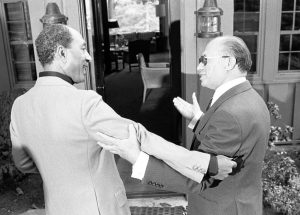
It is now thirty-eight years since the signing of the Israeli-Egyptian peace treaty, most famously evoked by the three-way handshake on the White House lawn that changed the Middle East. Israeli prime minister Menachem Begin and Egyptian president Anwar Sadat put war behind Israel and Egypt, and in so doing, ended the Israeli-Arab conflict. The Israeli-Palestinian conflict continues, and so too does the Israeli-Iranian struggle. But Israeli-Egyptian peace put an end to the destructive battlefield wars between Israel and Arab states of the kind that erupted in 1948, 1956, 1967, and 1973. Since the famous handshake among Begin, Sadat, and Jimmy Carter, there has been no battlefield war between Israel and a conventional Arab army. And Egypt and Israel now have been at peace longer than they were at war.
It has often been said of Begin and Sadat that the two men were like oil and water. “The two men were totally incompatible,” recalled Jimmy Carter, describing the Camp David negotiations that produced the treaty. “There was intense perturbation between them, shouting, banging on the tables, stalking out of the rooms. So for the next seven days, they never saw each other. And so we negotiated with them isolated from one another.”
Yet in a briefing paper prepared for the US team prior to the Camp David negotiations, these sentences appear: “Both Begin and Sadat have evidenced similar personal and national objectives throughout their familiar transformation from underground fighter to political leader. Despite their often vituperative comments, each should be able to recognize the other as a politician basically capable of change, compromise, and commitment.” The idea that the similarities between Begin and Sadat made peace possible has been elided in the interpretation of the negotiations that casts Jimmy Carter as hero.
This is no surprise. No two leaders could have seemed more different, and it is almost too easy to enumerate the contrasts. For starters, Anwar Sadat came from a poor village in the Nile Delta, a place of almost immemorial permanence. Begin came from the crumbling world of East European Jewry, later erased from the earth. Sadat was an Axis sympathizer during WWII. Begin’s parents and brother were murdered by the Nazis. Sadat made a career of the military, and even died in a military uniform. Begin was a civilian through and through. Americans found Sadat alluring and easy-going, a gregarious man in a leisure suit. They regarded Begin as rigid and ideological; one American official remarked that, even at Camp David, Begin was always dressed “as though he were about to go to a funeral.” Sadat was an authoritarian dictator who sent his opponents to prison. Begin was a classic liberal with a firm commitment to democracy and the rule of law.
But the similarities between the two are just as striking – perhaps even more so – and it may be precisely the personal parallels that brought them together at the crucial moment, and made the achievement of peace possible.
Marginal men
One obvious similarity is the one to which the US briefing paper alluded, in describing both as “underground fighters.” In fact, both entered politics through the back door, as conspirators who planned political violence and were steeled by long stints in political prison.
Sadat, as a young revolutionary, immersed himself in conspiratorial plots, both against the British (who then controlled Egypt) as well as against Egyptian leaders he regarded as collaborators. As a result, he found himself in and out of prison. In 1945, the twenty-seven-year-old Sadat and his friends decided to assassinate the on-and-off prime minister of Egypt, Nahhas Pasha. The group staked out Nahhas’s motorcade; one of the members threw a grenade, but it missed his car.
The group was disappointed. Eager to assassinate someone, they decided to kill the former finance minister, Amin Osman Pasha. This succeeded, and while Sadat was not the triggerman, he was tried as part of the conspiracy and was acquitted only after a lengthy trial.
Menachem Begin had the more famous “underground” career. He was first sent to prison during WWII by the Soviet secret police, the NKVD – an eight-month travail he recounted in his memoir White Nights. By then, he too had been initiated into a life of clandestine conspiracy – methods of operation he would bring with him to Palestine in the last days of the British Mandate.
There, at the age of thirty-one, he would rise to leadership of an underground organization, the Irgun. This group was responsible for the 1946 bombing of the King David Hotel in Jerusalem, which killed ninety-one persons. (Begin would always claim that a telephone call had been placed to warn that the bombs had been planted.) In 1947, Begin ordered the retaliatory hanging of two kidnapped British sergeants. Begin managed to stay underground throughout this campaign; the British never caught up with him.
Clandestine nationalist “underground” activity, involving violence against the British Empire and its collaborators, represented a clear parallel in the careers of Sadat and Begin. So, too, was their eclipse during their middle years, as the British Empire retreated from the Middle East and Egypt and Israel gained full independence. Both men spent many years on the political margins, overshadowed by domineering leaders who had a stronger grip on the imaginations of their peoples.
Sadat was a member of the Free Officers conspiracy in 1952, and was part of the cabal of young officers who overthrew the monarchy. But after Nasser emerged decisively as the leader, Sadat came to be regarded as the most colorless man in the ruling clique. He was socially conservative, rather more religious than his colleagues, and seemingly a bit less sophisticated because of his rural origins. He spent eighteen years in the shadow of Nasser, and became his number two only in the year before Nasser’s death. No one could have guessed, during Nasser’s long-running high-wire act, that Sadat would succeed him. (Sadat’s deferential posture may have spared his being purged by Nasser, who never considered him a threat.) When Sadat became president, he was fifty-two years old – the same age as Nasser at his death.
Begin languished even longer on the margins. The Zionist revolution was credited to David Ben-Gurion, the man associated most directly with Israel’s war of independence and institution-building. The Revisionists led by Begin would always claim to have played a crucial role in Israel’s struggle for independence, by their acts of resistance – some would call them terror – against the British and the Arabs. But this was a disputed narrative – put forward by Begin in his book The Revolt – and it failed to persuade the great majority of Israelis.
The evidence for this was the weak performance of Begin’s political party in Israeli elections. This left Begin a perpetual denizen of the opposition benches in the Israeli parliament. In a political landscape dominated by the Labor party, he spent decade after decade delivering speeches and doing little else.
His opening came only after the 1973 war, launched by Sadat, which finally precipitated a crisis of confidence in the Labor Party leadership and opened the door for Begin. (Here was a paradox: it was a decision of Sadat’s that cleared the way for Begin.) When Begin became prime minister in 1977, after leading his own party to defeat in eight election cycles, the world was astonished. He was sixty-four years old when he assumed the premiership.
Sadat and Begin thus spent decades in the shadow of men who effectively issued the declarations of independence of their countries. (Ben-Gurion actually declared Israel’s independence in 1948, and Nasser effectively declared Egypt’s independence by nationalizing the Suez Canal in 1956.) But neither of these giants had managed to bring peace to their peoples. Nasser drove Egypt to defeat in 1967, while Ben-Gurion, despite leading Israel to victories in 1948 and 1956, had been unable to translate military prowess into peace. This was true of his Labor Party successors as well. They left unfinished legacies, which provided the openings for Sadat and Begin.
Who dwell alone
Begin and Sadat also shared a strongly pro-Western, anti-Soviet orientation. Begin had been thrown into prison by the Soviets. Although it was the struggle against the Nazis that had formed him, his animosity towards the Soviet Union, while less in degree, was similar in kind. A champion of Jewish peoplehood first and foremost, he saw the Soviet Union as an oppressive regime of anti-Semitic evil. This was in contrast to many on the Israeli left at the time, who remembered the Soviet Union as the great ally of WWII and who persisted in admiring its (supposedly) socialist values.
Sadat shared this aversion to the Soviets. During Nasser’s years, Egypt aligned itself squarely with the Soviet Union, which became Egypt’s major arms supplier, financier of the Aswan Dam, and principal source of diplomatic backing. But Sadat never trusted the Soviets. He was certain they represented another form of colonialism, and that their policies were meant to keep Egypt subservient. He came to power as president in 1970, and already by 1972 he had expelled thousands of Soviet advisers whom he regarded as agents of a foreign empire, no different than the British of an earlier era. It would be his desire to align Egypt with the West – and particularly the US – that would set the stage for his decision to visit Jerusalem.
Both men also relied heavily on the technique of strategic surprise. Sadat had attempted, through his first few years in power, to achieve the return of the Sinai Peninsula to Egypt through back-channel diplomacy. He ultimately concluded that what had been taken by force could only be restored by force. That led him to the bold decision to launch war against Israel in October 1973, in cooperation with Syria. His war goals were limited: to compel Israel to come to the table and force the US to take Egypt seriously as its potential Arab partner.
The war produced just enough military success to be portrayed to the Egyptian people as a victory, so Sadat could claim to have achieved the battlefield triumph that had eluded Nasser. But to translate his (limited) military achievement into something more, there had to be a political move of comparable audacity. This would come in the form of his surprise decision to violate all the norms of Arab political conduct, and pay a visit to Israel. There he appeared in the Knesset, Israel’s parliament, and made a famous speech of reconciliation.
Begin also was given to the audacious act. Three of them marked his premiership. First, there was the decision to withdraw from all of Sinai, involving the demolition of Yamit, a large Jewish settlement there. It was the first time Israel had ever dismantled a settlement, and it came as a shock, especially to Begin’s admirers. Second, there was his decision in 1981 to bomb Iraq’s nuclear reactor – a complete surprise to the world, driven by an inner conviction that he was acting to save Israel. This was followed by his decision to invade Lebanon – a move intended by Begin to complement the peace with Egypt by remaking Israel’s strategic environment. Begin, like Sadat, could surprise both friends and adversaries with bold moves.
Both men were also driven by an almost isolationist nationalism. Nasser had placed Egypt squarely in the Arab circle: Egypt was to lead the Arab world, and Egyptians were first and foremost Arabs. In 1958, he even briefly subsumed Egypt into something called the United Arab Republic, which joined Egypt and Syria in a single polity. Sadat, in contrast, extricated Egypt from its Arab commitments. He regarded it as a civilization unto itself, so weighty that it could stand aloof and alone. Yes, it would engage in alliances and relationships with other Arab states, but Sadat was determined to put Egypt first, even if other Arabs might shun it.
Begin proceeded from a similar set of assumptions. The Jews were alone in the world, they were a people unto themselves, and they had been repudiated by East and West, even in those lands where they had been first emancipated. Begin did not regard this as tragedy, but as destiny. The Jews were destined to dwell alone, and he accepted the fact with equanimity. Here too, there would be alliances and relationships, but Israel did not belong to any larger club, and ultimately it could rely only upon itself. This set the stage for the bilateral agreement between two leaders seeking to isolate their peoples from the threats around them. (It also meant that the peace itself, as much as it was intended to reconcile Egypt and Israel, was also bound to isolate them from one another.)
The two men also had a shared concept of the territorial limits of peoplehood. For Sadat, Egyptian territory was sacred, and the Sinai was part of Egyptian territory. The commitment to the Palestinians, in contrast, was vague – diminished, in no small measure, by Egypt’s overall withdrawal from the Arab world. For Begin, the West Bank was sacred – not occupied territory, but Judea and Samaria, Israel’s patrimony. Yet the Sinai was foreign land. Had Begin been driven only by security considerations, he might have resisted withdrawal from the valuable strategic buffer represented by the Sinai. (Some of his advisers thought he should.) But his precise sense of where the Jewish homeland began and ended made possible an agreement based on a total Israeli withdrawal from the peninsula.
Triumph and tragedy
The saga of Camp David and the Israeli-Egyptian peace has been told many times. That Jimmy Carter faced a formidable challenge in bringing Sadat and Begin to an agreement is indisputable. Begin himself, in remarks that immediately followed negotiations, said the Camp David conference “should be renamed the Jimmy Carter conference.”
But the parallels in the lives of Sadat and Begin may have worked, in ways subtle but strong, in favor of an agreement. Here were two men forged by prison and violence into believers in their own destiny, but who had been written off politically for decades. By the time they came to power, they were in a hurry to achieve something that would transcend the legacies of their celebrated predecessors. Here were two men who believed their peoples were fated to struggle alone, but who were prepared to go to extraordinary lengths to cement relations with the US, in the interests of their peoples but also in order to shut the Soviet Union out of the Middle East. Here were two men who did not shy away from the bold gamble, and who actually saw a greater risk in inaction. And above all, here were two men possessed not only by a strong sense of peoplehood, but of its geography, which they conceived in ways that left no overlapping territorial claims.
There is one more parallel. Both men finished their lives tragically. Sadat was assassinated in 1981 on the reviewing stand during the annual celebration of Egypt’s October 6, 1973 military offensive. While world leaders attended his funeral, the Egyptian crowds stayed home, and so too did Arab leaders. He died in splendid (personal) isolation, mirroring that which he brought upon Egypt. Begin also died in isolation—one he had imposed on himself after he resigned the premiership in 1983, in the wake of the Lebanon war. In the decade between his resignation and his death in 1992, he went into seclusion. He was buried, as he wished to be, not among Israel’s leaders on Mount Herzl, but on the Mount of Olives, and not in a state funeral, but in a simple Jewish ceremony.
For many Egyptians, Sadat’s achievement in war was tainted by an ill-conceived peace. For many Israelis, Begin’s achievement in peace was tainted by an ill-conceived war. The two men who, with Jimmy Carter, shared the world’s stage on March 26, 1979 to thundering accolades departed this earth to mixed reviews.
But the peace treaty has turned out to be the most durable feature of the Middle Eastern landscape, and the bedrock on which the stability of the region rests. Two “incompatible” men forged it – perhaps because, ultimately, they were so much alike.
Dr. Martin Kramer is founding president emeritus of Shalem College in Jerusalem and the Koret Visiting Fellow at the Washington Institute for Near East Policy.

Tuesday, August 15, 2017

Hamas Tactics And Hate Show Up In Charlottesville

  • Although Hamas, the terrorist organization that rules the Gaza Strip, is shunned by U.S. negotiators, Fatah, the party headed by Palestinian Authority (PA) President Mahmoud Abbas, is considered a potential partner for peace with Israel.
  • Official Fatah social media pages, however, openly laud and encourage "lone wolves" to arm themselves with knives and vehicles with which to slaughter Israelis whenever and wherever possible.
  • Abbas and his henchmen in the PA do not allow freedom of expression. They do not "weep" over the "thuggish" and "deliberately murderous" conduct of their populace. Instead, they champion it and fund it. A Palestinian who uses his car as a deadly weapon is viewed by his peers and rulers as a hero. Physical violence is officially sanctioned and rewarded. An American who commits violence is demonized by everyone other than a handful of hard-core bigots.
A day before the car-ramming attack in Charlottesville, Virginia -- which left 32-year-old Heather Heyer dead and 19 others wounded -- the White House announced that it would be dispatchingPresident Donald Trump's son-in-law and special adviser, Jared Kushner, Special Adviser on International Affairs Jason Greenblatt, and Deputy National Security Adviser for Strategy Dina Powell to the Middle East for the second time since June.
The stated purpose of their trip, the scheduled date of which has yet to be disclosed, is to revive the peace process between Israel and the Palestinian Authority (PA). Justifiably, the Trump administration's declaration that it would resume efforts to broker negotiations between Jerusalem and Ramallah was drowned out by the events in Charlottesville.
The act of domestic terrorism, committed by 20-year-old James Alex Fields Jr. of Ohio, mimicked a choice method employed by Palestinian organizations Hamas and Fatah in Israel, and ISIS in Europe. The car-ramming so horrified the American public that it instantly became the key issue of the day, with candlelight vigils and memorials held across the country -- indicating mass consensus that such abhorrent behavior is anathema to American values and will not be tolerated.

James Alex Fields rams his car into a crowd of "antifa" marchers in Charlottesville, Virginia, on August 12. (Image source: Al Jazeera video screenshot)

The otherwise universal condemnation of the Charlottesville clashes between the "Alt-Right" and extreme "Antifa" (short for anti-Fascist) movements -- sparked by the city's decision to remove a statue of Civil War Confederate General Robert. E. Lee from Emancipation Park -- has, however, been clouded in two points of controversy.
One involves the fact that, while dubbed "Unite the Right," the protest was actually a gathering of neo-Nazis, Ku Klux Klan members and other racists, xenophobes and anti-Semites -- most, it turned out, imported from out-of-state.
Although the sight of their angry faces and banners was reminiscent of the Old South, it was being attributed to the current climate, ostensibly created by the Republican Party, conservatives in general, and Trump in particular.
The other controversy surrounds the wording of Trump's denunciation of the "many sides" of the violence.
Conservatives promptly dissociated themselves from the Charlottesville bullies, but simultaneously took Trump to task for not exhibiting the same moral outrage towards the white supremacists that he expresses against "radical Islamic terrorism."
On the Left, columnists went even further, blaming not only Trump but the United States itself for the climate that led to the events in Virginia.
In Politico, for example, Joshua Zeitz argued that "What Happened in Charlottesville Is All Too American."
To put things in perspective, however, conservative (and Jewish) political commentator Ben Shapiro -- whose own criticism of Trump has turned him into a target of anti-Semitic vilification on the web -- explained that the "Alt-Right" is neither "conservative" nor particularly widespread in America, in spite of its trying to create the impression that it is growing exponentially.
"They fill up comments sections at sites like Breitbart, and they email spam, and they prank call people, and they live on 4chan boards, but the vast majority of alt-right anti-Semitic tweets came from just 1,600 accounts," Shapiro wrote, citing Anti-Defamation League (ADL) statistics.
In a separate report, the ADL listed examples of events held by white supremacists to mobilize and spread a culture of hatred, yet referred to them as a "fringe movement."
This is not simply due to their relatively infinitesimal numbers in the United States, but to American culture as a whole, which is overwhelmingly liberal.
Well before college, children in the U.S. are treated to heavy doses of progressive ideas in their schools and on television. It is not racism and xenophobia with which they have been bombarded, particularly in the last decade, but rather with "identity politics." American kids are taught to respect people of different ethnic backgrounds, religious affinities, gender identities and sexual preferences -- as long as those meet "victimhood" criteria.
They are told that "white privilege" is an evil to be eradicated. In this context, "white" is a misnomer, of course, because Jews and Asians who excel in school are included in the derogatory category. Still, the principle is understood, and it both emanates from and is disseminated by left-wing groups.
It therefore beggars belief that the most vocal supporters of the Palestinian Authority -- an entity whose leadership purposely fosters a culture of hatred, racism, gender-abuse and anti-Semitism – hail from those same groups.
On August 13, a day after the Charlottesville travesty, convicted Palestinian terrorist Rasmea Odeh was honored in Chicago. Odeh, who in 1969 placed a bomb in a Jerusalem supermarket, killing two innocent people and wounding nine, and days later carried out an attack on the British Consulate, was released from Israeli prison as part of a prisoner swap in 1980. In March 2017, she was convicted in the United States of immigration fraud, for lying about her past to U.S. authorities. A plea deal, however, is enabling her to travel to Jordan, without serving any time behind bars.
Odeh emerged as a hero of many Americans. She led the anti-Trump Women's March on Washington and served as a key figure in the March 8, 2017 "Global Women's Strike."
She is also celebrated in the Palestinian Authority, an entity whose leadership fosters a culture of hate against Jews, Christians and the West in general. As has been extensively documented by Palestinian Media Watch, PA schools and summer camps educate children to believe not only that that murdering on behalf of the "liberation of Palestine" -- and in the name of Allah -- is honorable, but worthy of glorification. PA imams preach jihad. PA sports arenas and tournaments are named after "martyred" terrorists, all of whose families receive a monthly salary of more than $3,000 per month for life, courtesy of the American taxpayer -- a beneficence that led this month to the Taylor Force Act, approved by the Senate Foreign Relations Committee, to stop incentivizing PA murder by stopping the payments for it.
Although Hamas, the terrorist organization that rules the Gaza Strip, is shunned by U.S. negotiators, Fatah, the party headed by PA President Mahmoud Abbas, is considered a potential partner for peace with Israel.
Official Fatah social media pages, however, openly laud and encourage "lone wolves" to arm themselves with knives and vehicles with which to slaughter Israelis whenever and wherever possible.
Trump has expressed "confidence" that a deal can be reached, and is sending his team to the region again for yet another try at bringing both sides of the conflict to the table.
Kushner, however, told a group of congressional interns that "there may be no solution" to the conflict. Short of wiping Israel off the map, which the PA does in every cartographic depiction of the "state of Palestine," there certainly will be no solution in the foreseeable future.
Nevertheless, many Americans continue to repeat what Abbas regularly feeds the international community: that the "Israeli occupation" is at the root of Palestinian terrorism. For internal consumption, however, Abbas has made it clear, in word and deed, that Israel's very establishment in 1948 is what all Arabs should consider the real "catastrophe." This is why he laughably announced that he would sue the UK for the Balfour Declaration, a letter sent 100 years ago to the head of the Jewish community in Britain expressing support for a Jewish homeland in Palestine.
The majority of the Arab citizens of the Jewish state, who make up one-fifth of its population, not only know that Abbas totally distorts history to keep a stranglehold on his people and maintain status at the United Nations, but enjoy full rights as equal members of Israeli society. They have political parties and seats in the Knesset, hold seats on the Supreme Court, and are among the country's prominent academics, doctors, lawyers and other professionals. Israel is a liberal democracy, after all.
In America, two liberal organizations, the American Civil Liberties Union (ACLU) and the Rutherford Institute, defended the "constitutional and civil right" of the neo-Nazis and white supremacists to hold their rally in Charlottesville. When the free speech turned into illegal riots, however, the ACLU of Virginia stated:
"What happened... had nothing to do with free speech. It devolved into conduct against individuals motivated by hate that was initially thuggish, and ultimately, deliberately murderous. There will be a time to investigate, assign responsibility, and seek accountability, and we will be a voice in that process. For now, we decry white nationalism, reject hatred, and weep."
Abbas and his henchmen in the PA, in contrast, do not allow freedom of expression. They do not "weep" over the "thuggish" and "deliberately murderous" conduct of their populace; instead, they champion and fund it. A Palestinian who uses his car as a deadly weapon is viewed by his peers and rulers as a hero. Physical violence is officially sanctioned and rewarded. An American who commits violence is demonized by everyone other than a handful of hard-core bigots.
Still, many in the U.S. consider America to be a racist country and the Palestinians worthy of stalwart support. This is the true meaning of what George Orwell called "doublethink" -- the "power of holding two contradictory beliefs in one's mind simultaneously, and accepting both of them."
On the eve of team Trump's imminent visit to Israel and the Palestinian Authority, let us hope that Washington is not becoming similarly afflicted.
Ruthie Blum is the author of "To Hell in a Handbasket: Carter, Obama, and the 'Arab Spring.'"
© 2017 Gatestone Institute. All rights reserved. The articles printed here do not necessarily reflect the views of the Editors or of Gatestone Institute. No part of the Gatestone website or any of its contents may be reproduced, copied or modified, without the prior written consent of Gatestone Institute.