Contact Form

Name

Email *

Message *

Showing posts with label scabies. Show all posts

Friday, July 14, 2017

The Added Benefit Of Having Millions Of Migrants--Is This What Americans Want?

  • A new report by the Robert Koch Institute (RKI), the federal government's central institution for monitoring and preventing diseases, confirms an across-the-board increase in disease since 2015, when Germany took in an unprecedented number of migrants.
  • Some doctors say the actual number of cases of tuberculosis is far higher than the official figures suggest and have accused the RKI of downplaying the threat in an effort to avoid fueling anti-immigration sentiments.
  • "Around 700,000 to 800,000 applications for asylum were submitted and 300,000 refugees have disappeared. Have they been checked? Do they come from the high-risk countries?" — Carsten Boos, orthopedic surgeon, interview with Focus magazine.
A failed asylum seeker from Yemen who was given sanctuary at a church in northern Germany to prevent him from being deported has potentially infected more than 50 German children with a highly contagious strain of tuberculosis.
The man, who was sheltered at a church in Bünsdorf between January and May 2017, was in frequent contact with the children, some as young as three, who were attending a day care center at the facility. He was admitted to a hospital in Rendsburg in June and subsequently diagnosed with tuberculosis — a disease which only recently has reentered the German consciousness.
Local health authorities say that in addition to the children, parents and teachers as well as parishioners are also being tested for the disease, which can develop months or even years after exposure. It remains unclear if the man received the required medical exams when he first arrived in Germany, or if he is one of the hundreds of thousands of migrants who have slipped through the cracks.
The tuberculosis scare has cast a renewed spotlight on the increased risk of infectious diseases in Germany since Chancellor Angela Merkel allowed in around two million migrants from Africa, Asia and the Middle East.
A new report by the Robert Koch Institute (RKI), the federal government's central institution for monitoring and preventing diseases, confirms an across-the-board increase in disease since 2015, when Germany took in an unprecedented number of migrants.
The Infectious Disease Epidemiology Annual Report — which was published on July 12, 2017 and provides data on the status of more than 50 infectious diseases in Germany during 2016 — offers the first glimpse into the public health consequences of the massive influx of migrants in late 2015.
The report shows increased incidences in Germany of adenoviral conjunctivitis, botulism, chicken pox, cholera, cryptosporidiosis, dengue fever, echinococcosis, enterohemorrhagic E. coli, giardiasis, haemophilus influenza, Hantavirus, hepatitis, hemorrhagic fever, HIV/AIDS, leprosy, louse-borne relapsing fever, malaria, measles, meningococcal disease, meningoencephalitis, mumps, paratyphoid, rubella, shigellosis, syphilis, toxoplasmosis, trichinellosis, tuberculosis, tularemia, typhus and whooping cough.
Germany has — so far at least — escaped the worst-case scenario: most of the tropical and exotic diseases brought into the country by migrants have been contained; there have no mass outbreaks among the general population. More common diseases, however, many of which are directly or indirectly linked to mass migration, are on the rise, according to the report.
The incidence of Hepatitis B, for example, has increased by 300% during the last three years, according to the RKI. The number of reported cases in Germany was 3,006 in 2016, up from 755 cases in 2014. Most of the cases are said to involve unvaccinated migrants from Afghanistan, Iraq and Syria. The incidence of measles in Germany jumped by more than 450% between 2014 and 2015, while the number of cases of chicken pox, meningitis, mumps, rubella and whooping cough were also up. Migrants also accounted for at least 40% of the new cases of HIV/AIDS identified in Germany since 2015, according to a separate RKI report.
The RKI statistics may be just the tip of the iceberg. The number of reported cases of tuberculosis, for example, was 5,915 in 2016, up from 4,488 cases in 2014, an increase of more than 30% during that period. Some doctors, however, believe that the actual number of cases of tuberculosis is far higher and have accused the RKI of downplaying the threat in an effort to avoid fueling anti-immigration sentiments.
In an interview with Focus, Carsten Boos, an orthopedic surgeon, warned that German authorities have lost track of hundreds of thousands of migrants who may be infected. He added that 40% of all tuberculosis pathogens are multidrug-resistant and therefore inherently dangerous to the general population:
"When asylum seekers come from countries with a high risk for tuberculosis infections, the RKI, as the highest German body for infection protection, should not downplay the danger. Is a federal institute using political correctness to conceal the unpleasant reality?
"The media reports that in 2015, the federal police registered about 1.1 million refugees. Around 700,000 to 800,000 applications for asylum were submitted and 300,000 refugees have disappeared. Have they been checked? Do they come from the high risk countries?
"One has the impression that in the RKI the left hand does not know what the right one is doing."

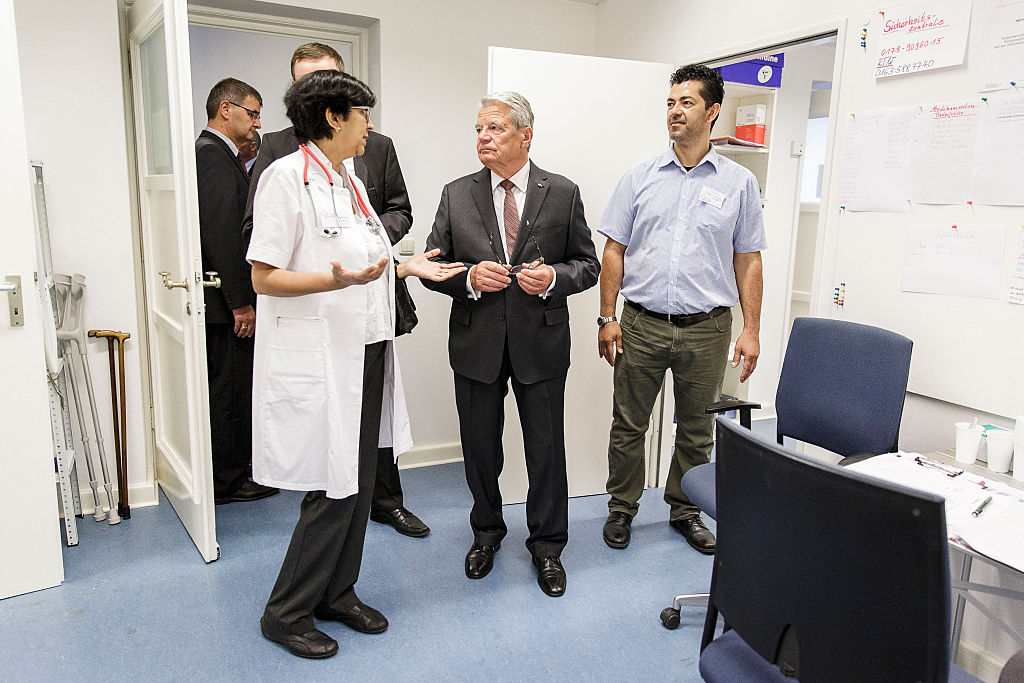
Joachim Gauck, then Germany's president, speaks to doctors in the infirmary of a reception center for migrants on August 26, 2015 in Berlin-Wilmersdorf, Germany. (Photo by Jesco Denzel/Bundesregierung via Getty Images)

German newspapers have published a flurry of articles about the public health dimension of the migrant crisis. The articles often quote medical professionals with first-hand experience of treating migrants. Many admit that mass migration has increased the risk of infectious diseases in Germany. Headlines include:
"Refugees Often Bring Unknown Diseases to the Host Country"; "Refugees Bring Rare Diseases to Berlin"; Refugees in Hesse: Return of Rare Diseases"; "Refugees Often Bring Unknown Diseases to Germany"; "Experts: Refugees Bring 'Forgotten' Diseases"; "Three Times More Hepatitis-B Cases in Bavaria"; "Cases of Tapeworm in Germany Increased by More than 30%"; "Infectious Disease: Refugees Bring Tuberculosis"; "Tuberculosis in Germany is on the Rise Again, Especially in the Big Cities: Caused by Migration and Poverty"; "Refugees Are Bringing Tuberculosis"; More Diseases in Germany: Tuberculosis is Back"; "Medical Practitioner Fears Tuberculosis Risk due to Refugee Wave"; "Significantly More Tuberculosis in Baden-Württemberg: Migrants often Affected"; "Expert: Refugee Policy to Blame for Measles Outbreak"; "Scabies on the Rise in North Rhine-Westphalia"; "Almost Forgotten Diseases Like Scabies Return to Bielefeld"; "Do You Come into Contact with Refugees? You Should Pay Attention"; and "Refugees: A Wide Range of Disorders."
At the height of the migrant crisis in October 2015, Michael Melter, the chief physician at the University Hospital Regensburg, reported that migrants were arriving at his hospital with illnesses that are hardly ever seen in Germany. "Some of the ailments I have not seen for 20 or 25 years," he said, "and many of my younger colleagues have actually never seen them."
Marc Schreiner, director of international relations for the German Hospital Federation (Deutschen Krankenhausgesellschaft), echoed Melter's concerns:
"In the clinics, it is becoming increasingly common to see patients with diseases that were considered to have been eradicated in Germany, such as scabies. These diseases must reliably be diagnosed, which is a challenge."
Christoph Lange, a tuberculosis expert at the Research Center Borstel, said that German doctors were unfamiliar with many of the diseases imported by migrants: "It would be useful if tropical diseases and other diseases that are rare in our lives played a bigger role in the training of physicians."
The German Society for Gastroenterology, Digestive and Metabolic Diseases recently held a five-day symposium in Hamburg to help medical practitioners diagnose diseases which are rarely seen in Germany. Those include:
  • Louse-borne relapsing fever (LBRF): During the past two years, at least 48 people in Germany were diagnosed with LBRF, a disease that was unheard of in the country before the migration crisis in 2015, according to the RKI report. The disease, which is transmitted by clothing lice, has been prevalent among migrants from East Africa who have been travelling for months to reach Germany on a single set of clothes. "We had all forgotten about LBRF," said Hans Jäger, a Munich-based doctor. "It has a mortality rate of up to 40% if it is not recognized and not treated with antibiotics. The symptoms are like in malaria: fever, headache, skin rash."
  • Lassa fever: In February 2016, a patient who had been infected in Togo, West Africa, was treated and died in Germany. After his death, a Lassa virus infection was confirmed in another person who had professional contact with the corpse of the deceased. The person was treated at an isolation facility and survived the disease. This was the first documented transmission of the Lassa virus in Germany.
  • Dengue fever: Nearly a thousand people were diagnosed with dengue fever, a mosquito-borne tropical disease, in Germany during 2016. This is up 25% from 2014, when 755 people were diagnosed with the disease.
  • Malaria: The number of people diagnosed with malaria jumped sharply in 2014 (1,007) and 2015 (1,063), but declined slightly in 2016 (970). Most of those affected contracted the disease in Africa, particularly from Cameroon, Ghana, Nigeria and Togo.
  • Echinococcosis: Between 2014 and 2016, more than 200 people in Germany have been diagnosed with echinococcosis, a tapeworm infection. This represents in an increase of around 30%. Those affected contracted the disease in Afghanistan, Bulgaria, Greece, Kosovo, Iraq, Macedonia, Morocco, Syria and Turkey.
  • Diphtheria: Between 2014 and 2016, more than 30 people in Germany have been diagnosed with diphtheria. Those affected contracted the disease in Ethiopia, Eritrea, Libya, Sri Lanka and Thailand.
  • Scabies: Between 2013 and 2016, the number of people diagnosed with scabies in North Rhine-Westphalia jumped by nearly 3,000%.
Meanwhile, Germany currently is in the throes of a measles outbreak that health authorities have linked to immigration from Romania. Around 700 people in Germany have been diagnosed with measles during the first six months of 2017, compared with 323 cases in all of 2016, according to the Robert Koch Institute. The measles outbreak has spread to all of Germany's 16 federal states except one, Mecklenburg-Vorpommern, a state with a very low migrant population.
The epicenter of the measles crisis is in North Rhine-Westphalia (NRW), Germany's most populous state and also the state with the highest number of migrants. Nearly 500 people have been diagnosed with measles in NRW during the first six months of 2017; most of the cases have been reported in Duisburg and Essen, where a 37-year-old mother of three children died from the disease in May. Outbreaks of measles have also been reported in Berlin, Cologne, Dresden, Hamburg, Leipzig, Munich and Frankfurt, where a nine-month-old baby was diagnosed with the disease.
On June 1, 2017, the German Parliament approved a controversial new law that requires kindergartens to inform German authorities if parents fail to provide evidence that they have consulted a doctor about vaccinating their children. Parents who refuse to comply face a fine of €2,500 ($2,850). "We cannot be indifferent to the fact that people are still dying of measles," saidGerman Health Minister Hermann Gröhe. "That's why we are tightening up regulations on vaccination."
Some say the new law does not go far enough; they are calling for vaccinations to be made compulsory for everyone in Germany. Others say the law goes too far and infringes on privacy protections guaranteed by the German constitution; they add that parents, not the government, should decide what is best for their children. The fallout from Chancellor Merkel's open-door migration policy continues.
Soeren Kern is a Senior Fellow at the New York-based Gatestone Institute. Follow him on Facebook and on Twitter.
© 2017 Gatestone Institute. All rights reserved. The articles printed here do not necessarily reflect the views of the Editors or of Gatestone Institute. No part of the Gatestone website or any of its contents may be reproduced, copied or modified, without the prior written consent of Gatestone Institute.

Thursday, December 10, 2015

The Very Big Downside To Accepting Syrian Refugees


image: http://www.wnd.com/files/2015/12/superbug.jpg
Tens of thousands of migrants pouring into Europe are bringing infections that will soon be untreatable.
Only a month after Chinese scientists reported finding a gene conveying resistance to a key antibiotic used by public-health officials as a last-resort drug against bacterial infections, the same mutation has been identified in Denmark.
Colistin, the most common polymyxin-class antibiotic, is used to treat bacterial infections that resist all other available antibiotics, reported New Scientist. The newly discovered resistant MCR-1 gene means bacteria that cause intestinal, urinary and blood infections in humans can now become “pan resistant” against all current antibiotics. The MCR-1 gene easily transfers among bacteria, and November’s concerns that it could soon go global have already been realized.
Danish researchers, analyzing their own database of bacterial DNA collected from people, animals and food, found one person with a blood infection carrying the same MCR-1 gene. MCR-1 was also found in five poultry samples from meat imported from Germany between 2012 and 2014. Additionally, Danish scientists reported the MCR-1 bacteria also carried genes making them resistant to penicillin and cephalosporins, two other widely used antibiotics.
“History shows that these mobile resistance genes can spread around the world quickly, silently riding in people, animals and food,” said Dr. Lance Price, head of George Washington University’s Antibiotic Resistance Action Center.
“We must act swiftly to contain the spread of colistin-resistant bacteria, or we will face increasing numbers of untreatable infections,” Price said.
The MCR-1 gene is believed to have arisen from antibiotic overuse in the livestock and poultry industries, particularly in China where colistin dosing is widespread and unregulated. According to New Scientist, 12,000 tons of colistin are fed to livestock every year, primarily to speed up growth and prevent infections in crowded pens and feedlots where bacteria can spread quickly.

The discovery in Denmark, with evidence of MCR-1 dating back to 2012 in Germany, is made worse by the recent massive influx of migrants from the Mideast.
Dr. Jan-Thorsten Gräsner, director of Germany’s Institute for Rescue and Emergency Medicine, said approximately five percent of the recent influx of asylum seekers – or about 75,000 newcomers – are bringing resistant germs with them, reported the Gatestone Institute.
German public-health officials are reporting the reappearance of diseases long absent for years.
Dr. Michael Melter, chief physician at University Hospital Regensburg, told Die Welt, “Some of the ailments I have not seen for 20 or 25 years,” he said, “and many of my younger colleagues have actually never seen them.”
Officials are watching for outbreaks of both bacterial and viral diseases, including Crimean Congo hemorrhagic fever, diphtheria, Ebola, hepatitis, HIV/AIDS, malaria, measles, meningitis, mumps, polio, scabies, tetanus, tuberculosis, typhus and whooping cough.

Marc Schreiner, director of international relations for the German Hospital Federation, echoed Melter: “In the clinics, it is becoming increasingly common to see patients with diseases that were considered to have been eradicated in Germany, such as scabies. These diseases must be reliably diagnosed, which is a challenge.”
In cases of highly contagious diseases, including tuberculosis, expensive quarantines are required. That process is made more difficult now by cultural differences that have seen migrants hostile and uncooperative with medical personnel and by the the latest emergence of antibiotic resistance.
The MCR-1 gene has not yet been found in North America, but researchers at the Centers for Disease Control and Prevention are now analyzing their databases to see if it has gone previously undetected. Colistin is not widely used in North American livestock operations, but as the Denmark experience demonstrates, that does not mean MCR-1 has not found its way here.
If resistance becomes widespread and bacterial infections cannot be treated with antibiotics, common infections and injuries could become fatal and risks for simple surgeries would increase, all made worse by a population of migrants introducing diseases that can no longer be treated.
Copyright 2015 WND

Read more at http://www.wnd.com/2015/12/resistance-to-last-resort-antibiotic-reaches-europe/#h28o9Pfiep7rlUpJ.99

Tuesday, September 23, 2014

Illegal Aliens Bringing Disease To The US. Why Are We Not Hearing About It?

Illegal Alien Disease Epidemic – Doctors And Nurses Gagged, Threatened With Arrest if They Talk


Share on FacebookTweet about this on TwitterShare on Google+Pin on PinterestShare on TumblrShare on Reddit
034-scabies-610
The message to doctors and nurses was simple; you talk, you go to jail. That message was delivered by officers of the government security contractors hired to police the Lackland Air Base illegal alien induction facility.
Some have spoken up anyway, because the risks are so great. They say the American taxpayers and citizens have a right to know what disease epidemic risk is being brought into our nation. They were interviewed confidentially by Todd Starnes of Fox News.
The secret nature of the process is itself of concern to the whistleblowers. One psychiatric counselor said, “There were several of us who wanted to talk about the camps, but the agents made it clear we would be arrested. We were under orders not to say anything.”
The security guarding the workers is provided by “Baptist Family & Children’s Services,” a contractor hired by HHS. They are referred to by themselves and others within the facility ominously as the “Brown Shirts.”
The counselor said “It was a very submissive atmosphere, once you stepped onto the grounds, you abided by their laws – the Brown Shirt laws.”
Upon entry to the facility all cell phones and other communication devices are confiscated and anyone caught with a phone is immediately terminated. She said, “Everyone was paranoid, the children had more rights than the workers.”
The infectious diseases that are still being brought in include measles, scabies, chicken pox and strep throat. Mental health and emotional conditions are also being diagnosed, and may or may not be treated.
The counselor described watching lice crawling down the hair of children she was attending to.
A former nurse calls it a “lice epidemic.” She said, “You could see the bugs crawling through their hair,” and added, “After we would rinse out their hair, the sink would be loaded with black bugs.”
That former nurse said, “We have so many kids coming in that there was no way to control all of the sickness – all this stuff coming into the country. We were very concerned at one point about strep going around the base.”
The counselor and the nurse both said the official position is to conceal the extent of the illnesses from the public.
The nurse describes how, “When they found out the kids had scabies, the charge nurse was adamant – ‘Don’t mention that. Don’t say scabies.’ But everybody knew they had scabies. Some of the workers were very concerned about touching things and picking things up. They asked if they should be concerned, but they were told ‘don’t worry about it.’”
Another problematic condition which concerned the nurse was the fact that the children were transported to Lackland on domestic charter buses and airplanes. Whatever conditions they have may have been left on the seats and other surfaces and could infect others.
The counselor noticed children who she recognized as being suicidal and recommended that they be sent to a psychiatric unit. Rather than treat one boy she pointed out, he was placed with a family in America.
It was at that point that she filed a Child Protective Services report and quit her job, concerned that her license was at risk if the child later committed suicide.
The counselor says she kept a detailed journal about what is going on inside the Lackland facility and remarked, “When people read that journal they are going to be astonished. I don’t think they will believe what is going on in America.”
She reports that she was later contacted by federal agents who demanded that she return to Lackland and surrender her journal to them. She refused to do so and has not returned to Lackland.
It is Cloward-Piven in action. The nurse expressed her belief that, “They’re going to crush the system. We can’t sustain this. They are overwhelming the system and I think it’s a travesty.”
Rick Wells is a conservative author who recognizes that our nation, our Constitution and our traditions are under a full scale assault from multiple threats. Please “Like” him on Facebook, “Follow” him on Twitter or visit www.rickwells.us

Friday, July 4, 2014

Illegal Immigrants Are Bringing Diseases With Them? Why Is The Government Not Stopping Them?

  • Text smaller
  • Text bigger
border-children
The establishment media’s refusal to acknowledge that once-contained or eradicated diseases are re-entering the U.S. through the latest flood of illegal aliens isn’t a surprise to Michael Savage, who earned a doctorate in epidemiology at the University of California at Berkeley before becoming a top nationally syndicated talk-radio host.
“What the liberal media is hiding from you can be dangerous for your safety, your security and your health,” he told his listeners.
After earning his doctorate in 1978 and writing six books, Savage pitched to publishers a book titled “Immigrants and Epidemics,” which he wrote with the dean of a “prestigious public health university.”
“Although all my previous books had done well,” Savage recalled, “all publishers in New York City in 1982 said we cannot publish a book on immigrants and epidemics, no matter how well (documented) or factually true it is. We can’t publish it for political reasons.”
The rejection angered him, he said, and was one of the reasons he eventually decided to go into talk radio, in 1994.
Since then, he said, “I’ve been trying to warn Americans about what unscreened immigrants will be bringing into America.”
‘You’re not going to hear this’
As thousands of illegal-alien children, prompted by President Obama’s policies, overwhelm the capacity of southern border states, Border Patrol agents who essentially have been turned into child caretakers are being exposed to disease, Savage said.
“Right now, you’re not going to hear this, but we have Tuberculosis, hand-foot-and-mouth disease, Chagas disease – previously eradicated from Southern California – on the rise and testing positive in … Border Patrol agents,” Savage said.
Other diseases emerging among Border Patrol agents, he said, include H1N1 Swine flu and chicken pox.
“The Border Patrol is being threatened with lawsuits and firing if they disclose this,” he said. “Congressmen are being turned away from the border as they go to investigate this surge of infected illegal aliens being thrown across the border at us.”
Speaking to his critics, Savage pointed to his academic qualifications.
“It’s easy for you to say I’m simply an alarmist or a racist, I’m a this-ist or a that-ist,” he said. “Well you’ve got it all wrong. The only “ist” I am is an epidemiologist. I am not a racist. I am not an alarmist. I am an epidemiologist by training.”
‘Next American revolution’
Savage called the border crisis an “invasion orchestrated in the White House for political reasons.”
It reached a flashpoint Tuesday when protesters blocked buses from transporting illegal-alien children from Central America to Border Patrol facilities in Murrieta, California, south of Los Angeles.
Savage sees the Murrieta protest as a seminal moment in which the “real America” said no to the government.
“It’s the beginning of the next American revolution,” he said. “This is not a joke. Take a look at their faces: Women, men, children holding signs ‘Stop illegal immigration.’”
Savage criticized House Minority Leader Nancy Pelosi for justifying the violation of law by emphasizing that “every person has a spark of divinity in them.”
“Sure, they have a spark of divinity,” Savage responded, but, he asked, “What kind of mothers would do to humans what they wouldn’t do to a dog?
“If you drop a dog off on the side of a street and run away, you’re considered a bad person; you could be arrested,” he said. “But the federal government has no problem with dropping children off on the side of a road?”
Savage asked if Americans really understand what will happen “when a soccer mom awakens one morning and her daughter’s hair is crawling with lice?”
“Do you understand what’s going to happen when she awakens one morning and her little darling comes home testing positive for Tuberculosis, because one of the divinely inspired children of Nancy Pelosi was permitted to enter that classroom with Tuberculosis?”
Failure to follow the Constitution
He rattled off a series of further questions:
  • “Do you know that your U.S. government officials can be arrested for refusing to protect Americans from the dangerous diseases that they are exposing us to?”
  • “Do you understand they are waging a war against conservative communities by bringing in whole populations of automatic Democrat voters, legal or illegal?”
  • “Do you understand that this is not ultra-tolerance for immigrants but a war against America?”
In his 2005 book “Liberalism is a Mental Disorder,” Savage noted in a chapter called “Alien invasion” that Republican President Ronald Reagan signed legislation allowing amnesty, which, according to most experts, made the illegal-alien problem worse.
“If you think it’s a problem that began with Obama, you’re mistaken,” Savage told his listeners Wednesday.
In his 2005 book, he noted that the U.S. Constitution requires the federal government to “protect each state against invasion.”
Both Republicans and Democrats are responsible, Savage said.
“Thanks to their failure to follow the Constitution with the same fervor with which they slavishly follow poll numbers,” he wrote, “our borders are more porous than your grandmother’s sieve.”