Egypt's Crucial Role in the Middle East
The presence of the Egyptian foreign minister in Israel last month came as a surprise to many. Critical Egyptian public opinion and the Egyptian media indicate that, in the years since the Israeli-Egyptian peace was signed, the formal agreement has yet to trickle into public consciousness and that there is still considerable suspicion on both sides of the border. The same is true of the peace between Israel and Jordan.
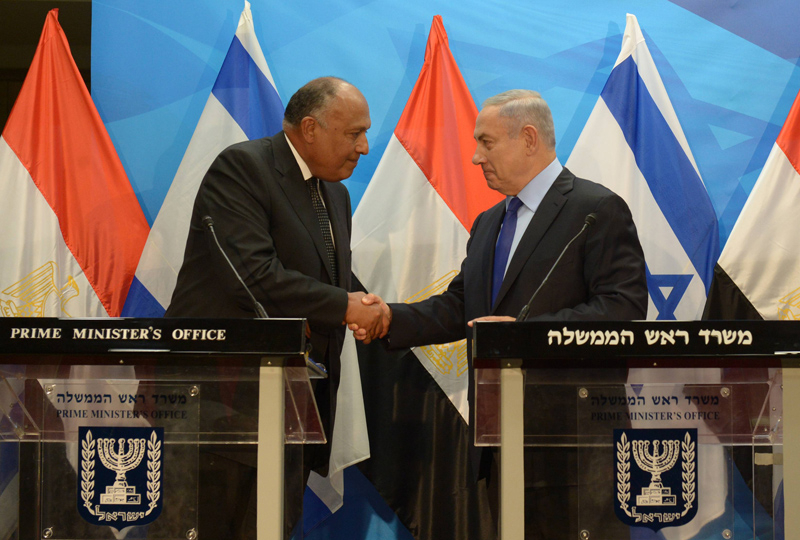
Under the reign of the Muslim Brotherhood's Mohamed Morsi, relations had reached a new low, with Egypt covertly aiding Iran's proxy, Hamas, against Israel. The visit of Egyptian Foreign Minister Sameh Shoukry to Israel in early July 2016 could be an indication that the frozen peace between Israel and Egyptians, signed by Begin and Sadat in 1979, might be thawing.[1] At the level of regional strategy, Egypt has a central role in the anti-Iran coalition of Sunni Arab states, which includes Saudi Arabia, Kuwait, Bahrain and the UAE. The violence of the Arab Spring brought to the fore the inevitable confrontation between a revisionist, aggressive Shi'ite Iran and the Arab countries deploying to defend themselves against Iranian aggression, mainly in Yemen, Syria, Iraq and Africa. Under such circumstances, even publicizing any kind of cooperation between Egypt and Israel indicates a thaw and could, for the benefit of the Arab and Muslim world, be the beginning of legitimizing bilateral relations. Shoukry's visit to Israel might even have been intended to pave the way for a broadening of relations with Israel and an avowal of the hitherto covert cooperation between many Arab and Muslim states and Israel.
However, given the current situation of Egypt's rapprochement with Israel and Russia, there might be a confrontation -- unfortunately with the United States. Even as the Iranians proceed with developing nuclear weapons and the ballistic missiles to carry them, and as they use incitement, weapons, money, and proxies to destabilize the Arab and Muslim states, the American shoulder grows colder towards both Israel and the el-Sisi government in Egypt. The current administration is known throughout the Middle East for empowering its enemies and being treacherous to its friends. We joke that is far better for a country to be America's enemy than its ally: it will then spend unlimited amounts of wealth and effort and wealth to woo you. It seems never to have met an enemy it did not like. Both Israel and Egypt regard Hamas as a terrorist organization because it collaborates with ISIS in the Sinai Peninsula and because it is the Palestinian branch of the Muslim Brotherhood, whose sole avowed purpose is globally to spread Islam. According to sources in Egypt, Israel deliberately leaked information about firepower and intelligence aid from the Israel Defense Forces (IDF) to the Egyptian forces operating in the Sinai Peninsula to use this "collaboration with the 'enemy'" to strengthen relations between the two countries. It is, however, in the interest of Arab and Muslim states to find a solution as soon as possible to get the Palestinian problem off the agenda, to be able to form a united front against Iran. It might even help to win if such a "strong horse" were included. The visit of Egypt's foreign minister to Jerusalem seemed a signal to the Palestinian Authority to lower its expectations. The traditional Arab stance, used by autocratic leaders to bamboozle their dissatisfied populace by pointing them at an external villain instead of at our own leaders, has clearly begun to change. Israel as the greatest enemy, is, intelligently for most of us in the Arab and Muslim world, being replaced by Iran. The visit to Israel also indicates that Hamas has weakened the Palestinian Authority's legitimacy and ability to maneuver, as it continues to present itself as an obstacle to a solution to the Israeli-Palestinian conflict and keeps Western countries busy with its marginal problems, preventing them from dealing with the genuinely critical regional issues. Like it or not -- and they could do worse -- at some point the Sunni Arab states would be wise to allow Israel into their trenches as they fight to the death against Iran. Bassam Tawil is a scholar based in the Middle East. [1] The last times Egyptian dignitaries visited in Israel was in 1995, when President Mubarak attended the funeral of Israeli Prime Minister Rabin, and later, when the Egyptian Foreign Minister Ahmad Maher visited Jerusalem and was attacked by Palestinians while he prayed in Al-Aqsa mosque.
© 2016 Gatestone Institute. All rights reserved. The articles printed here do not necessarily reflect the views of the Editors or of Gatestone Institute. No part of the Gatestone website or any of its contents may be reproduced, copied or modified, without the prior written consent of Gatestone Institute.
|
Our goal is to have intelligent discussion of the topics of the day. We realize everyone has their opinion and they should be allowed to express it in a discussion forum without calling each other names. We learn from discussion and not from name calling or argument.We use cookies to personalise content and ads, to provide social media features and to analyse our traffic. We also share information about your use of our site with our social media, advertising and analytics partners. See details
Contact Form
Showing posts with label sinai peninsula. Show all posts
Monday, August 15, 2016
America Giving Egypt And Israel The Cold Shoulder.
Friday, March 11, 2016
If One Thinks That Gaza Is A Pleasant Place With Peaceful People, You Are A Fool
Egypt Reports Gaza Tunnels Big Enough For Trucks
“To go into the clefts of the rocks, and into the crevices of the crags, from before the terror of the LORD, and from the glory of His majesty, when he ariseth to shake mightily the earth.” Isaiah 2:21 (The Israel Bible™)
image: http://www.breakingisraelnews.com/wp-content/uploads/2015/04/terror-tunnel-gaza-hamas.jpg

A view of a terror tunnel dug by Palestinian terrorists beneath the border between the Gaza Strip and Israel. (Photo: David Buimovitch/Flash90)
Egypt has discovered new tunnels connecting Gaza to its territory in the Sinai Peninsula, some purported to be several kilometers long and large enough to accommodate the passage of trucks.It is estimated there are dozens of such tunnels.
Ynet reported claims by the Egyptian government of finding weapons in the Sinai that were manufactured in Gaza. They included Hamas made rockets and Improvised Explosive Devices (IED) made from hot-water tanks filled with explosives that are capable of destroying a tank. Hamas is allied with Islamic State (ISIS) affiliated groups that are fighting Egypt in the Sinai with deadly effect.
Egypt has flooded the border with Gaza in an effective effort to prevent tunnels leading into Sinai. In 2014, Egypt established a buffer zone in an attempt to prevent such tunnels. At the time there were estimated to be approximately 1,200 tunnels, most of which have been destroyed. Flooding the buffer zone has led to several collapses and the deaths of Palestinians working on the tunnels, 13 since the beginning of the year.
Israel has not instituted a program to combat tunnels that are suspected to already be in place. The tunnels were used with deadly effect in the 2014 war when Israel destroyed more than 30 at the time.
A tunnel collapse on Thursday trapped eight Hamas militants, seven of whom were rescued while one remains missing. Members of Hamas’s Izzedine al-Qassam Brigades are beginning to refuse orders to dig underground tunnels as a result of the many deadly collapses, seven in recent months.
Hamas reported the tunnel as commercial, intended for smuggling goods however media sources report it as a military tunnel to link up with ISIS affiliated groups in the Sinai peninsula. Hamas has been accused of aiding the groups with personnel and supplies.
Israel has not instituted a program to combat tunnels that are suspected to already be in place. The tunnels were used with deadly effect in the 2014 war and Israel destroyed more than 30 at the time.
Such an effort is an enormous drain on Gaza’s limited resources and Hamas has been accused of misappropriating humanitarian resources intended for the reconstruction of the civilian infrastructure.
Read more at http://www.breakingisraelnews.com/63407/egypt-reports-gaza-tunnels-big-enough-for-trucks-terror-watch/#J3zDVxc1PDGwmmdS.99
Saturday, October 31, 2015
Sinai Where Plane Was Shot Down Is Contested Area. ISIS Claims Downing Of Russian Plane
ISIS affiliate in Egypt says downed Russian plane in Sinai; Moscow denies claim
CAIRO - A terrorist group affiliated to Islamic State in Egypt claimed responsibility for the downing of a Russian passenger plane that crashed in Egypt's Sinai peninsula on Saturday, the group said in a statement circulated by supporters on Twitter.
Egyptian security sources earlier on Saturday said early investigations suggested the plane, carrying 224 passengers and crew, crashed due to a technical fault.
The claim of responsibility was also carried by the Aamaq website which acts as a semi official news agency for Islamic State.
Egyptian security sources earlier on Saturday said early investigations suggested the plane, carrying 224 passengers and crew, crashed due to a technical fault.
The claim of responsibility was also carried by the Aamaq website which acts as a semi official news agency for Islamic State.
"The fighters of the Islamic State were able to down a Russian plane over Sinai province that was carrying over 220 Russian crusaders. They were all killed, thanks be to God," the statement circulated on Twitter said.
The downed Airbus A321, operated by Russian airline Kogalymavia under the brand name Metrojet, was flying from the Sinai Red Sea resort of Sharm el-Sheikh to St Petersburg in Russia when it went down in a desolate mountainous area of central Sinai soon after daybreak, the aviation ministry said.
Meanwhile, Russia's Minister of Transport Maxim Sokolov told the Interfax news agency that claims that the Russian airliner was shot down by terrorists "can't be considered accurate."
"Now in various media there is assorted information that the Russian passenger (plane)... was supposedly shot down by an anti-aircraft missile, fired by terrorists. This information can't be considered accurate," Interfax quoted him as saying.
A north Sinai security source said initial examination showed the crash was due to a technical fault, but gave no detail. The plane, he said, had landed in a "vertical fashion," explaining the scale of devastation and burning.
The Russian Embassy in Cairo said it had been told by Egyptian officials the pilot had been trying to make an emergency landing at El-Arish.
"I now see a tragic scene," an Egyptian security officer at the site told Reuters by telephone. "A lot of dead on the ground and many who died whilst strapped to their seats.
"The plane split into two, a small part on the tail end that burned and a larger part that crashed into a rock. We have extracted at least 100 bodies and the rest are still inside," the officer, who requested anonymity, said.
Egypt's prosecutor general has agreed to allow a Russian government agency to participate in investigating what caused the crash, state-owned newspaper Al-Ahram's website said.
The North Sinai prosecution office summoned air and ground traffic control officials for questioning over the incident, and ordered a technical team from the Civil Aviation Ministry to analyze the contents of the plane's black box, the newspaper added
Sinai is the scene of an insurgency by militants close to Islamic State, who have killed hundreds of Egyptian soldiers and police and have also attacked Western targets in recent months.
Russia, an ally of Syrian President Bashar Assad, launched air raids against opposition groups in Syria including Islamic State on Sept. 30. Security sources said there was no indication the Airbus had been shot down or blown up.
Subscribe to:
Posts (Atom)