Our goal is to have intelligent discussion of the topics of the day. We realize everyone has their opinion and they should be allowed to express it in a discussion forum without calling each other names. We learn from discussion and not from name calling or argument.We use cookies to personalise content and ads, to provide social media features and to analyse our traffic. We also share information about your use of our site with our social media, advertising and analytics partners. See details
Contact Form
Showing posts with label trump administration. Show all posts
Showing posts with label trump administration. Show all posts
California Rep. Maxine Waters is a rising star among the Left. Since President Donald Trump was elected in 2016, Waters has been a leading voice of the so-called “resistance” movement.
On Saturday, though, Waters crossed a line — and critics say she committed a felony.
Appearing at a charity toy drive, Waters grabbed a microphone and instructed her followers to attack and harass Trump administration officials everywhere they went.
“We want history to record that we stood up. That we pushed back,” Waters told an angry crowd. “That we fought. That we did not consider ourselves victims of this president. History will record that while he tried to step on all of us, we kicked him in his rear and we stepped on him.”
“The message has to be, ‘Mr. President, we’re not afraid of you,” Waters said. “If you think we’re rallying now, you ain’t seen nothin’ yet.”
“If you see anyone from [the Trump administration] in a restaurant, in a department store, at a gasoline station — you get out and you create a crowd,” Waters later told her supporters. “And you push them, and you tell them they’re not welcome. Anyone. Anywhere.”
Waters doubled down on her violent rhetoric during an appearance on MSNBC later that day.
“I want to tell you, these members of his cabinet who remain and try to defend [Trump]: They won’t be able to go to a restaurant. They won’t be able to stop at a gas station. They’re not going to be able to shop at a department store,” Waters said. “The people are going to turn on them. They’re going to protest. They’re absolutely going to harass them until they decide that they’re going to tell the president, ‘No, I can’t hang with you.’ This is wrong. This is unconscionable. We can’t keep doing this to children.'”
Critics say Waters is encouraging political violence.
Conservative commentator Bill Mitchell said Waters was effectively inciting a riot, and called for her arrest.
ARREST HER FOR INCITEMENT TO RIOT NOW! Maxine Waters: People Are 'Going to Harass' Trump Administration Officials at Restaurants, Stores, and Gas Stations | Breitbart http://bit.ly/2Kl9uC8 via @BreitbartNews
During the Obama era up to 200,000 deportation cases were "administratively closed" without action, a move that left tens of thousands of illegal immigrants free to roam America, sometimes indefinitely, according to a new report.
When added to those cases still pending court action, it brings the backlog of cases to about 800,000, far more than previously known
In the report for the Center for Immigration Studies,former immigration judge Andrew R. Arthur said that there are some 100,000 cases that were closed, but told Secrets that it could be as high as 200,000.
"My back-of-the-envelope calculations suggest at least 100,000 more are possible, for 200,000 on top of the 600,000 we currently have," said Arthur.
In his report, he said the exact number isn't known. "I believe that the Obama administration's use of the practice may have ‘cooked the books' as it relates to the true number of cases that are pending adjudication before the immigration courts."
The Trump administration has taken action to reverse the practice of letting authorities close the cases and is working to reschedule them, he added.
That's likely to create an even bigger immigration court backlog of about 2,400 cases per judge.
"The good news is that the Trump administration has reversed the practice of administrative closure of cases that are not a priority, and has effectively eliminated prioritization as well, returning ‘prosecutorial discretion' to its proper role as a law-enforcement tool to be used on a case-by-case basis, not a blanket abdication of authority," he wrote in the report titled, "The Immigration Court Backlog Is Larger than We Know."
While administratively closing some cases was a practice that increased under Obama, Arthur added that there is no legal authority for it. He wrote: "Don't go looking for this authority in the regulations, because it does not exist there." Quoting Justice, he said, "It is merely an administrative convenience which allows the removal of cases from the calendar in appropriate situations. Put another way, administrative closure allows the immigration courts to shelve cases that it does not want to, or cannot, deal with, at least at the time of closure."
He was part of a Center for Immigration Studies panel last week that reviewed the issue as well and the appeals process for those ordered deported.
Paul Bedard, the Washington Examiner's "Washington Secrets" columnist, can be contacted at pbedard@washingtonexaminer.com
SINGAPORE -- U.S. Defense Secretary Jim Mattis turned up the heat on North Korea and its main benefactor, China, on Saturday, calling the North Koreans a "clear and present danger" and chastising the Chinese for coercive behavior in the South China Sea.
His sharp words for both countries suggest he believes China will, out of self-interest, exert leverage on North Korea to halt its nuclear and missile programs even as Washington pushes Beijing to change course in the South China Sea.
Speaking at an international security conference in Singapore, Mattis said the Trump administration is encouraged by China's renewed commitment to working with the U.S. and others to rid North Korea of its nuclear weapons. He also said he thinks China ultimately will see it as a liability rather than an asset.
China blocked tough new sanctions against North Korea that the United States pushed in the U.N. Security Council on Friday. However, the Security Council did vote unanimously to add 15 individuals and four entities linked to the North's nuclear and missile programs to a U.N. sanctions blacklist.
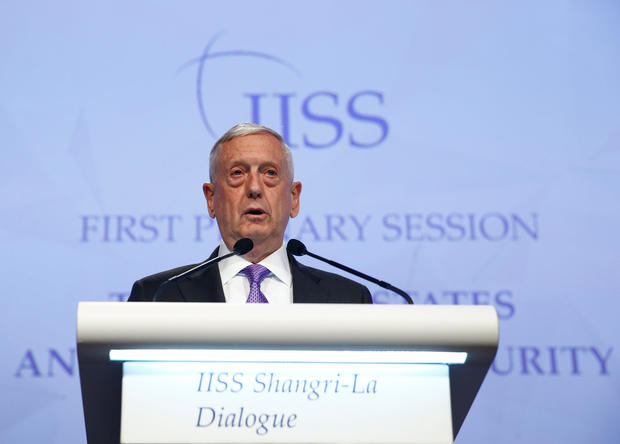
In his speech to the Shangri-La Dialogue, sponsored by the International Institute for Strategic Studies, Mattis sought to balance his hopeful comments on China with sharp criticism of what he called Beijing's disregard for international law by its "indisputable militarization" of artificial islands in disputed areas of the South China Sea.
Secretary of Defense James Mattis speaks at the 16th IISS Shangri-La Dialogue in Singapore June 3, 2017.
EDGAR SU / REUTERS
"We oppose countries militarizing artificial islands and enforcing excessive maritime claims unsupported by international law," he said. "We cannot and will not accept unilateral, coercive changes to the status quo."
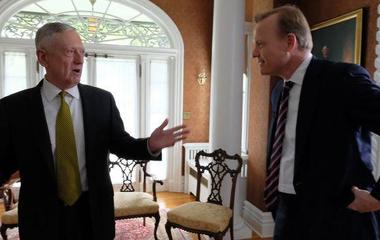
In an interview on CBS News' "Face the Nation" on Sunday, Mattis told host John Dickerson that "a conflict in North Korea ... would be probably the worst kind of fighting in most people's lifetimes."
Rep. Mac Thornberry, a Republican from Texas and chairman of the House Armed Services Committee, told a news conference later that he believed Mattis had effectively stressed the U.S. commitment to allies in the Asia-Pacific region.
"He was very clear, very strong," said Thornberry, who led a bipartisan congressional delegation on an Asia tour and attended Saturday's Singapore conference.
Overall, Mattis' speech struck a positive, hopeful tone for cooperation and peace in the Asia-Pacific region, where he and his predecessors have made it a priority to nurture and strengthen alliances and partnerships.
"While competition between the U.S. and China, the world's two largest economies, is bound to occur, conflict is not inevitable," he said. "Our two countries can and do cooperate for mutual benefit. We will pledge to work closely with China where we share common cause."
He was, however, unrelentingly critical of North Korea, a politically and economically isolated nation whose leaders have long viewed the United States as a military threat, in part because of periodic U.S. military exercises with South Korea, which the North sees as preparations for attacks aimed at destroying its ruling elite.
He called North Korea an "urgent military threat." In a question-and-answer session with his audience of national security experts from across the globe, Mattis was asked whether the U.S. might attack the North pre-emptively and without warning South Korea in advance.
"We're working diplomatically, economically, we're trying to exhaust all possible alternatives to avert this race for a nuclear weapon in violation of ... the United Nations' restrictions on North Korea's activities," he said.
"We want to stop this. We consider it urgent," he added.
The U.S. has about 28,500 troops permanently based in South Korea, a defense treaty ally.
"North Korea's continued pursuit of nuclear weapons and the means to deliver them is not new," Mattis said in his prepared remarks.
"But the regime has increased the pace and scope of its efforts," he added, alluding to the North's series of nuclear device tests in recent years and an accelerated pace of missile tests seemingly aimed at building a rocket with enough range to hit the U.S.
"While the North Korean regime has a long record of murder of diplomats, of kidnapping, killing of sailors and criminal activity, its nuclear weapons program is maturing as a threat to all," Mattis said. "As a matter of national security, the United States regards the threat from North Korea as a clear and present danger."
The issue arose briefly during questions from his audience, but Mattis did not address it directly. An Australian questioner asked, in light of Mr. Trump's abandonment of an international trade deal known as the Trans-Pacific Partnership, and his withdrawal from the Paris climate deal, "why should we not fret that we are present at the destruction of" a global rules-based order?
"There's going to be fresh approaches taken" to various issues by Mr. Trump, Mattis said, while making it clear that he personally believes the U.S. needs to avoid isolationist tendencies.
"Like it or not, we're part of the world," he said.