Contact Form

Name

Email *

Message *

Showing posts with label security council. Show all posts

Thursday, December 21, 2017

UN Members Will Seal Their Own Fate On Jerusalem Capital Vote


Sanhedrin Declares: UN Vote Is Nations Choosing Blessing or Curse

“When all the nations of the earth gather against her. In that day, I will make Yerushalayim a stone for all the peoples to lift; all who lift it shall injure themselves.” Zechariah 12:3 (The Israel Bible™)
In a special session of 71 elders, the court of the nascent Sanhedrin called on the nations of the world to take their prophesied role in building Jerusalem by not voting against the declaration of the President Trump in the United Nations, emphasizing that this was an auspicious moment that will decide their fate, whether for blessing or curse.
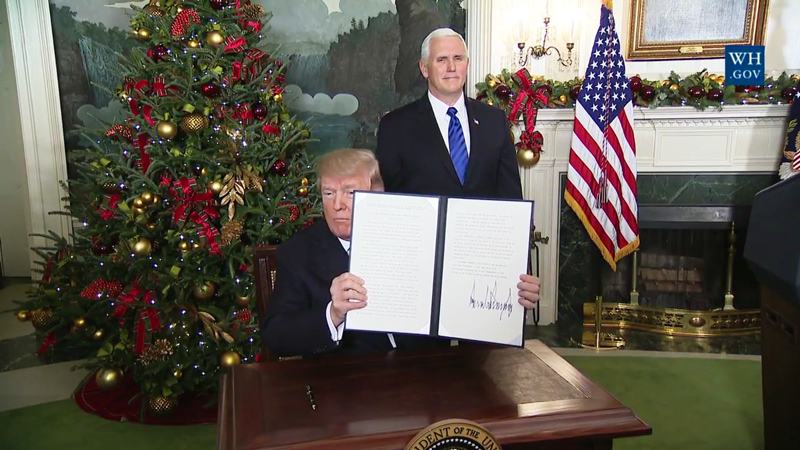
The General Assembly is scheduled to vote Thursday on a resolution that would express “deep regret at recent decisions concerning the status of Jerusalem.” This vote comes in response to President Trump’s speech two weeks ago in which he acknowledged Jerusalem as the capital of Israel. The UN resolution also calls on countries not to move their embassies to Jerusalem.
The Sanhedrin prefaced its declaration with a verse from Isaiah.
In all of My sacred mount Nothing evil or vile shall be done; For the land shall be filled with devotion to Hashem As water covers the sea. Isaiah 11:9
The declaration reads:
The nations should now take this opportunity to advance their required role in building God’s House in Jerusalem, the House of Universal Peace, on Mount Moriah, as prophesied in the Bible in order to bring about the long-awaited world peace.
Nations that vote for this evil decree via their representatives are instruments of destruction and their fate is sealed, as has been the case throughout history for those nations who have chosen the path of evil.
For the nations that have, until now, come against Jerusalem this vote is an opportunity to leave their evil ways. If not, they are sealing their own fate and will see judgments from heaven. The nations that support the US president’s declaration will gain merit in heaven.
We emphasize that this vote does not affect the prophecies concerning Jerusalem as the City of God since God’s word is eternal. It is Jerusalem’s fate to be a Light Unto the Nations.
Any nation that desires life will act intelligently and support the declaration of the United States.”
Rabbi Hillel Weiss, the spokesman for the Sanhedrin, explained the proclamation in simpler terms.
“Every child who learns the Bible knows that if you bless Israel, you will be blessed, and if you curse Israel, you will be cursed,” Rabbi Weiss told Breaking Israel News, citing the verse.
I will bless those who bless you And curse him that curses you; And all the families of the earth Shall bless themselves by you. Genesis 12:3
“This does not come from any special powers that Israel has and it is not for our benefit,” Rabbi Weiss explained. “Israel is God’s tool in this world for testing the hearts of men. By their actions towards Israel, men and even entire countries, show their feelings towards God. Right now, the world is being called upon, nation by nation, to display this.”
This vote in the UN General Assembly comes just two days after an identical vote in the UN Security Council. In that vote, the US stood alone as 14 countries voted to condemn the president’s recognition of Jerusalem. The US Ambassador Nikki Haley vetoed the resolution, preventing it from passing.
This series of events stands in stark contrast to what took place exactly one year ago, when, in the final days of his presidency, Barack Obama chose not to use a veto to block a UN Security Council vote declaring the Israeli presence in Jerusalem to be illegal. President Trump, who had already won the election but was awaiting his inauguration, posted a nearly-prophetic tweet.

Read more at https://www.breakingisraelnews.com/99725/sanhedrin-declares-un-vote-nations-choosing-blessing-curse/#6imxoF4qLubEMSJh.99

Thursday, December 7, 2017

Jerusalem IS Israel's Capital

Tuesday, August 15, 2017

Looks Like North Korea Has Run Out Of Friends. Trump Makes China And North Korea Blink


China Announces It Will Implement Tough Sanctions Against North Korea

"...tensions continue to mount..."

 Print

For the second time in recent days, China took a major step to put pressure on North Korea to resolve its standoff with the United States over North Korea’s missile development efforts.
The Chinese government announced Monday it will implement the sanctions that were imposed against North Korea by the United Nations on Aug. 5.
The Security Council sanctions block nations from accepting North Korea’s primary exports, including coal, iron, iron ore, lead and seafood. The sanctions also target other revenue streams, such as banks and joint ventures with foreign companies. The sanctions could cost North Korea a third of its $3 billion annual export revenue.

Although China did not block the sanctions at the U.N., it was unclear until the announcement whether China, which is North Korea’s largest trading partner, would implement them.
China also faces possible action from President Donald Trump, who has said he may order an investigation into allegations of unfair Chinese trade practices.
“It is obviously improper to use one thing as a tool to imposing pressure on another thing,” Foreign Ministry spokeswoman Hua Chunying said Monday. “There will be no winner from a trade war, it will be lose-lose.”
A
China’s action to implement the sanctions came days after a state-run newspaper said that if North Korea attacks the United States, it will fight any war that results on its own.
“China should also make clear that if North Korea launches missiles that threaten U.S. soil first and the U.S. retaliates, China will stay neutral,” the Global Times editorial said.
Throughout the escalation of tensions between the United States and North Korea, China has called for restraint.
“The current situation on the Korean Peninsula is complicated and sensitive,” Foreign Ministry spokesman Geng Shuang said in a statement Friday.

“China hopes that all relevant parties will be cautious in their words and actions, and do things that help to alleviate tensions and enhance mutual trust, rather than walk on the old pathway of taking turns in shows of strength, and upgrading the tensions,” he said.
Writing in The Washington Post, David Von Drehle said China needs to emerge from the North Korean-American showdown with a win.
” … the audience of greatest concern to China — namely, the other leading countries in the region, including Japan, India, Australia, South Korea, the Philippines and Vietnam — faces the urgent question of whether they can trust a rising China to share in safeguarding their sphere. If the problem of Kim isn’t defused, those nations are sure to seek even deeper alliances with the United States while building their own military capacity. China’s regional influence will shrink rather than grow,” he wrote.
What do you think? 

Saturday, June 3, 2017

Pressure Is Up On China And North Korea


Defense Secretary Mattis turns up heat on North Korea and China

SINGAPORE -- U.S. Defense Secretary Jim Mattis turned up the heat on North Korea and its main benefactor, China, on Saturday, calling the North Koreans a "clear and present danger" and chastising the Chinese for coercive behavior in the South China Sea. 
His sharp words for both countries suggest he believes China will, out of self-interest, exert leverage on North Korea to halt its nuclear and missile programs even as Washington pushes Beijing to change course in the South China Sea. 
Speaking at an international security conference in Singapore, Mattis said the Trump administration is encouraged by China's renewed commitment to working with the U.S. and others to rid North Korea of its nuclear weapons. He also said he thinks China ultimately will see it as a liability rather than an asset. 
China blocked tough new sanctions against North Korea that the United States pushed in the U.N. Security Council on Friday. However, the Security Council did vote unanimously to add 15 individuals and four entities linked to the North's nuclear and missile programs to a U.N. sanctions blacklist. 
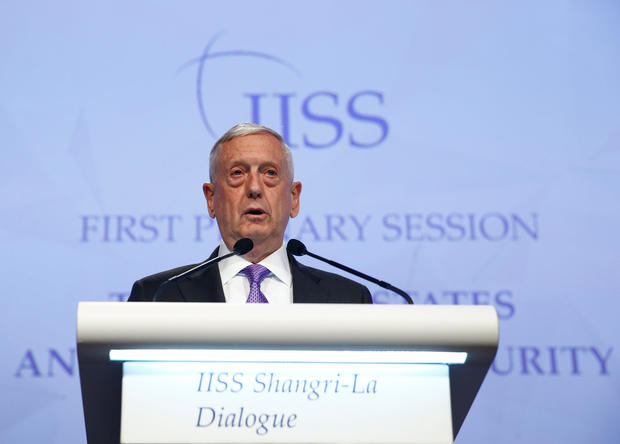
In his speech to the Shangri-La Dialogue, sponsored by the International Institute for Strategic Studies, Mattis sought to balance his hopeful comments on China with sharp criticism of what he called Beijing's disregard for international law by its "indisputable militarization" of artificial islands in disputed areas of the South China Sea. 

2017-06-03t020454z-623068857-rc1ea4b83b50-rtrmadp-3-asia-security.jpg
Secretary of Defense James Mattis speaks at the 16th IISS Shangri-La Dialogue in Singapore June 3, 2017.
EDGAR SU / REUTERS

"We oppose countries militarizing artificial islands and enforcing excessive maritime claims unsupported by international law," he said. "We cannot and will not accept unilateral, coercive changes to the status quo." 
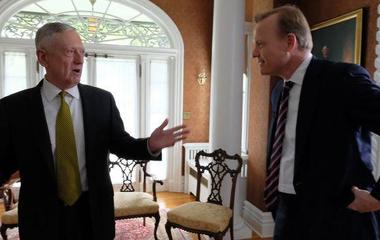
In an interview on CBS News' "Face the Nation" on Sunday, Mattis told host John Dickerson that "a conflict in North Korea ... would be probably the worst kind of fighting in most people's lifetimes."  
Rep. Mac Thornberry, a Republican from Texas and chairman of the House Armed Services Committee, told a news conference later that he believed Mattis had effectively stressed the U.S. commitment to allies in the Asia-Pacific region. 
"He was very clear, very strong," said Thornberry, who led a bipartisan congressional delegation on an Asia tour and attended Saturday's Singapore conference. 
Overall, Mattis' speech struck a positive, hopeful tone for cooperation and peace in the Asia-Pacific region, where he and his predecessors have made it a priority to nurture and strengthen alliances and partnerships. 
"While competition between the U.S. and China, the world's two largest economies, is bound to occur, conflict is not inevitable," he said. "Our two countries can and do cooperate for mutual benefit. We will pledge to work closely with China where we share common cause." 
He was, however, unrelentingly critical of North Korea, a politically and economically isolated nation whose leaders have long viewed the United States as a military threat, in part because of periodic U.S. military exercises with South Korea, which the North sees as preparations for attacks aimed at destroying its ruling elite. 
He called North Korea an "urgent military threat." In a question-and-answer session with his audience of national security experts from across the globe, Mattis was asked whether the U.S. might attack the North pre-emptively and without warning South Korea in advance.
"We're working diplomatically, economically, we're trying to exhaust all possible alternatives to avert this race for a nuclear weapon in violation of ... the United Nations' restrictions on North Korea's activities," he said. 
"We want to stop this. We consider it urgent," he added. 
The U.S. has about 28,500 troops permanently based in South Korea, a defense treaty ally. 
"North Korea's continued pursuit of nuclear weapons and the means to deliver them is not new," Mattis said in his prepared remarks. 
"But the regime has increased the pace and scope of its efforts," he added, alluding to the North's series of nuclear device tests in recent years and an accelerated pace of missile tests seemingly aimed at building a rocket with enough range to hit the U.S. 
"While the North Korean regime has a long record of murder of diplomats, of kidnapping, killing of sailors and criminal activity, its nuclear weapons program is maturing as a threat to all," Mattis said. "As a matter of national security, the United States regards the threat from North Korea as a clear and present danger." 
Mattis made no mention of President Donald Trump's decision to pull the U.S. out of the Paris climate change agreement. 
The issue arose briefly during questions from his audience, but Mattis did not address it directly. An Australian questioner asked, in light of Mr. Trump's abandonment of an international trade deal known as the Trans-Pacific Partnership, and his withdrawal from the Paris climate deal, "why should we not fret that we are present at the destruction of" a global rules-based order? 
"There's going to be fresh approaches taken" to various issues by Mr. Trump, Mattis said, while making it clear that he personally believes the U.S. needs to avoid isolationist tendencies. 
"Like it or not, we're part of the world," he said.