Contact Form

Name

Email *

Message *

Showing posts with label Americans. Show all posts

Monday, May 18, 2020

Ronald Reagan-- Believer In Americans

Ronald Reagan was so clear-eyed, so intelligent, and so wise!  He also was such a great communicator and a person whose humor was disarming.

In this clip, it shows how much faith he has in Americans and their ability to understand and to do what is right.  No wonder the Democrats hated him--he set back their plans by generations!

Please take a few seconds and reflect on the message and how it applies to today!

Conservative Tom

https://www.instagram.com/p/CAVII72Ah6x/

Wednesday, May 22, 2019

America Is Heading Toward Socialism!

Four in 10 Americans Embrace Some Form of Socialism

Four in 10 Americans Embrace Some Form of Socialism

STORY HIGHLIGHTS

  • 43% of Americans say socialism would be a good thing for the country
  • 51% believe socialism would be a bad thing for the country
  • Americans split on viewing economy as free market or government controlled
WASHINGTON, D.C. -- Americans today are more closely divided than they were earlier in the last century when asked whether some form of socialism would be a good or bad thing for the country. While 51% of U.S. adults say socialism would be a bad thing for the country, 43% believe it would be a good thing. Those results contrast with a 1942 Roper/Fortune survey that found 40% describing socialism as a bad thing, 25% a good thing and 34% not having an opinion.
More Americans Now See Socialism as a Good Thing for the Country
Would some form of socialism be a good thing or a bad thing for the country as a whole?
19422019Change
%%pct. pts.
Good thing2543+18
Bad thing4051+11
No opinion346-28
Net "good thing"-15-8+7
Note: 1942 data gathered by Roper Center for Public Opinion Research
GALLUP
The Roper/Fortune survey is one of the oldest trend questions measuring attitudes on socialism in the U.S. Gallup's update of the question in an April 17-30 survey finds Americans more likely to have an opinion on the matter now, as well as a smaller gap in the percentage calling socialism a bad thing vs. a good thing.
Previous Gallup research shows that Americans' definition of socialism has changed over the years, with nearly one in four now associating the concept with social equality and 17% associating it with the more classical definition of having some degree of government control over the means of production. A majority of Democrats have said they view socialism positively in Gallup polling since 2010, including 57% in the most recent measure in 2018.

Outlook on Socialism Around the World

The April 17-30 survey also updates another historical question on socialism. Gallup first asked Americans in 1949 about their outlook on the spread of democracy over the next 50 years. At that time, seven in 10 Americans (72%) predicted that most countries in the world would have a democratic government. It's important to note that in much of the political rhetoric of the time, the terms democracy and capitalism were more intimately intertwined than they are today, perhaps synonymous to many.
Americans' Views on Future of Democracy and Socialism Globally
During the next 50 years, do you think most of the nations of the world will have a democratic government, a communist government or a socialist government?
19492019Change
%%pct. pts.
Democratic7257-15
Socialist1429+15
Communist96-3
No opinion58+3
GALLUP
The current update on this question finds a marked increase in the percentage saying that most countries during the next 50 years will have a socialist government (29%). It is unclear whether this is due to the flourishing of democracies -- particularly in Europe and Latin America -- led by what are often described as social democrats, or whether a fundamental shift is taking place among some Americans in their views of socialism.

Government vs. Free Market

In the same April survey, Gallup asked Americans whether they would prefer mostly free market or government control over several economic and societal activities. Americans are most likely to prefer free market control in the areas of technological innovation and the distribution of wealth. Majorities also want the free market to drive the economy overall, wages, higher education and healthcare.
Preference for the government to serve as the primarily responsible actor only garners majority support for protecting online consumer privacy and the environment.
Majority Want Free Market to Lead on Many Fronts
Would you prefer to have the free market or the government be primarily responsible for what happens in each of the following areas?
Free marketGovernmentNet "free market"
%%pct. pts.
Technological innovation7519+56
The distribution of wealth6828+40
The economy overall6233+29
Wages6235+27
Higher education5641+15
Healthcare5344+9
Protecting consumers' privacy online4057-17
Environmental protection3066-36
GALLUP, APRIL 17-30, 2019
Notably, more Americans favor free market than government control over healthcare and higher education, two areas in which Democratic politicians have made proposals to greatly expand government involvement. But at least four in 10 Americans appear sympathetic to policies that would increase the government's role in those areas.
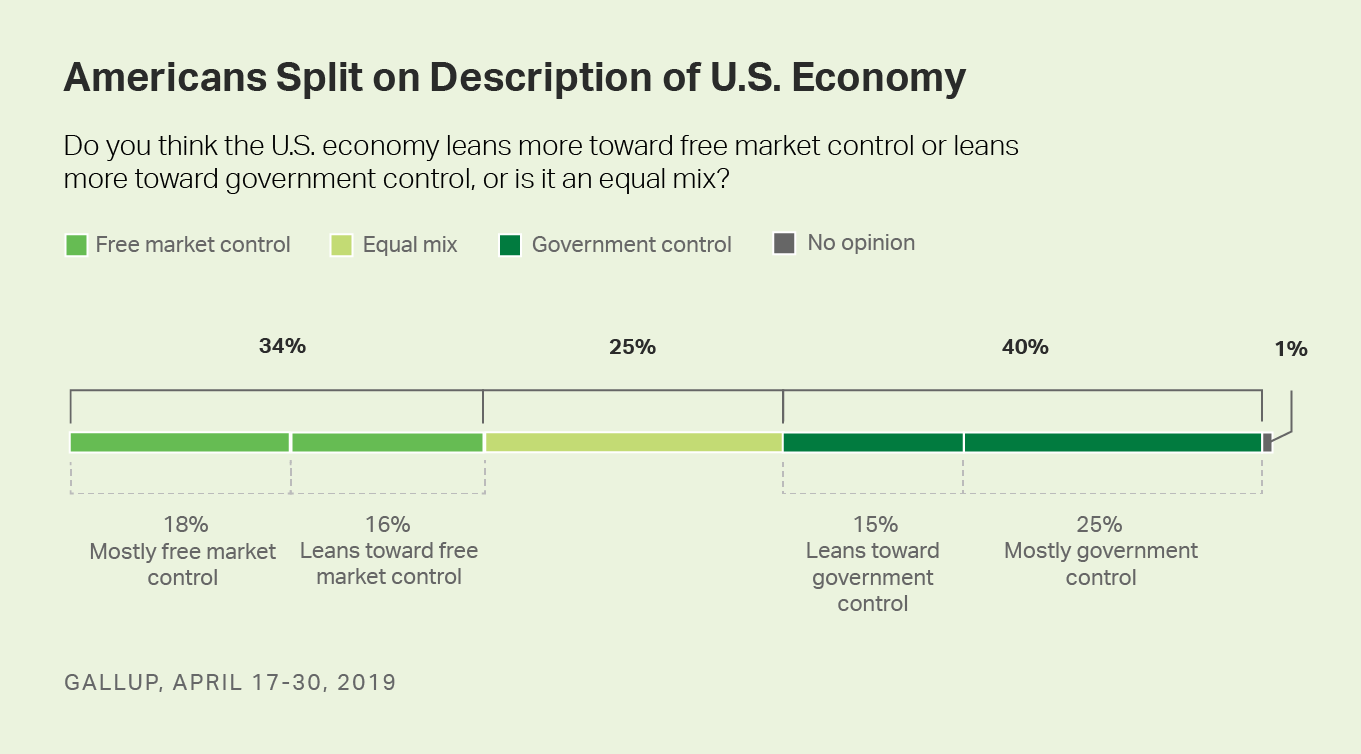
While there is ample support for a market-driven approach to many of the issues cited above, Americans are divided on how they describe the current state of the U.S. economy. When asked whether they think the U.S. economy leans more toward free market control or toward government control, 40% say it leans more toward government control while fewer say it leans toward free market control (34%). One in four describe it as an equal mix.
Stacked bar graph. Americans’ views of the current state of free market versus government control of the economy.

Bottom Line

Americans' views on socialism are complex. While some recent data can easily lend to overstated conclusions, there are marked changes in Americans' views of socialism when taking a longer, more historical look at the data. However, exactly what Americans mean by the term is nuanced and multifaceted. While half of Americans consider socialism as bad for the country, nearly two-thirds say that the U.S. economy is more influenced by the government than the free market, or that it reflects an equal mix of the two.
Additionally, while a majority of Democrats view socialism positively, that is not a major change in the eight years Gallup has tracked this metric. The major shift over this time has been the reduced rate of Democrats who now view capitalism positively (47%).
These data alone make it hard to generalize a simplistic conclusion about Americans' opinions of, and willingness to entertain, socialism. But there are a few clear takeaways. About four in 10 Americans are accepting of some form of socialism or socialist policies, and Democrats currently have a more positive view of socialism than capitalism. In addition, the April survey found that 47% of Americans say they would vote for a socialist candidate for president. While that figure represents nearly half of the U.S. adult population, even higher percentages say they would vote for an atheist (58%) or Muslim (60%) presidential candidate.
However, when they are asked what role they would like to see the government play in certain areas of society, Americans continue to endorse the free market.
Shifting attitudes about socialism, capitalism, and the current economic and political systems in America -- as well as what alternatives many see as solutions for current shortcomings -- will continue to be a major focus for Gallup.
Learn more about how the Gallup Poll Social Series works.

Sunday, January 13, 2019

Ignorance Of The Facts Will Lead To Another Tragedy

One-Third of Americans Don't Believe 6 Million Jews Were Murdered During the Holocaust

One-third of Americans think “substantially less” than 6 million Jews were murdered in the Holocaust, according to a new survey that highlights a worrying lack of basic knowledge about the World War II-era genocide.
The Conference on Jewish Material Claims Against Germany, or Claims Conference, released the findings of its survey to coincide with Holocaust Remembrance Day. They show a notable lack of understanding among Americans, especially millennials, the group said.
The Claims Conference said there are “critical gaps both in awareness of basic facts as well as detailed knowledge of the Holocaust” in American society, stressing that U.S. schools must provide more comprehensive education on the crimes.
The survey shows that 70 percent of Americans believe people care less about the Holocaust than they used to. A majority, 58 percent, said they believe something like the Holocaust could happen again.
Concentration camp uniform Holocaust
A uniform of an Auschwitz survivor is displayed on December 9, 2004, at the Jewish Museum in London. A recent survey found that 66 percent of millennials do not know what Auschwitz was. Ian Waldie/Getty Images
Just under a third (31 percent) of those surveyed do not believe that 6 million Jews were killed during the Holocaust and think the real death toll is at least 2 million lower. This was true for 41 percent of millennials.
Adolf Hitler's fascist Nazi regime killed approximately 6 million Jews before and during World War II. The Nazis also murdered millions of Eastern European civilians, Soviet prisoners of war, disabled people, homosexuals and political prisoners. Estimates of the total death toll reach as high at 15 million to 20 million people.
Almost half (45 percent) of Americans were unable to name a single concentration camp, and the number was even worse for millennials (49 percent). Two-thirds (66 percent) of millennials were unable to explain what Auschwitzwas. The death camp is one of the most infamous ones that existed in Nazi-ruled Europe, and its name has become synonymous with the genocide.
Fifteen percent thought people should be allowed to display Nazi slogans or symbols today, while 11 percent said it is acceptable to hold neo-Nazi views.
These figures are especially concerning given the reported rise in hate group numbers, activity and confidence in recent years. A February report from the Southern Poverty Law Center claimed that the number of hate groups in the U.S. has increased by 20 percent over the past three years. The number of neo-Nazi groups increased from 99 in 2016 to 121 in 2017, the center said.
Around two-thirds (68 percent) of Americans believe there is anti-Semitism in the U.S. today, and a majority (51 percent) think there is either a great deal of (17 percent) or many (34 percent) neo-Nazis in the country today.
Neo-Nazis Charlottesville
White nationalists, neo-Nazis, the Ku Klux Klan and members of the "alt-right" march in Charlottesville, Virginia, on August 12, 2017. Most Americans believe that significant numbers of neo-Nazis are in the country, a new survey says. Chip Somodevilla/Getty Images
Despite the worrying figures, 93 percent of those asked think the Holocaust should be taught in schools, while 96 percent believe that the genocide happened.
Claims Conference President Julius Berman said it is “vital to open a dialogue on the state of Holocaust awareness so that the lessons learned inform the next generation. We are alarmed that today’s generation lacks some of the basic knowledge about these atrocities.”
Greg Schneider, executive vice president of the Claims Conference, said, “There remain troubling gaps in Holocaust awareness while survivors are still with us; imagine when there are no longer survivors here to tell their stories. We must be committed to ensuring the horrors of the Holocaust and the memory of those who suffered so greatly are remembered, told and taught by future generations.”
The Claims Conference said its results are based on a representative sample of 1,350 American adults interviewed by phone and online. Respondents were selected randomly and reflected the demographics of the American adult population, it said.

Saturday, July 21, 2018

All Americans Must Become Aware Of The Evils Of Socialism Which Are Antithetical To The American Way Of Living


Government is always the
enemy of your liberty


Merriam-Webster reports that "socialism" has become a "trending" word, i.e., "lookups" for it have "jump[ed] over 1500 percent ... following the Democratic primary victory for a congressional seat in New York City by Alexandria Ocasio-Cortez." I hope, though likely in vain, that Americans did not conduct most of those "lookups." If they did, they prove yet again how dumbed-down they are. Given that we've lived in a socialist country for over a century now, asking the definition of "socialism" is only a little less ludicrous than asking for that of "television." If you can't recognize such horrors after suffering them all your life, well, you're as devoted to scholasticism as any medieval monk.
Meanwhile, we might assume from the brouhaha over Alexandria Ocasio-Cortez's triumph that she's the first socialist candidate in American history. Au contraire, though she is among the few to admit openly — heck, to outright brag of — such evil intent. Since the 1930s, Americans have rarely elected anyone other than socialists and their twins, communists — though the occasional fascist does sneak past them. (Indeed, the clown our hyphenated commie beat is as socialist as she.) How else would voters protect their beloved Social Security as well as socialism's other loot, Medicare and Medicaid, public housing, "free" indoctrination — sorry, education, food stamps, Obummercare, et cetera, ad nauseam?
As its name implies,"socialism" imposes government's force on social and interpersonal struggles. Which begs the question: How did a country devoted to autonomy, individuality and freedom from that lethal enemy of both, the State, degenerate to de facto socialism? Who convinced Americans, with their healthy and overwhelming contempt for political government, that Leviathan was instead their friend, their doctor, their sugar-daddy, their ever-lovin' mama? Who persuaded them that politicians could and should fix entirely social problems rather than sticking to those areas traditionally considered governmental, such as dispensing justice (or, more accurately, injustice), ruining trade via tariffs and murder, a.k.a. war?

Indeed, that fascinating query applies universally, not merely to the United States. Political government throughout history has ever been a lethal enemy — and its subjects usually feared it as such. Which is the only sensible reaction, given that the State rests entirely on physical force. One analysis of it widely but erroneously attributed to George Washington explains, "Government is not reason, it is not eloquence — it is force! Like fire it is a dangerous servant and a fearful master..."
True to this nature, governments in all times and all places have bullied and bossed, caged and conscripted. They were liable to torture and execute anyone even mildly challenging their authority; they impoverished commoners so the rulers could live sumptuously. Few victims deluded themselves that the despots exploiting them also cared about their welfare.
Even so, government pretty much stuck to several clearly defined roles: it battled foreign enemies, suppressed revolts at home and plundered taxpayers to finance those activities as well as the rulers' luxuries. But for kings and other tyrants to meddle with such social ills as poverty, illiteracy, racial hatred or a lack of medical insurance? The peasants those potentates regularly abused would have scorned any such suggestion as utter lunacy.
Then some crackpots in early 19th-century France suggested that government train its guns not only on foreign aggressors and domestic "criminals" (often mere dissidents) but on interpersonal problems. And they did so with mumbo-jumbo as well as breathtaking insouciance toward rationality.
Their ring-leader, Charles Fourier, "comes off as a confused thinker" whose "ideas seem quite fantastical and without ground in reality ... pure nonsense[, with the] characteristic pretension of the visionary: contradictory, confused, repetitive, chaotic and, of course, long-winded." (And this from a dispassionate "lecture" on "Modern European Intellectual History"!)
To be fair, Fourier professed an interest in ameliorating the misery he saw around him, which he (and many others) wrongly blamed on the Industrial Revolution. And his bizarre solutions — such as "Phalanxes, which are experimental[. They] are places that combine families that are unequal in fortune ... These buildings were designed to accommodate a person's passions and talents. ... a friendly union would be formed between the people because of the similiarites [sic] they all shared[,] ... creating happiness and cheerfulness within the society" — seem to have been voluntary at first.
But as is typical of do-gooders, Fourier soon insisted that his "socialism would have to be enforced." Only a "confused thinker" of this magnitude could have urged such a ridiculous contradiction: that government, which relies on physical compulsion, should repair society, which functions well only in the absence of physical compulsion. What Fourier advocated was akin to claiming doctors can heal a fractured leg by smacking it with a sledgehammer. Or as Frederic Bastiat put it in his classic, The Law, "Socialism ... confuses the distinction between government and society."
This untenable combination of two diametric opposites, government and society, philosophically invalidates Fourier — and all socialists, communists, fascists and Progressives before and since. Worse, when your sole tool is a hammer, everything looks like a nail. Statists reflexively believe that only their god, Government, can mend whatever's broken. Ergo, they condemn as irresponsible and impossible leaving private trouble to private citizens for resolution. No wonder Bastiat also observed, "...every time we object to a thing being done by government, the socialists conclude that we object to its being done at all."
The more things change, the more they stay the same. Even in 1850, when Bastiat wrote The Law, socialists were guilty of the same logical absurdities that characterize them today: "We disapprove of state education," Bastiat complained. "Then the socialists say that we are opposed to any education. We object to a state religion. Then the socialists say that we want no religion at all. We object to a state-enforced equality. Then they say that we are against equality. And so on, and so on." Indeed. We object to Obummercare, and the socialists say we want people to die in the streets.
What is socialism? Nothing more than mixing apples and oranges to cook up Paradise — a recipe for disaster.

— Becky Akers

To voice your opinion, or read more on personalliberty.com, go here.


Saturday, June 9, 2018

Black Lives Matter Is Wrong Headed

My ‘Black Lives Matter’ Problem (Or… is it Your Problem?)

“Black Lives Matter” is wrong on crime, wrong on Israel, and wrong on education.
www.israel-commentary.org
By Jason D. Hill
Excerpted and redacted from the article in COMMENTARY,  JUNE 2018
… I had lunch recently with a retired (uber liberal) professor who once taught at a university in New York and now teaches inside prisons.… 
… Our conversation, had left my mind racing with thoughts about the moral hypocrisy of Black Lives Matter. I thought about two transgressive and unpardonable sins of the Black Lives Matter movement. The first has to do with its outrageous position on Israel; the second pertains to its immoral demands regarding the education of black Americans.
The leaders of Black Lives Matter have written a profoundly anti-Israel (and anti-American) manifesto in which they accuse Israel of “genocide” and “apartheid.” The manifesto endorses the “Boycott, Divestment, Sanctions” (BDS) movement and takes the view that the United States justifies and advances the global war on terror via its alliances with Israel. This, according to Black Lives Matter, makes the U.S. complicit in a supposedly genocidal massacre of the Palestinian people.
As a staunch defender of Israel on moral grounds, I categorically condemn the moral ineptitude of the Black Lives Matter movement on this point. If there is a victim in the Middle East, it is the beleaguered state of Israel. 
The Jewish state is the only technologically advanced and democratic country in a region of illiberal, primitive, and human-rights-abusing nations that treat women worse than cattle and don’t know the meaning of religious reciprocity. 
Since its founding, Israel has fought marauders in the likes of the Jordanians, the Egyptians, and the Syrians. These parties have invaded Israel, threatened her right to exist, and tried to eliminate her and Jewry itself from the region. 
Israel’s enemies among the Palestinians have sought to do the same with the help of terrorist organizations such as Hezbollah, Hamas, and the Palestinian Authority. And the Palestinians have made an unprecedented demand in the history of warfare. Displaced by a war that their leaders started and lost, they claim a right to return to a territory they failed to conquer. 
While Arab Israelis serve in the Knesset side by side with Israeli Jews, Palestinians have elected governments whose charters have called for the annihilation of Jews and whose leaders portray Jews as pigs, vermin, and an evil to be eradicated.
Israel is the only country I know of that grants citizenship and land rights to its avowed enemies. What’s more, Israel offered a Palestinian state to both Yassir Arafat and Mahmoud Abbas and was not only repeatedly turned down but repaid with the second intifada and the indiscriminate murder of Israeli citizens. Palestinian intransigence is forged in the conviction that no deal will be made so long as Jews—any Jews—occupy the land of Israel. 
In 2005, Israel unilaterally handed over its territory in Gaza to the terrorist government Hamas and was, and still is, rewarded by a daily showering of rockets into Israeli land.
With its accusations against Israeli Jews, Black Lives Matter suggests that in their support of Israel, such Jews are complicit in the unproven crimes of genocide and apartheid. We must remember that even amid the daily onslaughts of war and terror that Palestinians inflict on Jews, the Israelis, in a spirit of almost irrational altruism, take great pains to limit civilian casualties and to ensure that those caught in a war they did not personally initiate are spared as much harm as possible.
Black Lives Matter is not only being unjust toward Israel; its anti-Israel stance betrays Jews in America, to whom blacks in this country are enormously indebted. If there are any unsung heroes of the civil-rights movement, it is those Jews who played an enormous but largely unacknowledged role in the liberation of blacks from racial oppression.
 American Jews undertook monumental efforts to found and fund some of the most important civil-rights organizations in the U.S. These include the National Association for the Advancement of Colored People (NAACP), the Southern Christian Leadership Conference (SCLC), and the Student Nonviolent Coordinating Committee (SNCC). In 1909, Henry Moscowitz joined W.E.B. Du Bois and other civil-rights leaders to create the NAACP. The vice chairman of the Union of American Hebrew Congregations (now the Union for Reform Judaism), Kivie Kaplan, served as the national president of the NAACP from 1966 to 1975. Arnie Aronson worked with A. Philip Randolph and Roy Wilkins to found the Leadership Conference.
From 1910 to 1940, there were more than 2,000 primary and secondary schools and 20 black colleges (including Howard, Dillard, and Fisk Universities) established in whole or in part by contributions from Jewish philanthropist Julius Rosenwald. 
At the height of enrollment at the so-called Rosenwald schools, nearly 40 percent of Southern blacks were educated at one of these institutions. 
During the civil-rights movement, Jewish activists represented a disproportionate number of whites involved in the struggle for black emancipation. Jews made up half of the young people who participated in the Mississippi Freedom Summer in 1964. Leaders of the Jewish Reform Movement were arrested with the Reverend Dr. Martin Luther King Jr. in St. Augustine, Florida, in 1964, after mounting a challenge to racial segregation in public accommodations. 
The Civil Rights Act of 1964 and the Voting Rights Act of 1965 were drafted in the conference room of the Religious Action Center (RAC) of Reform Judaism, under the aegis of the Leadership Conference, which for decades was in the RAC’s building.
The hard, cold, and unsentimental fact of the matter is that without Jewish financial backing and moral contributions, there may never have been a civil-rights movement.
There is another morally irresponsible claim made by the Black Lives Matter movement—a claim that should offend any self-respecting black American citizen. I refer to the movement’s demand that the United States provide free college education to blacks. 
On what grounds is this organization making such a demand? Why free college education for blacks but not for poor whites or for Latino, Asian, or Native-American college students? What special sociopolitical conditions exist for blacks that do not hold for other ethnic or racial groups such that blacks deserve to be exempt from paying college tuition?
Could it be that the spokespersons for the movement are failing here to recognize another cultural pathology blacks face? I have in mind the problem of single-parent families—in which 70 percent of African-American children now live. This is a financially untenable situation for a massive swath of black America. And it is certainly an issue over which blacks have control. 
…The cardinal sin of asking for anything for free in this life is that you abnegate your responsibility not just for maintaining your existence but, more important, for achieving your humanity. 
The demand for a free education, along with the demand for race-based reparations by Black Lives Matter and others, is symptomatic of another problem in race relations. There are those on the left who see self-reliance, initiative, and a commitment to one’s own life as, at best, hopelessly naive. 
Such people see grit, honor, hard work, and self-reliance as “white” ideals that are being imposed on others. Those traits reinforce whiteness, in their minds, and there is a gnawing resentment of those blacks who wish to appropriate such virtues for themselves. They cease being black in the minds of some on the far left. 
Such ideas assume a malevolence about the American polis that is untenable and empirically false. No doors are closed forever to anyone in this great country of ours. If your ethos and character disposition are set for achievement, if your will is wedded to a resilience and tenacity, and you rid yourself of the idea that you are entitled to the financial earnings of other people, you will find a way to make it here. 
On the other hand, the kind of dependency that Black Lives Matter promotes lays the groundwork for personal failure.  (And their followers proudly embrace that perpetual personal failure, aiding and abetting their own self-destruction) jsk
pastedGraphic.png
This essay is adapted from Jason D. Hill’s forthcoming book We Have Overcome: An Immigrant’s Letter to the American People, which will be published by Bombardier Books in July and is available for pre-publication sale on Amazon.

Monday, January 1, 2018

Migrants Bring Along With Them Unacceptable Cultural Attitudes