Our goal is to have intelligent discussion of the topics of the day. We realize everyone has their opinion and they should be allowed to express it in a discussion forum without calling each other names. We learn from discussion and not from name calling or argument.We use cookies to personalise content and ads, to provide social media features and to analyse our traffic. We also share information about your use of our site with our social media, advertising and analytics partners. See details
(UnitedVoice.com) – The United States has been at war with illegal narcotics for decades. For the most part, the war has never been overly successful. That’s changing.
Recently, Project Python, an operation led by the Drug Enforcement Administration (DEA), dealt a massive blow to Cártel de Jalisco Nueva Generación (CJNG), a Mexican drug cartel. A series of raids captured millions of dollars and sent hundreds of cartel members to jail. With that success under their belt, the Trump administration is adding a new target to their crosshairs: a socialist South American dictator.
Thursday, Attorney General, William Barr, revealed an indictment for Nicolas Maduro, the President of Venezuela. In his briefing, Barr called out Maduro for working with the Revolutionary Armed Forces of Colombia (FARC). He claimed Maduro both funded and protected FARC while they carried out narco-terrorism.
VENEZUELA'S NICOLÁS MADURO WAS CHARGED TODAY FOR A MASSIVE NARCO-TERRORISM & INTERNATIONAL COCAINE TRAFFICKING CONSPIRACY. U.S. PROSECUTORS SAY HE LED A VIOLENT DRUG CARTEL EVEN AS HE ASCENDED TO THE TOP OF GOVERNMENT.
In addition to Maduro, a large number of former and current Venezuelan officials were also indicted. The State Department did not stop at indictments either; they put bounties out for information leading to the capture of Maduro and four other officials. The current offering for the President is $15 Million dollars.
President Trump and his team are taking the battle to the drug lords, regardless of where they may be hiding. From here in the United States with Project Python, to foreign leaders in South America, criminals everywhere are on notice.
Long overdue redacted wake-up call from the brilliant Victor Davis Hanson
The Washington Times
November 11, 2019
(I started to make bold certain paragraphs of this article but I soon realized that the whole article should be in bold.
Dr. Hanson is speaking directly to all of us – regardless of your socio-economic status. So, read it as if your own butt is on the line – because it is) Jerome S. Kaufman
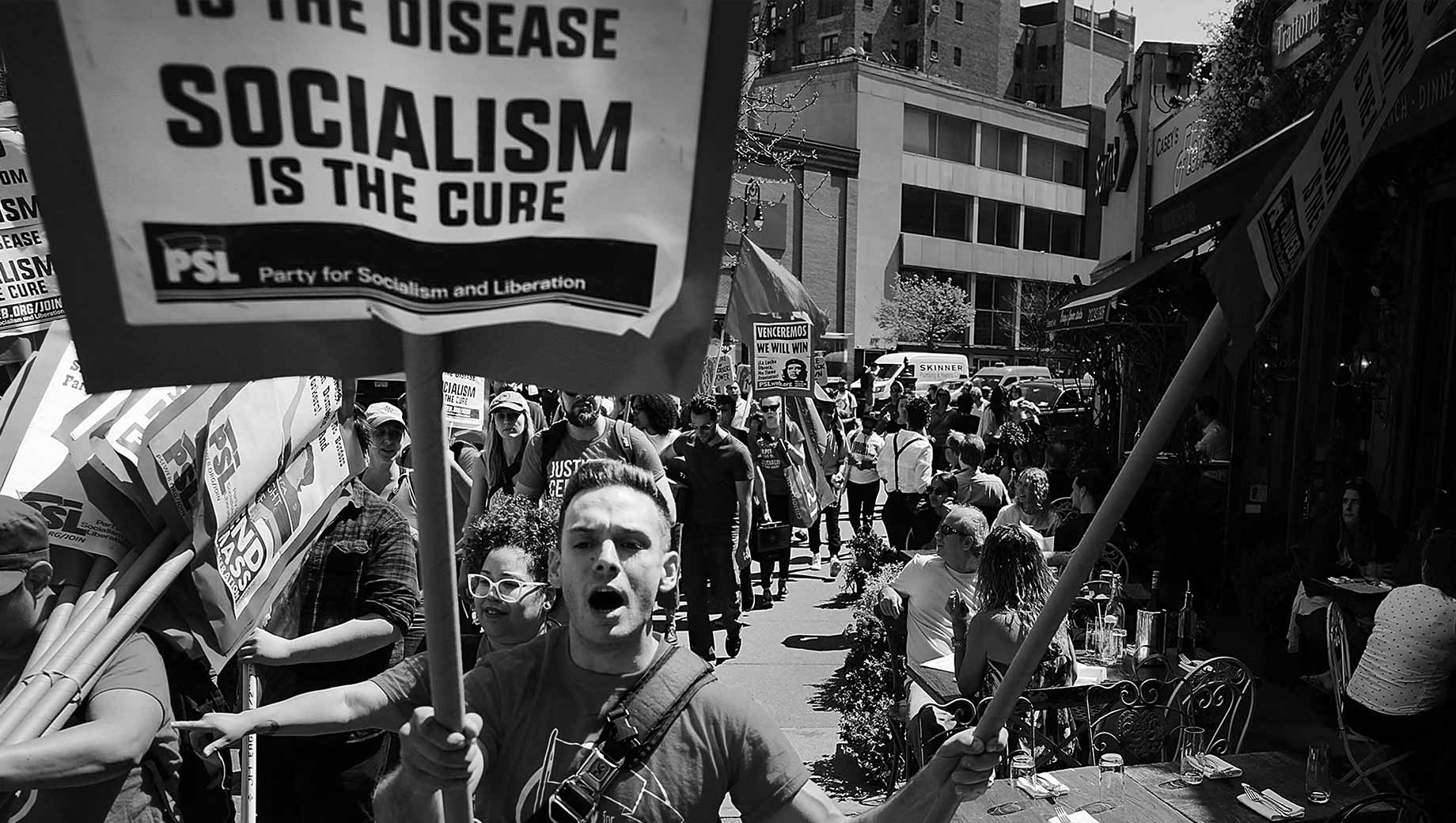
Multiple forms of socialism, from hard Stalinism to European redistribution, continue to fail. Russia and China are still struggling with the legacy of genocidal Communism. Eastern Europe still suffers after decades of Soviet-imposed socialist chaos.
Cuba, Nicaragua, North Korea, and Venezuela are unfree, poor, and failed states. Baathism — a synonym for pan-Arabic socialism — ruined the post-war Middle East.
The soft-socialist European Union countries are stagnant and mostly dependent on the U.S. military for their protection.
In contrast, current American deregulation, tax cuts and incentives, and record energy production have given the United States the strongest economy in the world.
So why, then, are virtually all the Democratic presidential contenders — either overtly or implicitly – running on socialist agendas in one form or another.
Why are the heartthrobs of American progressives — Representatives Alexandria Ocasio-Cortez (D., N.Y.), Rashida Tlaib (D., Mich.), and Ilhan Omar (D., Minn.) — calling for socialist redistributionist schemes?
Why do polls show that a majority of American Millennials have a favorable view of socialism?
There are lots of catalysts for the new socialism.
Massive immigration is changing the demography of the United States. The number of foreign-born U.S. residents and their children has been estimated at almost 60 million, or about 1 in 5 U.S. residents. Some 27 percent of California residents were born outside of America.
Many of these immigrants flee from poor areas of Latin America, Mexico, Africa, and Asia that were wrecked by statism and socialism. Often, they arrive in the U.S. unaware of economic and political alternatives to state socialism.
When they reach the U.S. — often without marketable skills and unable to speak English — many assume that America will simply offer a far better version of the statism from which they fled. Consequently, many take for granted that government will provide them an array of social services, and they become supportive of progressive socialism.
Another culprit for the new socialist craze is the strange leftward drift of the very wealthy in Silicon Valley, in corporate America, and on Wall Street. Some of the new progressive rich feel guilty about their unprecedented wealth. So they champion redistribution as the sort of medieval penance that alleviates guilt.
Yet the influential and monied classes usually are so well off that higher taxes hardly affect them. Instead, redistributionist taxation hurts the struggling middle classes.
In California, it became hip for wealthy leftists to promote socialism from their Malibu, Menlo Park, or Mill Valley enclaves — while still living as privileged capitalists. Meanwhile, it proved nearly impossible for the middle classes of Stockton and Bakersfield to cope with the reality of crushing taxes and terrible social services.
From 2008 to 2017, the now-multimillionaire Barack Obama, first as candidate and then as president, used all sorts of cool socialist slogans, from “spread the wealth around” and “now is not the time to profit” to “you didn’t build that” and “at a certain point you’ve made enough money.”
Universities bear much of the blame. Their manipulation of the federal government to guarantee student loans empowered them to jack up college costs without any accountability. Liberal college administrators and faculty did not care much when graduates left campus poorly educated and unable to market their expensive degrees.
More than 45 million borrowers now struggle with nearly $1.6 trillion in collective student debt, with climbing interest. That indebtedness has delayed — or ended — the traditional forces that encourage conservatism and traditionalism, such as getting married, having children and buying a home.
Instead, a generation of single, childless, and mostly urban youth feels cheated that their high-priced degrees did not earn them competitive salaries. Millions of embittered college graduates will never be able to pay off what they owe — and want some entity to pay off their debts.
In paradoxical fashion, teenagers were considered savvy adults who were mature enough to take on gargantuan loans. But they were also treated like fragile preteens who were warned that the world outside their campus sanctuaries was downright mean, sexist, racist, homophobic, and unfair.
Finally, doctrinaire Republicans for decades mouthed orthodoxies of free rather than fair trade. They embraced the idea of creative destruction of industries, but without worrying about the real-life consequences for the unemployed in the hollowed out red-state interior.
Add up a lost generation of woke and broke college graduates, waves of impoverished immigrants without much knowledge of American economic traditions, wealthy advocates of boutique socialism, and asleep-at-the-wheel Republicans, and it becomes clear why historically destructive socialism is suddenly seen as cool.
Regrettably, sometimes the naïve and disaffected must relearn that their pie-in-the sky socialist medicine is far worse than the perceived malady of inequality.
And unfortunately, when socialists gain power, they don’t destroy just themselves. They usually take everyone else down with them as well.
VICTOR DAVIS HANSON is the Martin and Illie Anderson Senior Fellow at the Hoover Institution of Stanford University and the author, most recently, of The Case for Trump. @vdhanson
Redacted from an earlier but more pertinent than ever article
By David Kupelian, Editor
WhistleBlower Magazine
World Net Daily2019
Democratic presidential primary debates highlight one of the great paradoxes of our time: The Democratic Party, to all appearances, has gone completely mad, embracing wildly radical policies from mass gun confiscation to socialism to late-term abortion to allowing convicted, incarcerated terrorists to vote. Yet the party could well see its candidate elected president in 2020.
www.israel-commentary.org
Lords of the internet mean to defeat Trump – then reshape America and the world
How is that possible?
Consider, after all, the degree of lunacy now championed by Democrat presidential candidates: America is being negatively transformed by a full-scale, never-ending invasion across its southern border, but all the Democrat candidates love, enable and encourage it. Their “Green New Deal” schemes would cost untold trillions of taxpayer dollars while destroying America’s fossil fuel industries, thereby putting millions out of work.
They celebrate full-term abortion (aka infanticide) and cheer the epidemic of delusional men invading women’s locker rooms and showers and dominating the world of women’s sports. One Democrat candidate, Julian Castro, announced from the debate stage that he even wants taxpayer-funded abortions for men who get pregnant.
Add to this insanity the never-ending calls to impeach President Donald Trump, all part of a rolling coup attempt that has severely traumatized America with the most outrageous political hoax in U.S. history – the allegation, utterly without evidence, that the president of the United States is secretly a traitorous Russian double agent.
Of course, the fake news media serve as the grand enablers of all this, modern alchemists magically transmuting leftwing insanity into fools’ gold, forever portraying Democrats as moral and caring, and Republicans as selfish and evil.
However, all of this intense daily drama also serves as camouflage – the perfect smokescreen for concealing another and even more daunting attempted coup d’état taking place largely out of view.
And therein lies the answer to our question of how a wildly unhinged political party like the Democrats of 2019 could actually retake the White House – and Congress – and therefore the courts – in 2020.
Imagine, just for a minute, that some unseen yet immensely powerful entity existed, one capable of influencing the minds of hundreds of millions of people, shaping their perceptions in such a profound way as to steer them toward voting for a certain party or candidate.
Suppose, further, that this influence was virtually undetectable, indeed that the entity was one we had come to admire, consulting it on a daily basis, tapping freely into its vast, almost god-like reservoir of universal knowledge and understanding.
Suppose further that, though imperceptible to us, this great and all-knowing something had a secret plan for our lives and our society, an overriding will to guide and shape us and our world in its benevolent image.
This, in essence, is what America – indeed the whole world – is dealing with in the Age of Big Tech.
As the June issue of Whistleblower magazine documents, citing hard evidence including multiple peer-reviewed studies, Google is already determining the results of elections around the world. And, contends Google researcher Robert Epstein, Ph.D., former editor-in-chief of Psychology Today (and a Democrat who voted for Hillary Clinton in 2016), Google likely swung as many as 3 million votes toward Hillary in the 2016 presidential contest. It just turned out not to be quite enough.
In widely read Wired article headlined, “Is Big Tech Merging with Big Brother” journalist David Samuels writes,“the threat of government surveillance systems being integrated with the existing corporate surveillance capacities of big-data companies like Facebook, Google, Microsoft, and Amazon into one gigantic all-seeing eye appears to trouble very few people.”
He then spends the rest of his 5,000+ word article documenting how America’s elite class appears “to accept the merger of the U.S. military and intelligence complex with Big Tech as a good thing.”
Indeed, with the growing presence of Big Tech in Washington, D.C. – from Google’s huge corporate lobbying expenditures, to Amazon CEO Jeff Bezos’ purchase of the Washington Post, to major high-tech contracts being awarded by the CIA, Pentagon and other federal agencies to companies like Amazon, Microsoft and Google – the merger of Big Tech and Big Government appears to be happening.
And then there’s this: In a June report on Breitbart.com, technology writer Allum Bokhari reveals, based on an internal Facebook document obtained by the news website, that Facebook monitors users’ offline behavior to determine whether or not the user should be labeled a “hate agent.”
Let’s say it straight: Big Tech – overwhelmingly far-leftist progressive in worldview and therefore, by definition totalitarian – is attempting to transform the world in its image.
Big Tech – first and foremost Google, which accounts for 90 percent of all search inquiries worldwide – has become almost like a god to billions of people. But that god is attempting to reshape errant and wayward humanity in its image. Its most urgent task right now? Defeat Trump in the 2020 election. Big Tech is still kicking itself for having failed in 2016. It doesn’t intend to make the same mistake again.
43% of Americans say socialism would be a good thing for the country
51% believe socialism would be a bad thing for the country
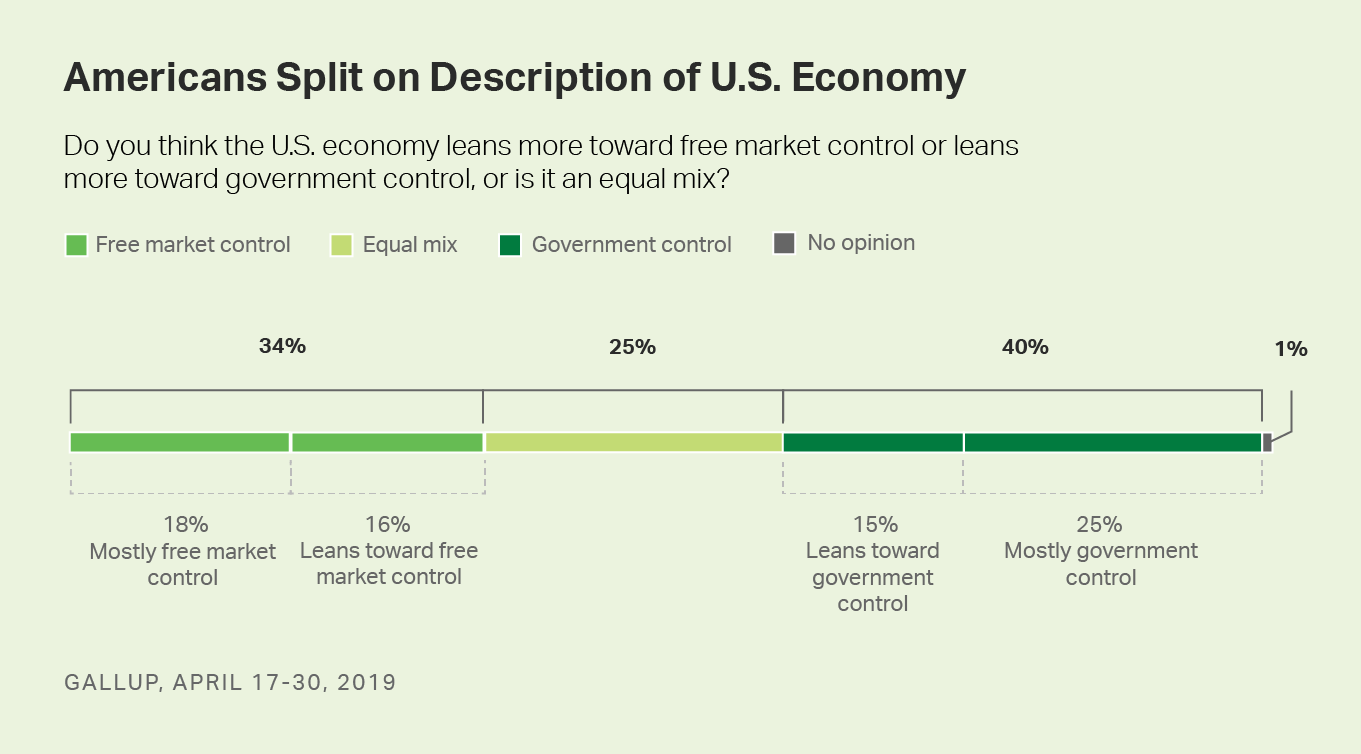
Americans split on viewing economy as free market or government controlled
WASHINGTON, D.C. -- Americans today are more closely divided than they were earlier in the last century when asked whether some form of socialism would be a good or bad thing for the country. While 51% of U.S. adults say socialism would be a bad thing for the country, 43% believe it would be a good thing. Those results contrast with a 1942 Roper/Fortune survey that found 40% describing socialism as a bad thing, 25% a good thing and 34% not having an opinion.
More Americans Now See Socialism as a Good Thing for the Country
Would some form of socialism be a good thing or a bad thing for the country as a whole?
1942
2019
Change
%
%
pct. pts.
Good thing
25
43
+18
Bad thing
40
51
+11
No opinion
34
6
-28
Net "good thing"
-15
-8
+7
Note: 1942 data gathered by Roper Center for Public Opinion Research
GALLUP
The Roper/Fortune survey is one of the oldest trend questions measuring attitudes on socialism in the U.S. Gallup's update of the question in an April 17-30 survey finds Americans more likely to have an opinion on the matter now, as well as a smaller gap in the percentage calling socialism a bad thing vs. a good thing.
Previous Gallup research shows that Americans' definition of socialism has changed over the years, with nearly one in four now associating the concept with social equality and 17% associating it with the more classical definition of having some degree of government control over the means of production. A majority of Democrats have said they view socialism positively in Gallup polling since 2010, including 57% in the most recent measure in 2018.
Outlook on Socialism Around the World
The April 17-30 survey also updates another historical question on socialism. Gallup first asked Americans in 1949 about their outlook on the spread of democracy over the next 50 years. At that time, seven in 10 Americans (72%) predicted that most countries in the world would have a democratic government. It's important to note that in much of the political rhetoric of the time, the terms democracy and capitalism were more intimately intertwined than they are today, perhaps synonymous to many.
Americans' Views on Future of Democracy and Socialism Globally
During the next 50 years, do you think most of the nations of the world will have a democratic government, a communist government or a socialist government?
1949
2019
Change
%
%
pct. pts.
Democratic
72
57
-15
Socialist
14
29
+15
Communist
9
6
-3
No opinion
5
8
+3
GALLUP
The current update on this question finds a marked increase in the percentage saying that most countries during the next 50 years will have a socialist government (29%). It is unclear whether this is due to the flourishing of democracies -- particularly in Europe and Latin America -- led by what are often described as social democrats, or whether a fundamental shift is taking place among some Americans in their views of socialism.
Government vs. Free Market
In the same April survey, Gallup asked Americans whether they would prefer mostly free market or government control over several economic and societal activities. Americans are most likely to prefer free market control in the areas of technological innovation and the distribution of wealth. Majorities also want the free market to drive the economy overall, wages, higher education and healthcare.
Preference for the government to serve as the primarily responsible actor only garners majority support for protecting online consumer privacy and the environment.
Majority Want Free Market to Lead on Many Fronts
Would you prefer to have the free market or the government be primarily responsible for what happens in each of the following areas?
Free market
Government
Net "free market"
%
%
pct. pts.
Technological innovation
75
19
+56
The distribution of wealth
68
28
+40
The economy overall
62
33
+29
Wages
62
35
+27
Higher education
56
41
+15
Healthcare
53
44
+9
Protecting consumers' privacy online
40
57
-17
Environmental protection
30
66
-36
GALLUP, APRIL 17-30, 2019
Notably, more Americans favor free market than government control over healthcare and higher education, two areas in which Democratic politicians have made proposals to greatly expand government involvement. But at least four in 10 Americans appear sympathetic to policies that would increase the government's role in those areas.
While there is ample support for a market-driven approach to many of the issues cited above, Americans are divided on how they describe the current state of the U.S. economy. When asked whether they think the U.S. economy leans more toward free market control or toward government control, 40% say it leans more toward government control while fewer say it leans toward free market control (34%). One in four describe it as an equal mix.
Bottom Line
Americans' views on socialism are complex. While some recent data can easily lend to overstated conclusions, there are marked changes in Americans' views of socialism when taking a longer, more historical look at the data. However, exactly what Americans mean by the term is nuanced and multifaceted. While half of Americans consider socialism as bad for the country, nearly two-thirds say that the U.S. economy is more influenced by the government than the free market, or that it reflects an equal mix of the two.
Additionally, while a majority of Democrats view socialism positively, that is not a major change in the eight years Gallup has tracked this metric. The major shift over this time has been the reduced rate of Democrats who now view capitalism positively (47%).
These data alone make it hard to generalize a simplistic conclusion about Americans' opinions of, and willingness to entertain, socialism. But there are a few clear takeaways. About four in 10 Americans are accepting of some form of socialism or socialist policies, and Democrats currently have a more positive view of socialism than capitalism. In addition, the April survey found that 47% of Americans say they would vote for a socialist candidate for president. While that figure represents nearly half of the U.S. adult population, even higher percentages say they would vote for an atheist (58%) or Muslim (60%) presidential candidate.
However, when they are asked what role they would like to see the government play in certain areas of society, Americans continue to endorse the free market.
Shifting attitudes about socialism, capitalism, and the current economic and political systems in America -- as well as what alternatives many see as solutions for current shortcomings -- will continue to be a major focus for Gallup.
Socialism always fails, and a lot of time is being spent these days trying to explain to a generation of young voters why that is always the case.
Not only does socialism fail from an economic standpoint, but oftentimes it also is a source of pain and oppression for the masses.
And yet here we are, with Sen. Bernie Sanders, I-Vt., Rep. Alexandria Ocasio-Cortez, D-N.Y., and those among the far left making socialism more acceptable and even chic in some circles — socialist hipsters, basically.
There is a ton of work still to do to help younger Americans understand how Venezuela and Cuba ended up being such horrible places (in some cases, we even have to explain that yes, indeed, these are horrible places). Until Venezuela was in the news on a regular basis because of the approach of its people toward starvation, as well as the expropriation and daily tyranny from Chavez-Maduro regime, there were plenty of intellectuals praising the system. And let’s not forget the praises or lack of condemnation for the oppressive regime that is Cuba coming from many world leaders after Fidel Castro finally died.
So yes, there is a lot of work to be done. However, if that’s all we do in response to AOC and Sanders promising Americans that a socialist regime will produce a world where everyone works less, earns more, gets free healthcare and schooling, and receives generous subsidies from the government even when one decides not to work, no one tempted by socialism will listen.
The Swedish Model
That’s because when Sanders and his ilk talk about socialism, they aren’t talking about expropriating property rights, nationalizing all businesses, or eliminating all but one — the state’s — television channel. They aren’t talking about Venezuela or Cuba. Instead, they are talking about Denmark and Sweden.
It is true that Sanders and his people fail to understand that socialism exists on a spectrum. On one side you have the dictatorships, while on the other side you have the social democracies. Both sides of the spectrum use oppression and compulsory taxation to achieve their goals. But the degree to which they do so varies a great deal.
This variation in socialist methods gives rise also to variation in the legitimacy of different degrees of socialism. No one seriously ever thinks of French president Emmanuel Macron as a despot (even though his own people happen to call himtyrannical on a regular basis) in spite of the gigantic size of the French state and the enormous amount of taxes extracted by the regime. One side allows elections, the other side either forbids them or makes a mockery of the concept.
Yet, it is also true that all varieties of socialism fail to achieve their goals for the same reason: All varieties attempt, to one degree or another, to substitute the decisions of government planners for those of private citizens interacting in competitive markets.
And in doing so, all varieties of socialism suffer from the insurmountable knowledge problem, as beautifully demonstrated by the late economist Don Lavoie in his book 1985 book, National Economic Planning: What is Left?
That said, there is still a vast difference between Venezuela and Denmark in terms of how much of the economy planners try to control and, as a result, how much of the economy planners destroy. I worry that if we keep talking as if today’s American Democrats envision controls as extensive as exist in Venezuela, those of us who warn of the dangers that lurk in the schemes of Sanders and AOC won’t get through.
The French Model
In addition to this difficulty is the fact that while they claim that they are talking about Nordic countries, what Sanders and AOC actually have in mind is a regime more like that of France. When Sweden and Denmark each had in place a regime closer to what Sanders is talking about, the results were so bad that each of these countries put in placepretty dramatic free-market reforms. These two countries are by no means libertarian paradises, but thanks to large spending cuts and lower taxes, they aren’t the hot mess that they once were.
France is, though, such a mess. That’s because there is one aspect in particular that the AOCs and Sanderses of the world fail to mention to their followers when they talk about their socialist dream: All of the goodies that they believe the American people are entitled to receive in fact come at a great cost — and so the only way to pay for these goodies is with oppressive and regressive taxes (i.e., taxes heaped on to the backs of the middle class and the poor).
France was once a role model for what big government can do for its people. But it has become an embarrassing example since “The Gilets Jaunes” took to the streets to demonstrate against the insane amount of taxes they pay. These guys aren’t upper class. They are the people who have until now supported the policies that are inevitable when you have the government providing so many services and involved so deeply in so much of the economy.
The Organization for Economic Cooperation and Development (OECD) released its annual Revenue Statistics report this week, and France topped the charts, with a tax take equal to 46.2% of GDP in 2017. That’s more than Denmark (46%), Sweden (44%) and Germany (37.5%), and far more than the OECD average (34.2%) or the U.S. (27.1%, which includes all levels of government).
France doesn’t collect that revenue in the ways you might think. Despite the stereotype of heavy European income taxes on the rich, Paris relies disproportionately on social-insurance, payroll and property taxes. Social taxes account for 37% of French revenue; the OECD average is 26%. Payroll and property taxes contribute 3% and 9%, compared to the OECD averages of 1% and 6%.
As a reminder, the payroll tax is very regressive; it consumes a larger share of low and middle class earners than rich people. In addition:
Then Europe adds a regressive consumption tax, the value-added tax. In France, VAT and other consumption taxes make up 24% of revenue, and that’s on the low side compared to an OECD average of 33%. Consumption taxes often fall hardest on the poor and middle class, who devote a greater proportion of their income to consumption.
To be sure, the spending is also more regressive in France in that the biggest share goes to the middle and low-income earners. But it is a stupid system in which you tax one group to redistribute to that same group.
Add one more increase to an already high (and regressive) gas tax in France to the existing 214 taxes and duties and the people went nuts. They have been protesting continuously since November 17th, 2018. I don’t condone the violence, but I understand why the protestors are so furious.
Regimentation in Labor
Their anger is further fueled by the very rigid labor market. France has all sorts of labor regulations on the books: some preventing firms from firing workers and, hence, creating a disincentive to hire workers in the first place. Other regulations, such as the minimum wage, that make the cost of employing people so high that employers don’t employ people. It is also not surprising that so many fast food restaurants in France have replacedemployees with robots.
Like other countries, the French also have all sorts of “generous” family friendly laws that end up backfiring and penalizing female employment. The French government is also very generous to those people who don’t work. All of these policies make the lives of lower and middle-class people harder, unemployment is high (24.5 percent for young French people) and economic growth has been anemic for decades.
The bottom line is this. All those people in America who currently fall for the socialism soup that AOC and Sanders are selling need to realize that if their dream came to pass, they, not the rich — not the bankers and politicians — will be ones suffering the most from the high taxes, high unemployment, and slow growth that go hand in hand with the level of public spending they want.
Everyone would suffer, of course. But those who will be screwed the most are definitely those at the bottom.