Our goal is to have intelligent discussion of the topics of the day. We realize everyone has their opinion and they should be allowed to express it in a discussion forum without calling each other names. We learn from discussion and not from name calling or argument.We use cookies to personalise content and ads, to provide social media features and to analyse our traffic. We also share information about your use of our site with our social media, advertising and analytics partners. See details
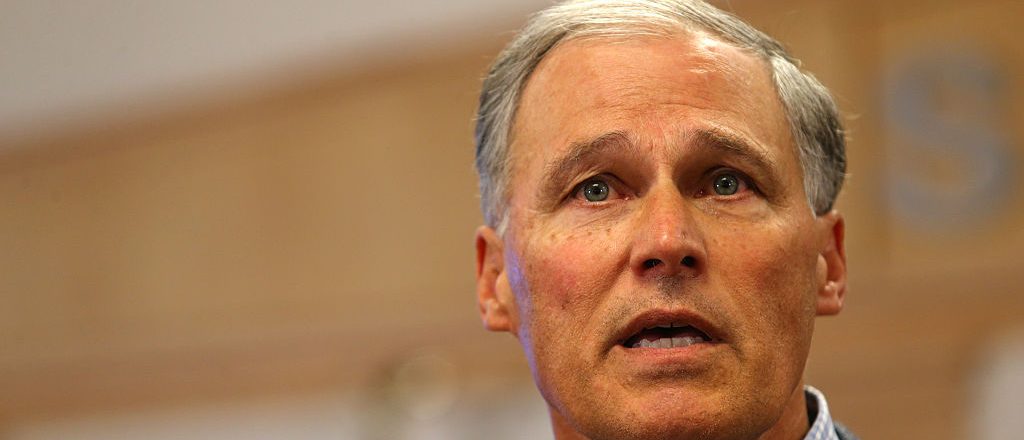
Washington state’s Democratic Governor Jay Inslee warned there was “just 59 days” to save future generations from “an endless cycle of crop-killing droughts one year, and rivers spilling their banks the next.”
Inslee went on a lengthy Twitter rant in efforts to convince the state legislature to pass legislation to tax carbon dioxide emissions. Washington residents voted down Inslee’s last carbon tax plan by a wide margin in 2016.
The state legislature’s session ends in 59 days, on March 8. Democrats have a slim majority in both state legislative chambers.
Inslee wants lawmakers to pass a tax on carbon dioxide emissions from power plants and industrial facilities.
Inslee’s plan would tax carbon dioxide emissions at $20 a ton in 2019, that would gradually rise at 3.5 percent above inflation each following year. Inslee’s office estimates it will raise $3.3 billion over the next four years.
About $950 million would go toward education programs. The rest would go toward green energy programs and research, water infrastructure, wildfire mitigation. Some money would offset taxes or go to poor families.
The plan could raise household electricity prices five percent, and gas prices by about 10 percent, according to official estimates.
Inslee’s first carbon tax plan failed in 2016 after liberal groups couldn’t agree how to spend the revenues it was expected to raise. Inslee also proposed a cap-and-trade program, that both Democrats and Republicans rejected in 2015.
If Inslee’s carbon tax plan passes, the legislation would have no measurable impact on projected future global warming. Indeed, even if the U.S. as a whole stopped emitting, the impact would be extremely small, based on government climate models.
A fool's errand: Al Gore's $15 trillion carbon tax
by Fred Palmer | May 9, 2017, 5:00 AM Share on Twitter Share on Facebook Email this article Share on LinkedIn
Al Gore wants to reverse modernity and save the world from itself through an elimination of its fossil-fuel-based energy system. During the final week of April, his newly created Energy Transitions Commission released a document setting forth a fool's-errand pathway to "decarbonize" the world's energy system.
If this sounds familiar, it is. Gore's plan features a new, sophisticated, and expensive public-relations campaign, but it's all based on his views on carbon dioxide first broached in his 1992 book Earth in the Balance, which he reissued in 2000 for his failed presidential campaign. The subsequent efforts made by Gore during the past 25 years have transformed little from their genesis, and he remains as tragically wrong today as he was when he first surfaced as an opponent of everything linked to carbon-dioxide.
If you scroll through the verbiage surrounding the document, you will find the core policy recommendation is a massive, punishing carbon tax. Gore would start the tax at $50 per ton, which would increase to $100 per ton over time, essentially destroying the market for continued robust development of the world's fossil-fuel base. Our economic growth and personal well-being depends on robust fossil-fuel use, so Gore's plan would destroy these as well.
But, don't worry! The all-in estimated cost to re-engineer humanity is only a mere $15 trillion—enough money to give every man, woman, and child in the United States more than $46,000.
Al Gore has been demonizing fossil fuels and attempting to marginalize all those involved in the traditional energy sector since 1988, the year the climate-change movement was rolled out in Washington, D.C., which happened to correspond with a nationwide heatwave and with Yellowstone in flames. Ever since, Gore's pathway to political power and personal riches has been a successful one, to be sure, but his multi-trillion-dollar effort today is his most sophisticated effort to date. Unfortunately for him, it will also fail, because what he's selling in his "new" proposal is bad for the people being asked to embrace it.
Over the years, Gore has emerged in many contexts in his effort to eradicate carbon-dioxide emissions, a benign gas required for all life to thrive on Earth—plant, animal, and human alike. It has never mattered to Gore that ordinary people everywhere have been hurt and will continue to be hurt by his continual efforts to make fossil-fuel energy expensive and that the poorest among us are harmed the most by the energy policies he supports.
The anti-humanity proposals in Gore's latest initiative have as one of their chief goals the elimination of fossil fuels, full stop. Gore does allow for greater use of natural gas into the 2030s, but he eliminates coal right away. He also allows for oil use to grow into the mid-2020s, but "decarbonize" means just that; his plan inevitably ends with a phase-out of fossil-fuel use. Fortunately for us all—and make no mistake about it, the American people understand this—the fossil-fuel-free future Gore imagines is not supported by observation-based science, and it is contradicted by all the evidence we have gained from recorded human history.
April 22 was the 47th anniversary of the first Earth Day, which occurred in 1970. Since that day, the number of people on Earth has increased from 3.7 billion to 7.5 billion, and average life expectancy for all the world's people has risen by 11 years, to 67 years old. Likewise, food production has soared and energy production and consumption, mostly thanks to fossil fuels, has increased by more than four times.
Since the first Earth Day, the natural environment has improved substantially, through urbanization, and the biosphere and agriculture are more robust. Earth is greener, because of the additional carbon dioxide in the air, as numerous studies now show.
Since the first Earth Day, the flawed computer models backed by radical environmentalists have failed continuously, and we now know they can never serve as a reliable tool to make policy judgements governing the future of human life on Earth.
And since the first Earth Day, we can now say with confidence that all these positive developments have resulted from, or are closely linked to, the robust use of fossil fuels, including oil, natural gas, and coal.
The world is blessed with an abundance of fossil-fuel reserves, which allow the billions of people alive today and the billions yet to come to enjoy longer and better lives. They will continue to provide additional energy to grow food, resources to build cities, and by helping urbanization, they will allow the natural environment to improve, as it has for decades.
Gore's $15 trillion carbon tax should and will be rejected for the phony, radical environmental vision it represents.
Fred Palmer (fpalmer@heartland.org" target="_blank">fpalmer@heartland.org) is a senior fellow for energy policy at The Heartland Institute, a free-market think tank founded in 1984 and based in Arlington Heights, Illinois.
Former White House advisers, cabinet secretaries pressing tax
Trump’s economic adviser Gary Cohn among scheduled attendees
Mute
Current Time2:08
/
Duration Time4:14
Loaded: 0%
Progress: 0%
Ivanka Trump: The Quiet Power Behind the President
The One Idea Climate Change Adversaries Agree On
A group of prominent Republicans and business leaders backing a tax on carbon
dioxide were taking their case Wednesday to top White House aides, including
chief economic adviser Gary Cohn.
The group, including former Treasury Secretaries Hank Paulson and James Baker,
is pressing President Donald Trump to tax carbon dioxide in exchange for
abolishing a slew of environmental regulations. They unveiled their plan with a
press conference in Washington and an op-ed in the Wall Street Journal.
"We know we have an uphill slog to get Republicans interested in this," Baker said
before heading to the White House. But "a conservative, free-market approach is
a very Republican way of approaching the problem."
Other possible attendees at the meeting include the president’s daughter, Ivanka
Trump, who weighed climate change policy during the campaign, and Vice
President Mike Pence.
The Republican and business leaders, calling themselves the Climate Leadership
Council, lend their stature to an approach for addressing climate change that
mirrors an idea already advanced by Exxon Mobil Corp. Supporters say the tax
is a conservative solution to climate change that replaces a regulatory regime
with a free-market approach for addressing the greenhouse gas emissions.
Wal-Mart Founder
Paulson, who served as Treasury secretary under President George W. Bush,
previously has advocated a carbon tax through his eponymous think tank, the
Paulson Institute. Baker, who served as secretary of state and Treasury secretary
under two Republican administrations, as well as former Secretary of State
George Shultz, Wal-Mart Stores Inc.founder Rob Walton and Sequoia Capital Operations LLC partner Thomas Stephenson, among others. Economic advisers
to former presidents George H.W. Bush and Ronald Reagan also are involved in the
effort.
"Climate change poses an unacceptable risk to our climate and to our economy,"
Paulson said in a statement. "Putting a price on carbon is by far the most efficient
and effective way to restrict emissions."
Baker himself conceded he remains "somewhat of a skeptic about the extent to
which man is responsible for climate change" but the "risks are too great to ignore."
The plan faces strong political headwinds; both Trump and a majority of the House of Representatives have come out against a carbon tax in the past year.
Trump also has pledged to do away with environmental regulations limiting
emissions of carbon dioxide
But the idea of a carbon tax, long favored by economists as the most
straightforward way to address climate change, could gain traction as part
of a broad tax overhaul on Capitol Hill.
The blueprint involves a $40 tax on every metric ton of carbon dioxide released
by burning fossil fuels, with the price climbing over time. To avoid an undue
burden on the poor from the higher energy bills that would result, the projected
$200 billion to $300 billion in annual revenue would be redistributed to households
in the form of quarterly checks from the Social Security Administration. Families
of four would see an average annual payout of $2,000 under the plan.
The proposal also calls for border adjustments that would act to hike the costs
of products imported from countries that do not put a price on carbon.
Martin Feldstein, who headed former President Ronald Reagan’s Council of
Economic Advisers, said the tax would be imposed at the point fossil fuels
enter the economy, such as when oil leaves the refinery or coal leaves the mine.
"The tax at the source is then built in to the prices of the products made from
that raw material," Feldstein said.
Romney Tweet
Former Republican presidential candidate Mitt Romney described the proposal
in a tweet as a "thought-provoking plan from highly respected conservatives to
both strengthen the economy and confront climate risks."
The group envisions the carbon tax taking the place of an array of Obama-era
environmental regulations that raise the cost of fossil fuels. The centerpiece of
President Barack Obama’s climate agenda, the Clean Power Plan slashing
emissions from electricity, would be immediately repealed, while others would
be phased out over time. U.S. companies emitting carbon dioxide also could win
Tillerson, Exxon’s former chief executive, previously acknowledged the climate
is changing and described a carbon tax as the most efficient means of embedding
its cost in economic decisions stretching from oil companies to consumers.
Oil Companies
BP Plc has said a well-constructed carbon tax or cap-and-trade system would
encourage energy producers and consumers to pare emissions, while Royal Dutch Shell PlcChairman Charles Holliday has called a carbon tax the most effective
and practical way of driving that change.
It is unclear how the new plan will be received by Republicans in the White House
and on Capitol Hill.
The Republican-led House last June approved a non-binding resolution condemning the idea of a carbon tax as "detrimental to American families
and businesses." The measure, which passed 237-163, was designed to lock
in lawmakers’ positions, making it harder for those who lodged a vote opposing
a tax to support one later on.
The approach also runs counter to Trump’s campaign promise to help bring
back coal mining jobs. Because it generates more carbon dioxide emissions
than natural gas and oil, coal would be the fossil fuel hardest hit by a tax on carbon.
Opponents fear that with the foundation laid now, lawmakers could seize on a
carbon tax as a potent source of revenue to offset rate reductions during a future
congressional debate on overhauling the tax code.
"This is not a climate proposal; it’s a tax proposal," said Thomas Pyle, head of
the free-market advocacy group American Energy Alliance. "There’s no need to
trade Obama’s climate regulations for a carbon tax. Donald Trump has already
promised to undo them."
The idea of scuttling carbon dioxide regulations also is a non-starter with many
environmentalists who could be critical to advancing the tax idea.
“We have a moral obligation to protect future generations from the growing
dangers of climate change,” said Rhea Suh, president of the Natural Resources
Defense Council. “Effective action means building on the progress we’re
already making — not sacrificing those gains by weakening the laws Congress
has already passed.”
But a carbon tax has gained traction in some circles. Republican Bob Inglis, a
former representative from South Carolina, has pitched the tax as a free-market
solution to climate change. Tesla Inc. founder Elon Musk also has pressed the
Trump administration on the issue. It could benefit his electric vehicle business
by driving more consumers away from gasoline-fueled automobiles.
The issue divides the oil industry; though Exxon Mobil is just one of several
large integrated companies that favor a carbon tax, the idea is opposed by
many independent producers that do not own pipeline and refining operations.