Contact Form

Name

Email *

Message *

Showing posts with label Corbyn. Show all posts

Monday, February 18, 2019

A Warning For All Americans

Analysis: Democrats at the crossroads – will the party remain a home for Jews?
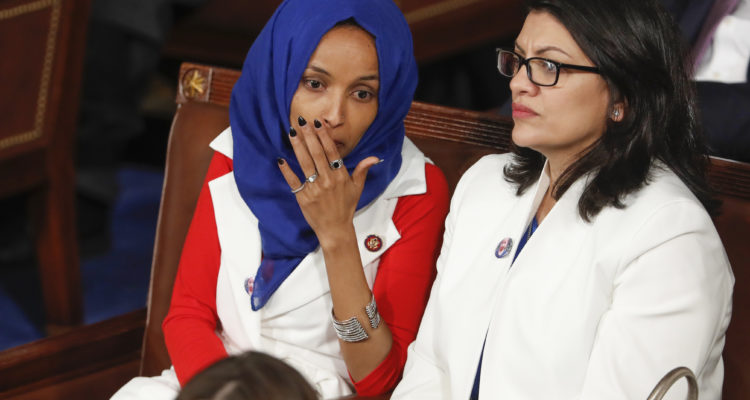
America’s Democratic Party leadership must deal with the budding weeds of anti-Semitism now or risk going the way of Britain’s Labour.
By Daniel Krygier, World Israel News
The American Democratic Party has traditionally seen itself as an embodiment of tolerance and a natural political home for minorities. As a result, generations of U.S. Jews have loyally voted for the Democratic Party. However, dark clouds of radicalization have wafted into the party’s halls. A growing tolerance for intolerance, especially Islamist anti-Semitism, raises a disturbing question mark as to whether it will remain a viable home for Jews. 
The ascent of anti-Israel and anti-Jewish bigots, including freshman Democratic congresswomen Ilhan Omar and Rashida Tlaib, is bringing the Democrats to a crossroads – will the party reject further radicalization or will it go down the slippery slope of bigotry and embrace rank anti-Semitic British-style Corbynism?
Some would scoff at the idea that the Democratic Party could go the way of Britain’s Labour party. But look at what happened there. Little over a decade ago, Labour couldn’t be more mainstream, headed by leaders like Tony Blair and Gordon Brown. Now it is a party of crackpots and anti-Semites.
Under the leadership of its current leader, Jeremy Corbyn, the party has embraced the ideology of the extreme global left. Anti-Americanism and anti-Jewish bigotry, twin characteristics of leftist radicalism  have enveloped Britain’s Labour.
British Jews, like American Jews, tend to be liberal, and they voted loyally for the Labour Party. Now they’re leaving Labour in droves. The British Labour party is a window into the dark future that awaits the U.S, Democratic party if it does not face down the radical, anti-Semitic threat bubbling up from within. 
The signs so far are not good. The Democrats initially rushed to Omar’s and Tlaib’s defense, denying there was anything anti-Semitic about earlier remarks they had made. Only after much foot-dragging did they condemn Omar’s classic anti-Semitic trope about AIPAC buying influence, which she then followed with a half-hearted apology – one the president correctly called out as “lame.”
Democrats will be tempted to ignore anti-Semitism even more as the U.S. Muslim population grows. It’s still relatively small compared to the much larger number of European Muslims. However, the U.S. Muslim population is growing fast and is expected to outnumber American Jews within a generation. If Tlaib and Omar are any indication, it is a population with an anti-Semitism problem.
However, that doesn’t mean Democrats must kow-tow to it. Indeed, many Muslim Americans do not share the radical Judeo-phobic worldview of Omar and Tlaib. They merely want to improve their socio-economic situation in America, to get ahead and give their children a better future. It’s up to the Democrats to decide whether to pander to the darker forces within that population or to appeal to the better angels of their nature.
As a result, the Democratic party should resist the populist extremist positions of Omar and Tlaib in favor of genuine co-existence and tolerance. The short-term gains the Democrats may feel from brushing away the anti-Jewish bigotry of their newest members risks harming the long-term viability of their party.
As the saying goes, what starts with the Jews does not end with the Jews. This is the reason why the radicalization of the Democratic party should concern all Americans and not just Jews. Unlike the dire situation in Britain’s Labour party, the radicalization of the Democrats is far from a done deal. But to stop it, party leaders must take action now. a

Sunday, June 4, 2017

If Someone Is Anti-Israel Are They Not Also Anti-Semitic

On June 8, British voters will head to the polls, three years early. When Prime Minister Theresa May called last month for a snap election, the assumption was that she would win easily and increase her parliamentary majority. Recent numbers, however, show the gap closing between May and Labour leader Jeremy Corbyn.
Corbyn – who was given 200:1 odds of when he ran for the party leadership in 2015 – is doing surprisingly well again. This is despite the fact that Labour has been under fire for anti-Semitism in its ranks, and Corbyn himself has been accused of anti-Jewish bigotry. Corbyn denies having a problem with Jews, claiming that he is merely anti-Israel. Even if it were possible to hate Israel without being anti-Semitic – and I am not sure that it is – Corbyn's words and deeds demonstrate that he often uses virulent anti-Zionism as a cover for his soft anti-Semitism.
For example, in a speech last year, he said that Jews are "no more responsible" for the actions of Israel than Muslims are for those of ISIS. In 2009, he announced: "It will be my pleasure and my honour to host an event in Parliament where our friends from Hezbollah will be speaking. I also invited friends from Hamas to come and speak as well."

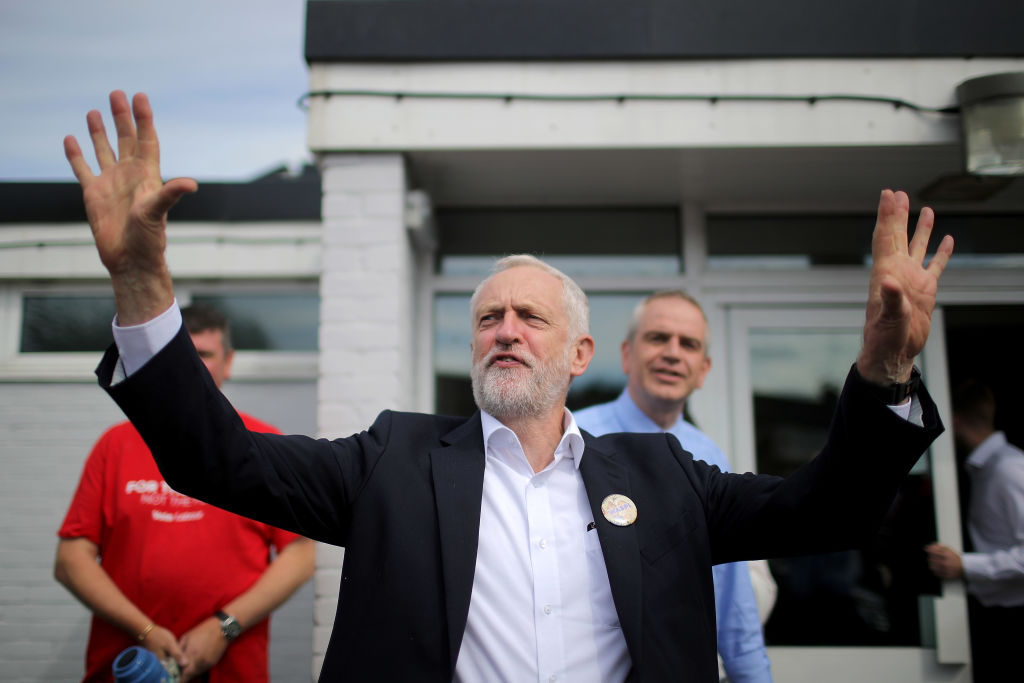
Labour Party leader Jeremy Corbyn. When British voters go to the polls on June 8, will they opt to keep Prime Minister Theresa May in power, or reject rationality in favor of intolerance? (Photo by Christopher Furlong/Getty Images)

The company that Corbyn keeps, too, suggests that at best he gives a free pass to bigotry, racism and anti-Semitism within the ranks of his own party, and at worst, he espouses them. He has shared speaking platforms and led rallies with some of the most infamous Jew-haters. He has attended meetings hosted by 9/11 conspiracy theorist Paul Eisen, author of a blog titled: "My Life as a Holocaust Denier." He has been associated with Sheikh Raed Salah – leader of the outlawed northern branch of the Islamic Movement in Israel, a blood libel perpetuator convicted for incitement to violence and racism – whom he referred to as a "very honoured citizen" whose "voice must be heard." Corbyn was also a paid contributor for Press TV, Iran's tightly controlled media apparatus, whose production is directly overseen by anti-Semitic Supreme Leader Ali Khamenei.
One of the biggest criticisms of the "Corbynization" of British politics has been the mainstreaming of traditional anti-Semitism. The country's chief rabbi, Ephraim Mirvis, has called the problem within the Labour party "severe."
Consider the late Gerald Kaufman, a Labour veteran and close political associate of Corbyn's who touted conspiracy theories about Jews throughout his political career. When speaking at a pro-Palestinian event, Kaufman said: "Jewish money, Jewish donations to the Conservative Party – as in the general election in May – support from the Jewish Chronicle, all of those things, bias the Conservatives." While Corbyn condemned this remark, he refused to yield to widespread demands for disciplinary action against Kaufman. This is in keeping with what a key former adviser to Corbyn, Harry Fletcher, wrote: "I'd suggest to him [Jeremy] about how he might build bridges with the Jewish community and none of it ever happened."
Let's be clear: I do not believe that Corbyn's rise in the polls is due to his hatred of Jews and Israel, but rather in spite of it. May called for elections and then refused to debate her opponents. She is running a lacklustre campaign somewhat reminiscent of U.S. Democratic Party candidate Hillary Clinton's last year. For his part, Corbyn is a populist, like U.S. President Donald Trump. Although politically polar opposites, they have much in common, such as a penchant for shooting from the hip and unpredictability.
Furthermore, many British voters are unaware of Corbyn's anti-Semitic associations. Others know, but don't care. Those on the hard-Left, such as union activists and academics, include knee-jerk opponents of the nation state of the Jewish people and supporters of academic and cultural boycotts of Israel. Many of these favor trade and engagement with such egregious human-rights violators as Iran, Cuba, China, Russia, Belarus and Venezuela. Singling out Israel – the Middle East's only democracy, with one of the world's best human-rights records, rule of law and concern for enemy civilians — for boycotts itself is a form of anti-Semitism.
Corbyn himself has called for boycotts of the Jewish state. He has advocated for an arms embargo, citing Israel's supposed "breach" of the human-rights clause of the EU-Israel trade agreement. He also led the call to boycott Israel's national soccer team in the European Championship in Wales. (Ironically, Israel only plays in this league because it was expelled from the Asian Football Confederation due to the Arab League's boycott.)
Corbyn, as well, has been a vocal supporter of the so-called Palestinian "right of return," something that would lead to an Arab majority and Jewish minority within Israel, and render the two-state solution completely obsolete.
Whether anti-Semitism is the cause or effect of the Labour party's problem is not important. What is relevant is that Corbyn not only has not stemmed the tide, but has played a big part in perpetuating it.
British voters now have the opportunity to choose where they will go as a nation. Will they opt to move away from stability, rationality and tolerance toward simple mindedness and xenophobia? I sincerely hope not.
Bernie Sanders has already made his choice. He is campaigning for Corbyn despite his record on anti-Semitism. Sanders will have to explain why a Jew is helping to elect a bigot with the views Corbyn holds about the Jewish people and their nation state.
  • Follow Alan M. Dershowitz on Twitter
© 2017 Gatestone Institute. All rights reserved. The articles printed here do not necessarily reflect the views of the Editors or of Gatestone Institute. No part of the Gatestone website or any of its contents may be reproduced, copied or modified, without the prior written consent of Gatestone Institute.wha

Thursday, June 1, 2017

Will Theresa May Be Re-Elected

May’s U.K. Election Gamble Imperiled

Prime Minister Theresa May’s bet that she could bolster her parliamentary majority ahead of Brexit talks now looks dicey

Britain's Prime Minister Theresa May answers questions during a campaign appearance at a manufacturer in Bath, England, on Wednesday.
Britain's Prime Minister Theresa May answers questions during a campaign appearance at a manufacturer in Bath, England, on Wednesday. PHOTO: LEON NEAL/AGENCE FRANCE-PRESSE/GETTY IMAGES
LONDON—For British Prime Minister Theresa May, what looked like a sure thing is 
starting to look more like a gamble.
When she called an election on April 18, some opinion polls showed her Conservative 
Party leading the main opposition Labour Party by more than 20 percentage points. 
That would have expanded her working majority in the House of Commons from 17 
seats to as many as 150.
Just a week before the vote, many of those polls show that lead has shrunk to single
 digits—though none point to an outright Labour win. On Thursday, polling firm
 YouGov PLC said her advantage had dwindled to 3 percentage points and suggested
 her party could lose seats. That would deprive her of the solid majority she says
 is essential in looming Brexit talks with the European Union.
Failing to win big would be a blow for the prime minister, who led her party into this
 election hoping to exploit the apparent unpopularity of Labour and its leader Jeremy
 Corbyn, a veteran left-winger beloved by young activists but less popular than
 Mrs. May among most voters.
“If it looks like it was in the bag and it was mishandled, then that’s not going to give
 her the same authority within the party,” said Anthony Wells, director of political
 and social research at YouGov.
Mrs. May’s failure to maintain 
her lead in the polls is the result of Conservative missteps and a better-than-expected public reception for Labour, analysts say.
The prime minister began her campaign with a focus on leadership, contrasting her experience in government with Mr. Corbyn’s lack of it. But her party’s manifesto, published in the week before a suicide bomber killed 22 in Manchester, was poorly received. The slip was blamed on a complex plan to finance elderly care, a proposal that bombed with graying voters.
Labour’s manifesto was packed with clear policies with broad appeal, especially to those who had voted Labour in the past but hadn’t made up their minds. The party said it would nationalize railways and pay for college tuition and child care.
At campaign stops and on television debates, Mr. Corbyn’s avuncular style contrasted with Mrs. May’s stilted performances and her repetition of her mantra of “strong and stable government.”
Her opponents have seized opportunities to turn Mrs. May’s emphasis on leadership against her. “The first rule of leadership is to show up,” said Caroline Lucas, co-leader of Britain’s Green Party, at a television debate Wednesday night attended by all party leaders except Mrs. May.
YouGov’s poll was accompanied by an analysis projecting the makeup of the next Parliament based on a separate and ongoing survey of as many as 50,000 voters. Its modeling suggested the Conservatives are on course to win 317 seats at the election June 8. That is 13 fewer than the party currently holds and short of the 326 needed to secure a majority in the 650-seat House of Commons.
YouGov cautioned that the projection is a median estimate and the same modeling yielded a range of gains and losses for the Conservatives, from a low of 285 seats to a high of 353.
The election will also be seen as a fresh test for pollsters in Britain, who have been revamping their methods after Mrs. May’s predecessor, David Cameron, defied expectations to win a comfortable victory in 2015. Polls also underestimated the strength of voters’ support for Brexit ahead of last year’s referendum.
A multitude of other surveys published by rival polling firms show a wide variation, with a Panelbase survey Thursday giving the Conservatives an eight-point lead. Analysts say the variation reflects differences in how results are weighed to reflect factors including voter turnout among different groups.
With her poll lead slipping, Mrs. May has tried to wrest the election debate back to Brexit, perceived as her strongest card, and to play down the surveys. At a recent campaign event, she fielded questions from factory workers, a format that contrasted with her more stage-managed appearances before party loyalists and media.
Parliamentary PopularityThe Conservative Party gained ground after Theresa May became prime minister in July,but its lead has shrunk in recent weeks.Party support, 14-day moving averageTHE WALL STREET JOURNALSource: WSJ average of opinion polls from BMG, ComRes, GfK, ICM, Ipsos Mori, Kantar TNS, ORB, Opinium, Panelbase, Survationand YouGov
%ConservativeLabourLib. Dem.UKIPJune ’16Aug.Oct.Dec.Feb. ’17AprilJune01020304050Brexit voteJune 23, 2016Election announcedApril 18, 2017
“There’s only one poll that matters and that’s the poll that’s going to take place next Thursday,” Mrs. May said Thursday at a speech deep in Labour territory in northeast England.
Some Conservative candidates say the narrowing in the polls is helping encourage supporters and wavering voters to cast ballots rather than stay home.
Jacob Rees-Mogg, a Conservative lawmaker, said that with the prospect of a Labour government negotiating Brexit there has been a shift back to the party and Mrs. May.
“Corbyn and Brexit remain absolutely at the heart of the campaign,” Mr. Rees-Mogg said. “That is why I think the Conservatives will win—Corbyn is ultimately very unpopular and people want a good Brexit negotiation.”