Contact Form

Name

Email *

Message *

Showing posts with label Jamie Dimon. Show all posts

Tuesday, May 7, 2019

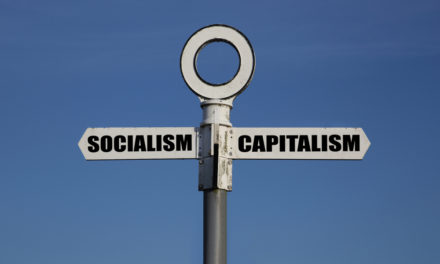
Capitalism Works. Socialism Doesn't

Warren Buffett Blasts Socialism: Capitalism ‘Absolutely a Miracle’ for the US

Warren Buffett Blasts Socialism: Capitalism ‘Absolutely a Miracle’ for the US
Warren Buffett rejected socialist ideas gaining momentum among the far left, delivering a resounding endorsement of capitalism and the free market on Monday in an interview with CNBC.
“If you look at what was here in 1776 and you look at what’s here now, this country has done an incredible job in terms of the deployment of resources and human ingenuity,” Buffett told CNBC’s Becky Quick. “The idea of people unleashing their potential … it’s absolutely a miracle.
“I’m a card-carrying capitalist.”
Buffett is of course keeping a close eye on the Democratic primary field, which includes a self-described “Democratic Socialist” (though he’s a millionaire) in Bernie Sanders, I-Vt. Buffett said “we win hands down” in the U.S. compared to Socialist countries, and that “we’re just getting started with what capitalism can do.”
“Does that mean that every decision should be made by open market determinants? No, there’s need for regulation,” Buffett said. “Human ingenuity is incredible, and you want something that maximizes its use, and then curbs, on a few of the ideas that some of those people may have to sort of have it for all themselves.”
Per CNBC:
Sitting next to Buffett, Microsoft co-founder and philanthropist Bill Gates told CNBC on Monday, “Some people think when you defend capitalism you’re defending the tax rates.” He said that is not the case. Gates and Buffett for years have called for higher taxes on wealthy individuals, like themselves, to fund social safety nets and pay down the country’s debt. They have also maintained the rich are being undertaxed compared with working Americans.
Other titans of industry — such as J.P Morgan CEO Jamie Dimon and hedge fund founder Ray Dalio — have expressed similar views when it comes to the need to reduce wealth inequality in the United States through higher taxes and investment.
The candidates seeking the Democratic presidential nomination — Sens. Sanders and Elizabeth Warren included — are running on this very platform of getting the rich to pay more of their fair share. President Donald Trump has sought to narrow the income gap by spurring economic growth with tax cuts for individuals and businesses, on the thought that more money in the pockets of consumers and corporations will mean more money finding its way into the economy.

Friday, April 10, 2015

Like Duh? Of Course There Will Be More Crisis Coming!

Dimon: 'There Will Be Another Crisis'

Friday, 10 Apr 2015 08:00 AM
By Dan Weil


While financial conditions have improved vastly since the 2008 credit meltdown, another financial crisis will eventually arise, says JPMorgan Chase CEO Jamie Dimon.

"The trigger to the next crisis will not be the same as the trigger to the last one, but there will be another crisis," he writes in his annual letter to shareholders.

"Triggering events could be geopolitical, a recession where the Fed rapidly increases interest rates, a commodities price collapse, a commercial real estate crisis, bubbles, etc."

And what about the impact on financial markets? "The markets in general could be more volatile" than in the typical financial crisis, Dimon explains.

The S&P 500 index suffered a negative total return of 37 percent in 2008.

Problems such as banks' low inventory of securities and reluctance to extend credit, thanks largely to increased regulation, "make it more likely that a crisis will cause more volatile market movements with a rapid decline in valuations even in what are very liquid markets," Dimon explains.
Latest News Update

"It will be harder for banks either as lenders or market-makers to 'stand against the tide.'"


David Stockman, White House budget director under President Reagan, sees a crisis looming close on the horizon.

"The worldwide central bank money printing spree of the last two decades has generated massive excess capacity and mal-investment all around the planet," he writes on his blog.

The Federal Reserve has kept its federal funds rate target at a record low of zero to 0.25 percent since December 2008 and inflated its balance sheet to $4.5 trillion through quantitative easing.

"What is coming, therefore, is not their father's inflationary spiral, but an unprecedented and epochal global deflation," Stockman states. In the United States, consumer prices were unchanged in the 12 months through February.

"So the central banks just keep printing, thereby inflating the asset bubbles worldwide. What ultimately stops today's new style central bank credit cycle, therefore, is bursting financial bubbles," he says.

"That has already happened twice this century. A third proof of the case looks to be just around the corner."

Related Stories:

© 2015 Newsmax Finance. All rights reserved.

Thursday, November 28, 2013

More Outlay By Big Banks Due To Mortgage Mess

Mortgage-related Cases May Cost US Banks up to $105 Billion More:S&P

Wednesday, 27 Nov 2013 07:02 AM

Share:
More . . .
A    A   |
   Email Us   |
   Print   |
The largest U.S. banks may need to pay out up to an additional $105 billion to settle legacy mortgage-related issues, but have a capital cushion that would help them absorb these losses, according to a report by ratings agency Standard & Poor's.
Eight of the top U.S. banks, including JPMorgan Chase & Co. and Bank of America Corp., may have an additional exposure of between $56.5 billion and $104 billion in potential mortgage-related payouts, the S&P report said.

Banks have faced a new wave of lawsuits as the government investigates their role in the packaging and sale of mortgage-backed securities comprising of bad loans in the run up to the financial crisis.
"Notably, mortgage-related litigation has recently gotten a second wind and has expanded beyond investor claims," S&P credit analysts led by Stuart Plesser wrote in the report.
The government has been seeking to hold firms liable under the Financial Institutions, Reform, Recovery and Enforcement Act of 1989 (FIRREA), which it uses to recover civil penalties for losses to federally insured financial institutions.
The largest banks, combined, could have a $155 billion buffer to absorb the losses and the banks' buildup in capital would help them withstand potential legal costs, S&P said.
The increase in litigation reserves significantly weighed on third-quarter profit for U.S. banks, the federal banking regulator said on Tuesday.
JPMorgan, the biggest U.S. bank by assets, reported its first quarterly loss under Chief Executive Jamie Dimon in October, as it recorded more than $9 billion of expenses to build its litigation reserves.
It agreed to pay $4.5 billion earlier this month to settle claims by investors who lost money on mortgage-backed securities.
Bank of America agreed to a $8.5 billion settlement in June 2011 with 22 institutional investors. The deal is still awaiting court approval.
S&P, however, said that while an unexpected legal expense could result in the weakening of a bank's business model, it had considered heightened legal issues into its ratings.
"Despite the substantial legal costs already incurred and the raft of new legal issues, we currently don't expect legal settlements to result in negative rating actions for the U.S. banks with the largest legal exposure," the S&P report said.
© 2013 Thomson/Reuters. All rights reserved.


Monday, October 21, 2013

The Costs Of Chase Acquisitions--Was It Worth The Investment

11:13 am
Oct 21, 2013

BANKS

Are Bear Stearns and WaMu Still Steals for J.P. Morgan?

Reuters
J.P. MorganJPM -0.06% is close to a historic legal settlement, a sore spot with its roots in the bank’s 2008 purchases of Bear Stearns and Washington Mutual.
The $13 billion preliminary agreement is over mortgage securities, many of which were underwritten and securitized by those two banks before J.P. Morgan acquired them. J.P. Morgan is now on the hook for the potential legal issues of the assumed banks.
The two deals, struck in the midst of the financial crisis, form much of the basis of Jamie Dimon‘s legend on Wall Street. While many peers were struggling under bad loans and a mortgage crisis, Mr. Dimon and J.P. Morgan had the confidence and balance sheet to buy up two failing rivals. The purchases helped spur an aggressive expansion at J.P. Morgan as it became the nation’s biggest bank by assets and deposits.
But facing a $13 billion black eye and recording the first quarterly loss in Mr. Dimon’s tenure, do the deals still look good? MoneyBeat went to the numbers.
The upfront costs: $3.4 billion
Bear Stearns: $1.5 billion – Though J.P. Morgan first agreed to buy Bear at the stunning price of $2 a share, it was forced to up the bid to over $10 a share in the face of shareholder rebellion. The stock deal ultimately cost around $1.5 billion.
That was viewed as a steal by most. Bear Stearns had a book value of $84 a share just before it failed and its CEO Alan Schwartz told people he felt he had been “mugged” by his rival.
Bloomberg News said the value of Bear’s brand new skyscraper, across the street from J.P. Morgan in midtown Manhattan, was worth $1.2 billion alone.
Washington Mutual: $1.9 billion – J.P. Morgan had attempted to buy WaMu in April 2008, WSJ had reported, offering up to $8 a share, which would have valued the thrift at about $9 billion. WaMu rejected that for a capital injection of about $7 billion from private-equity firm TPG. Instead, J.P. Morgan got it for the low price of $1.9 billion as the FDIC seized control.
By comparison, Wells Fargo a week later paid $15.4 billion for Wachovia without any government assistance.
Legal – About $19 billion
J.P. Morgan said a large portion of its $23 billion legal reserves is for mortgage-backed securities litigations, which would include the $13 billion settlement. The bank said 80% of its liabilities to mortgage-backed securities is from either Bear Stearns or Washington Mutual.
Meanwhile, J.P. Morgan has announced another $6 billion in legal settlements and fines that can loosely be traced back to either Bear or WaMu.
For instance, J.P. Morgan was responsible for $5.3 billion of 2012′s $25 billion nationwide foreclosure settlement. As part of that $5.3 billion, the bank spent more than $3 billion in borrower assistance in California and Florida, two markets it had little presence in before WaMu.
And year ago, the bank reached a $297 million settlement with the SEC over mortgage-backed securities it said were mostly created by Bear Stearns.
Meanwhile, this year’s $410 million settlement with FERC, or the Federal Energy Regulatory Commission, over alleged manipulation of energy prices, came from a commodities-trading business that had been largely built on the back of Bear’s operations.
Writedowns 
In the years after buying WaMu and Bear, J.P. Morgan was forced to writedown billions in loans that it no longer expected to collect on, charges that sap its bottom line. In total since the start of 2008, the bank has taken more than $80 billion in total loan-loss provisions, money it puts aside for soured loans. More than $46 billion of that has come from the retail operations, and much of the pain was from soured loans at WaMu, which the bank had to clean up. Every bank in the county was marking down loans of every type during the financial crisis.
Business growth:
J.P. Morgan’s reach has expanded dramatically since 2008, helping the bank and its investors stomach the charges. The benefits of the two deals to J.P. Morgan can most clearly be seen in its bulging investment bank and retail operations.
Investment bank – The bulk of Bear Stearns was added to J.P. Morgan’s investment banking arm, including Bear’s lucrative prime brokerage unit, which helped boost J.P. Morgan’s assets under management. Since 2008, J.P. Morgan’s investment bank has grown in size and stature, ranking either No. 1 or No. 2 in the league tables across the globe in every meaningful category, where it used to largely only top the debt rankings.
In terms of money the investment bank manages for top clients, the average daily assets the investment bank held in the quarter before Bear Stearns were $755.8 billion. In the first full quarter that included Bear, that figure leapt 18% to $890 billion, a level it has never gotten back to.
Revenue and profit have surged ever since. In the quarter before owning Bear, J.P. Morgan’s investment bank generated $3 billion in revenue and posted a net loss of $87 million. The first full quarter it owned Bear, it earned $4 billion in revenue and $882 million in profits. In the completed third quarter, the investment bank had $8.2 billion in revenue and $2.2 billion in profits.
Retail – Mr. Dimon had been hot to get a toehold in Florida and California, telling investors the year before that, “Believe me, we would love to be much bigger in Florida and we’ll find some way to do it. You will see us there.”  WaMu was that way: the bank now has the third most deposits in California and fifth most in Florida, according to FDIC data.
In the third quarter of 2008, J.P. Morgan’s retail operations had a daily average of $222.2 billion in deposits and 3,157 branches. After adding WaMu it had $358.5 billion in deposits and 5,474 branches. Today it has $457 billion in deposits and 5,652 branches.
Before owning WaMu, J.P. Morgan’s retail arm earned $247 million in the 2008 third quarter profits. In the quarter it first added WaMu it earned $624 million. It earned $2.7 billion in the just-reported third quarter.
In sum, the bank has paid in treasure and in reputation since acquiring these two banks, and the flood of legal issues has only intensified the magnifying glass on the nation’s biggest bank. But it wouldn’t have been in the position to become the nation’s largest bank without those deals. Mr. Dimon is likely to see new calls for him to lose one of his titles of Chairman and CEO, but the deals that made him the toast of Wall Street won’t be his undoing.
Chase Punished For Purchasing Bad Mortgages. The Problem Is The Mortgages Were Issued Prior to 2008 And Government Pleaded With Chase To Help Them Out And Take Over The Bad Loans.

We learned over the weekend of the 13 Billion dollar "settlement" with the government over the bad mortgages that JP Morgan Chase had in its portfolio. They are the first of the big banks to be punished for the loans. 

Now we do agree that these loans were indeed bad, however, the Chase story has an interesting piece that hardly has made the news. Most of these loans were acquired prior to 2008 from Washington Mutual and Bear Stearns. The same goes for Bank of America's acquisition of loans from Countrywide.  


In the case of Chase, the government implored Chase to take over these loans as a failure by either Washington Mutual or Bear Stearns would have crippled the economy. Jamie Dimon agreed to the purchase "for the benefit of the country."  Now the company is paying with 50% of its 2013 income.  

So you say, that was a stupid move by Dimon and we would agree. However, this is not the first time that this tactic has been used. We were involved with a Savings and Loan in the early nineties that experienced the same "generosity" by the Feds.  This company had a strong balance sheet and was very stable according to government regulators.  Due to its strength, they were asked to take over a failing S&L in Florida. The Chairman of the Board (who we knew personally) protested saying that if they did as the government wished, they would be weakened to the point that they might be taken over.  

The officials who were dealing pressured the management to do the takeover and assured the Chairman in person and by letter that they would insulate the company from any adverse actions to their helping out the Feds. The deal was done.

Six months later, the formerly stable S&L received a letter saying that their financial health had so deteriorated (the assets from the bank they had taken over were counted in their asset mix) in the six months since taking over the other company, that the Feds were taking them over to "rehabilitate them" and to protect their depositors.  Of course, the company protested and sued but to no avail. They were out of business within months.

So what happened to the letter of assurance that the Feds had given them? The government said that the persons who wrote the letter did not have the authority to make those assurances.  In other words, they were pressured and tricked into making a bad decision.  Of course, the men who gave the letter still have their jobs but the entire S&L staff lost their jobs.

Dimon made a bad decision in an attempt to help the economy. Does anyone really think that will ever happen again? It will as it is very hard to battle a regulator who has your life and the future of your company in his hands. If you don't do as they wish, they will make your life miserable and can easily ruin your business. The government has unlimited resources to expend against you while any company, even Chase, has a limit. Does anyone really want to battle the government?  Not most.

So before you jump for joy that Chase is getting its "well-deserved medicine", think about how they got there. It is not always as clear as it might seem.  

Conservative Tom


J.P. Morgan Chase Settlement Benefits Obama Allies

Image: J.P. Morgan Chase Settlement Benefits Obama Allies
Monday, 21 Oct 2013 10:53 AM
By Audrey Hudson
Share:
More . . .
A    A   |
   Email Us   |
   Print   |
The tentative $13 billion settlement between J.P. Morgan Chase and the Justice Department is an extortion scheme to benefit the Obama administration's political supporters and likely will backfire the next time government needs the financial industry to bail it out of a crisis, Wall Street Journal editorial writers say.

"Federal law enforcers are confiscating roughly half of a company's annual earnings for no other reason than because they can and because they want to appease their left-wing populist allies," the Journal said in an editorial Monday.

The agreement would settle the allegation that the company issued faulty mortgage bonds, but, the Journal argues, the securities were issued before the 2008 financial panic and were not all Morgan products, but also issued by Bear Stearns and Washington Mutual.

The government pleaded with J.P. Morgan to take responsibility for those products to help them ease the crisis, the Journal noted.

Fast forward five years, and now the feds are punishing the company and Morgan CEO Jamie Dimon for coming to their rescue.

"We'd like to see Mr. Dimon fight the charges, but the political reality is that he and his bank don't have much choice . . . The government will only turn the screws harder if he resists," the editorial said.

For justice to be truly served, former Democratic Rep. Barney Frank and others — who blocked reforms to Fannie Mae and Freddie Mac and the Federal Reserve for establishing the easy-credit scheme — would have to be held accountable, the Journal continued.

"The lesson is how government has used the crisis to exert political control over even the most powerful private financial companies. The real lords of American finance are Attorney General Eric Holder, Treasury Secretary Jack Lew and their boss in the White House," the Journal said.

The newspaper also observed that proceeds from the settlement could be used in a political shakedown scheme to financially aid advocacy groups that support Obama and the Democratic Party.

"Perhaps the administration will have the checks arrive in swing Congressional districts right before the 2014 election," the editorial concluded.

Related Stories:

US 'Robbed' JPMorgan, Payback for Criticism of Obama


Morici: Obama Targeted JPMorgan — Why?


© 2013 Newsmax. All rights reserved.


Read Latest Breaking News from Newsmax.com http://www.newsmax.com/Newsfront/Morgan-Chase-Dimon-settlement/2013/10/21/id/532162?ns_mail_uid=65214852&ns_mail_job=1542624_10212013&promo_code=153EF-1#ixzz2iOe3reFZ
Urgent: Should Obamacare Be Repealed? Vote Here Now!