Contact Form

Name

Email *

Message *

Showing posts with label KrisAnne Hall. Show all posts

Wednesday, June 6, 2018

A Legal Scholar Looks At The Wedding Cake Decision

KrisAnne Hall: SCOTUS Gay Wedding Cake Decision Did Nothing To Protect Religious Freedom

 Print
The Supreme Court of the United States rendered its opinion on a highly anticipated case regarding the right of a baker to refuse to design and create a wedding cake for a gay marriage ceremony based upon his religious convictions. However, for SCOTUS, this appears not to be a case of religious freedom, but one of unjust government discrimination.

The History

Jack Phillips, a practicing Christian, often refused to design and create baked goods based upon his religious beliefs. His store was closed on Sundays and other Christian holidays, he refused to create or design desserts for Halloween, and he refused to make desserts that contained alcohol.
Phillips did not refuse to serve the same-sex couple who later filed a complaint. He only refused to design and create a cake for their wedding. He remarked that he would be happy to design and create cookies, birthday cakes, shower cakes or brownies, but not a wedding cake due to religious objections.
The same-sex couple filed a complaint with the Colorado Civil Rights Commission and the commission, after several hearings, decided that Phillips had violated Colorado’s public accommodation laws by refusing to create and design this wedding cake for the same-sex couple. The commission did not accept Phillip’s defense of religious conviction. In fact, members of the commission, on record and as justification for their decision, mocked Phillip’s beliefs and compared his religious convictions to slavery and the Holocaust.
TRENDING: Business Responds To Town’s Order to Remove American Flags by Doing the Opposite
The Supreme Court found in favor of Phillips in a 7-2 opinion, based particularly on the statements of the Colorado commissioners.
There are some very significant points that must be made to clarify this carefully written opinion. Because of the great public anticipation over this case, there will be a tendency to make more of what was said than was actually said and mischaracterize the magnitude of this decision.

1. Not a Matter of Religious Freedom

The court did not render its opinion on the basis of religious freedom. They did not declare that private business owners are free to discriminate based upon religious beliefs. As a matter of fact, they said the opposite:

Do you think the Supreme Court made the right decision in this case?

   
Completing this poll entitles you to The Western Journal news updates free of charge. You may opt out at anytime. You also agree to our Privacy Policy and Terms of Use.
“It is the general rule that (religious and philosophical) objections do not allow business owners and other actors in the economy and in society to deny protected persons equal access to goods and public services under a neutral and generally applicable public accommodations law.”
“Colorado law can protect gay persons, just as it can protect other classes of individuals, in acquiring whatever products and services they choose on the same terms and conditions as are offered to other members of the public.”
Phillips made multiple statements asserting his refusal to make the cake was based upon his religious convictions. However, it seems the court only references these objections for the purpose of condemning the Colorado commissioners’ apparent discriminatory statements voiced against Phillips. This court never asserted that Phillips was justified in his refusal based upon his right to religious freedom.
It is therefore not clear that this is an overall victory for private business owners or Christians to publicly maintain their convictions.

2. Clergy Cannot be Compelled

RELATED: Colorado Baker Reacts to ‘Big Win’ at Supreme Court: Now I Can Get Back To Doing What I Love
The court took time to clarify that it should be “assumed” that “when it comes to weddings … a member of the clergy who objects to gay marriage on moral and religious grounds could not be compelled to perform that ceremony without denial of his or her right to the free exercise of religion.”
It is interesting that the court feels it should be obvious and therefore not questioned that professional clergy maintain full rights to expression of their religious freedom but a baker does not. It would seem that the court sees the possession and expression of fundamental rights like freedom of religion as inherent in a profession rather inherent to all persons.

3. It’s Not Religious Freedom; It’s Freedom from Discrimination

This court did not declare that Phillips’ personal objections justified his refusal to bake this cake. Instead, it took a safer and more politically correct approach by finding that the Colorado commissioners’ statements applied the Colorado public accommodation law in a discriminating and biased manner.
The court said, “the baker, in his capacity as the owner of a business serving the public, might have his right to the free exercise of religion limited by generally applicable laws.” However, the government cannot use Phillips’ religious beliefs as the basis for the application of their laws.
Justice Anthony Kennedy pointed out that when commissioners on the Colorado board made statements describing Phillips’ faith as “one of the most despicable pieces of rhetoric that people can use” and equating his refusal to design and create a wedding cake for a same-sex marriage to the acts of slavery and the Holocaust, they began down the path of discriminating against him.
In addition to these condemning statements, the Colorado commission had, at the same time, determined that three other bakers could refuse to bake cakes critical of gay marriage, contrary to their secular convictions, making clear their bias and discriminatory application of this otherwise “neutral” law.
The majority opinion determined that it was this discriminatory act by the Colorado commission that required the court to overturn this case. Again, for the majority opinion, this appears not to be a case of religious freedom of expression, but one of unjust government discrimination.

4. Not Legal Yet

The court, almost in passing, also mentioned that Phillips’ may have been justified in his refusal to design and create this wedding cake because Colorado had not legalized gay marriage yet. His refusal, at that time, was not only in compliance with state law, but also a refusal to participate in an illegal activity.
Kennedy added this point of fact as a way of publicly warning business owners in states that have legalized gay marriage that they have no religious freedom argument to withhold services if state law otherwise compels them.

5. What About Freedom of Speech?

There is one aspect of personal rights the majority opinion mentions but strangely never fleshes out: the matter of freedom of speech.
The majority court introduces the question: Is the government’s law forcing Phillips to design and create a cake contrary to his personal message a violation of freedom of speech? But then, in what seems to be a lapse of concentration, the majority opinion never answers this question definitively.
It isn’t until we get to Justice Clarence Thomas’ concurrence that we find a truly worthy discussion of this important element. Thomas’ opinion on the matter of freedom of speech is so thorough and so supported by precedent it makes one wonder why the majority court refused to give this topic its due consideration.
Thomas points out that it is well within the history of the Supreme Court to support the expression of offensive beliefs in the name of freedom of speech. After all, he reminds us, if the burning of a flag or a 25 foot cross (Virginia v. Black), or designing and creating “a film featuring Klan members brandishing weapons and threatening to ‘Bury the niggers,’” (Brandenburg v. Ohio) are all protected speech, then surely designing and creating a cake ought to fit these categories as well.
By the terms laid out by Thomas, this case should have absolutely been decided in favor of Phillips on the merits of freedom of speech. Why the majority court would introduce this element but then fail to complete its thought on the matter is puzzling. Why the majority court would choose a single justification for their opinion when they could have had two compelling arguments is equally puzzling.

6. The Dissent

One final matter worth discussing is the dissent written by Justice Ruth Bader Ginsburg, joined by Justice Sonia Sotomayor. Not surprisingly, Ginsburg feels that this case should have been decided in favor of the same-sex couple. However, her argument against the majority opinion is so weak it makes clear her bias.
She does not address the fact that gay marriage was illegal at the time Phillips refused to design and created the cake. She does not even broach the freedom of speech aspect. Instead she asserts that the biased statements of a few commissioners against Phillips, during a government hearing in judgment of Phillips, do not rise to the level of “hostility” toward Phillips and therefore cannot be the justification for overturning this case.
Apparently, Ginsburg believes in a lower standard of discrimination for government than private citizens by claiming that these clear and impermissible words of hostility placed on the record by members of the commission and used as justification for their decision were not an exercise of content discrimination, yet the baker refusing to make a wedding cake for a gay marriage that was then against the law and violated his religious beliefs was discrimination.
KrisAnne Hall is a national speaker and consultant on the Constitution, founder of Liberty First University, former Russian linguist for the U.S. Army, and former prosecutor for the State of Florida. She also practiced First Amendment law for a prominent national non-profit law firm. KrisAnne now travels the country teaching the foundational principles of liberty and our constitutional republic. KrisAnne Hall is the author of six books on the Constitution and Bill of Rights and has an internationally popular radio presence. Her books and classes have been featured on C-SPAN TV. KrisAnne Hall can be found at www.KrisAnneHall.com.

Tuesday, June 3, 2014

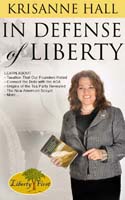
Suggestion: Take Advantage of Krisanne Hall's Offer. She Is A Fellow Constitutional Conservative.

Image
Close to 2500 Downloads So Far!!!!!
Image
I am totally in awe. Thanks to all of you!

Since we started the free promotion for "In Defense of Liberty" the book has gotten close to 2500 downloads and we're climbing up the Kindle ranking ladder. 

Because of this we are extending the campaign to get "In Defense of Liberty" E-Book for free.  It will be available for an additional 48 hours for FREE then after that it will be $5.99.  ACT NOW!
Thank You Sincerely
KrisAnne Hall

Promote Liberty Facebook Twitter Google+ LinkedIn StumbleUpon
Constitutional Education & Consulting, Inc., PO Box 26, Wellborn, FL 32094, USA

Unsubscribe | Change Subscriber Options

Monday, April 14, 2014

What Does The Constitution's Founders Say About The Nevada Standoff Between The BLM and Cliven Bundy?

Cliven Bundy, Cows And The Constitution

Cliven Bundy, is a Nevada rancher standing in defiance of a 2013 federal court order requiring his family to cease and desist cattle grazing on land that their family has used since 1887. Shiree Bundy Cox, daughter to Cliven Bundy explains this background:
“My great grandpa bought the rights to the Bunkerville allotment back in 1887 around there. Then he sold them to my grandpa who then turned them over to my dad in 1972. These men bought and paid for their rights to the range and also built waters, fences and roads to assure the servival (sic) of their cattle, all with their own money, not with tax dollars.”
So what’s the problem? The federal government came into the picture with gifts of plastic beads and promises to “help” the ranchers manage this land. The RANCHERS then paid a fee to the Bureau of Land Management to pay the salaries and keep the department operating under the premise that the BLM would be working to help the ranchers better their usage of the land. But just like all negotiations with government, the money got big and the federal control got even bigger.
Ms. Cox explains:
“[To] to keep the cows from over grazing, came the bureau of land management. They were supposed to assist the ranchers in the management of their ranges while the ranchers paid a yearly allotment which was to be use[d] to pay the BLM wages and to help with repairs and improvements of the ranches. My dad did pay his grazing fees for years to the BLM until they were no longer using his fees to help him and to improve. Instead they began using these money’s (sic) against the ranchers.”
This is not a case of a gray area of personal property vs. federal property. And now we are repeating a history of Kings and Tyrants because we forgot that the federal government has no Constitutional right to own land. Period. The only authority for federal land ownership is through precedent and practice. As a matter of fact, James Madison WARNED us of this very tyranny in 1792:
“I, sir, have always conceived — I believe those who proposed the Constitution conceived — it is still more fully known, and more material to observe, that those who ratified the Constitution conceived — that this is not an indefinite government, deriving its powers from the general terms prefixed to the specified powers – but a limited government, tied down to the specified powers, which explain and define the general terms.”
Our founders went to great pains to create a limited and defined federal government so we would not have to negotiate with Kings. With amazing foresight, Madison explains the consequence of allowing the federal government to turn these “clauses” into defined powers:
“If Congress can employ money indefinitely to the general welfare, and are the sole and supreme judges of the general welfare, they may take the care of religion into their Own hands; they may appoint teachers in every state, county, and parish, and pay them out of their public treasury; they may take into their own hands the education of children, establishing in like manner schools throughout the Union; they may assume the provision for the poor; they may undertake the regulation of all roads other than post-roads; in short, everything, from the highest object of state legislation down to the most minute object of police, would be thrown under the power of Congress; for every object I have mentioned would admit of the application of money, and might be called, if Congress pleased, provisions for the general welfare…”
Madison knew exactly what would happen if we ignored his warnings:
“I venture to declare it as my opinion that, were the power of Congress to be established in the latitude contended for, it would subvert the very foundations, and transmute the very nature of the limited government established by the people of America.”
Make no mistake, what is happening to Cliven Bundy and his family is the direct fulfillment of Madison’s warnings. We are seeing just what it looks like to “transmute the very nature of the limited government established by the people of America.” Madison will, in a few years, identify this type of government as one who will be “transformed” from the “present republican system” into “an absolute, or, at best, mixed monarchy.”(Virginia Assembly Report 1800) What is the greatest indication that this has already occurred? Alexander Hamilton gives us a telltale sign. In Federalist Paper #78 Hamilton warns that if the People allow the federal government to maintain unconstitutional legislative power, we will declare “that the deputy is greater than his principal; that the servant is above his master; that the representatives of the people are superior to the people themselves; that men acting by virtue of powers, may do not only what their powers do not authorize, but what they forbid.”
These are the times we live in. Congress continually creates unconstitutional laws, unconstitutional agencies, and unconstitutional regulation of powers that were to remain in the States. Now, We The People suffer a government that feels it is superior to the People themselves and has the power to rule and reign over them. That, Patriot, is NOT a republic, that is a Kingdom…just as Madison warned.
But don’t worry, the Congressional Research Service has issued a report that says the federal government is perfectly legal in their ownership of land. Rich, isn’t it? That the federal government can tell us what they can and cannot do? I thought we were a government “established among men deriving their just powers from the CONSENT of the GOVERNED.”
In the “Federal Land Ownership: Overview and Data” report issued February 8, 2012, the Congressional Research Service, the brain of Congress, declares that they have the RIGHT to own land. But they can only arrive at this conclusion if we are ignorant of the proper limitation of power for the federal government. Madison explains in Federalist Paper 45,
“The powers delegated by the proposed Constitution to the federal government are few and defined… The [federal powers] will be exercised principally on external objects, as war, peace, negotiation, and foreign commerce… the powers reserved to the several States will extend to all the objects which, in the ordinary course of affairs, concern the lives, liberties, and properties of the people, and the internal order, improvement, and prosperity of the State.” (emphasis mine)
But the CRS says their right to own land comes from the ability to create States. That is a complete misapplication of this power. There is NOTHING in the Constitution about the federal government seizing land that is already part of a State and controlling it. As a matter of fact, Madison says the EXACT OPPOSITE. This is CLEARLY a power that is “reserved to the several States”. But since they do not have legal authority they will, as mentioned before, cite “practice and precedent” as the source of their power.
The States have been struggling with the federal government over land for a very long time. And the acquiescence of the States to the usurped power, has created the problems in Nevada today. The CRS clearly states the purpose for federal land:
“Federal lands and resources have been important in American history, adding to the strength and stature of the federal government, serving as an attraction and opportunity for settlement and economic development, and providing a source of revenue for schools, transportation, national defense, and other national, state, and local needs.”
And the federal government has added to its strength to the point that the States are no longer the masters over their creation, but the federal government is supreme over the States. Pay close attention to the “results” of ownership of federal lands and resources…”schools, transportation, and other national, state, and local needs.” This is EXACTLY what Madison warned us would happen if we did not prevent the Congress from obtaining unlimited spending and unlimited power.
From the beginning, federal ownership was not supposed to be permanent. But the government never gives up anything once it has control. In 1976 with the enactment of the Federal Land Policy and Management Act of 1976 (FLPMA), Congress decided that all the remaining federal land would remain in federal ownership. No more honoring their “expanded” boundaries, they are going to expand them even further into permanent ownership. This sparked what became known as the Sagebrush Rebellion, an effort to provide state or local control over federal land and management decisions. How did the States choose to fight Congress over the possession of State land? In the federal court system. How do you think this is going to work out? You guessed it. The CRS practically “brags” about it:
“To date, judicial challenges and legislative and executive efforts generally have not resulted in broad changes to the level of federal ownership.”
This is NOT an issue of ranchers and cows. This is NOT about turtles and the environment. It is NOT about missed payment of fees. The feds are going to spend significantly more enforcing the fees, than the loss of the fees themselves. This is NOT about enforcing federal laws. How can cows grazing on land they have been eating from since 1887 be viewed as illegal, and yet the federal government allows illegal aliens to cross borders. Let us not forget, that Congress is trying to change immigration laws to fit the criminals. But when it comes to a man and his cows, we have to enforce this with SWAT teams! Really?
This IS an issue of a federal government completely out of control that acts more like a Kingdom than a republic. The question remains, America, what kind of government do YOU want? A Kingdom or a Republic? The choice is ours, because the powers delegated to this government do come from the consent of the governed. What are you willing to consent to?
- See more at: http://krisannehall.com/cliven-bundy-cows-constitution/#sthash.Olx1sKjH.dpuf