Contact Form

Name

Email *

Message *

Showing posts with label Native Americans. Show all posts

Thursday, May 4, 2017

For Those Of You Who Have Never Been In Or Had A Relative In The Military, This Story Will Change Your Opinions.


My Heart on the Line


Before my son became a Marine, I never thought much about who was defending me. Now when I read of the war on terrorism or the coming conflict in Iraq, it cuts to my heart. When I see a picture of a member of our military who has been killed, I read his or her name very carefully. Sometimes I cry.
In 1999, when the barrel-chested Marine recruiter showed up in dress blues and bedazzled my son John, I did not stand in the way. John was headstrong, and he seemed to understand these stern, clean men with straight backs and flawless uniforms. I did not. I live on the Volvo-driving, higher education-worshiping North Shore of Boston. I write novels for a living. I have never served in the military.
It had been hard enough sending my two older children off to Georgetown and New York University. John's enlisting was unexpected, so deeply unsettling. I did not relish the prospect of answering the question "So where is John going to college?" from the parents who were itching to tell me all about how their son or daughter was going to Harvard. At the private high school John attended, no other students were going into the military.
ADVERTISING
"But aren't the Marines terribly Southern?" asked one perplexed mother while standing next to me at the brunch following graduation. "What a waste, he was such a good student," said another parent. One parent (a professor at a nearby and rather famous university) spoke up at a school meeting and suggested that the school should "carefully evaluate what went wrong."
When John graduated from three months of boot camp on Parris Island, 3,000 parents and friends were on the parade deck stands. We parents and our Marines not only were of many races but also were representative of many economic classes. Many were poor. Some arrived crammed in the backs of pickups, others by bus. John told me that a lot of parents could not afford the trip.
We in the audience were white and Native American. We were Hispanic, Arab and African American and Asian. We were former Marines wearing the scars of battle, or at least baseball caps emblazoned with battles' names. We were Southern whites from Nashville and skinheads from New Jersey, black kids from Cleveland wearing ghetto rags and white ex-cons with ham-hock forearms defaced by jailhouse tattoos. We would not have been mistaken for the educated and well-heeled parents gathered on the lawns of John's private school a half-year before.
After graduation one new Marine told John, "Before I was a Marine, if I had ever seen you on my block I would've probably killed you just because you were standing there." This was a serious statement from one of John's good friends, an African American ex-gang member from Detroit who, as John said, "would die for me now, just like I'd die for him."
My son has connected me to my country in a way that I was too selfish and insular to experience before. I feel closer to the waitress at our local diner than to some of my oldest friends. She has two sons in the Corps. They are facing the same dangers as my boy. When the guy who fixes my car asks me how John is doing, I know he means it. His younger brother is in the Navy.
Why were I and the other parents at my son's private school so surprised by his choice? During World War II, the sons and daughters of the most powerful and educated families did their bit. If the immorality of the Vietnam War was the only reason those lucky enough to go to college dodged the draft, why did we not encourage our children to volunteer for military service once that war was done?
Have we wealthy and educated Americans all become pacifists? Is the world a safe place? Or have we just gotten used to having somebody else defend us? What is the future of our democracy when the sons and daughters of the janitors at our elite universities are far more likely to be put in harm's way than are any of the students whose dorms their parents clean?
I feel shame because it took my son's joining the Marine Corps to make me take notice of who is defending me. I feel hope because perhaps my son is part of a future "greatest generation." As the storm clouds of war gather, at least I know that I can look the men and women in uniform in the eye. My son is one of them. He is the best I have to offer. He is my heart.
Frank Schaeffer is a writer. His latest book, co-written with his son, Marine Cpl. John Schaeffer, is "Keeping Faith: A Father-Son Story About Love and the United States Marine Corps." He will answer questions about this article in a Live Online discussion at 1 p.m. today at www.washingtonpost.com.

Elizabeth Warren Is Into The Touchy Feely Not Facts

Elizabeth Warren Tweets Something Imbecilic About U.S. Military. Shapiro Pulverizes Her.

Photo by Denis Poroy/Getty Images
18487728448
On Wednesday morning, Senator Elizabeth Warren issued a tweet that certainly
 earned her brownie points among the leftists she has her latte with, but elicited
a fierce reply from Daily Wire Editor-in-Chief Ben Shapiro.
Warren tweeted:

Our military force's diversity is its greatest strength. The Army Secretary must show genuine support for ALL of our men & women in uniform.
Shapiro fired back:

I was going to go with its training, cause and vastly superior technology and firepower, but you do you https://twitter.com/senwarren/status/859812050276667392 …
Warren citing the military’s diversity as its greatest strength is as ludicrous as it
gets. The U.S. has 1.3 million active duty troops, the third largest number
 in the world behind India’s 1.4 million and China’s 2.2 million. North Korea
has slightly fewer troops than the U.S.: 1.2 million.
But the Military Strength Index weights the following criteria to rank a
country’s overall military capabilities: Number of active personnel in the
army (5%); Tanks (10%); Attack helicopters (15%); Aircraft (20%); Aircraft
carriers (25%); Submarines (25%). Thus the number of personnel is the
 least important factor in the strength of a military; the equipment means
 everything. According to a Credit Suisse report in 2015, the U.S. had
 the strongest military in the world, with a ranking of 0.94, followed by
Russia, (0.80), China, (0.79), Japan, (0.72), India, (0.69) and France, (0.61). 
As Shapiro also referenced, the United States not only has the greatest
equipment in the world, but also the finest training and a cause that has
been a never-ending source of strength for an army; the will to die so that
 your family back home can be free.
But for Warren, what really matters is diversity rather than excellence.
And she should know about the advantages of diversity; this is the same
woman who once claimed, “Native American has been a part of my story,
 I guess since the day I was born, I don’t know any other way to describe
it.” As Maggie Haberman wrote for Politico in 2012, “Warren had described
herself as a minority on a law professors’ listing for several years, ending
in 1995.”
Why shouldn’t she cite “diversity” as one helluva asset? It seemed to
work for her.

Tuesday, May 31, 2016

Native Americans Don't Agree With The Leftist View Of Indian Names On Sports Teams


washington redskins nfl


Here’s What NINE Out Of TEN Native 

Americans Think About The ‘Redskins’ 

Name!

You would think that after years of bitter acrimony brought on by debating whether the Washington NFL 
team’s name is offensive to Native Americans that SOMEONE might have had the bright idea to actually 
ASK Native Americans what they thought!
Yeah, seriously, like it took 5 years.
Here’s what they said:
Nine in 10 Native Americans say they are not offended by the Washington Redskins name,

according to a new Washington Post poll that shows how few ordinary Indians have been

persuaded by a national movement to change the football team’s moniker.
The survey of 504 people across every state and the District reveals that the minds of Native

Americans have remained unchanged since a 2004 poll by the Annenberg Public Policy Center

found the exact same result. Responses to The Post’s questions about the issue were broadly

consistent regardless of age, income, education, political party or proximity to reservations.
So the owner of the Redskins totally ran with this, and hopefully we don’t have to debate this stupid 
crap anymore.
Because what’s better than white liberals telling Native Americans that they should be offended at 
football and Native Americans telling them to screw off?
I can’t think of anything at the moment.

Monday, November 9, 2015

PC In Elementary School

Native American 2nd Grader Yanked From School- You Won’t Believe Why

3424913572_67cf1a0860_oSo a 7-year old kid rolls into his second grade classroom.
He’s sporting a new backpack.
And a fresh haircut.
And that’s where he went wrong.
Jakobe Sanden walked into his second-grade classroom with his backpack and a brand new Mohawk — a hairstyle, his father says, that represents Jakobe’s Native American roots. But it’s a symbol his school called a distraction — one that got him pulled from class.
Earlier this week, 7-year-old Jakobe was sent to the principal’s office at Arrowhead Elementary School in Santa Clara, Utah. His father, Gary Sanden, said administrators told him the hairstyle violated school policy. School officials called his parents and asked them to get it cut.
“We had the students that weren’t used to it,” Arrowhead principal Susan Harrah told Fox affiliate KSTU. “They had called that out. So the teacher brought the student to my attention.”
So, if second grade kids are offended, the kid must get a haircut?
Good news- After jumping through hoops, Kobe’s parents were able to keep him in school.
UPDATE: The school is still called Arrowhead, even though some Native Americans find this offensive.
We’ll keep you posted.

Thursday, April 2, 2015

What Does The Indiana Law Say? Does It Allow Discrimination Against Gays and LGBT?

Q&A on Indiana: Would Restaurants Be Allowed to Turn Away LGBT Customers?

Matt Tobey, left, and Lisa Dorazewski, center, who are co-owners of Rainbow Bakery, and Erin Tobey, right, hold signs protesting Indiana's Religious Freedom Restoration Act. (Photo: Jeremy Hogan/Polaris/Newscom)
Does the Indiana Religious Freedom Restoration Act allow business owners to put their beliefs above the rights of their employees or customers?
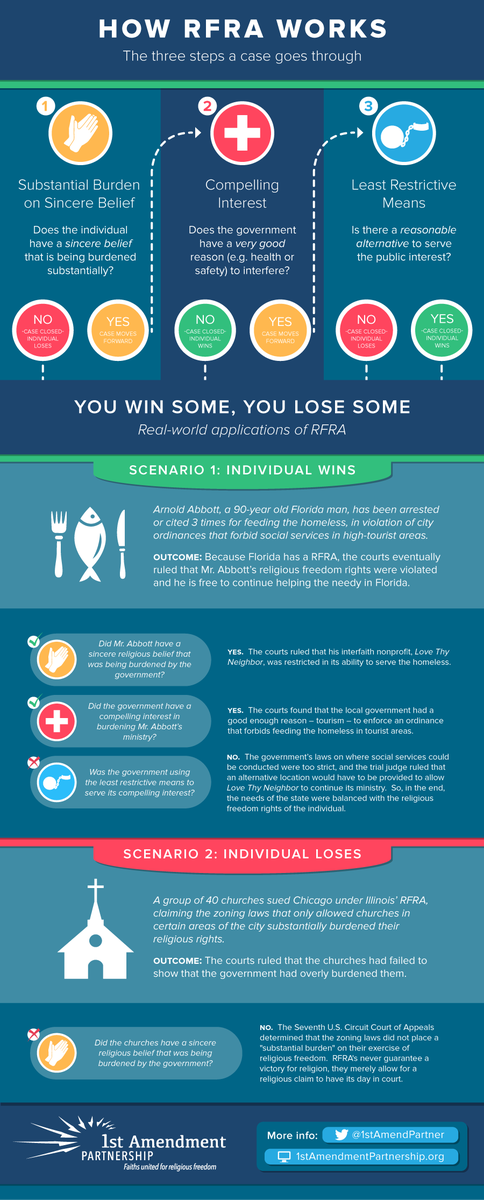
No, the Indiana Religious Freedom Restoration Act protects the rights of all citizens. This law treats all American citizens equally. It ensures that people of all faiths have the right to live out their beliefs at home, in worship and at work, without unnecessary government coercion. The Indiana Religious Freedom Restoration Act simply says that if the government is going to substantially burden religious exercise it must prove it is doing so for a compelling governmental interest and in the least restrictive way possible.
Indiana’s religious freedom law protects citizens from government coercion—it places the burden of proof on the government if it is going to violate liberty. For over 20 years, the federal government has lived by this standard—the Religious Freedom Restoration Act of 1993 passed unanimously in the House, with 97 votes in the Senate, and was signed into law by Bill Clinton. Today, there are a total of 30 states that live under that same standard through statute or court precedent.
Does this law give businesses a “license to discriminate”?
Ever feel like the only difference between the New York Times and Washington Post is the name? We do.
Try the Morning Bell and get the day's most important news and commentary from a team committed to the truth in formats that respect your time...and your intelligence.
No. In the more than 20 years that Religious Freedom Restoration Acts have been on the books, we haven’t seen the kind of absurd hypotheticals that opponents are just now conjuring up.
In reality, Religious Freedom Restoration Acts protect religious freedom for all Americans, in cases that have nothing to do with current political debates. For example, Religious Freedom Restoration Acts have provided protection for Sikhs, Muslims, Jews, Native Americans, among many others. They have protected the freedom of a Sikh woman to carry religious articles of her faith at work, allowed a Native American boy to wear long hair at school, and ensured a Christian ministry could continue serving recently released prisoners.
Importantly, Religious Freedom Restoration Acts aren’t ablank check to do whatever one wants in the name of religion. Not every Religious Freedom Restoration Act plaintiff has won. Sometimes, the government can show it has a compelling interest in burdening religious freedom—ensuring public safety, for instance. But Religious Freedom Restoration Acts ensure that government must meet a high bar before coercing religious believers.
People say Indiana’s law allows individuals to sue each other, not just the government, and it defines “person” to include corporations. Is Indiana’s law significantly different from the federal Religious Freedom Restoration Act and other state Religious Freedom Restoration Acts?
No, Indiana’s Religious Freedom Restoration Act is not significantly different from the federal Religious Freedom Restoration Act or other state Religious Freedom Restoration Acts. Indiana’s Religious Freedom Restoration Act states clearly what multiple federal courts have interpreted federal Religious Freedom Restoration Act to mean. It is not ambiguous and those who are describing it as an ominous new development with untold consequences are misreading the plain text of the law and the long legal history of Religious Freedom Restoration Act’s commonsense protections.
Indiana’s law is very similar in substance to both the federal religious freedom law and the other 19 states that have enacted Religious Freedom Restoration Acts. Religious Freedom Restoration Acts prohibit the government from substantially burdening religious exercise unless thegovernment can show a compelling interest and does so through the least restrictive way possible. These protectionsapply to individual people and to the organizations they form—be they schools, charities or businesses. The Indiana law does allow corporations to sue the government—but so does the federal Religious Freedom Restoration Act. Indiana’s law does not allow private citizens to sue each other. The Religious Freedom Restoration Act protects religious liberty in all spheres of life, as the Supreme Court reminded us last year when it protected the Green family and Hahn family—who run Hobby Lobby and Conestoga Wood—against the coercive Department of Health and Human Services mandate.
A number of courts, as well as the Obama administration, have argued that those protections at the federal level can apply in cases between two private individuals. As constitutional law professor, Josh Blackman, explains “four Courts of Appeals, covering nearly half the states in the Union, and the Obama Justice Department, have stated that RFRA [Religious Freedom Restoration Act] can be asserted as a defense in a private case seeking the enforcement of federal law.”
Won’t the Indiana Religious Freedom Restoration Act allow business owners to refuse service to LGBT people?
No, and no one is interested in refusing to serve gays and lesbians simply because of their sexual orientation. And no one has ever successfully used Religious Freedom Restoration Act to defend such actions. As law professor and religious liberty expert Douglas Laycock—a same-sex marriage supporter—notes:
I know of no American religious group that teaches discrimination against gays as such, and few judges would be persuaded of the sincerity of such a claim. The religious liberty issue with respect to gays and lesbians is about directly facilitating the marriage, as with wedding services and marital counseling.
Religious liberty concerns typically stem from those involved in the wedding industry being penalized by the government because they declined to participate in a same-sex wedding ceremony.
There are now numerous cases of photographers, florists, cake makers and farmers being forced to participate in celebrating same-sex weddings in violation of their belief that marriage is the union of a man and a woman. These are citizens who have no problem serving gays and lesbians but do object to celebrating same-sex weddings.
Religious liberty isn’t an absolute right. Religious liberty doesn’t always trump other values or rights. Religious liberty is balanced with concerns for a compelling state interest that’s being pursued in the least-restrictive means possible. The Indiana Religious Freedom Restoration Act, like all similar laws, doesn’t determine the outcome of a particular case. It simply provides a way for citizens to go into court to have their individual case reviewed by a court.
Wouldn’t the Indiana Religious Freedom Restoration Act allow a Muslim business owner to refuse service to women not wearing a hijab?
It depends. All the Religious Freedom Restoration Act does is say that Muslims get the same religious liberty protections as all other Americans and deserve their day in court. All Americans, regardless of their faith background, should be free to run their businesses, charities or houses of worship in accordance with their religious beliefs. There may be times when those religious beliefs conflict with a compelling government interest—ensuring public safety, for instance, which has been used as an argument against the hijab. Such a case would have to go to court and the evidence be weighed either way. Americans’ freedom is best protected when the state must show it has a compelling interest, pursued in the least restrictive way possible, before coercing or penalizing religious believers.
The way we’ve learned to live in a pluralistic society, with diverse religious and moral opinions, is to have a balancing test like the one the Religious Freedom Restoration Act provides.
Why does Indiana (or any state) need a Religious Freedom Restoration Act if there’s already a federal Religious Freedom Restoration?
The federal Religious Freedom Restoration Act protects against federal government violations of religious liberty, and state Religious Freedom Restoration Acts protect against state violations. Citizens need protection at both levels of government.
rfrainfographic