Contact Form

Name

Email *

Message *

Showing posts with label Ottoman Empire. Show all posts

Sunday, July 2, 2017

Countries That Wish To Control Immigration Are Sued By The European Union

  • Many so-called asylum seekers have refused to relocate to Central and Eastern Europe because the financial benefits there are not as generous as in France, Germany or Scandinavia. In addition, hundreds of migrants who have been relocated to Estonia, Latvia and Lithuania, which rank among the poorest EU countries, have since fled to Germany and other wealthier countries in the bloc.
  • "It needs to be said clearly and directly: This is an attack on Europe, on our culture, on our traditions." — Poland's Prime Minister Beata Szydło.
  • "I think we have a right to decide that we do not want a large number of Muslim people in our country. That is a historical experience for us." — Viktor Orbán, Prime Minister of Hungary, referring to Hungary's occupation by the Ottoman Empire from 1541 to 1699.
The European Union has initiated legal action against the Czech Republic, Hungary and Poland for failing to comply with a controversial order to take in thousands of migrants from Africa, Asia and the Middle East.
The so-called infringement procedure, which authorizes the European Commission, the powerful executive arm of the European Union, to sue member states that are considered to be in breach of their obligations under EU law, could lead to massive financial penalties.
The dispute dates back to September 2015, when, at the height of Europe's migration crisis, EU member states narrowly voted to relocate 120,000 "refugees" from Italy and Greece to other parts of the bloc. This number was in addition to a July 2015 plan to redistribute 40,000 migrants from Italy and Greece.
Of the 160,000 migrants to be "shared," nine countries in Central and Eastern Europe were ordered to take in around 15,000 migrants. Although the Czech Republic, Hungary, Romania and Slovakia voted against the agreement, they were still required to comply.
Since then, several Central European EU member states have vehemently refused to accept their assigned quotas of migrants. Poland, for example, has a quota of 6,182 migrants, not one of whom has been admitted. The Czech Republic has a quota of 2,691 migrants, of whom only 12 have been taken. Hungary has a quota of 1,294, none of whom have been admitted.
EU, Many so-called asylum seekers have refused to relocate to Central and Eastern Europe because the financial benefits there are not as generous as in France, Germany or Scandinavia. In addition, hundreds of migrants who have been relocated to Estonia, Latvia and Lithuania, which rank among the poorest countries in the EU, have since fled to Germany and other wealthier countries in the bloc.
Meanwhile, the enforcers of European "unity" have sought to shame the Central European holdouts into compliance by appealing to nebulous concepts such as European "values" and "solidarity." French President Emmanuel Macron, for example, recently warned:
"European countries that do not respect the rules should pay the full political consequences. There is a double betrayal. They decide to abandon EU principles, turn their back on Europe and have a cynical approach to the union which gives them money, without respecting its values."
Leaders in Central and Eastern Europe have held their ground. In Poland, Prime Minister Beata Szydło said her country would not be blackmailed by European Union officials. In a speech to Parliament on May 24, two days after the jihadist attack in Manchester, England, in which a Polish couple was killed, she said:
"We are not going to take part in the madness of the Brussels elite.... Rise from your knees and from your lethargy or you will be crying over your children every day.
"If you cannot see this — if you cannot see that terrorism currently has the potential to hurt every country in Europe, and you think that Poland should not defend itself — you are going hand in hand with those who point this weapon against Europe, against all of us.
"It needs to be said clearly and directly: This is an attack on Europe, on our culture, on our traditions. Do we want strong politicians who can see the danger and can fight against it efficiently?"

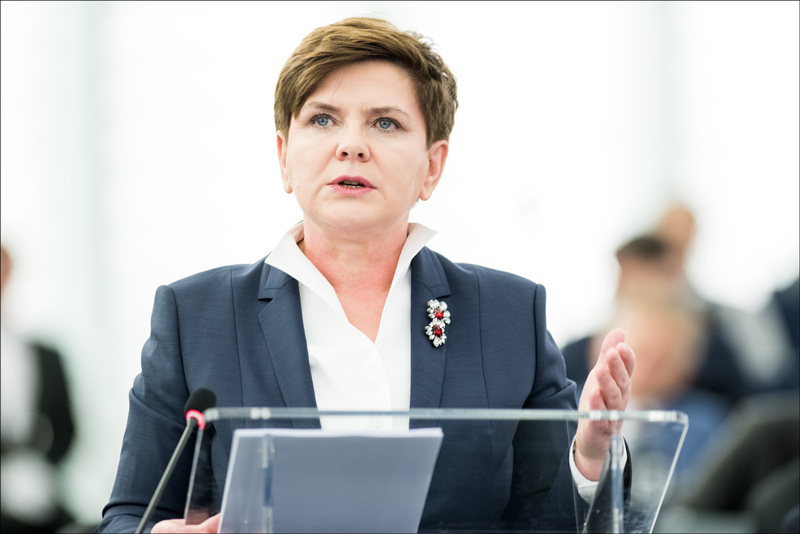
In a May 24 speech, Polish Prime Minister Beata Szydło said her country would not be blackmailed by European Union officials: "We are not going to take part in the madness of the Brussels elite... This is an attack on Europe, on our culture, on our traditions." (Illustrative image source: European Parliament/Flickr)

Polish Interior Minister Mariusz Błaszczak said that agreeing to European Union quotas would "certainly be worse" than any punishment meted out by Brussels:
"We must not forget the terror attacks that have taken place in Western Europe, and how — in the bigger EU countries — these are unfortunately now a fact of life. Remember, that the now very numerous Muslim communities in Western Europe started out as relatively small numbers....
"I tell my counterparts in Western Europe that the relocation strategy only intensifies illegal migration because traffickers get even more customers when would-be migrants hear that people delivered to Europe are being given refuge in EU nations other than Italy and Greece."
Henryk Kowalczyk, a Polish member of parliament, said:
"Poland makes a contribution to the EU.... We are doing what the bloc says, what the treaties say. If the French president was thinking of refugees, well that issue is not mentioned in the treaties and when we joined the European Union we were not taking on that commitment."
Poland's European Affairs Minister Konrad Szymański added: "There is no conflict on values between the Commission and Poland — it is about how to interpret these values."
In the Czech Republic, Prime Minister Bohuslav Sobotka said that "given the deteriorating security situation in Europe and the non-functioning of the quota system, the Czech government will not participate in it." He added: "We are ready to defend our position in the EU and the relevant judicial institutions."
Czech Minister of Foreign Affairs Lubomír Zaorálek said that EU should focus on "economic and social convergence among EU countries, rather than attempts to distribute migrants with forced quotas." He pointed out that in some Eastern European countries, "the most vulnerable inhabitants are often poorer than the incoming migrants themselves."
Zaorálek added that "people who are coming have no real interest in being integrated" and want to live with their "partners from similar cultural, ethnic, religious backgrounds." He said that people in Central and Eastern Europe do not want to "repeat the mistake of the Western countries" which have "neighborhoods full of thousands and thousands of people living in imperfect living conditions" and which are "very risky, not only during the night but also during the day." He pointed out that "there are no suicide bombers among Ukrainians or Vietnamese," two long-established communities in the Czech Republic.
In Slovakia, Prime Minister Robert Fico said that mass migration and forced multiculturalism would change the essence of his country:
"I think it is the duty of politicians to talk about these things very clearly and openly. I do not want to see a Muslim community in Slovakia. I do not want there to be several tens of thousands of Muslims who gradually begin to promote their ideology. We do not want to change the traditions of this country, which are built on the Christian tradition. It has been like this for centuries. Sovereignty and national pride must be part of our ruling coalition."
Fico added that 95% of so-called refugees were actually economic migrants:
"We will not assist in this folly with arms opened wide with the notion that we will accept them all regardless of whether they are economic migrants or not. We must start telling the truth about migration."
In Hungary, Prime Minister Viktor Orbán has warned of the "explosive consequences" of a culture clash between Europe and migrants from the Muslim world:
"To understand what we must do, we need to grasp the true nature of the situation we are facing. Europe is not in the grip of a 'refugee problem' or a 'refugee situation,' but the European continent is threatened by an ever mounting wave of modern-era migration. Movement of people is taking place on an immense scale, and from a European perspective the number of potential future immigrants seems limitless.
"With each passing day we see that hundreds of thousands have been turning up and clamoring at our borders, and there are millions more intending to set out for Europe, driven by economic motives....
"We must acknowledge that the European Union's misguided immigration policy is responsible for this situation. Irresponsibility is the mark of every European politician who holds out the promise of a better life to immigrants and encourages them to leave everything behind and risk their lives in setting out for Europe. If Europe does not return to the path of common sense, it will find itself laid low in a battle for its fate....
"Let us not forget that those arriving have been raised in another religion, and represent a radically different culture. Most of them are not Christians, but Muslims. This is an important question, because Europe and European identity is rooted in Christianity. Is it not worrying in itself that European Christianity is now barely able to keep Europe Christian? If we lose sight of this, the idea of Europe could become a minority interest in its own continent."
Referring to Hungary's occupation by the Ottoman Empire from 1541 to 1699, Orbán said:
"I think we have a right to decide that we do not want a large number of Muslim people in our country. We do not like the consequences of having a large Muslim community that we see in other countries and I do not see any reason for anyone else to force us to create ways of living together in Hungary that we do not want to see. That is a historical experience for us."
Soeren Kern is a Senior Fellow at the New York-based Gatestone Institute. Follow him onFacebook and on Twitter.
© 2017 Gatestone Institute. All rights reserved. The articles printed here do not necessarily reflect the views of the Editors or of Gatestone Institute. No part of the Gatestone website or any of its contents may be reproduced, copied or modified, without the prior written consent of Gatestone Institute.

Wednesday, March 29, 2017

ISIS Is Not The Only Group That Wants A Caliphate

Hizb ut-Tahrir in Turkey Calls for Restoring the Caliphate

By March 29, 2017


BESA Center Perspectives Paper No. 435, March 29, 2017
EXECUTIVE SUMMARY: Violence is not the only means by which Islamist groups and individuals hope to expand Islamic influence, establish Islamic governments, and eventually restore the caliphate. In addition to the Islamic State (ISIS) and al-Qaeda, many non-violent, legal groups either overtly or covertly share those aims. “Are they violent or not?” should not be the main question while analyzing Islamist groups or governments. “What is their aim?” is the better question if we are to understand them and take effective precautions. Methods might vary, but the establishment of Islamic rule is the ultimate goal of Islamist ideology.
Recent discussions of jihad or political Islam (or Islamism as it is commonly known) have most often focused on ISIS. But jihad and other efforts towards establishing an Islamic political order are not the exclusive province of ISIS. The expansion and institutionalization of Islam by violent (and non-violent) means is a millenarian tradition and a fundamental goal of Islam from its earliest days. ISIS is just one Islamist organization seeking to re-establish the caliphate.
Dating back to the Prophet Muhammad’s immediate successors, the caliphate (Khilafah) is a form of government, ruled by Islamic sharia law, that represents the political unity of the worldwide Muslim community (Umma). The last caliphate of the Ottoman Empire was abolished in 1924 by republican Turkey, but Islamist groups and organizations around the world have never ceased attempting to re-establish the venerable institution.
The Islamist group Hizb ut-Tahrir, for example, an international and pan-Islamic political organization, is quite active in Turkey, with conferences, publications, and marches. According to its official website, “Hizb ut-Tahrir is a political party whose ideology is Islam, so politics is its work and Islam is its ideology. It works within the Umma and together with her, so that she adopts Islam as her cause and is led to restore the Khilafah and the ruling by what Allah revealed.”
The group also publishes the monthly magazine Koklu Degisim (Radical Change), wherein it promotes the idea that “violence and all other problems in the Middle East are caused by Western states.” It opposes the Geneva talks to end the Syrian civil war and calls for the fall of Russia, Israel, the UN, and the “infidel” West. An article published in its June 2016 edition said: “Islam as an ideological and a political idea is permanent, and it will win.”
On March 3, 2017, Mahmut Kar, the head of the media bureau of “the Turkey Province of Hizbut Tahrir”, and Osman Yildiz, the Istanbul representative of its magazine “Koklu Degisim” (Radical Change), were taken into police custody when they went to the Bayrampasa police station in Istanbul to receive a letter of notification about a ban on their planned conference, “Why does the world need the caliphate?” due to be held three days later. They were released a week later.
This detention must have come as a surprise to the group given that, for quite some time, it had been holding annual conferences advocating the restoration of the caliphate. On March 3, 2015, on the 91st anniversary of the abolition of the caliphate, Hizb ut-Tahrir held a conference titled “The Democratic Presidency Model or the Rashidun Caliphate?” at the AKP-governed Uskudar Municipality, In March 2015, while thousands of supporters marched in Istanbul  chanting: “From Turkey to Egypt, from Indonesia to Morocco, from Lebanon to Kurdistan, caliphate, caliphate!”
The following year, the group organized two “international caliphate conference.” The first, held in Istanbul on March 3, 2016, was attended by some 1,000 people with speakers from many countries; the second was held three days later in the AKP-ruled Ankara municipality with the participation of over 5,000 people (according to Hizb ut-Tahrir press release). “We want the Rashidun Caliphate,” theologian and author Abdullah Imamoglu told the Ankara conference. “When we say this, are there those who say ‘What is the caliphate when there is kafir [infidel] America?’ We reply to them that a second caliphate is not a dream.”
According to Kar, his March 2017 detention stemmed from Ankara’s eagerness to give the impression that it was at war with ISIS. He wrote: “Turkey, in order to say ‘I struggle against ISIS’ and to prove this to the West and the USA with concrete statistics, arbitrarily detains many Muslims without doing a detailed investigation.” This, in his view, was totally unnecessary since “Hizb-ut Tahrir absolutely opposes the use of force and violence and armed struggle … The real issue is reminding Muslims of the caliphate that was abolished 93 years ago. It is about, without prevaricating or beating around the bush, screaming the fact that the caliphate is the administrative system of Islam.”
This desire is hardly limited to Hizb ut-Tahrir. The yearning for the imposition of sharia law and the restoration of the caliphate is a central element of political Islam. The open expression of this desire and the means for its pursuit are simply a matter of timing and tactics. ISIS and al-Qaeda strive to attain these goals through violent means, Hizb ut-Tahrir, like other Islamist organizations and governments, does not engage in violence – or at least will refrain from violence until “the right time” comes.
So before rushing to whitewash Islamist efforts to re-establish the caliphate by attributing them to poverty, “Muslim grievances,” or Western foreign policy, one ought to consider the historical continuity and universality of these efforts as well as their doctrinal foundations.
From Turkey to Indonesia, from Pakistan to Canada, from Egypt to Sweden, millions of Muslims – regardless of economic, social, or ethnic background – yearn to re-establish a caliphate ruled by the sharia. Their common trait is their religious piety. Much of the history of Islam is a history of conquest of non-Muslim lands and the establishment of Islamic rule in them. In fact, that is Islamism’s ultimate goal.
Before one defends sharia law in the name of “diversity” or “multiculturalism”, one would therefore be well advised to investigate what happens to human rights – particularly women’s rights and religious liberty – once political Islam becomes the ruling ideology.
Uzay Bulut is a Turkish journalist. She covers Turkish politics, political Islam, and religious minorities in Turkey and the Middle East.

Tuesday, September 20, 2016

The Hordes Are Coming. Will Europe Fall This Time?


  • Hungarian Prime Minister Viktor Orbán is the Eastern nemesis of the European elite. No one else in Europe except him speaks about defending "Christianity."
  • "Those arriving have been raised in another religion, and represent a radically different culture. Most of them are not Christians, but Muslims ... This is an important question, because Europe and the European identity is rooted in Christianity." — Hungarian Prime Minister Viktor Orbán.
  • The last chance to save Europe's roots might well come from the former communist members of the EU -- those who defeated the Ottomans in 1699 and now feel culturally threatened by their heirs.
  • Cypriots know much better than the comfortable bureaucrats of Brussels the consequences of a cultural collision. Ask about their churches on the Turkish side of the island; how many of them are still standing?
Austria's fate is now at stake.
Perhaps it was a coincidence that Cardinal Christoph Schönborn, Archbishop of Vienna and tipped to be the next Pope, chose September 12, the anniversary of the Siege of Vienna, when Turkey's Ottoman troops nearly conquered Europe, to deliver a most dramatic appeal to save Europe's Christian roots.
"Many Muslims want and say that 'Europe is finished'," Cardinal Schönborn said, before accusing Europe of "forgetting its Christian identity." He then denounced the possibility of "an Islamic conquest of Europe."
Konrad Pesendorfer, head of the Austrian Office of Statistics, said that by 2030, 40% of the population of Vienna will be foreign-born, thanks to internal demography and migration flows (60,000 arrivals in just one year).
Since the fall of Constantinople in 1453, much of Eastern Europe's Christian population spent centuries under Islamic occupation, particularly under the Ottomans. It now seems that the clock has reverted to 1683, when Ottoman armies were at the gates of Vienna.
It is not a coincidence that the fierce resistance of Eastern Europeans has been the main impediment to a unified response by the European Union to the migrant crisis. It was these Eastern states that forced German Chancellor Angela Merkel to halt the massive flux of migrants. Today, where there is no border, migrants keep coming en masse. In August alone,23,000 migrants arrived in Italy.
Brussels is whipping up a propaganda war to cast the Western Europeans, who favor unvetted Muslim migration, as cosmopolitan and tolerant, and Eastern Europeans as a bunch of xenophobic bigots, if not outright neo-Nazis.
Europe's educated elite might do well to listen to their Eastern brethren. These countries, ironically, are the core of the "new Europe," the last to join the European project and the very countries, having escaped from authoritarian regimes, which should have revived it. Brussels' policy is now pushing this Eastern bloc back under Russia's sphere of influence.
The Eastern Europeans' reluctance to open the doors to massive Muslim migration can be explained by the economic crisis, falling birth rates, their relatively homogenous societies, the persecution of the Christians under Communism, memories of a conflict with Islam dating back to the Middle Ages, and the attempt by Brussels to impose a cultural agenda. The European Parliament, in fact, has constantly passed resolutions pressuring conservative East European member-states such as Poland, Hungary and Croatia, to legalize same-sex marriage and abortion on demand.
The President of the European Commission, Jean Claude Juncker, calls him "Viktator" Orbán. But Hungarian Prime Minister Viktor Orbán, defiant, is going ahead with the construction of a wall on Hungary's border with Serbia. When Communism fell, Hungary was the first country to open the Iron Curtain and let people out. Now it is first country to erect a fence to keep people out. Orbán is also planning an additional fence along that border.
Orbán is the Eastern nemesis of the European elite. No one else in Europe except him speaks about defending "Christianity." The "Visegrad-4," the alliance between Czech Republic, Poland, Bulgaria and Slovakia, want to distinguish between Christian and Muslim immigrants. Orbán has the support of Hungarian bishops who oppose Pope Francis' open-armed policy toward migrants.
In an opinion piece for the Frankfurter Allgemeine newspaper, Orbán wrote:
"Those arriving have been raised in another religion, and represent a radically different culture. Most of them are not Christians, but Muslims. This is an important question, because Europe and European identity is rooted in Christianity."
Orbán's rebelliousness goes back to his student days in 1989, when he was at the funeral of Imre Nagy, who led the anti-Soviet insurrection of 1956 -- Orbán had the courage to demand the withdrawal of the communist invaders.
Orbán later led Hungary into NATO.
Son of a communist and a Calvinist mother, Orbán has a devout Catholic wife and five children. To those who question whether he is a reactionary, Orbán replies: "I eat with a fork and a knife, but we are not nice guys from the mainstream." For him, the European Commission is a kind of new politburo. "We did not tolerate being dictated to from Vienna in 1848 nor from Moscow in 1956 and 1990," Orbán said. "Now we're not going to allow ourselves to be dictated to by anyone from Brussels or anywhere else."
Orbán's speeches are full of historical references, as when he asked Hungarians to behave with the same courage shown by their ancestors "in the war against the Ottoman armies."
The Hungarian constitution is unique in Europe; it protects "life from conception" and says that marriages can take place only between a man and a woman.
Orbán's approach has been adopted by other ex-communist members of the EU. Poland's President Andrzej Duda complained about "dictates" from Brussels to accept migrants flowing into the Continent from the Middle East and Africa. Meanwhile Poland's Law and Justice Party leader, Jaroslaw Kaczynski, appealed "to an old historical viewpoint, according to which Poland is a bulwark for Christianity in the East and must save Europe from itself."
"Since its adoption of Christianity in 966, Poland has often played the role of Antemurale Christianitatis, a bastion of Christendom," according to Crisis Magazine.
"From halting the European advance of Mongols at the Battle of Legnica in 1241, to saving Europe from Muslim colonization when King John III Sobieski defeated the Turks at Vienna in 1683, this has been reinforced. Communism failed to extinguish Polish Catholicism, when John Paul II was elected pope in 1978 and inspired the rise of the Solidarity movement, which playing a crucial role in ending communism. More recently, Polish immigrants have filled hitherto empty pews in Western Europe. During the current Vatican synod on the family, Polish bishops have been among the most vocal defenders of tradition."


Hungarian Prime Minister Viktor Orbán is the Eastern nemesis of the European elite. No one else in Europe except him speaks about defending "Christianity." Right: Poland's King John III Sobieski in battle against the Ottoman Turks at Vienna, in 1683.

The prime minister of another Eastern European country, Robert Fico of Slovakia, said his country will accept only Christian refugees; that Islam "has no place" in his country and that "multiculturalism is a fiction."
Czech President Milos Zeman also attacked multiculturalism. Even Socratis Hasikos, Cyprus' interior minister, said that his country would accept refugees but wanted them to be Christians. For many Cypriots, the line that divides the island is a frontier between Greek Christianity and Turkish Islam, just as the Berlin Wall was a frontier between democracy and communism.
As the prestigious American Catholic magazine First Things noted, "in Hungary, Croatia, and elsewhere in Eastern Europe, a pro-family, pro-life revolution and a rediscovery of Christian roots is occurring."
Like it or not, the last chance to save Europe's roots might well come from the former communist members of the EU -- those who defeated the Ottomans in 1699 and now feel culturally threatened by their heirs.
Cypriots know much better than the comfortable bureaucrats of Brussels the consequences of a cultural collision. Ask about their churches on the Turkish side of the island; how many of them are still standing?
Giulio Meotti, Cultural Editor for Il Foglio, is an Italian journalist and author.

© 2016 Gatestone Institute. All rights reserved. The articles printed here do not necessarily reflect the views of the Editors or of Gatestone Institute. No part of the Gatestone website or any of its contents may be reproduced, copied or modified, without the prior written consent of Gatestone Institute.

Tuesday, June 2, 2015

When (Not If) ISIS Overtakes St. Matthew's Monastery Will Anyone In The West Even Mention It? Will Anyone Care That The Monks Are Killed And Ancient Library Destroyed? We Fear Not!


St. Matthews Monastery is a 1,650-year-old structure built into the side of a mountain on the Nineveh Plain of northern Iraq.
St. Matthew’s Monastery is a 1,650-year-old structure built into the side of a mountain on the Nineveh Plain of northern Iraq.
A 1,650-year-old monastery in northern Iraq, one of the oldest Christian monasteries in the world, is in danger of falling to ISIS.
St. Matthew’s monastery, founded in A.D. 363, has survived the Ottoman and Persian Empires, Mongol invaders and Kurdish conquests. Today it’s threatened by ISIS. Only three monks remain.
It has served as a place of refuge for persecuted Christians and other religious minorities for centuries, but now its very existence is threatened.
Some of the earliest Christians sought safety there. And when Islamic hordes stormed the city of Mosul, just 20 miles away, last June, the monastery’s thick stone walls again became a safe haven.
Located about 20 miles north of Mosul, the monastery is in protected Kurdish territory but is just a little more than three miles from the front lines of battle.
“We can see the battles and the airstrikes from here in front of us, especially at night. The sky lights up at night, but we of course are not scared. God protects us,” Father Yousif Ibrahim, one of three monks who resides in the monastery, told USA Today. There are also six students living at St. Matthew’s.

Before Iraq fell into chaos, the monastery was home to thousands of nuns, priests and students with the Syriac Orthodox Church. The ancient church traces its founding back to the time of Christ. Some of its earliest founders may have personally known Jesus Christ. They still speak Aramaic, the language of Jesus.
It houses one of the most ancient Christian libraries in the region. Many of the oldest manuscripts have been removed and taken to Kurdish-controlled areas.
Christian refugees running out of places to hide
More than 125,000 Christians have been forced from their homes over the past 12 months. They now live as refugees, most of them in the semi-autonomous state of Kurdistan.
ISIS has previously vowed to destroy all Christian historical sites in the areas that fall under its control. In March, it destroyed the ancient Christian Mar Behnam Monastery in the predominantly Christian town of Qaraqosh in northern Iraq.
The jihadists have desecrated Christian cemeteries, seized Christian girls for sex slaves and killed other children in front of their parents’ eyes.
ISIS destroyed Jonah’s tomb in Mosul in July and destroyed countless Assyrian artifacts in Nimrod in March. The jihadist organization believes Christian relics represent a religion of polytheistic infidels and are an affront to Islam.
St. Matthew’s is built like a fortress into the side of Mount Al-Faf. Kurdish soldiers pushed the ISIS fighters back last summer to about four miles from St. Matthew’s, but the monastery is again in danger of falling to the Islamic jihadists
On CBS’ “60 Minutes” in March, Father Ibrahim told Lara Logan the worst part was the uncertainty.
“We don’t know exactly, but we are expecting the worst,” he told Logan.
Mosul has been completely emptied of its 10,000 Christians.
Nicodemus Sharaf, the archbishop, now lives as a refugee in Kurdish capital of Erbil along with 60,000 other Christian refugees.
Despite all of the Christian refugees in Iraq and Syria, most of the refugees being sent to the United States and other Western countries are Muslim. The United Nations selects and assigns almost all of the refugees.
When he left Mosul, Sharaf said ISIS fighters were already inside the city.
“I don’t have time to take anything. He told me you have five minutes. I took just five books; they are very old.”
Many even older were left. Christian relics dating to the first century B.C. fell into the hands of ISIS.
ISIS uses the Arabic letter “N” for Nazarene to mark the homes of Christians. When they use red paint to put the “N” on a home, the occupants can expect a visit soon by ISIS fighters. They are given a choice: Convert, pay the Islamic head tax or die.
“Speak up. Of course there is good people in the Islam people. Not all are bad, I believe. But where is the good people? Where is their voice? Nothing!” Archbishop Sharaf said. “Where is their voice? Few! Few!
“They lost our dignity here. I’m sorry to say that. We don’t have dignity in our country, in our land.”
Obama’s airstrikes offer little hope
President Obama’s airstrikes are seen as pinpricks on ISIS.
Archbishop Bashar Warda, who leads the flock of the Chaldean Catholics in Erbil, told Logan ISIS “is a cancer” that needs to be defeated.
Logan asked if that meant militarily.
“Please God,” he said. “It’s a disease, so sometimes you take some hard measures, unfortunate measures, to remove this cancer.”
In its heyday, St. Matthew’s monastery was home to 7,000 monks. The area surrounding the complex was named Al-Faf, meaning “the thousands,” in homage to the legion of monks who worshiped, taught and studied on its steep dry slopes, USA Today reported. “But just like the Christian population in Iraq, that number has dwindled dramatically over the years.”
Islamic jihadist groups have systematically targeted Christians over the past century, and ISIS is only a continuation of that long history, Ibrahim told the newspaper. Despite holding fort at the monastery, Ibrahim says St. Matthew’s, and Christianity in Iraq, are living on borrowed time.
Iraq’s Christians will eventually abandon the nation, Ibrahim said, leaving their history behind. Only then will he consider fleeing the war-torn country himself.
“The shepherd cannot leave his sheep,” he told USA Today.
“Saint Matthew ended up here because he was fleeing persecution, but persecution follows us,” Sahar Karaikos, one of the six students still at St. Matthews, told the newspaper. “We can’t run from it, we have to stand in front of our history.”
DoD Graphic iraq