Contact Form

Name

Email *

Message *

Showing posts with label Latvia. Show all posts

Saturday, July 8, 2017

"Morality Police" Come To Berlin

  • Threats of violence against "errant" women are viewed as "acts of patriotism."
  • "They have come to Germany because they wanted to live in Germany, but they keep trying to turn it into Chechnya with its medieval ways." — Social worker interviewed by Meduza.
  • "Everyone's attention is fixed on the Syrians, but the Chechens are the most dangerous group. We are not paying sufficient attention to this." — Police in Frankfurt (Oder).
A hundred Islamists are now openly enforcing Sharia law on the streets of Berlin, according to local police who are investigating a recent string of violent assaults in the German capital.
The self-appointed morality police involve Salafists from Chechnya, a predominantly Sunni Muslim region in Russia. The vigilantes are using threats of violence to discourage Chechen migrants from integrating into German society; they are also promoting the establishment of a parallel Islamic legal system in Germany. German authorities appear unable to stop them.
The Sharia patrol came to public light in May 2017, when Chechen Salafists released a video warning other Chechens in Germany that those who fail to comply with Islamic law and adat, a traditional Chechen code of behavior, will be killed. The video's existence was reported by Meduza, a Russian-language independent media organization based in Latvia. The video, which circulated through WhatsApp, an online messaging service, showed a hooded man aiming a pistol at the camera. Speaking in Chechen, he declared:
"Muslim brothers and sisters. Here, in Europe, certain Chechen women and men who look like women do unspeakable things. You know it; I know it; everybody knows it. This is why we hereby declare: For now, there are about 80 of us. More people are willing to join. Those who have lost their national identity, who flirt with men of other ethnic groups and marry them, Chechen women who have chosen the wrong path and those creatures who call themselves Chechen men — given half a chance, we will set all of them straight. Having sworn on the Koran, we go out onto the streets. This is our declaration of intent; do not say that you were not warned; do not say that you did not know. May Allah grant us peace and set our feet on the path towards justice."
According to Meduza, the declaration was read by a representative of a Berlin-based gang of about one hundred members, headed by former henchmen of Dzhokhar Dudayev, the late Chechen separatist leader. All Berliners of Chechen origin who were interviewed by Meduza said they were aware of the gang's existence.
The video surfaced after nude images of a 20-year-old Chechen woman who lives in Berlin were sent en masse from her stolen cellphone to every person on her contact list. Within an hour, the woman's uncle demanded to speak with her parents. According to Meduza, they agreed to "resolve the issue" within the family by sending the woman back to Chechnya, where she would be killed to restore the family's honor. German police intervened just hours before the woman was to board a plane bound for Russia.
After the woman was placed in protective police custody, her circumstance went from being a family issue to a communal one. According to Meduza, it is now the duty of any Chechen man, regardless of his ties to her or her family, to find and punish her. "It is none of their business, but it is an unwritten code of conduct," said the woman, who has since cut her hair and now wears colored contact lenses in an effort to hide her identity. She said that she intends to change her name and undergo plastic surgery. "If you don't change your name and your face, they will hunt you down and kill you," she said. Although the woman graduated from a German high school, she hardly ever leaves her apartment because it is too dangerous. "I don't want to be Chechen anymore," she said.
According to Meduza, at least half of the population of single Chechen girls in Germany have enough compromising information on their cellphones to be considered guilty of violating adat:
"Associating with men of other nationalities, smoking, drinking alcohol, visiting hookah lounges, discotheques or even public swimming pools can cause communal wrath. A single photograph in a public WhatsApp chat can outcast an entire family and the rest of the community would be obliged to cease all communication with them. With everyone under suspicion and everyone responsible for one another, Chechen girls say they are sometimes approached by strangers in the street who chastise them for their appearance, including for wearing bright lipstick. The theft of a cellphone and the subsequent posting of compromising material is a hard blow; the dishonored person has no one to turn to and the one who posted the victim's photos does not risk anything."
Chechens interviewed by Meduza said that expectations for behavior are more rigid and strict in among Chechen emigrants in Germany than in Chechnya itself. This situation has been described as "a competition in righteousness" between Chechens living abroad and those in Chechnya who are loyal to Chechen leader Ramzan Kadyrov: each party is seeking to prove that they are the better Chechens, and threats of violence against "errant" women are viewed as "acts of patriotism."

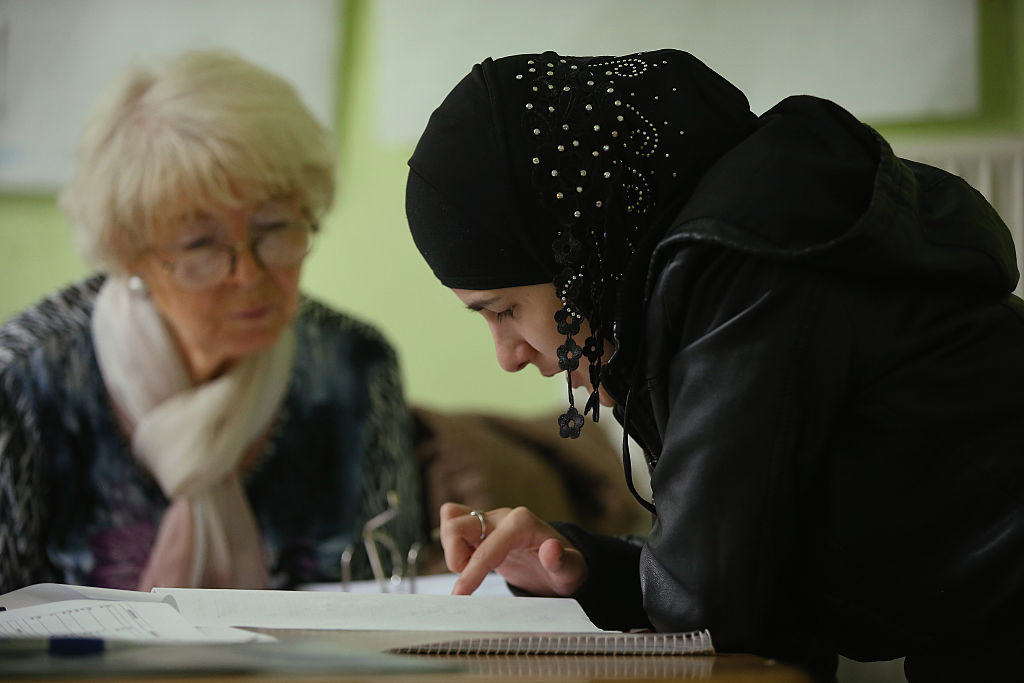
Chechens have said in interviews that expectations for behavior are more rigid and strict in among Chechen emigrants in Germany than in Chechnya itself -- "a competition in righteousness." Threats of violence against "errant" women are viewed as "acts of patriotism." Pictured above: A volunteer tutor (left) instructs an asylum-applicant from Chechnya in a German-language class, on November 10, 2015, in Berlin, Germany. (Photo by Sean Gallup/Getty Images)

In one instance, a young Chechen woman was recorded on video while walking down a street in Berlin and conversing with a non-Chechen man. That same evening, a few dozen unknown Chechen men drove to her house in northern Berlin. The man she had been seen with was brutally beaten; almost all of his teeth were knocked out. The young woman managed to hide.
On July 4, the Berlin newspaper Tagesspiegel reported that several other women and men have been assaulted by the Sharia gang in recent weeks, and that the Berlin Criminal Police Office has now launched an investigation. A police spokesperson said that the investigation is being hampered by the fact that so far no victim has publicly dared to bring formal accusations against the gang. The victims are all, apparently, afraid of retribution.
According to Tagesspiegel, some members of the gang, which has grown to around a hundred members, are armed and many have combat experience from the Chechen wars with Russia. The gang members, who also come from Dagestan and Ingushetia, have attacked Muslims as well as non-Muslims, including Christian asylum seekers at migrant shelters in Berlin.
The gang is linked to several Salafist mosques in the German capital, including Fussilet 33, which once served as the headquarters of the so-called Berlin Caliphate. The mosque was shuttered by German authorities in February 2017, after they learned that Anis Amri, the Tunisian jihadist who carried out the suicide attack on a Berlin Christmas market, had sheltered there.
Around 60,000 Chechens live in Germany, according to official statistics, although the actual number is believed to be much higher. Nearly 40,000 Chechens have applied for asylum in Germany during just the past five years; many have crossed the border illegally from Poland.
An internal paper produced by the Federal Audit Office (Bundesrechnungshofes) revealed that "the majority of the unauthorized persons in Germany are Russian citizens of Chechen ethnicity, some of whom have been linked to the Islamic terrorist environment."
The Chechen community in Germany is primarily based in Brandenburg and Berlin, where they are firmly entrenched in a parallel society. A social worker interviewed by Meduza said that the main obstacle to Chechen integration is their ultra-conservative moral code, the adat:
"They have come to Germany because they wanted to live in Germany, but they keep trying to turn it into Chechnya with its medieval ways. This inability and reluctance to integrate is extremely frustrating and typical of all migrants, not just Chechens. The only difference is that most other migrants come from the 20th century, not the times of feudalism."
In an interview with Radio Berlin-Brandenburg, Maciej Falkowski, a Polish political scientist specializing in the Caucuses, said that many younger members of the Chechen diaspora are embracing radical Islam:
"The Chechen people are a very self-contained, homogenous nation. They resolve all problems among themselves. You will hardly find a Chechen, for example, who will seek remedy from a German court. Religion, of course, also plays an important role in the younger generation. Moreover, the Chechens have not had their own country for hundreds of years and therefore are not acquainted with the legal state (Rechtsstaat) in our sense of the concept.
"We are increasingly seeing a generational conflict among the Chechens. The elderly are rather skeptical of Salafism and radical Islam, while the younger ones are embracing it. They believe Salafism offers answers with regard to their identity. Here they find community and charismatic leaders. Salafism is now their dominant current."
Heiko Homburg, an official at Ministry of the Interior of Brandenburg, the German federal state that encircles Berlin, said that most of the known Islamic extremists there are from Chechnya:
"Our problem in Brandenburg is that the Caucasian Emirate [a militant jihadist organization active in southwestern Russia], to which many Chechens feel committed, has submitted to the Islamic State. So, whether we want it or not, we have de facto Islamic State structures here in Brandenburg."
German security officials estimate that 1,500 to 2,000 Chechens are currently fighting in Iraq and Syria. As the Islamic State nears its end, it is feared that many of those fighters will travel to Europe, through Ukraine and Poland with the help of pan-European, Chechen clan relations.
In Frankfurt (Oder), a German city on the border with Poland, police are warning that Chechen migration is a ticking time bomb:
"We have a serious and ever-growing problem with radical Chechens who are constantly traveling back and forth across the German-Polish border. Their families are building Europe-wide structures which they are using to finance the Islamic State with the proceeds of organized crime. Everyone's attention is fixed on the Syrians, but the Chechens are the most dangerous group. We are not paying sufficient attention to this."
Soeren Kern is a Senior Fellow at the New York-based Gatestone Institute.
© 2017 Gatestone Institute. All rights reserved. The articles printed here do not necessarily reflect the views of the Editors or of Gatestone Institute. No part of the Gatestone website or any of its contents may be reproduced, copied or modified, without the prior written consent of Gatestone Institute.

Sunday, July 2, 2017

Countries That Wish To Control Immigration Are Sued By The European Union

  • Many so-called asylum seekers have refused to relocate to Central and Eastern Europe because the financial benefits there are not as generous as in France, Germany or Scandinavia. In addition, hundreds of migrants who have been relocated to Estonia, Latvia and Lithuania, which rank among the poorest EU countries, have since fled to Germany and other wealthier countries in the bloc.
  • "It needs to be said clearly and directly: This is an attack on Europe, on our culture, on our traditions." — Poland's Prime Minister Beata SzydÅ‚o.
  • "I think we have a right to decide that we do not want a large number of Muslim people in our country. That is a historical experience for us." — Viktor Orbán, Prime Minister of Hungary, referring to Hungary's occupation by the Ottoman Empire from 1541 to 1699.
The European Union has initiated legal action against the Czech Republic, Hungary and Poland for failing to comply with a controversial order to take in thousands of migrants from Africa, Asia and the Middle East.
The so-called infringement procedure, which authorizes the European Commission, the powerful executive arm of the European Union, to sue member states that are considered to be in breach of their obligations under EU law, could lead to massive financial penalties.
The dispute dates back to September 2015, when, at the height of Europe's migration crisis, EU member states narrowly voted to relocate 120,000 "refugees" from Italy and Greece to other parts of the bloc. This number was in addition to a July 2015 plan to redistribute 40,000 migrants from Italy and Greece.
Of the 160,000 migrants to be "shared," nine countries in Central and Eastern Europe were ordered to take in around 15,000 migrants. Although the Czech Republic, Hungary, Romania and Slovakia voted against the agreement, they were still required to comply.
Since then, several Central European EU member states have vehemently refused to accept their assigned quotas of migrants. Poland, for example, has a quota of 6,182 migrants, not one of whom has been admitted. The Czech Republic has a quota of 2,691 migrants, of whom only 12 have been taken. Hungary has a quota of 1,294, none of whom have been admitted.
EU, Many so-called asylum seekers have refused to relocate to Central and Eastern Europe because the financial benefits there are not as generous as in France, Germany or Scandinavia. In addition, hundreds of migrants who have been relocated to Estonia, Latvia and Lithuania, which rank among the poorest countries in the EU, have since fled to Germany and other wealthier countries in the bloc.
Meanwhile, the enforcers of European "unity" have sought to shame the Central European holdouts into compliance by appealing to nebulous concepts such as European "values" and "solidarity." French President Emmanuel Macron, for example, recently warned:
"European countries that do not respect the rules should pay the full political consequences. There is a double betrayal. They decide to abandon EU principles, turn their back on Europe and have a cynical approach to the union which gives them money, without respecting its values."
Leaders in Central and Eastern Europe have held their ground. In Poland, Prime Minister Beata SzydÅ‚o said her country would not be blackmailed by European Union officials. In a speech to Parliament on May 24, two days after the jihadist attack in Manchester, England, in which a Polish couple was killed, she said:
"We are not going to take part in the madness of the Brussels elite.... Rise from your knees and from your lethargy or you will be crying over your children every day.
"If you cannot see this — if you cannot see that terrorism currently has the potential to hurt every country in Europe, and you think that Poland should not defend itself — you are going hand in hand with those who point this weapon against Europe, against all of us.
"It needs to be said clearly and directly: This is an attack on Europe, on our culture, on our traditions. Do we want strong politicians who can see the danger and can fight against it efficiently?"

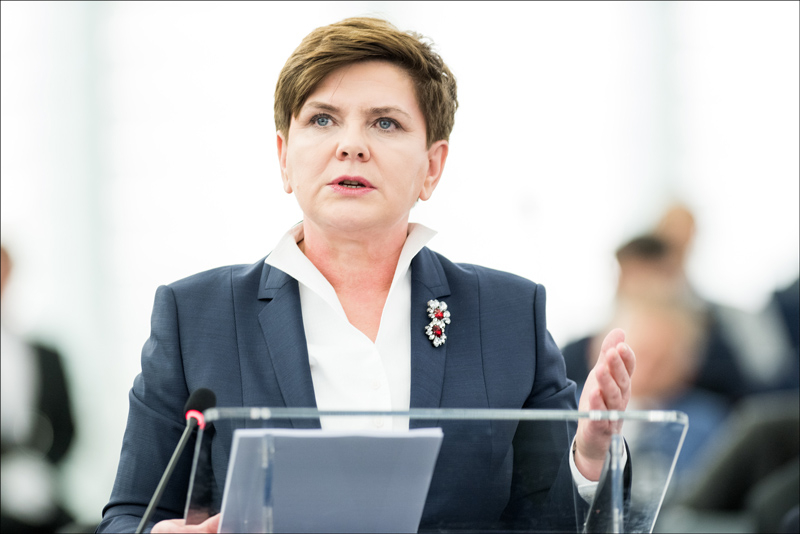
In a May 24 speech, Polish Prime Minister Beata Szydło said her country would not be blackmailed by European Union officials: "We are not going to take part in the madness of the Brussels elite... This is an attack on Europe, on our culture, on our traditions." (Illustrative image source: European Parliament/Flickr)

Polish Interior Minister Mariusz BÅ‚aszczak said that agreeing to European Union quotas would "certainly be worse" than any punishment meted out by Brussels:
"We must not forget the terror attacks that have taken place in Western Europe, and how — in the bigger EU countries — these are unfortunately now a fact of life. Remember, that the now very numerous Muslim communities in Western Europe started out as relatively small numbers....
"I tell my counterparts in Western Europe that the relocation strategy only intensifies illegal migration because traffickers get even more customers when would-be migrants hear that people delivered to Europe are being given refuge in EU nations other than Italy and Greece."
Henryk Kowalczyk, a Polish member of parliament, said:
"Poland makes a contribution to the EU.... We are doing what the bloc says, what the treaties say. If the French president was thinking of refugees, well that issue is not mentioned in the treaties and when we joined the European Union we were not taking on that commitment."
Poland's European Affairs Minister Konrad SzymaÅ„ski added: "There is no conflict on values between the Commission and Poland — it is about how to interpret these values."
In the Czech Republic, Prime Minister Bohuslav Sobotka said that "given the deteriorating security situation in Europe and the non-functioning of the quota system, the Czech government will not participate in it." He added: "We are ready to defend our position in the EU and the relevant judicial institutions."
Czech Minister of Foreign Affairs Lubomír Zaorálek said that EU should focus on "economic and social convergence among EU countries, rather than attempts to distribute migrants with forced quotas." He pointed out that in some Eastern European countries, "the most vulnerable inhabitants are often poorer than the incoming migrants themselves."
Zaorálek added that "people who are coming have no real interest in being integrated" and want to live with their "partners from similar cultural, ethnic, religious backgrounds." He said that people in Central and Eastern Europe do not want to "repeat the mistake of the Western countries" which have "neighborhoods full of thousands and thousands of people living in imperfect living conditions" and which are "very risky, not only during the night but also during the day." He pointed out that "there are no suicide bombers among Ukrainians or Vietnamese," two long-established communities in the Czech Republic.
In Slovakia, Prime Minister Robert Fico said that mass migration and forced multiculturalism would change the essence of his country:
"I think it is the duty of politicians to talk about these things very clearly and openly. I do not want to see a Muslim community in Slovakia. I do not want there to be several tens of thousands of Muslims who gradually begin to promote their ideology. We do not want to change the traditions of this country, which are built on the Christian tradition. It has been like this for centuries. Sovereignty and national pride must be part of our ruling coalition."
Fico added that 95% of so-called refugees were actually economic migrants:
"We will not assist in this folly with arms opened wide with the notion that we will accept them all regardless of whether they are economic migrants or not. We must start telling the truth about migration."
In Hungary, Prime Minister Viktor Orbán has warned of the "explosive consequences" of a culture clash between Europe and migrants from the Muslim world:
"To understand what we must do, we need to grasp the true nature of the situation we are facing. Europe is not in the grip of a 'refugee problem' or a 'refugee situation,' but the European continent is threatened by an ever mounting wave of modern-era migration. Movement of people is taking place on an immense scale, and from a European perspective the number of potential future immigrants seems limitless.
"With each passing day we see that hundreds of thousands have been turning up and clamoring at our borders, and there are millions more intending to set out for Europe, driven by economic motives....
"We must acknowledge that the European Union's misguided immigration policy is responsible for this situation. Irresponsibility is the mark of every European politician who holds out the promise of a better life to immigrants and encourages them to leave everything behind and risk their lives in setting out for Europe. If Europe does not return to the path of common sense, it will find itself laid low in a battle for its fate....
"Let us not forget that those arriving have been raised in another religion, and represent a radically different culture. Most of them are not Christians, but Muslims. This is an important question, because Europe and European identity is rooted in Christianity. Is it not worrying in itself that European Christianity is now barely able to keep Europe Christian? If we lose sight of this, the idea of Europe could become a minority interest in its own continent."
Referring to Hungary's occupation by the Ottoman Empire from 1541 to 1699, Orbán said:
"I think we have a right to decide that we do not want a large number of Muslim people in our country. We do not like the consequences of having a large Muslim community that we see in other countries and I do not see any reason for anyone else to force us to create ways of living together in Hungary that we do not want to see. That is a historical experience for us."
Soeren Kern is a Senior Fellow at the New York-based Gatestone Institute. Follow him onFacebook and on Twitter.
© 2017 Gatestone Institute. All rights reserved. The articles printed here do not necessarily reflect the views of the Editors or of Gatestone Institute. No part of the Gatestone website or any of its contents may be reproduced, copied or modified, without the prior written consent of Gatestone Institute.

Wednesday, January 4, 2017

Why Don't We Know About This Military Buildup Against Russia? Does This Explain The Over The Top Blaming Russia For Hacking?

US to send tanks, helicopters & 6,000 troops to join 1st E. Europe armored brigade deployment

US to send tanks, helicopters & 6,000 troops to join 1st E. Europe armored brigade deployment
The US Army will deploy nearly 6,000 troops, along with tanks, infantry vehicles, heavy howitzers, and combat helicopters to step up its “armored presence” in Eastern Europe, where a massive NATO buildup to counter an “assertive” Russia is underway. 
The 3rd Armored Brigade Combat Team (3rd ABCT) of the Colorado-based 4th Infantry Division will deploy 4,000 soldiers in the region in January of next year, the US Army said in a press release. 
In addition, the Army will send more than half of the New York-based 10th Combat Aviation Brigade, comprising 1,750 airmen, along with 60 aircraft, including CH-47 Chinooks, UH-60 Blackhawks, and medevac helicopters, according to Stars and Stripes. 
Both units will be part of Operation Atlantic Resolve, the US-led buildup on Russia’s borders whose stated goal is “reassuring” America’s Eastern European allies, which claim to perceive a threat from Russia.
The 3rd ABCT is said to be the first “rotation” armored brigade that will be deployed in Europe. It will first arrive in Poland, where the brigade’s headquarters will be set up, along with an armored cavalry unit and a field artillery battalion wielding self-propelled M109 Paladin howitzers.
Other brigade elements will spread across the region, Army Lieutenant Colonel Jason Brown, a 4th Infantry Division spokesman, told the newspaper.
One battalion with M1 Abrams tanks will be stationed in Estonia and Latvia, while another will operate in Germany. A mechanized infantry battalion with M2 Bradley infantry fighting vehicles and M1 Abrams tanks will move to Romania and Bulgaria.
“I am confident we are the right heavy brigade to continue the armored presence in Europe,” Colonel Christopher R. Norrie, commander of the 3rd Armored Brigade, said on Thursday.
In the meantime, the 10th aviation brigade is expected to be headquartered in Germany, while its units will be forward-based at undisclosed locations in Latvia, Romania, and Poland, Stars and Stripes reported.
This is the latest in a series of recent US and NATO-led deployments in the Baltic states and Eastern Europe. Earlier, the bloc sent up to 4,000 troops to the region as part of a multinational unit that includes US, German, British, and Canadian battalions.
Norway, a Nordic country bordering Russia in the north, will see a “limited rotational force” of approximately 330 Marines deploying at the Vaernes military base in January of 2017.
In the Black Sea, the US and NATO maintain a naval task force, along with Aegis Ashore ballistic missile defense sites in Romania that became operational earlier this year. The second missile defense compound is expected to go online in Poland next year.
The heavy buildup appears perfectly fit the current mood of Western policymakers. On Thursday, Anders Fogh Rasmussen, NATO’s former Secretary General, openly called upon the US to be “a world policeman to restore international law and order,” while criticizing the Obama administration for its reluctance to employ military forces overseas.
Russia has consistently said it will take reciprocal measures to counter the security threats emerging on its western borders, which will include forming new army units and accelerating the modernization of its military.

Tuesday, September 15, 2015

China And Russia Make Dramatic Increases In Military Strength While Obama Guts America's

US Air Force: Russia Makes 'Alarming' Strides in Air Power

Image: US Air Force: Russia Makes 'Alarming' Strides in Air Powern this handout image supplied by Host photo agency / RIA Novosti, An Ilyushin Il-78 Midas air force tanker and a Tupolev Tu-95MS Bear strategic bomber during the military parade on May 9, 2015 in Moscow, Russia. (Getty Images)
Monday, 14 Sep 2015 06:42 PM
A U.S. Air Force general on Monday cited what he called "alarming" moves by the Russian military to beef up its air forces in the years since the invasion of Georgia in 2008 and to establish firm defenses around areas like Crimea.General Frank Gorenc, commander of U.S. Air Forces in Europe, told reporters he was concerned about Russia's moves to increase the quantity and quality of its aircraft and field unmanned aircraft.
"The advantage that we had from the air, I can honestly say, is shrinking," Gorenc said at the annual Air Force Association conference.
Gorenc called "alarming" both Russia's investments in modernizing its air force and in building formidable surface-to-air missile defenses. Two examples of the latter are defenses set up around the Crimea region of Ukraine, which Russia annexed in 2014, and Kaliningrad, a Russia enclave between Poland and Lithuania.

U.S. officials often warn of strides by China in developing defenses against U.S. stealth fighters and bombers and more capable surface-to-air missiles, but Gorenc said Russia was making similar moves.
"This is not just a Pacific problem; it is as significant in Europe as it is anywhere else on the planet," he said. "I don't think it's controversial to say they've closed the gap in capability."
Latest News Update
Gorenc said the Air Force needed to develop new training, tactics and procedures to respond to the increased capabilities of its potential adversaries, and maintain the long-standing military edge it has enjoyed for decades while protecting U.S. and allied forces on the ground.
"We just need to be cognizant of it," he said. "We just need to continue to work really hard to make sure that we can provide that."

The U.S. Air Force this week is completing the first deployment of an unmanned MQ-1 Predator drone in Latvia, also the first such deployment in European air space.
He said the move could help pave the way for greater use of drones in Europe, where congested air space and logistical constraints have limited such opportunities thus far.
© 2015 Thomson/Reuters. All rights reserved.