Contact Form

Name

Email *

Message *

Showing posts with label Sunni Muslims. Show all posts

Tuesday, January 16, 2018

Saudi Arabia Fails To Lead

Iranian Protests Reveal Leadership Fault Lines in the Muslim World
By January 16, 2018


BESA Center Perspectives Paper No. 717, January 16, 2018
EXECUTIVE SUMMARY: If week-long anti-government protests in Iran exposed the Islamic Republic’s deep-seated economic and political problems, they also laid bare Saudi Arabia’s structural inability to establish itself as the leader of the Sunni Muslim world.
The responses by major Sunni Muslim countries in the Middle East and North Africa to the recent anti-government protests in Iran demonstrated that none of the contenders for regional dominance and leadership, which include Turkey and Egypt, were willing to follow the Saudi lead.
In fact, the responses appeared to confirm that regional leadership was more likely to be shared among Turkey, Egypt, and Iran than decided in the debilitating power struggle between Saudi Arabia and the Islamic Republic, a struggle that has wreaked havoc across the region and which the Kingdom is losing.
Uncharacteristically, Saudi Arabia under the rule of King Salman and his son, Crown Prince Muhammad bin Salman, has refrained from commenting on the protests. The kingdom has also been silent in the walk-up to US President Donald J. Trump’s decision on what to do about American adherence to the 2015 international nuclear agreement with Iran.
While Saudi media, oblivious to the potential for dissent in the kingdom, gloated about the exploding discontent in Iran, Saudi leaders stayed quiet in a bid to avoid providing Iranian leaders with a pretext to blame external forces for the unrest. (That did not stop Supreme Leader Ayatollah Ali Khamenei and other Iranian leaders from laying the blame at the doors of Saudi Arabia, Israel, and the US).
Similarly, Saudi Arabia, whose regional prominence is to a significant extent dependent on American, if not international, containment of Iran, stayed on the sidelines as Trump deliberated undermining the agreement that for almost three years has severely restricted Iran’s nuclear program and halted the Islamic Republic’s ambition of becoming a nuclear power any time soon.
While the Saudis would welcome any tightening of the screws on Iran, they have come to see the agreement as not only preventing Iran (at least for now) from developing a military nuclear capability but also as avoiding a regional nuclear arms race in which Turkey and Egypt as well as, potentially, the United Arab Emirates would take part.
The agreement gives the kingdom an opportunity to set up building blocks for a future military nuclear capability, if deemed necessary. Trump’s apparent willingness to ease restrictions on Saudi enrichment of uranium as part of his bid to ensure that US companies play a key role in the development of Saudi Arabia’s nuclear energy sector facilitates the Saudi strategy.
In contrast to the Saudis, Turkish president Recep Tayyip Erdoğan was vocal in his support for the Iranian government and called Iranian President Hassan Rouhani to express his solidarity. Egypt, like Saudi Arabia, has not commented on the protests but has studiously avoided being sucked into the Saudi-Iranian rivalry, including its multiple proxy battles in Yemen and elsewhere.
The various responses to the Iranian protests reveal more than simply differences of evaluation of those events. They show the fault lines of two, if not three, major alliances that are emerging among the contenders for regional leadership in the Middle East and North Africa and adjacent regions like the Horn of Africa.
They also highlight Saudi Arabia’s inability to garner overwhelming support for its ambitions and/or efforts to achieve them. Those efforts include the kingdom’s declaration of an economic and diplomatic boycott of Qatar; its military intervention in Yemen; and its failed attempt to force the resignation of Lebanese Prime Minister Saad Hariri.
Turkey has effectively sought to counter Saudi moves not only by forging close ties to the Islamic Republic despite their differences over Syria, but also by supporting Qatar with a military base in the Gulf state. It has also kept up a supply of food and other goods into Qatar, the flow of which had been interrupted by the Saudi-led boycott.
Turkey has established a military training facility in Somalia and is discussing creating a base in Djibouti, the Horn of Africa’s rent-a-military base country par excellence (it contains foreign military facilities operated by France, the US, Saudi Arabia, China, and Japan). Turkey also recently signed a $650 million agreement with Sudan to rebuild a decaying Ottoman port city and construct a naval dock to maintain civilian and military vessels on the African country’s Red Sea coast. Saudi Arabia sees the Turkish moves as an effort to encircle it.
Turkey, to the chagrin of Saudi Arabia and its closest regional ally, the UAE, as well as Egypt, has supported the Muslim Brotherhood as well as other strands of political Islam. Egypt recently launched an investigation into embarrassing leaks from alleged intelligence officers that were broadcast on the Brotherhood’s Istanbul-based Mekameleen TV station and published in The New York Times. Egypt has denied the accuracy of the leaks.
If Saudi Arabia, backed by the UAE, Bahrain, and Israel (as an unacknowledged partner) constitutes one bloc, Turkey forms another that could include the region’s third pole, Iran. Egypt, conscious of its past as the Arab world’s undisputed leader, may not yet be able to carve out a distinct leadership role for itself, but it is working hard to keep the door open.
Underlying the jockeying for regional dominance is a stark reality. Turkey, Iran, and Egypt have, to varying degrees, crucial assets that Saudi Arabia lacks: large populations, huge domestic markets, battle-hardened militaries, resources, and a deep sense of identity rooted in an imperial past and/or a sense of thousands of years of history. Saudi Arabia has its status as custodian of Islam’s most holy cities and financial muscle. In the long run, those are unlikely to prove sufficient.
Dr. James M. Dorsey, a non-resident Senior Associate at the BESA Center, is a senior fellow at the S. Rajaratnam School of International Studies at Singapore’s Nanyang Technological University and co-director of the University of Würzburg’s Institute for Fan Culture.

Saturday, July 8, 2017

"Morality Police" Come To Berlin

  • Threats of violence against "errant" women are viewed as "acts of patriotism."
  • "They have come to Germany because they wanted to live in Germany, but they keep trying to turn it into Chechnya with its medieval ways." — Social worker interviewed by Meduza.
  • "Everyone's attention is fixed on the Syrians, but the Chechens are the most dangerous group. We are not paying sufficient attention to this." — Police in Frankfurt (Oder).
A hundred Islamists are now openly enforcing Sharia law on the streets of Berlin, according to local police who are investigating a recent string of violent assaults in the German capital.
The self-appointed morality police involve Salafists from Chechnya, a predominantly Sunni Muslim region in Russia. The vigilantes are using threats of violence to discourage Chechen migrants from integrating into German society; they are also promoting the establishment of a parallel Islamic legal system in Germany. German authorities appear unable to stop them.
The Sharia patrol came to public light in May 2017, when Chechen Salafists released a video warning other Chechens in Germany that those who fail to comply with Islamic law and adat, a traditional Chechen code of behavior, will be killed. The video's existence was reported by Meduza, a Russian-language independent media organization based in Latvia. The video, which circulated through WhatsApp, an online messaging service, showed a hooded man aiming a pistol at the camera. Speaking in Chechen, he declared:
"Muslim brothers and sisters. Here, in Europe, certain Chechen women and men who look like women do unspeakable things. You know it; I know it; everybody knows it. This is why we hereby declare: For now, there are about 80 of us. More people are willing to join. Those who have lost their national identity, who flirt with men of other ethnic groups and marry them, Chechen women who have chosen the wrong path and those creatures who call themselves Chechen men — given half a chance, we will set all of them straight. Having sworn on the Koran, we go out onto the streets. This is our declaration of intent; do not say that you were not warned; do not say that you did not know. May Allah grant us peace and set our feet on the path towards justice."
According to Meduza, the declaration was read by a representative of a Berlin-based gang of about one hundred members, headed by former henchmen of Dzhokhar Dudayev, the late Chechen separatist leader. All Berliners of Chechen origin who were interviewed by Meduza said they were aware of the gang's existence.
The video surfaced after nude images of a 20-year-old Chechen woman who lives in Berlin were sent en masse from her stolen cellphone to every person on her contact list. Within an hour, the woman's uncle demanded to speak with her parents. According to Meduza, they agreed to "resolve the issue" within the family by sending the woman back to Chechnya, where she would be killed to restore the family's honor. German police intervened just hours before the woman was to board a plane bound for Russia.
After the woman was placed in protective police custody, her circumstance went from being a family issue to a communal one. According to Meduza, it is now the duty of any Chechen man, regardless of his ties to her or her family, to find and punish her. "It is none of their business, but it is an unwritten code of conduct," said the woman, who has since cut her hair and now wears colored contact lenses in an effort to hide her identity. She said that she intends to change her name and undergo plastic surgery. "If you don't change your name and your face, they will hunt you down and kill you," she said. Although the woman graduated from a German high school, she hardly ever leaves her apartment because it is too dangerous. "I don't want to be Chechen anymore," she said.
According to Meduza, at least half of the population of single Chechen girls in Germany have enough compromising information on their cellphones to be considered guilty of violating adat:
"Associating with men of other nationalities, smoking, drinking alcohol, visiting hookah lounges, discotheques or even public swimming pools can cause communal wrath. A single photograph in a public WhatsApp chat can outcast an entire family and the rest of the community would be obliged to cease all communication with them. With everyone under suspicion and everyone responsible for one another, Chechen girls say they are sometimes approached by strangers in the street who chastise them for their appearance, including for wearing bright lipstick. The theft of a cellphone and the subsequent posting of compromising material is a hard blow; the dishonored person has no one to turn to and the one who posted the victim's photos does not risk anything."
Chechens interviewed by Meduza said that expectations for behavior are more rigid and strict in among Chechen emigrants in Germany than in Chechnya itself. This situation has been described as "a competition in righteousness" between Chechens living abroad and those in Chechnya who are loyal to Chechen leader Ramzan Kadyrov: each party is seeking to prove that they are the better Chechens, and threats of violence against "errant" women are viewed as "acts of patriotism."

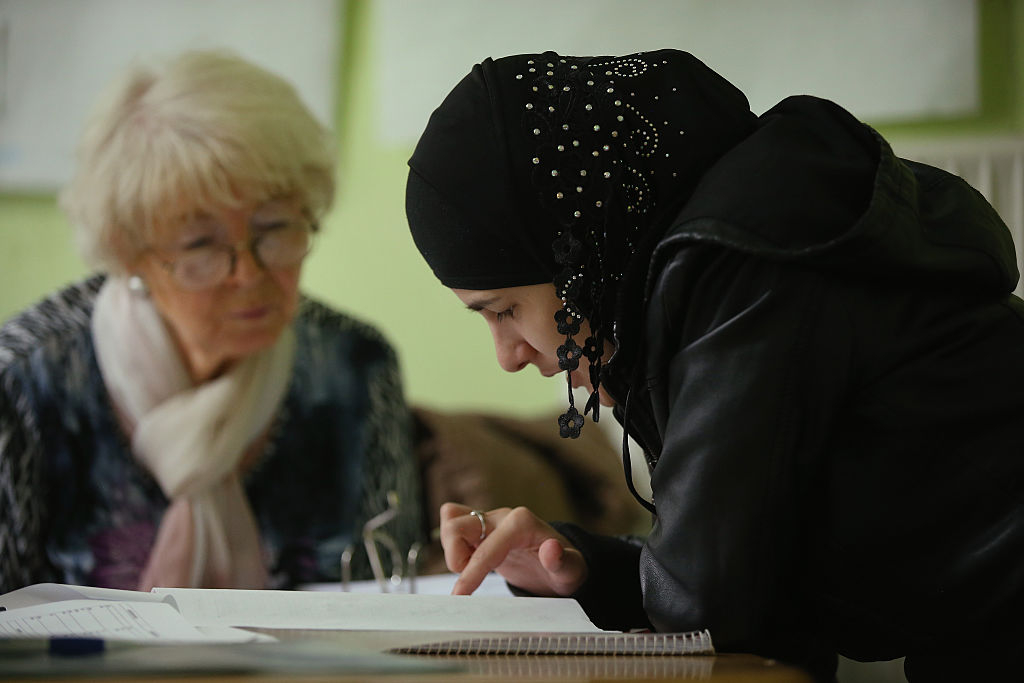
Chechens have said in interviews that expectations for behavior are more rigid and strict in among Chechen emigrants in Germany than in Chechnya itself -- "a competition in righteousness." Threats of violence against "errant" women are viewed as "acts of patriotism." Pictured above: A volunteer tutor (left) instructs an asylum-applicant from Chechnya in a German-language class, on November 10, 2015, in Berlin, Germany. (Photo by Sean Gallup/Getty Images)

In one instance, a young Chechen woman was recorded on video while walking down a street in Berlin and conversing with a non-Chechen man. That same evening, a few dozen unknown Chechen men drove to her house in northern Berlin. The man she had been seen with was brutally beaten; almost all of his teeth were knocked out. The young woman managed to hide.
On July 4, the Berlin newspaper Tagesspiegel reported that several other women and men have been assaulted by the Sharia gang in recent weeks, and that the Berlin Criminal Police Office has now launched an investigation. A police spokesperson said that the investigation is being hampered by the fact that so far no victim has publicly dared to bring formal accusations against the gang. The victims are all, apparently, afraid of retribution.
According to Tagesspiegel, some members of the gang, which has grown to around a hundred members, are armed and many have combat experience from the Chechen wars with Russia. The gang members, who also come from Dagestan and Ingushetia, have attacked Muslims as well as non-Muslims, including Christian asylum seekers at migrant shelters in Berlin.
The gang is linked to several Salafist mosques in the German capital, including Fussilet 33, which once served as the headquarters of the so-called Berlin Caliphate. The mosque was shuttered by German authorities in February 2017, after they learned that Anis Amri, the Tunisian jihadist who carried out the suicide attack on a Berlin Christmas market, had sheltered there.
Around 60,000 Chechens live in Germany, according to official statistics, although the actual number is believed to be much higher. Nearly 40,000 Chechens have applied for asylum in Germany during just the past five years; many have crossed the border illegally from Poland.
An internal paper produced by the Federal Audit Office (Bundesrechnungshofes) revealed that "the majority of the unauthorized persons in Germany are Russian citizens of Chechen ethnicity, some of whom have been linked to the Islamic terrorist environment."
The Chechen community in Germany is primarily based in Brandenburg and Berlin, where they are firmly entrenched in a parallel society. A social worker interviewed by Meduza said that the main obstacle to Chechen integration is their ultra-conservative moral code, the adat:
"They have come to Germany because they wanted to live in Germany, but they keep trying to turn it into Chechnya with its medieval ways. This inability and reluctance to integrate is extremely frustrating and typical of all migrants, not just Chechens. The only difference is that most other migrants come from the 20th century, not the times of feudalism."
In an interview with Radio Berlin-Brandenburg, Maciej Falkowski, a Polish political scientist specializing in the Caucuses, said that many younger members of the Chechen diaspora are embracing radical Islam:
"The Chechen people are a very self-contained, homogenous nation. They resolve all problems among themselves. You will hardly find a Chechen, for example, who will seek remedy from a German court. Religion, of course, also plays an important role in the younger generation. Moreover, the Chechens have not had their own country for hundreds of years and therefore are not acquainted with the legal state (Rechtsstaat) in our sense of the concept.
"We are increasingly seeing a generational conflict among the Chechens. The elderly are rather skeptical of Salafism and radical Islam, while the younger ones are embracing it. They believe Salafism offers answers with regard to their identity. Here they find community and charismatic leaders. Salafism is now their dominant current."
Heiko Homburg, an official at Ministry of the Interior of Brandenburg, the German federal state that encircles Berlin, said that most of the known Islamic extremists there are from Chechnya:
"Our problem in Brandenburg is that the Caucasian Emirate [a militant jihadist organization active in southwestern Russia], to which many Chechens feel committed, has submitted to the Islamic State. So, whether we want it or not, we have de facto Islamic State structures here in Brandenburg."
German security officials estimate that 1,500 to 2,000 Chechens are currently fighting in Iraq and Syria. As the Islamic State nears its end, it is feared that many of those fighters will travel to Europe, through Ukraine and Poland with the help of pan-European, Chechen clan relations.
In Frankfurt (Oder), a German city on the border with Poland, police are warning that Chechen migration is a ticking time bomb:
"We have a serious and ever-growing problem with radical Chechens who are constantly traveling back and forth across the German-Polish border. Their families are building Europe-wide structures which they are using to finance the Islamic State with the proceeds of organized crime. Everyone's attention is fixed on the Syrians, but the Chechens are the most dangerous group. We are not paying sufficient attention to this."
Soeren Kern is a Senior Fellow at the New York-based Gatestone Institute.
© 2017 Gatestone Institute. All rights reserved. The articles printed here do not necessarily reflect the views of the Editors or of Gatestone Institute. No part of the Gatestone website or any of its contents may be reproduced, copied or modified, without the prior written consent of Gatestone Institute.

Wednesday, March 1, 2017

Inter-Islam Conflicts. Islam Is Far From Homogeneous.


Are Ahmadis Muslims? Let us ask Prophet Muhammad


An Ahmadi Muslim shopkeeper, Mr. Asad Shah, was recently stabbed to death in Glasgow, UK. Mr. Tanveer Ahmad, a Sunni Muslim of Pakistani origin, claimed he committed the act because Asad had “disrespected Islam.” In his eyes, Asad was a blasphemer. The Sunni extremist group, Almi Majlis Tahaffuz Khatme Nubuwat (AMTKN), found to have links with Al Qaeda, sent out a message congratulating all Muslims on Asad’s murder. Just a few days later, ‘Kill Ahmadis’ pamphlets were found at the group’s Mosque in Stockwell. Other Sunni groups in Pakistan also praised Mr. Tanveer as a hero of Islam and congratulated the Sunnis on his “courageous act.”
Following the murder, the Muslim Council of Britain released a statement clarifying that they would not identify Mr. Asad Shah as a Muslim. King’s College academic Mr. Shiraz Maher also voiced the same sentiment, asking if there was a problem if he did not consider Mr. Asad Shah a ‘real Muslim?’ Also following the murder, a sign calling on fellow Sunnis to boycott the Ahmadi Muslims and sever all ties with them was put up at the largest Sunni Mosque in Slough, UK. “Qadianis (pejorative for Ahmadi Muslims) ... are not Muslims,” the sign said.
Where Mr. Asad Shah’s murder has brought different communities together in solidarity, it has also brought a deep-rooted, disturbing, sectarian phenomenon to the fore.
Ahmadi Muslims, who constitute the largest organized Muslim community in the world, have long been persecuted in Sunni-majority countries. In 1974, Pakistan declared the Ahmadis a non-Muslim minority in its constitution. In 1984, new laws restricting their religious freedom were passed. Since then, scores of Ahmadi Muslims - including three of my uncles - have been jailed for reciting the Quran, praying like a Muslim, saying the Muslim call to prayer, identifying as a Muslim etc. Interestingly, when Mr. Toaha Qureshi of the notorious Stockwell Mosque was questioned regarding this well-known apartheid of Ahmadi Muslims in Pakistan, he conveniently placed the blame on the victims themselves. “No they do not (live in fear). That is their desire, to come here and get political asylum. Nothing else,” he claimed.
It is not only the Pakistani State. Saudi Arabia also bans the Ahmadi Muslims from open profession. Indonesia has strict laws that restrict the religious freedom of the Ahmadi Muslims. The basis of this oppression is the orthodox Sunni view (shared by some Shia clerics) that aspects of the Ahmadiyya belief make them unfit to identify as Muslim. This certainly begs the question, who is a Muslim? And who has the authority to dismiss self-identifying Muslims as ‘infidels?’
When people converted to Islam, Prophet Muhammad - the founder of the Islamic faith - only required them to pledge allegiance to the oneness of God and the truth of his prophetic mission. There was no other requirement whatsoever. This is why Muslims have long believed that the Kalima (proclaiming oneness of God and prophethood of Muhammad) is the basis of the Islamic faith. The question of who would be counted as a Muslim came up during the first census in the State of Medina. Prophet Muhammad asked that anyone who claimed to be Muslim be counted as one. Their profession of Islam was all he required to be considered a part of the Muslim community. There was no religious test devised to test a claimant’s ‘Muslimness.’ Prophet Muhammad knew well that there were hypocrites living in Medina, some of whom were even conspiring against him. Prophet Muhammad knew that they did not even consider him a true prophet. Yet, not only did he never forbid them from identifying with the Muslims, he allowed them open access to his Mosque. Rather than forbid them from praying and punishing them for ‘posing as Muslim,’ he in fact prayed with them, and for them.
There are other traditions that shed more light on this issue. Prophet Muhammad is reported to have said:
“Whoever says, ‘None has the right to be worshipped but Allah’, faces our Qibla (Mecca) during the prayers, prays like us and eats our slaughtered animal, then he is a Muslim, and has got the same rights and obligations as other Muslims have.” (Bukhari)
In another detailed narration, Prophet Muhammad defined both Islam and the tenets of faith:
“One day while Allah’s Apostle was sitting with the people, a man came to him walking and said, “O Allah’s Apostle. What is Belief?” The Prophet said, “Belief is to believe in Allah, His Angels, His Books, His Apostles, and the meeting with Him, and to believe in the Resurrection.” The man asked, “O Allah’s Apostle What is Islam?” The Prophet replied, “Islam is to worship Allah and not worship anything besides Him, to offer prayers perfectly, to pay the obligatory alms i.e. Zakat and to fast the month of Ramadan.” (Bukhari)
The well-known five pillars of Islam, and the six articles of faith, are based on this and other similar traditions. Ahmadi Muslims believe in all these tenets of Islam.
These sayings of Prophet Muhammad spell out how he defined a Muslim. He did not denounce self-identifying Muslims as non-Muslim. Such rejection and exclusion was the hallmark of his opponents. He repeatedly cautioned that judging someone’s truth or sincerity to their claim of Islam was a prerogative of God alone. Once, the famous general Khalid bin Waleed suggested to the Prophet that there were many people who outwardly professed Islam while there was no faith in their heart. Prophet Muhammad responded firmly:
“I have not been commanded to pierce through the hearts of people, nor to split their bellies (to look what is inside them)” (Muslim)
There is another famous incident of a Muslim killing a non-Muslim during a battle, despite the man having recited the Kalima. When Prophet Muhammad found out, he was furious. The Muslim soldier said: “O Messenger of Allah, that man read the Kalima merely to protect himself from our sword.” Prophet Muhammad reprimanded him:
“Did you open his heart and look inside it?”
Even the founder of the Islamic faith was not granted the authority to judge someone’s ‘Muslimness.’ God commanded in the Quran:
The Arabs of the desert say, ‘We believe.’ Say, “You have not believed yet; but rather say, ‘We have accepted Islam,’ for the true belief has not yet entered into your hearts.” (49:14)
This verse speaks of those Bedouins whom God Himself attests were completely faithless, yet were allowed to identify as Muslim. This prohibition of excommunication or Takfir is emphasized in the sayings of Prophet Muhammad, who equated such exclusion to murder.
How then did this culture of social boycotts and excommunication (Takfir) spread in the Muslim world? Why do many Muslim groups promote exclusion and prejudice? Why do even so-called moderate clerics like Shaykh Hamza Yusuf or Shaykh Umar Al-Qadri judge the faith of other Muslim communities in such a nonchalant way? Do these clerics believe they are a higher authority than Prophet Muhammad?
There are two ways groups like the Muslim Council of Britain or extremist Sunni groups in Pakistan try to dismiss other Muslims as infidel. The first is by discarding Prophet Muhammad’s definitions and inventing others of their own. The second is by misrepresenting the beliefs of other Muslims and forcing them out of the Prophet’s definition.
I call on all such Muslim clerics, bodies and States to realize how their sectarianism is directly linked to violence against the Ahmadi (and other) Muslims. That Asad Shah’s tragic murder would lead to more sectarian calls of exclusion is an unfortunate and painful realization. I call on such Muslim bodies to see the beauty in diversity and appreciate the value in embracing pluralism and inclusivity within Islam. I call on them to the ways of Prophet Muhammad. When it came to him, it was quite clear who must be counted with the Muslims: Anyone who claimed to be one. And who actually was a true Muslim from within? He let God be the judge of that!